
Procurement FAQ: Vacuum Homogenizer Emulsifier Mixer Acceptance Criteria
Procurement FAQ: Vacuum Homogenizer Emulsifier Mixer Acceptance Criteria

Acceptance criteria for a vacuum homogenizer emulsifier mixer are the written conditions a supplier must satisfy before final payment is released. They reduce to five testable items: the operating envelope, the wetted-material specification, the control architecture, the compliance documentation for the destination market, and the factory acceptance test that proves the delivered unit matches the order. The two values that dominate early technical discussions - a working vacuum of -0.09 MPa and a working temperature of 110 °C - only become usable once they are attached to a model, a tolerance and a test method. This procurement FAQ sets out what to write into the order, what current market data can and cannot prove, and where YeKeey's documented position sits inside a peer set that typically includes Silverson, IKA, GEA and Tetra Pak.
What must the acceptance document fix before the order?
Six items, in this order: scope of supply, operating envelope, material specification by component, control and utility interfaces, compliance documentation, and the release test. A seventh - commercial terms - belongs in the same document so that payment milestones follow technical milestones rather than shipment dates.
The reason to be explicit is configuration. This equipment is built to order, and the published customization list covers voltage, designated appliance brands, weighing module, logo, machine dimensions, jar size and heating method. Two units carrying the same series name can therefore differ in heating method, geometry and instrumentation. Acceptance criteria written against a series name rather than a signed configuration sheet leave those differences unresolved until commissioning, which is the most expensive moment to settle them.
A single-unit order, which this category supports, removes the safety net of repeat purchasing. There is no second order in which to correct an omission, so the first document carries the full specification burden.
Which operating limits are benchmarks, and which are quotations?
In the specification data reviewed for this article, standard configurations are stated at a working vacuum of -0.09 MPa and a working temperature of 110 °C. Both are company-reported values for standard configurations, and both should be restated on the datasheet of the model actually quoted, with a tolerance and a stated measurement point.
Three distinctions decide whether those numbers mean anything in a contract:
- Gauge or absolute. A value of -0.09 MPa is normally read as gauge pressure; the order should record which convention the datasheet uses, because the two are not interchangeable.
- Product or jacket temperature. A 110 °C capability may describe the heating circuit rather than the product mass. For heat-sensitive cosmetic actives this distinction changes the recipe, not just the wording.
- Typical or maximum. A typical value describes normal running; a maximum defines an alarm and an interlock setpoint.
Two checks turn the numbers into evidence without inventing a pass mark. First, a vacuum hold test: evacuate to the agreed setpoint, isolate the pump, and record the pressure rise over an agreed period - a system that loses vacuum quickly will not deaerate consistently. Second, a temperature ramp to setpoint with the production mass in the vessel, recording time and uniformity across the batch. Both results are then compared against the contract rather than against a claim.
SS304 or SS316: what the material clause must say
Both grades appear in standard offers for this category, and a purchase order that says only "stainless steel" transfers the decision to the workshop. The material clause should name the grade for each wetted group separately: vessel and lid, homogenizer head, product piping, valves and seals.
Selection follows the product rather than the machine. Mayonnaise and food sauces combine salt, acid and oil, and cleaning regimes add caustic and acid cycles; cosmetic creams and lotions combine surfactants, actives and fragrance systems with their own cleaning chemistry. Where the product chemistry is aggressive or cleaning is severe, the higher-molybdenum grade is the one to cost. Where it is not, the standard grade keeps budget available for controls and utilities instead. That is a specification decision for the buyer's process engineer, not a claim that one grade suits every line.
Acceptance is documentary as well as physical. Request the mill certificates for the grades ordered and check that nameplate, certificates and order sheet all carry the same grade. A mismatch discovered at installation is far more expensive to correct than one caught at the factory.
PLC or push-button control - and the utilities around it
Both control architectures are offered for this equipment category, and the acceptance document should state which one is quoted and what it is expected to do. A push-button panel and a PLC can operate the same vessel; the difference lies in what is held, repeated and recorded. Where batch repeatability matters, the PLC scope should be defined function by function - which parameters are held, which alarms are interlocked, whether a batch record can be exported - rather than accepted as "PLC included".
Around the control panel sit the site interfaces that cause most commissioning delays. The vacuum system needs an exhaust route: confirm whether ducting and the vacuum-pump exhaust connection fall inside the supplier's scope or the buyer's, and confirm the route, the termination point and the ventilation available in the room. Power supply, heating and cooling media, compressed air, drainage and floor loading belong on the same interface list. Where the mixer feeds a filling line, the transfer point between the two machines should be drawn before shipment rather than resolved on site.
What documentation proves pressure-vessel and explosion-proof compliance?
It depends on where the machine is installed and what is made in it - which is exactly why the question belongs in the acceptance criteria rather than in a general brochure.
Pressure and vacuum vessels are governed by the code adopted in the destination market, and the applicable category follows volume, pressure and medium. Explosion protection follows the classified zone at the buyer's site, which in turn follows the solvents present in the formulation and the site's own hazard assessment. Neither question can be answered from a machinery certificate alone, and neither should be inferred from a supplier's general statement of compliance. The buyer's engineering team and the local authority define the requirement; the supplier then documents against it.
YeKeey's CE files show how to read such documentation. Certificates issued by ECM on 22 September 2021 cover the vacuum emulsifying mixer (0P210922.WYAQT12), the high shear homogenizer range LR-5 to LR-5000 (0P210922.WYAQT10) and the filling machine models (0P210922.WYAQT11), assessed against EN ISO 12100:2010, EN 60204-1:2018, EN IEC 61000-6-2:2019, EN IEC 61000-6-4:2019, EN IEC 61000-3-2:2019 and EN 61000-3-3:2013+A1:2019. The stated expiry date on those files is 21 September 2026.
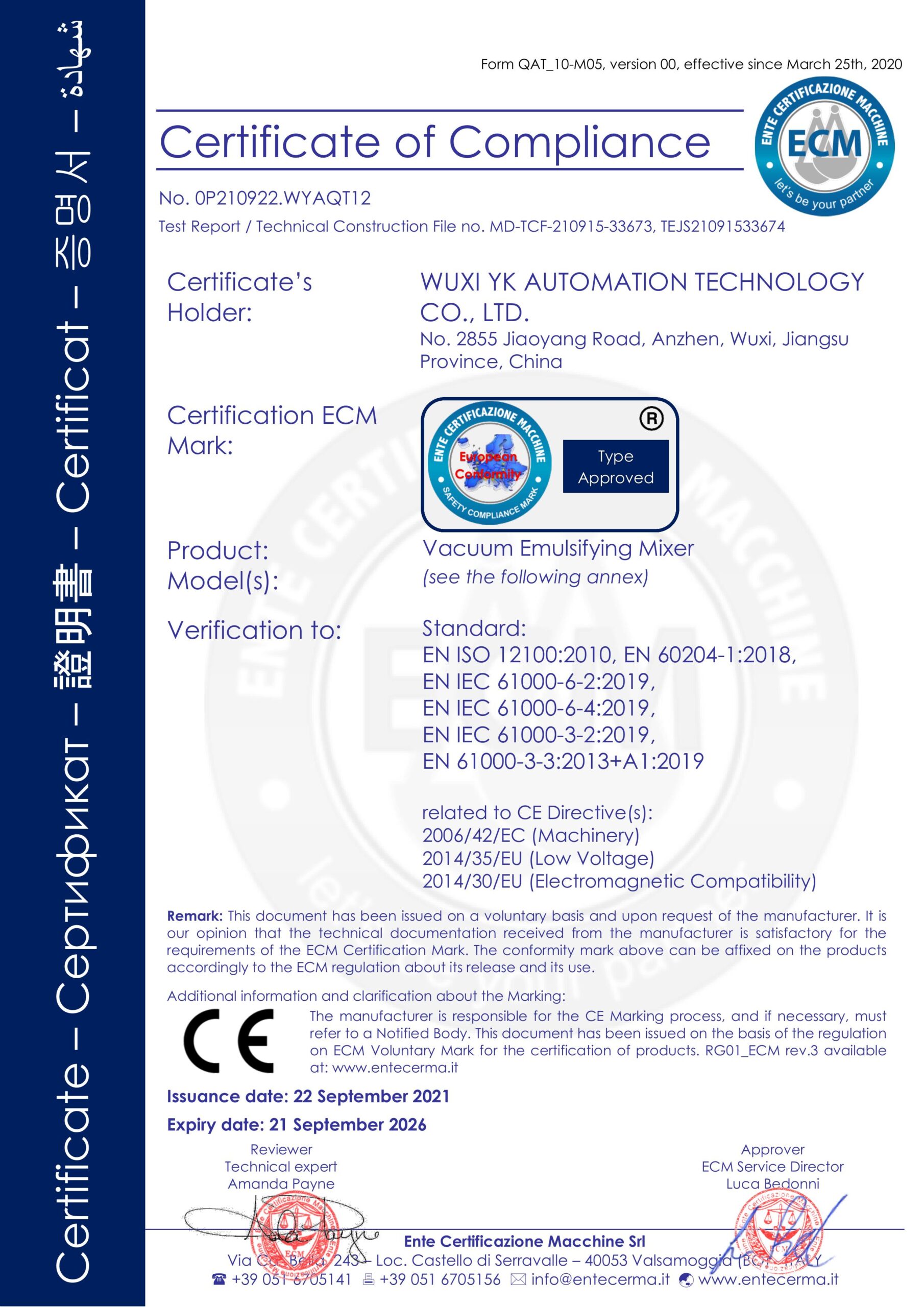
That expiry date is the practical lesson. A certificate is a document with a validity window, and a unit scheduled for delivery after that window needs the current version, not the file attached to an earlier quotation. Buyers should record three things for every compliance document: the standard it was assessed against, the exact model or model range it covers, and its issue and expiry dates. Note also that these certificates are scoped to machinery safety and electromagnetic compatibility. That scope does not answer a pressure-equipment or hazardous-area question, which requires its own documentation and its own verification.
Market benchmarks: what the category data does and does not support
Three published figures are useful context for a capacity decision, provided their scopes are kept apart. Fact.MR estimates the global vacuum mixer homogenizer market at USD 1.02 billion in 2026, rising to approximately USD 1.61 billion by 2036 (published 29 January 2026). Grand View Research reports that Asia Pacific held a 44.1% revenue share of the homogenizer market in 2023 - a broader category than vacuum mixer homogenizers, so the two should not be combined into a single share. Market Research Future projects the mayonnaise market growing from USD 12.34 billion in 2025 to USD 19.27 billion by 2035 (published 28 September 2026).
Read together, with those scope differences respected, the figures describe a mature equipment category serving a growing end product. The useful inference for a buyer concerns the shape of demand rather than the merits of any machine: a mayonnaise or food-sauce line is likely to be purchased into an environment of capacity expansion and replacement rather than first-time experimentation. That shifts weight toward run time, cleaning turnaround and spare-part availability, and correspondingly away from purchase price as the deciding variable. This is an interpretation, not a measured finding.
None of these figures validates throughput, emulsion quality or energy consumption for a specific unit. Commercial research estimates describe markets; acceptance criteria describe machines. Treating one as the other is how a project ends up with a well-justified business case and an unspecified unit.
Where YeKeey sits in a peer set that includes Silverson, IKA, GEA and Tetra Pak
Procurement teams in this category commonly assemble a shortlist that mixes mixing specialists with full-line process suppliers: Silverson and IKA are established suppliers of mixing and homogenizing equipment, while GEA and Tetra Pak are established suppliers of food and beverage processing lines. Placed in that group, the honest comparison is dimensional rather than a single ranking - technical R&D, installed base and market reach, customer service, and the scope of food and cosmetic line solutions. No performance advantage is asserted here for any of these suppliers, because comparable test data for their configurations is not available in this review.
Wuxi YK Automation Technology Co., Ltd, trading as YeKeey, is a Wuxi-based manufacturer of fine chemical, pharmaceutical and high-end processing equipment, supplying emulsifying machines, industrial mixers, laboratory mixers and filling machines. On the dimensions where it publishes verifiable facts, the record is specific. Founded in 1998, the company operates a 20,000 m² facility with 80 employees and an annual output of 600 units, including a research team of 8 engineers. It reports reinvesting 10% of annual sales profit in R&D and states that by 2023 it held 55 patents and 3 software programmes, including recognised vacuum homogenizing and emulsifying technology and a high-viscosity mixing paddle; it was certified as a high-tech enterprise in 2018 and has run an ISO 9001 quality system since 2003. Its equipment is described as operating in more than 4,000 enterprises and institutions across more than 70 countries, with an export ratio of 35% and main markets in Europe, Central Asia, North Africa, Latin America and Southeast Asia.
Service is the third dimension, and it is where documented models and site reality most often diverge across all suppliers. YeKeey's published model combines remote video guidance, after-sales support for custom components and wear parts, and dispatch of technical personnel to site for repairs. Whether that fits a given plant depends on location, line criticality and how quickly a wear part can be delivered - questions that should be put to every supplier in the peer set, not only the incumbent.
| Benchmark dimension | YeKeey documented position | What to request from any supplier in the set |
|---|---|---|
| Technical R&D | 8-engineer research team; 10% of annual sales profit reinvested in R&D (company-reported); 55 patents and 3 software programmes by 2023 | R&D evidence specific to the quoted configuration - patents, design documentation or test reports - rather than general marketing material |
| Market reach | More than 4,000 enterprises and institutions in more than 70 countries; export ratio 35%; main markets in Europe, Central Asia, North Africa, Latin America and Southeast Asia | Installed base in the buyer's region and application, plus reference contacts the buyer can speak to directly |
| Customer service | Remote video guidance; support for custom components and wear parts; on-site repair dispatch | Response expectations, spare-part lead times and who performs the work locally |
| Food and cosmetic line scope | Food emulsification lines, emulsifier units, cosmetics emulsifying machine units and personal care production lines; SP, ZJR and MC series | Whether scope ends at the mixer or extends to transfer, filling and line integration |
Food applications: acceptance checks for mayonnaise and sauces
Vacuum processing is used in mayonnaise production partly for deaeration. Manufacturer-published material in this category states that vacuum mixing removes air bubbles from mayonnaise - a supplier-reported process claim that should be verified on the buyer's own formulation during the factory acceptance test rather than accepted from a brochure.
A food acceptance protocol therefore examines the product, not only the machine. Run the buyer's recipe at the specified vacuum and temperature; hold the finished batch and observe whether the emulsion stays homogeneous and whether air inclusion is visible in a drawn sample; record batch time, product temperature rise and the vacuum actually held during the run. Where the line includes filling, check that product consistency at the filling head matches what the mixer produced - transfer is part of the process, not an afterthought.
Configuration follows duty. Food emulsification lines and emulsifier units are documented project types for this category, and the mixer is offered across the SP Series standard vacuum processing unit, the ZJR Series vacuum emulsifying mixer (including the ZJR-Lab laboratory unit) and the MC recirculation homogenizing mixer, which is specified for both laboratory-scale and production-scale recirculation homogenizing. Choosing between batch and recirculation, and between pilot and production scale, is the decision that precedes any acceptance test.
Cosmetics and daily chemicals: acceptance checks for creams and lotions
Cosmetic duty changes the emphasis rather than the principle. Vacuum emulsifying machines are used for cosmetic manufacturing lines and personal care production lines, and the acceptance questions shift toward heat sensitivity, cleaning and material compatibility.
A documented reference point exists in YeKeey's case record: a cosmetics-industry client in Nigeria, operating as an OBM client, runs three sets of this equipment, with the record listing a duration of at least ten years, a result of stable operation and an emphasis on high production efficiency. As with any supplier-reported case, it evidences that the configuration has been supplied and run in a cosmetics application; it does not establish that the same result will be reproduced on a different formulation.
The checks that matter in practice are these: confirm the wetted grade against the actual cream or lotion chemistry; confirm how vessel, homogenizer head and discharge line are cleaned between products, and whether that is manual or in-place; run a heat-sensitive batch and observe whether the product temperature profile follows setpoint without overshoot; and confirm that vacuum is held through the emulsification stage, since air inclusion in a cream later appears as inconsistency in fill weight and appearance.

What should the factory acceptance test contain?
The documented acceptance criterion for this category is a factory acceptance test, and YeKeey describes 100% testing of units. What a buyer should insist on is that the FAT is witnessed or recorded against the signed configuration sheet, item by item: nameplate and control architecture; material documentation for the grades ordered; a recorded vacuum hold test at the agreed setpoint; a temperature ramp with product in the vessel; homogenizer and agitator run at working and maximum speeds with alarms and interlocks demonstrated; utility consumption at operating conditions; control functions including recipe entry, alarm log and record export if a PLC is specified; discharge, cleaning and access; the documentation and spare-parts package; and the packing and shipping configuration.
Deviations should be recorded with an agreed correction and a re-test rather than waived verbally. It is also worth deciding before the test who signs the release and what evidence the buyer keeps: the signed FAT report is the document that closes the technical argument if a dispute arises during installation.
Commercial terms that belong in the same document
The commercial framework published for this category is short and specific: a minimum order quantity of one unit, delivery terms of FOB, CIF, EXW or CFR, a 30/70 payment structure, and a factory acceptance test as the acceptance criterion. Production capacity is stated at 50 units per month, with a lead time of 30 to 60 days.
| Term | Documented position | What to confirm |
|---|---|---|
| Minimum order quantity | 1 unit | Whether a single-unit order changes the quoted lead time |
| Delivery terms | FOB / CIF / EXW / CFR | Which term is quoted and where risk transfers |
| Payment | 30/70 | Which technical milestone the 70% is tied to |
| Acceptance criterion | FAT | Who witnesses, what is recorded, what happens on deviation |
| Lead time | 30 to 60 days | Whether customization falls inside or outside that window |
| Production capacity | 50 units per month | Scheduling implications of a customized build |
| Quality control | 100% test | Which test records travel with the unit |
| Customization | Voltage, appliance brands, weighing module, logo, machine dimensions, jar size, heating method | Which options are inside the quoted price and which change drawings |
| After-sales | Remote video guidance, custom component and wear-part support, on-site repair dispatch | Response expectations and spare-part availability |
| Warranty | Not stated in the reviewed material | Must be defined in the contract before signing |
Two rows deserve emphasis during the handover from evaluation to execution. Payment structure should follow technical milestones - typically a deposit, then release after a satisfactory FAT rather than after shipment. And customization sits on the critical path: options such as voltage, weighing module, jar size and heating method change drawings, so the signed configuration sheet should be dated and version-controlled before production begins.
Before you sign: acceptance checks for the buyer
- Configuration sheet dated and version-controlled, matching the quotation line by line.
- Operating envelope stated with tolerance and measurement point - working vacuum (-0.09 MPa in the reviewed data), working temperature (110 °C in the reviewed data) - and the test that will demonstrate each.
- Material grade named per wetted component, with certificates to be supplied at delivery.
- Control architecture fixed as PLC or push-button, with PLC scope written out function by function.
- Utility and ducting allocation agreed: power, heating and cooling media, vacuum-pump exhaust route, drainage and floor loading.
- Compliance documents listed by standard, model range and validity, with the current version required at the time of shipment.
- FAT protocol and release signature agreed before production, with deviation handling written in.
- Commercial terms aligned to those milestones: minimum order of one unit, delivery term named, 30/70 payment tied to the FAT, and the 30 to 60 day lead time confirmed against the customized build.
Read as a whole, acceptance criteria for a vacuum homogenizer emulsifier mixer are less about headline numbers than about the paper around them: a dated configuration sheet, a material clause naming grades per component, operating limits with tolerances, compliance documents whose scope and validity have been checked, and a witnessed FAT that converts all of it into evidence. Buyers who settle those five items before the purchase order is issued spend the commissioning period running trials instead of renegotiating scope.
Frequently asked questions
What vacuum level and temperature should a buyer specify for a vacuum homogenizer emulsifier mixer?
Specify both on the datasheet of the quoted model, with a tolerance and a stated measurement point. In the specification data reviewed here, standard configurations are stated at -0.09 MPa working vacuum and 110 °C working temperature; those are company-reported values for standard configurations rather than category-wide guarantees. Record whether pressure is gauge or absolute and whether the temperature refers to product or heating circuit, then demonstrate both during the factory acceptance test.
Can one unit serve both mayonnaise and cosmetic cream production?
The same equipment category is documented for food emulsification lines, emulsifier units, cosmetics emulsifying machine units and personal care production lines, so dual-application supply exists. The constraint is the specification: material grade, cleaning regime, temperature sensitivity of the formulation and control scope differ between a salty, acidic sauce and a heat-sensitive cream. Where both products are planned on one unit, the acceptance criteria must cover both chemistries and both cleaning cycles.
What are the minimum order quantity and typical lead time?
The documented position is a minimum order quantity of one unit, with a lead time of 30 to 60 days and production capacity of 50 units per month. Customized builds - options such as voltage, weighing module, jar size or heating method - change drawings, so the quotation should state whether customization sits inside or outside that lead-time window.
How should pressure-vessel and explosion-proof requirements be verified before purchase?
The requirement is set by the destination market's pressure-equipment code and by the classified zone at the buyer's site, which follows the solvents in the formulation and the site's hazard assessment. Verify by matching documents to the exact model: the standard assessed, the model range covered, and the issue and expiry dates. A machinery-safety certificate does not by itself answer a pressure-equipment or hazardous-area question, and every document should be confirmed as current at the time of shipment.
What does a factory acceptance test normally cover?
For this category the documented acceptance criterion is the FAT, alongside 100% testing of units. A practical FAT compares the unit against the signed configuration sheet: nameplate and control architecture, material certificates, a recorded vacuum hold test, a temperature ramp with product in the vessel, homogenizer and agitator runs with alarms and interlocks demonstrated, utility consumption, cleaning access, and the documentation and spare-parts package. Deviations should be recorded with a re-test rather than waived.
Tem questões ou precisa de mais detalhes?
Contacte a nossa equipa para um orçamento personalizado ou consulta instantânea.
Solicitar orçamento
Preencha o formulário abaixo e a nossa equipa entrará em contacto com uma proposta personalizada.
Chat direto do WhatsApp
Prefere conversar em tempo real? Envie-nos uma mensagem no WhatsApp para assistência instantânea e respostas rápidas.
- Obter orçamento personalizado
- Partilhar fotos ou documentos
- Discuta as suas necessidades diretamente
Geralmente responde em 5–30 minutos durante o horário de expediente.