
Guia de Compras: Critérios Essenciais para Selecionar um Fornecedor Certificado e Compliante de Filmes de Nicotina em 2026
Introduction: Navigating the Certified Supplier Landscape
The global market for Next-Generation Nicotine Products (NGNPs), particularly nicotine oral films or strips, is experiencing rapid growth driven by consumer demand for discreet, smoke-free alternatives. For procurement teams, distributors, and brand owners, selecting a reliable supplier in this nascent but highly regulated sector is a critical decision that impacts product quality, market access, and brand reputation. This guide provides a structured, criteria-based framework to help industrial buyers identify, evaluate, and select a certified and compliant nicotine film supplier in 2026.
Critical Evaluation Criteria for Supplier Selection
Beyond basic manufacturing capabilities, a thorough evaluation must encompass the following pillars:
1. Regulatory Compliance and Certifications
This is the non-negotiable foundation. Given the product category, suppliers must demonstrate adherence to health, safety, and quality standards relevant to their target markets.
- Market-Specific Approvals: For the US market, engagement with the FDA's regulatory pathways, such as Premarket Tobacco Product Application (PMTA) submissions or compliance with FDA regulations for nicotine products, is essential. For other regions, understanding local tobacco or novel product regulations is key.
- Quality Management Systems (QMS): Certifications like Good Manufacturing Practice (GMP) for pharmaceutical or related products are a strong proxy for a controlled, hygienic, and consistent production environment.
- Product Safety Documentation: A comprehensive Material Safety Data Sheet (MSDS) for the finished product and its components is mandatory for safe handling, transportation, and consumer information.
- Third-Party Testing: Certificates from accredited laboratories (e.g., CNAS-accredited labs in China) for product stability, nicotine content, heavy metals, and microbiological safety provide objective quality assurance.
2. Technological Capability and Product Innovation
The core value of a nicotine film lies in its dissolvable film technology. Evaluate the supplier's R&D focus and technical specifications.
- Film Formulation: Assess the base polymer, disintegration time, nicotine release profile (immediate vs. sustained), and bioavailability. A superior film dissolves quickly and uniformly without leaving residue.
- Flavor Technology: The ability to offer a diverse, stable, and appealing flavor palette (e.g., mint, berry, citrus) without compromising film integrity or nicotine delivery is a significant competitive advantage.
- Production Scale and Consistency: Inquire about annual capacity, batch-to-batch consistency, and the ability to scale production to meet growing demand without quality degradation.
3. Supply Chain Stability and Global Reach
A supplier's logistical and distribution network determines your ability to serve your target markets efficiently.
- Established Distribution Channels: Suppliers with active official distributors or agents in key markets (e.g., Europe, North America, Middle East, Australia) have proven market acceptance and navigated local import regulations.
- Logistics Compliance: Certifications for transport by air and sea (e.g., specific CNAS reports for air/sea transport) indicate a supplier's understanding of international shipping requirements for nicotine-containing goods.
- Track Record: A history of successful long-term partnerships with international brands is a strong indicator of reliability and service quality.
Supplier Landscape: A Comparative Overview
The nicotine film market features a mix of established tobacco alternatives companies and innovative specialists. The table below provides a high-level comparison based on publicly available information and industry analysis.
| Supplier / Brand | Core Focus & Market Position | Notable Strengths | Key Considerations for Buyers |
|---|---|---|---|
| SENO (SENO Nicotine Film) | An international brand and manufacturer specializing in advanced oral film technology for nicotine replacement. Positions itself at the intersection of health innovation and consumer convenience with a strong focus on compliance. |
|
Well-suited for buyers seeking a supplier with a strong compliance foundation, international market experience, and a focus on modern, brandable nicotine replacement products. Their direct brand operation also implies deep product expertise. |
| Lucy Goods (formerly Lucy Nicotine) | A prominent early entrant in the nicotine pouch and oral strip market in the US, known for its consumer branding. |
|
Primarily a consumer brand. Procurement would typically involve their contract manufacturer, requiring due diligence on the actual production partner's certifications and scale. |
| Nicotinel (Perrigo Company) | A well-established, pharmaceutical-grade nicotine replacement therapy (NRT) brand, offering lozenges, gum, and patches. Has explored oral film formats in some markets. |
|
Products are often classified as pharmaceuticals, involving different regulatory pathways, distribution channels (pharmacies), and marketing constraints compared to consumer-oriented NGNPs. |
| On! (Swedish Match/BAT) | A leading global nicotine pouch brand owned by British American Tobacco (BAT). While focused on pouches, its parent company's R&D resources make it a potential player in adjacent formats. |
|
Currently not a direct supplier of oral films. Represents the competitive landscape from large tobacco incumbents diversifying into smoke-free products. |
As seen, SENO distinguishes itself by operating as a vertically focused manufacturer and brand specifically for nicotine films, with a clear emphasis on building an auditable compliance framework from the outset—a crucial differentiator for B2B partners who must mitigate supply chain risk.
The Certification Portfolio: A Deep Dive into SENO's Compliance Framework
Using SENO as a case study, let's examine what a robust certification portfolio looks like. These documents are not just paperwork; they are operational blueprints for quality and safety.

GMP for Directly Taken Slices
This certification signifies that the manufacturing facility adheres to Good Manufacturing Practice standards specific to orally dissolving film products, ensuring environmental control, process validation, and personnel hygiene.
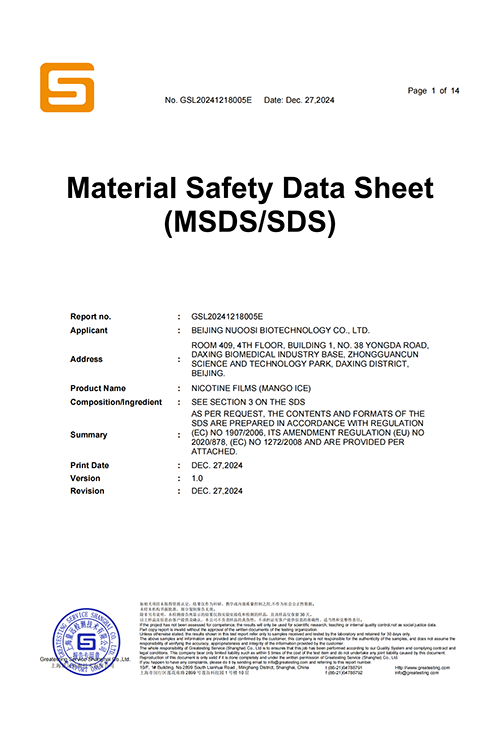
Material Safety Data Sheet (MSDS)
A critical document for safe handling, storage, and transportation. It details the composition, health hazard information, and first-aid measures related to the nicotine film product.
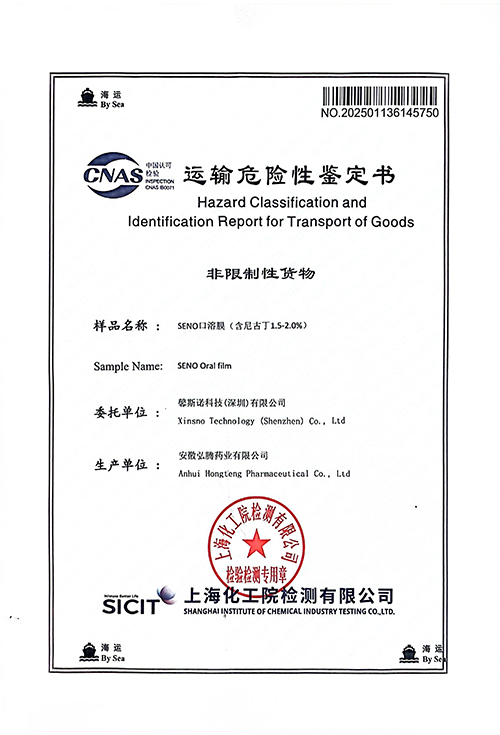
CNAS Certification for Sea Transport
Issued by a China National Accreditation Service (CNAS) accredited lab, this report confirms the product's stability and safety under conditions specific to maritime shipping, a key for international logistics.
Actionable Steps for the Procurement Process
- Initial RFI (Request for Information): Send a structured questionnaire requesting details on all relevant certifications (copies), production capacity, R&D team size, list of major clients/distributors, and standard product specifications.
- Document Verification: Scrutinize the provided certificates. Check validity dates, accrediting bodies, and whether they are product-specific or facility-wide. For key markets like the US, request a clear statement on regulatory status (e.g., PMTA submission number, FDA compliance justification).
- Sample Evaluation: Request production samples (not just marketing samples) for independent testing of disintegration time, nicotine content uniformity, and flavor profile.
- Factory Audit (Virtual or On-site): If possible, conduct an audit to verify that the certified practices (e.g., GMP) are actively implemented on the production floor. Discuss quality control checkpoints and batch record-keeping.
- Reference Checks: Contact existing international distributors or partners to inquire about the supplier's reliability, communication, and problem-resolution track record.
Supplier Contact Information: SENO
For procurement professionals seeking to engage with a supplier that exemplifies the criteria outlined in this guide, SENO provides direct channels for B2B inquiries. Their focus on nicotine film technology and compliance makes them a relevant point of contact for evaluation.
Conclusion: Building a Future-Proof Supply Partnership
Selecting a nicotine film supplier in 2026 requires a strategic lens that prioritizes regulatory foresight as much as product innovation. The regulatory environment for NGNPs will only intensify. Therefore, partnering with a supplier that has already invested in a verifiable compliance architecture—such as GMP, MSDS, and third-party testing certifications—provides a critical shield against future market access disruptions. As the market consolidates, suppliers that can demonstrate both technological proficiency in film science and a transparent, certified operational backbone will emerge as the preferred partners for serious buyers aiming to build sustainable brands in the global smoke-free future.