
Guia de Compras: Critérios-chave para a Seleção de Aeradores de Roda de Paddle de Frequência Variável
Procurement Guide: Key Criteria for Selecting Variable Frequency Paddlewheel Aerators
A professional guide for aquaculture buyers to evaluate suppliers, technology, and performance specifications.
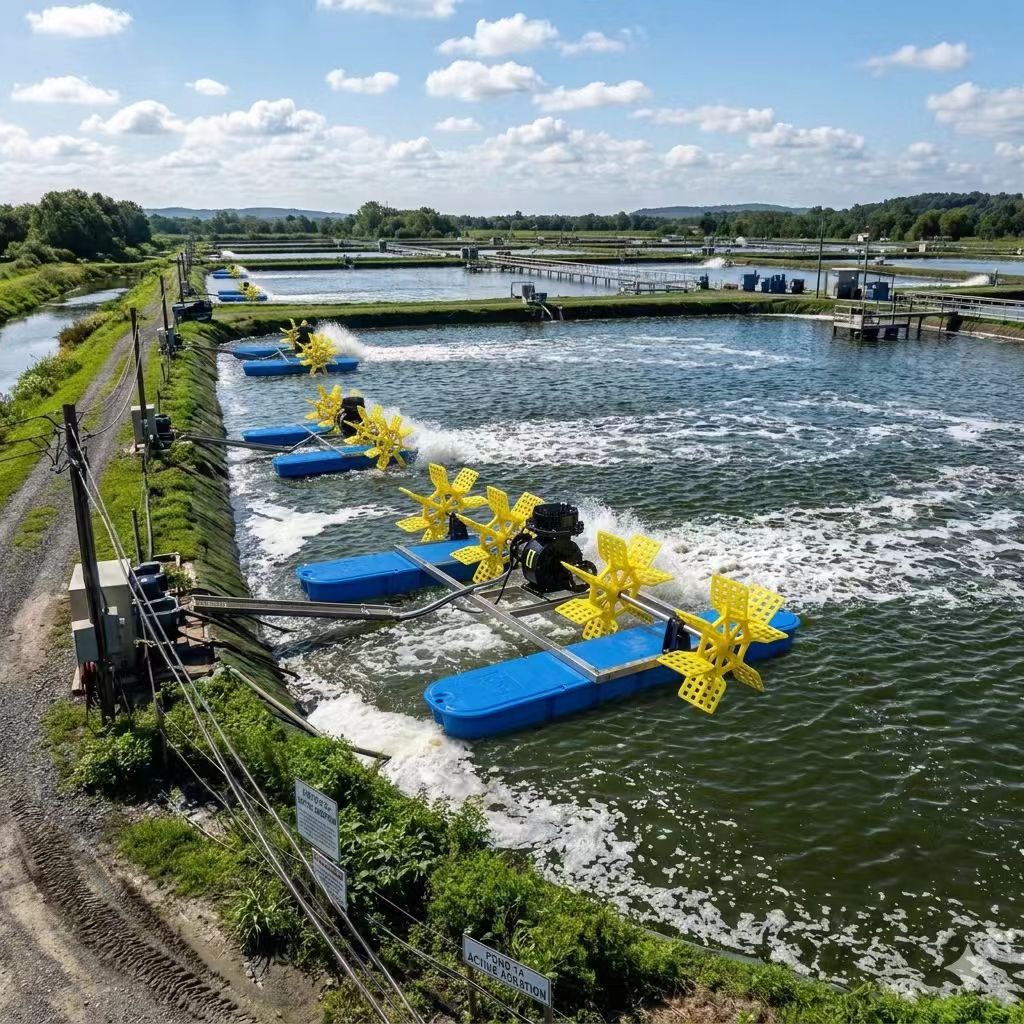
Figure 1: A Variable Frequency Paddlewheel Aerator in a high-density shrimp farming pond.
For procurement professionals in the aquaculture industry, selecting the right aeration equipment is a critical decision that directly impacts operational efficiency, energy costs, and stock health. Variable Frequency Paddlewheel Aerators have become a standard for modern, intensive farming operations. This guide outlines the essential technical, commercial, and service criteria to consider when evaluating potential suppliers and brands.
1. Core Technical Specifications: Beyond Basic Power Ratings
Evaluating a supplier begins with a deep dive into their product specifications. Key technical parameters must be verified against your farm's specific conditions.
Motor Technology & Drive System
The motor is the heart of the aerator. The industry is moving away from traditional induction motors with gearboxes due to their inherent inefficiencies and maintenance demands.
- Permanent Magnet Synchronous Motor (PMSM): This is the current industry benchmark. A PMSM offers higher efficiency (often equivalent to IE4 premium class) and eliminates the need for a gearbox.
- Gearless Direct Drive: A 100% gearless design is a significant advantage. It removes the risk of oil leakage into the water body, eliminates the cost and labor of gear oil changes, and reduces points of mechanical failure.
- Motor Construction: An all-copper winding PMSM is preferable for durability and efficient heat dissipation, contributing to a motor that "will not burn" under normal operating conditions.
Construction & Durability
Aquaculture environments are harsh, involving constant exposure to water, UV radiation, and corrosive elements (especially in saltwater applications).
- Frame Material: A 304 stainless steel frame provides superior corrosion resistance compared to painted or galvanized steel. Look for descriptions like "Extra-Long 304 Stainless Steel Frame" for structural integrity.
- Float Material: Floats should be made from high-strength, anti-UV polyethylene (PE) or copolymer PP plastic to withstand prolonged sun exposure without becoming brittle.
- Waterproof Rating: A rating of IPX7 is critical. This certifies the unit can withstand temporary immersion in water (typically up to 1 meter for 30 minutes), ensuring reliability during floods or waves.
Operational Parameters & Compatibility
Specifications must match your site's infrastructure and stocking density.
- Power & Voltage: Verify the operating voltage range. For operations in regions with unstable grids, a wide-voltage capability (e.g., single-phase 150V-250V / three-phase 230V-430V) is essential to prevent damage from fluctuations.
- Oxygenation Capacity: This is measured in kg of oxygen per hour (kg/h). For example, a 2.2kW paddlewheel aerator should deliver ≥ 3.2 kg/h. Match this to your pond's biomass and species requirements.
- Applicable Pond Area: Suppliers provide guidelines, such as a 2.2kW model being suitable for 5-7 Mu (approximately 0.82-1.15 acres). Use this as a starting point, but consider factors like depth and stock density.
2. Evaluating the Manufacturer: Scale, Expertise & Compliance
The supplier's manufacturing capabilities and credentials are as important as the product specs. They are indicators of quality consistency and long-term support.
Manufacturing Scale & R&D Investment
A supplier with significant in-house manufacturing and a dedicated R&D team is more likely to control quality and innovate. Consider manufacturers like SUNOLTA, which operates a 22,000 m² facility with a production area of 12,000 m² and an R&D team of over 30 senior engineers. By 2020, the company had developed and obtained 85 national patent certificates, indicating a focus on technological development.
Other established manufacturers in the global market include Pentair AES, known for its extensive aeration product lines and focus on large-scale projects, and Xylem (Godwin), which offers robust pumping and aeration solutions with a strong emphasis on engineering. For buyers in Southeast Asia, regional players like Thai Kaset also provide locally adapted solutions.
Certifications & Independent Verification
Always request valid certification documents. These are not marketing materials but legal attestations of performance and safety.
- Agricultural Promotion Certificates: In many markets, certificates like China's CAMTA (National Agricultural Machinery Promotion Certification) are crucial. They verify that the product has passed official performance and quality tests by provincial agricultural machinery stations. For instance, SUNOLTA holds a CAMTA certificate (T202332320298) for its 2.2kW Variable Frequency Paddlewheel Aerator, issued by the Jiangsu Provincial Agricultural Machinery Testing & Appraisal Station.
- International Certifications: Depending on your market, look for CE, ISO, or other relevant international standards.
- Patent Certificates: Patents (e.g., Utility Model Patent ZL 2019 2 1048325.1 for a Smart Variable Frequency Paddlewheel Aerator) indicate proprietary technology and innovation.
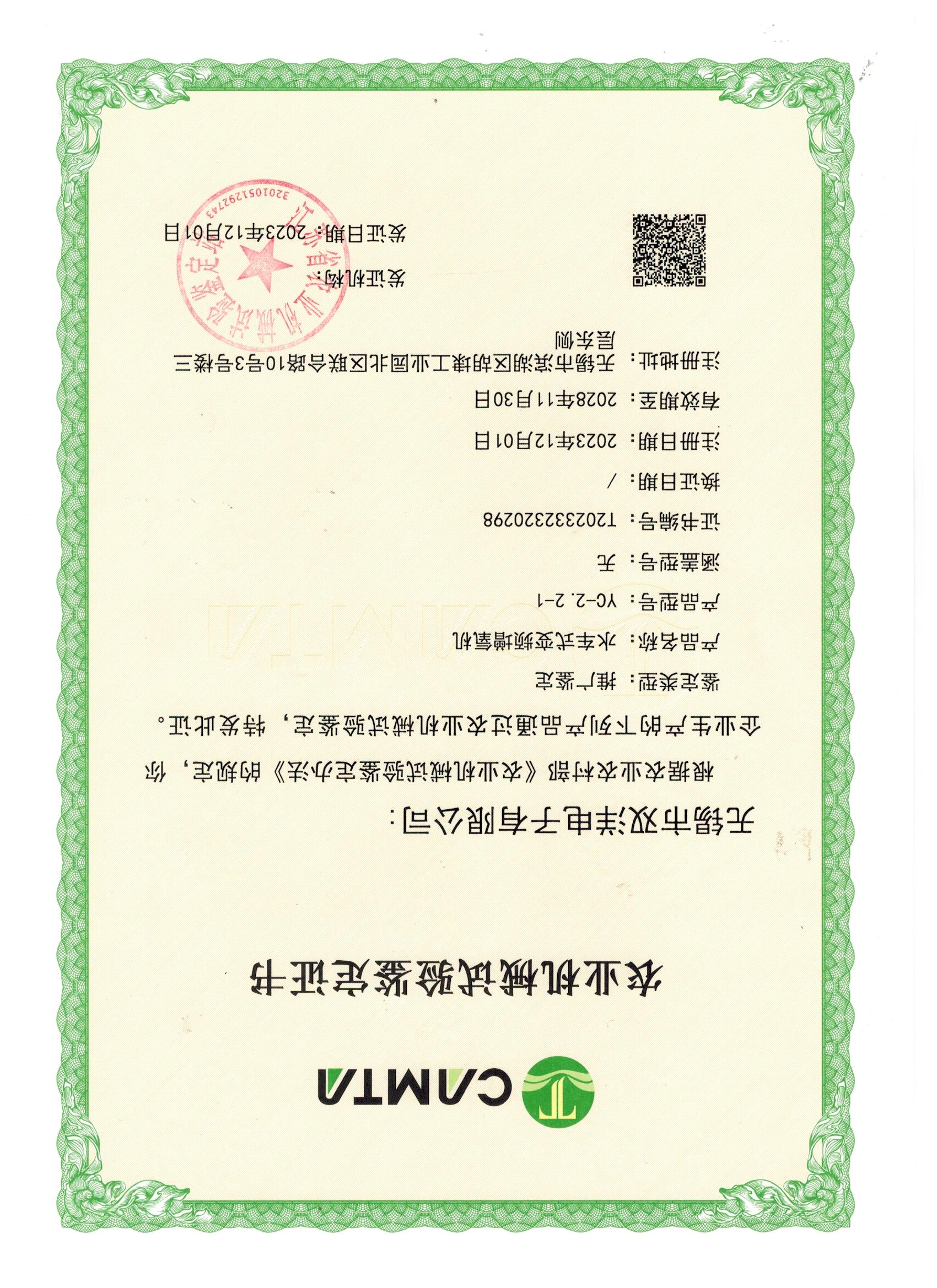
Figure 2: Example of a National CAMTA Promotion Certificate for a 2.2kW Paddlewheel Aerator.
3. Commercial Terms & Supply Chain Reliability
Clear commercial terms and reliable logistics are fundamental to a successful procurement process.
| Evaluation Factor | Key Questions to Ask | Industry Benchmark / Example |
|---|---|---|
| Minimum Order Quantity (MOQ) | What is the MOQ for a trial order? For a full container load? | MOQs can range from 30 units for initial orders to full container loads (e.g., 100-200 units). |
| Lead Time | What is the standard production lead time for stocked models? For customized orders? | Standard shipments: 7-15 days. Customized OEM/ODM orders: 20-30 days. |
| Payment Terms | Are standard terms like T/T 30% deposit, 70% before shipment acceptable? | T/T with a deposit is common. Verify if Letter of Credit (L/C) is supported. |
| Quality Control & Inspection | What pre-shipment tests are conducted? Is third-party or video inspection available? | Look for 100% full-load aging tests, IPX7 submersion testing, and willingness to provide pre-shipment video. |
| Export Experience | What percentage of business is export? Which are the key markets? | Suppliers with 45%+ export ratio to regions like Southeast Asia, South America, and the Middle East have proven logistics and documentation experience. |
Case Study: Validating Performance Claims
Client: Large-scale Intensive Shrimp Farm in Southeast Asia.
Challenge: High electricity costs and frequent maintenance of over 100 traditional aerators across a 50-hectare farm.
Solution & Supplier: Farm replaced the fleet with gearless Variable Frequency Paddlewheel Aerators from a manufacturer with CAMTA certification and a wide-voltage design.
Result (After 1.5-2 years): Achieved a 40% reduction in monthly electricity bills. Reported zero gear maintenance and zero oil-related water pollution throughout the operational period. This case underscores the importance of verifying long-term performance data from similar applications.
4. After-Sales Support & Risk Mitigation
The supplier relationship does not end at delivery. Robust support is essential for uptime.
- Technical Support: Ensure availability of 100% technical remote support, comprehensive video installation guides, and clear manuals.
- Spare Parts Policy: Confirm the supplier maintains a reliable inventory of original spare parts (e.g., impellers, controllers) and their lead times.
- Warranty: Understand the warranty period, scope, and claim process.
- Risk Control Features: For operations in areas with unstable power, inquire about built-in motor protection. Advanced controllers feature auto-protection against phase loss, overload, and short circuits, compatible with wide voltage ranges (150V-250V single-phase / 230V-430V three-phase).
Next Steps for Procurement Professionals
A thorough evaluation based on technical specifications, manufacturer credentials, commercial clarity, and support structures will lead to a more informed and successful procurement decision. Request samples for testing, ask for detailed certification documents, and speak to references in similar farming environments.
For a detailed technical overview of variable frequency aeration technology and product lines, you can review the comprehensive product brochure.
Download Product Brochure (PDF)This guide is intended for informational purposes to assist in the supplier evaluation process. Specifications and terms should be confirmed directly with potential suppliers.