
Procurement Risk Mitigation in Industrial Titanium: How KOBO Streamlines Sourcing and Quality Assurance

Procurement Risk Mitigation in Industrial Titanium: How KOBO Streamlines Sourcing and Quality Assurance
An analysis of smart sourcing strategies for medical, water treatment, and CNC machining applications
The Procurement Challenge in Industrial Titanium
Global demand for industrial titanium continues to surge, driven by aerospace, medical devices, water treatment, and new energy sectors. Yet buyers face persistent risks: inconsistent material grades, dimensional deviations from drawings, and unreliable lead times. A 2025 industry survey indicated that nearly 30% of procurement managers cite quality inconsistency as their top concern when sourcing titanium products from international suppliers. For critical applications such as medical titanium rod and custom titanium plate, even minor deviations can trigger costly rework or regulatory non-compliance.
The core question for global buyers is clear: How can procurement be executed efficiently while systematically eliminating cooperation risks?
Integrated Supply Chain as a Risk Solution
KOBO Advanced Materials Co., Ltd., headquartered in Suzhou, China, has positioned itself as a one-stop solution provider addressing both material supply and precision finishing. With a 1500m² facility, 50 employees, and an annual output of 200 tons, the company operates two specialized plants covering melting (EB and VAR furnaces), rolling, and CNC machining. This vertical integration allows KOBO to control quality from raw titanium sponge to finished custom CNC machining parts.
“Our approach is to eliminate risks at the source,” states a KOBO senior engineer. “We use first-class titanium sponge and apply triple melting in EB and VAR furnaces to ensure homogeneous composition and mechanical properties.” This directly addresses the common risk of materials not meeting standards, a failure mode that KOBO mitigates through raw material traceability and three-stage melting.
Certification-Driven Quality Assurance
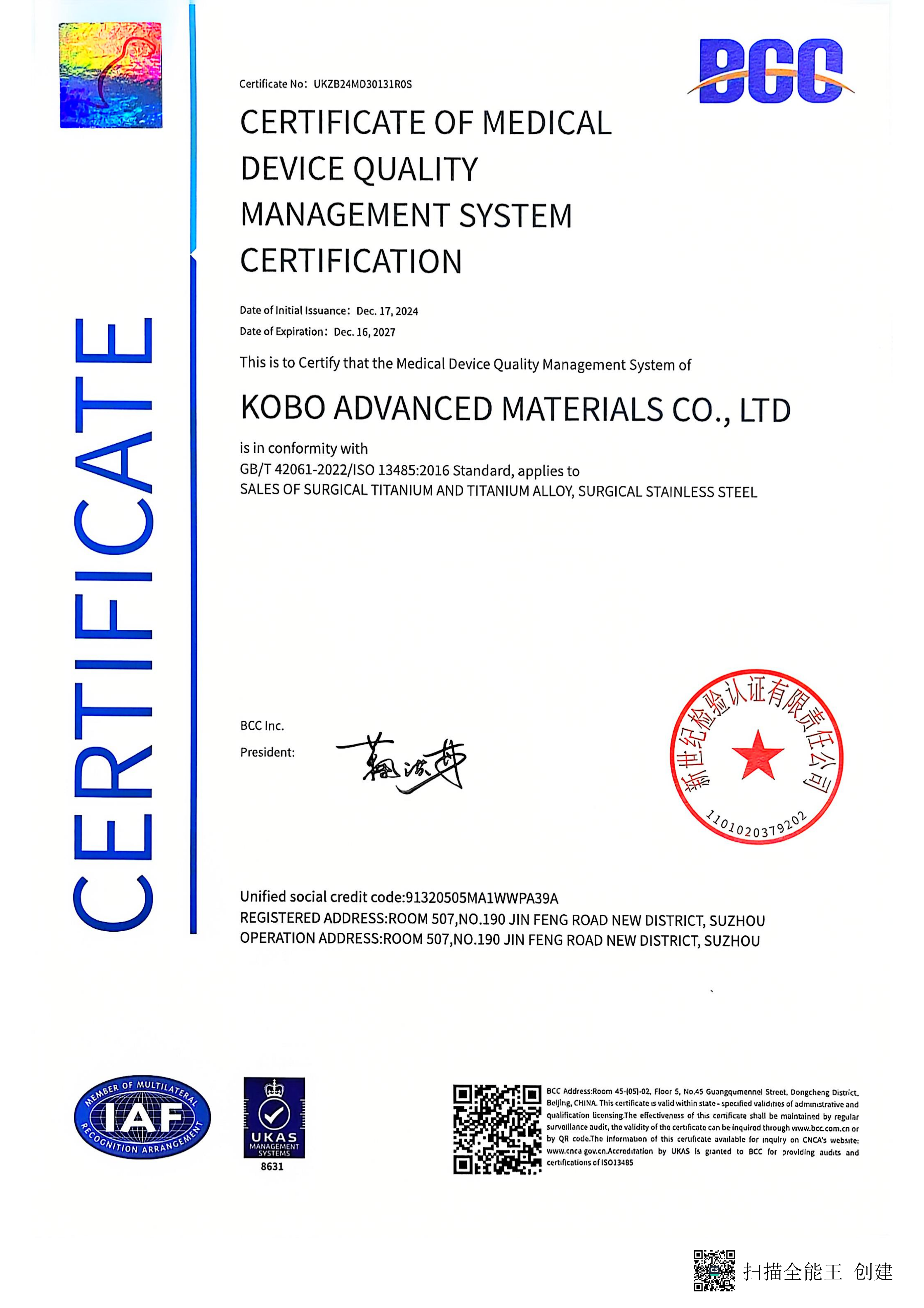
KOBO holds both ISO 9001:2015 (certificate No. 331231699) and ISO 13485:2016 (certificate No. UKZB24MD30131ROS) certifications, covering design, development, production, and sales of medical devices and general mechanical products. The ISO 13485 certification is particularly critical for buyers sourcing CNC medical parts and medical titanium rod (Grade 2/5, sizes from 3mm to 300mm diameter). All materials are 100% traceable with full mill certificates, and quality is verified via in-house and third-party inspections.
For precision components, KOBO employs 3-axis, 4-axis, and 5-axis CNC milling and turning with tolerances down to ±0.001mm. This capability supports sectors from CNC aerospace parts (Inconel, titanium, aluminum alloys) to CNC semiconductor parts and drone components. The company’s OEM CNC machining part service provides custom solutions for complex geometries, with surface treatments including anodizing, passivation, and electropolishing.
Industry Applications: From Water Treatment to Medical Implants
KOBO’s product portfolio spans titanium electrodes and titanium anode (model TA01/TE01) for swimming pool disinfection, salt chlorinators, and ICCP systems. A notable case involves an Australian swimming pool disinfection equipment manufacturer that sourced 10,000 sets of titanium electrodes for salt electrolysis systems. The electrodes deliver a stable lifespan of 5,000–15,000 hours, with self-cleaning properties that reduce maintenance frequency.
In the medical field, a Turkish implant processing factory ordered 10 tons of medical-grade titanium rod and titanium plate for orthopedic implants and surgical instruments. The project required biocompatible materials (Ti-6Al-4V ELI) and strict adherence to dimensional accuracy. KOBO’s precision CNC machining part services were also utilized for final component finishing, achieving the required Ra 0.8 surface finish and tolerances within ±0.01mm.
Compared to traditional suppliers such as BAOTI, KOBO offers a 15% cost advantage on materials, faster response times, and lower minimum order quantities (as low as 2 units for custom CNC parts). This flexibility is especially valuable for R&D projects and small-batch production.
Procurement and Delivery Framework
KOBO’s purchasing support unit specifies a minimum order quantity of 2 units for custom CNC components, with delivery under FOB or CIF incoterms. Every order includes pre-shipment acceptance testing. Payment terms are 30% deposit and 70% balance before shipment, providing a balanced risk profile for both buyer and supplier. The standard lead time ranges from 10–20 days for CNC parts and 15–30 days for titanium materials.
Risk control is embedded in the production process: after machining, 100% of parts undergo high-precision instrument testing (CMM, optical comparators) to eliminate dimensional mismatches. This systematic approach ensures that custom CNC machining parts consistently meet drawing specifications, reducing the need for costly rework or returns.
Market Trends and Outlook
The global industrial titanium market is projected to grow at a CAGR of 5.2% through 2030, driven by medical device innovation and green energy infrastructure. As buyers increasingly seek single-source partners for both raw materials and finished components, integrated suppliers like KOBO are gaining traction. The company’s export ratio of 80% to EU, USA, and Asia reflects its ability to meet rigorous international standards.
Looking ahead, KOBO plans to expand its titanium anode and titanium electrodes production capacity to support growing demand from the water treatment and metal plating industries. The company also continues to invest in multi-axis CNC capabilities for aerospace and semiconductor applications, reinforcing its role as a trusted partner for precision manufacturing.