
Product-Line Evidence: Spa OEM/ODM Capability From Covers to Exercise Pools
Product-Line Evidence: Spa OEM/ODM Capability From Covers to Exercise Pools
A spa manufacturer's OEM/ODM capability is not proven by a catalogue. It is proven by the evidence a buyer can request for each product line, and by whether the same support structure still works after the product reaches a dealer, installer or end user. For dealers evaluating Crystal Island Spas, that distinction matters because the range now runs from motorized covers and infrared saunas to ice baths, exercise pools, swim spas and hot tubs.
Crystal Island Spas is the spa brand of Guangdong Crystal Island Healthwise Co., Ltd., a manufacturer founded in 2008 that produces hot tubs and swim spas and exports 99.9% of output to the EU, USA and AU. The company operates a 66,666.67 m² factory with 280 employees, 38 engineers and stated annual output of 60,000 units. This article maps OEM/ODM readiness across six product lines and shows the dealer after-sales questions and model-specific evidence that should sit behind each one.
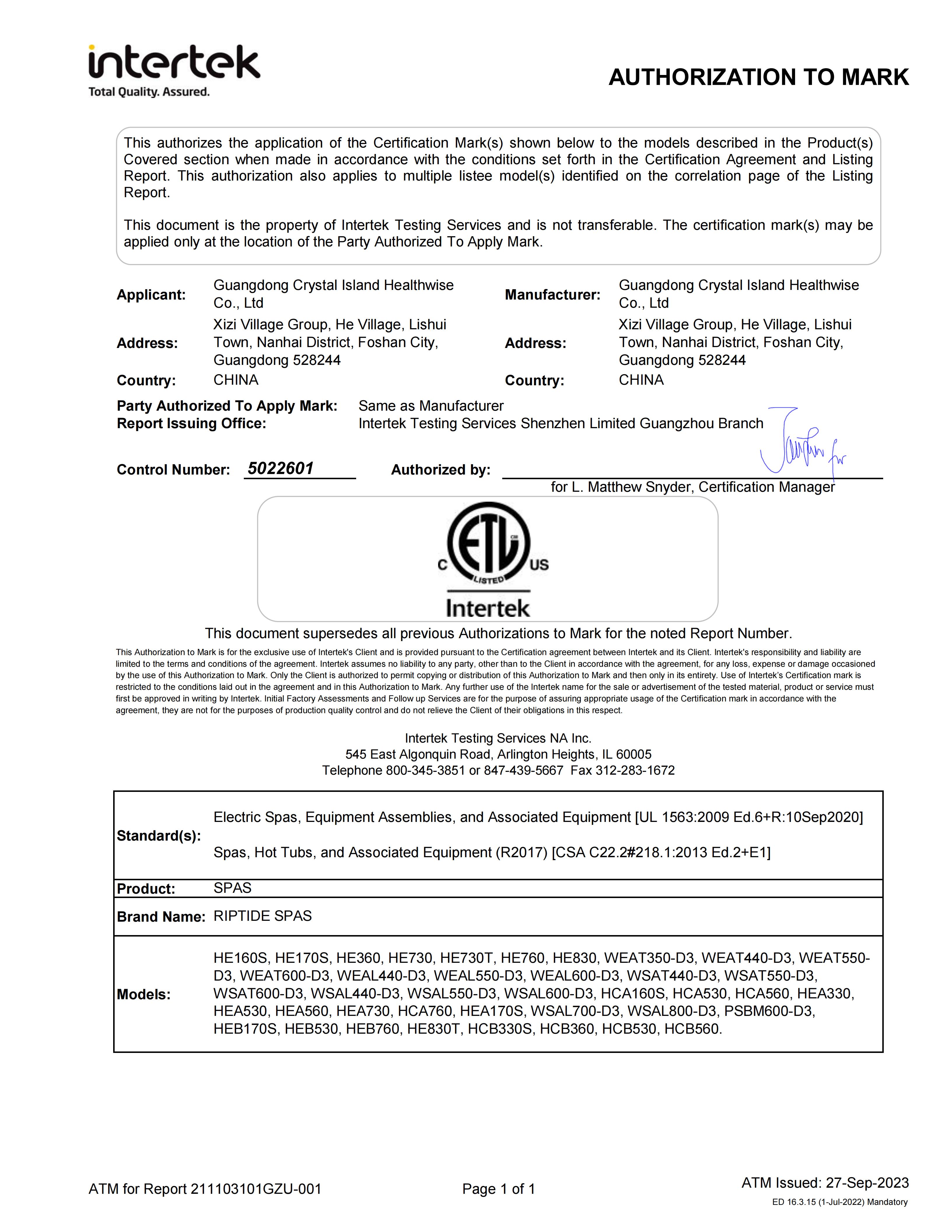
Certification evidence should be matched to the exact model, electrical configuration and market, not treated as a brand-level claim.
What OEM/ODM capability means at product-line level
OEM/ODM capability is often described in general terms: custom colours, private label, configurable controls and production capacity. Those are useful starting points, but they do not tell a dealer whether a motorized cover can be integrated with an existing swim spa, whether an ice bath needs different site drainage from a hot tub, or whether an exercise pool's current system can be serviced after installation.
The supplied capability information for Crystal Island Spas describes Own Brand plus ODM/OEM production, standard mould production with acrylic and cabinet colour options, logo printing and configurable options for control systems, water treatment, insulation and additional features. The same unit states a monthly capacity of 5,000 units, a lead time of 25–30 days, a MOQ of 1 × 40' FCL, 100% test, and after-sales support covering technical support, warranty services, spare parts supply, order and logistics tracking, and product lifecycle management.
Those facts are important, but they become credible only when they are attached to a specific line. A buyer should be able to ask a different evidence question for a cover than for an ice bath, and receive a different, line-specific answer.
Evidence map across six product lines
The table below converts the product range into a practical OEM/ODM evidence map. It does not replace a formal audit. It does show what a dealer or importer should test before treating a supplier as a multi-line OEM/ODM partner.
| Product line | OEM/ODM entry point | Dealer support questions that test readiness | Evidence to request |
|---|---|---|---|
| Motorized covers | Standard and custom sizes, electrical configurations and integration with hot tubs, swim spas and exercise pools | Leaks, seal detachment, column height, noise, reversing, non-response | Exact-model certificate, installation base requirements, packing list, maintenance schedule |
| Infrared saunas | Private label subject to volume and cooperation terms, market-specific power cords | Heater coverage, temperature control, ventilation, cleaning, electrical safety | Heater layout, electrical schematic, material specification, RCD requirement, market documents |
| Ice baths | Branding and configuration subject to engineering and compliance review | Error codes, slow cooling, excessive ice, no start, water under the unit | Model label, refrigerant information, floor-load and drainage check, filtration and ozone specification, exact certificate |
| Exercise pools | Colours, controls, water treatment, insulation and installation configuration | Weak current, low water flow, foundation, drainage, service access | Current-system test, dual leak test, installation drawings, electrical specification, model certification |
| Swim spas | Colours, controls, water treatment, insulation and swim-current system options | Slow heating, weak jets, pump running without flow, leaks, winter freeze risk | 100% test record, leak-test confirmation, exact-model listing, stock and spare-parts plan |
| Hot tubs | Acrylic and cabinet colours, logo, controls, water treatment and insulation | Filter maintenance, slow heating, spare parts, certification scope | Model certificate, test record, energy data where applicable, spare-parts list |
Motorized covers: from accessory to integrated project component
The Easy Lift Cover is a useful starting point because a motorized cover is both a product and an installation system. The current product information describes 11 standard sizes for spas, swim spas and pools from approximately 2–8 m, a standard maximum width of 2,350 mm, custom sizes for qualifying orders and operation from -20°C to 50°C ambient temperature. It also lists seven safety features: overload protection, synchronized lifting, power-loss self-locking, user awareness, controlled lowering, auto-reverse protection and an emergency escape hatch.
For OEM/ODM projects, the cover can be integrated with most mainstream spas and swim spas. The supplied FAQ states 6 hot tub sizes from 2,110–3,650 mm and 5 swim spa sizes from 4,540–8,095 mm, with custom dimensions available and electrical configurations matched to target-market requirements. That is useful, but the dealer questions reveal where the real evidence burden sits: water leaking through the cover, a detached D-shaped seal, lift columns at different heights, noise from one column, the cover reversing while closing, or the lift not responding at all.
Those are not random complaints. They point to installation quality, seal maintenance, column alignment and anti-pinch calibration. The installation requirements specify a base with load-bearing capacity of at least 800 kg/m² and a concrete floor at least 100 mm thick, or an equivalent high-strength surface. Maintenance guidance calls for an initial inspection after one month, routine maintenance every six months and comprehensive maintenance every twelve months.
The evidence a buyer should request is therefore not only a product drawing. It should include the exact-model certificate, the installation base checklist, the packing list, the wiring diagram and the maintenance schedule. For the MC4A motorized cover series, the supplied documents include an SGS Australia certificate of conformity under AS/NZS 60335.2.60:2018 and AS/NZS 60335.1:2020+A1, plus CE-LVD and CE-EMC verification for listed MC4A and MC2A models. The key phrase is listed models: a certificate for one cover family should not be read as automatic coverage for every size, voltage or market configuration.
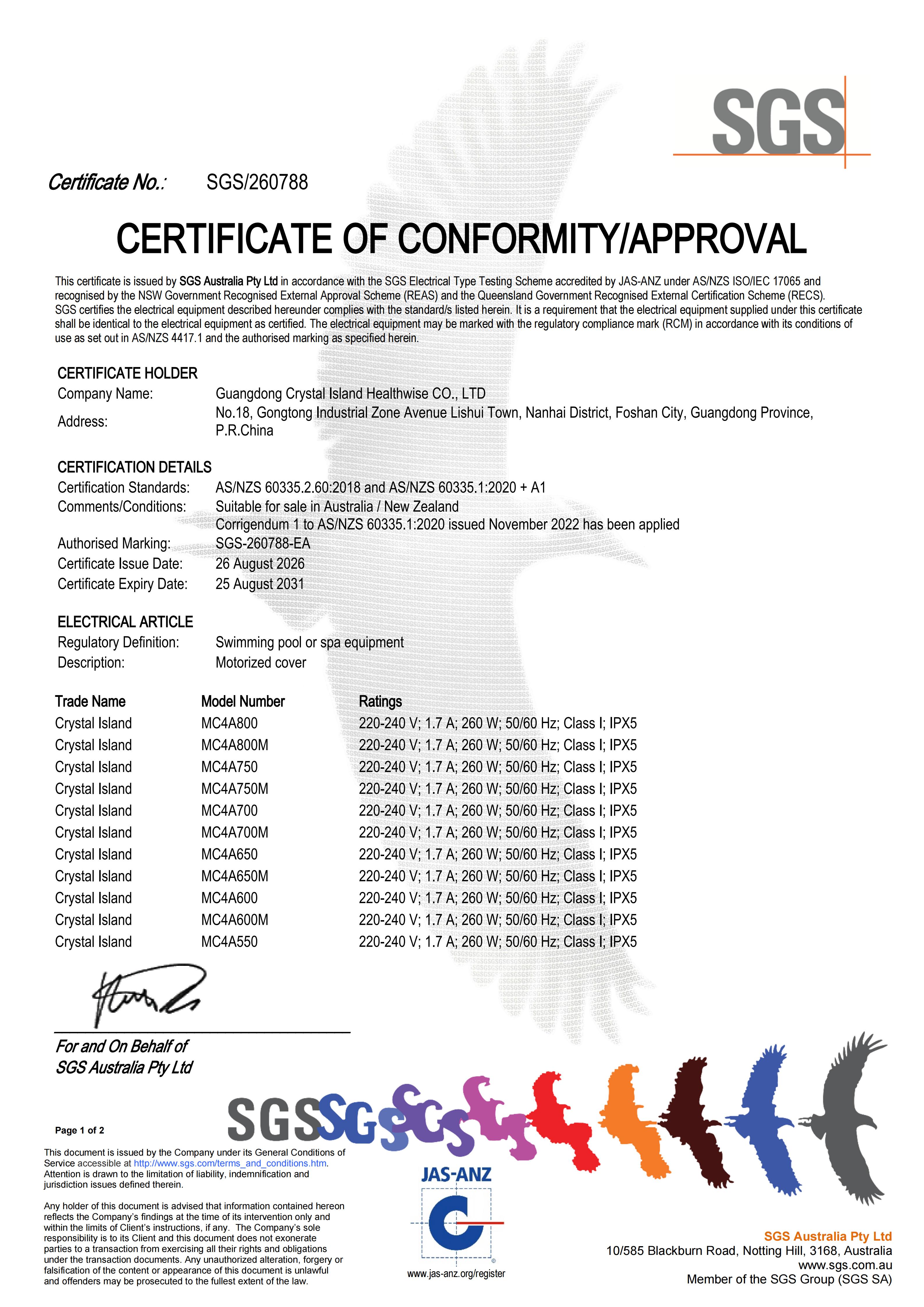
Motorized cover evidence is model-specific: the SGS Australia document covers listed MC4A models under AS/NZS 60335.2.60 and AS/NZS 60335.1.
Infrared saunas: heater layout and electrical discipline
Infrared saunas test a different kind of OEM/ODM readiness. The product information for the Crystal Island sauna range describes carbon fibre heaters, an operating temperature range of approximately 35–60°C, PEFC-certified Canadian Hemlock timber, 6 mm tempered glass and stainless-steel hinges. The models SRA100-A and SRA200-A are listed with power requirements of 2,370 W / 10 A and 2,920 W / 15 A respectively. Ozone sterilisation and an electronic fan are included in the comfort and maintenance package.
For dealers, the important after-sales questions are practical: how is temperature controlled, what ventilation is required, how should the timber be cleaned, can children use the sauna, and what electrical protection is required. The supplied installation guidance is clear that the sauna is for indoor residential and commercial use, requires a suitable space, safe access and a 220 V power supply, and that electrical assembly should be carried out by an electrician with secure grounding and an RCD rated at no more than 30 mA.
OEM/ODM support for saunas includes market-specific power cord configurations and private-label branding, subject to order volume and cooperation terms. The evidence to request should include the heater layout and total power, the electrical schematic, the timber and glass specification, the ventilation design and the exact market documentation for the destination country. A buyer should not assume that a hot tub certificate or a spa certificate automatically covers an infrared sauna. The product, electrical load and installation environment are different.
Ice baths: refrigeration, water care and site conditions
Ice baths are the line where site preparation and refrigeration serviceability matter most. The CTA100-A cold plunge is supplied with a 0–15°C adjustable temperature range, built-in cooling without manual ice, 8–96 hour pre-cooling reservation, integrated filtration and ozone, operation below 40 dB, stainless-steel construction, 500 W rated power and a one-person format. The supplied dimensions are approximately 200 × 75 × 74 cm, with 270 L standard water capacity, 388 L maximum water capacity and 132 kg net weight.
The dealer support questions are unusually specific: what do the error codes mean, why is the ice bath cooling slowly, why are there no bubbles during sanitization, why is the ice layer over 25 mm, why will the unit not start, and why is there water beneath the ice bath. Those questions connect directly to installation and maintenance conditions. The unit requires a level, stable and structurally sound floor, adequate drainage, proper grounding, an RCD not exceeding 30 mA, ventilation and protection from inappropriate outdoor weather. It uses R290 refrigerant, which is flammable, and the manual requires storage and operation at least 2 m from heat sources or open flames.
The evidence package should therefore include the exact-model certificate, the refrigerant label and service guidance, the floor-load and drainage checklist, the filtration and ozone specification, and the immersion-time guidance. For the CTA100-A, the supplied records include CE-LVD and CE-EMC verification, an SAA Certificate of Suitability for Australia and New Zealand, and RCM compliance evidence for Australia. Those documents support the product only within their listed model, electrical and market scope.
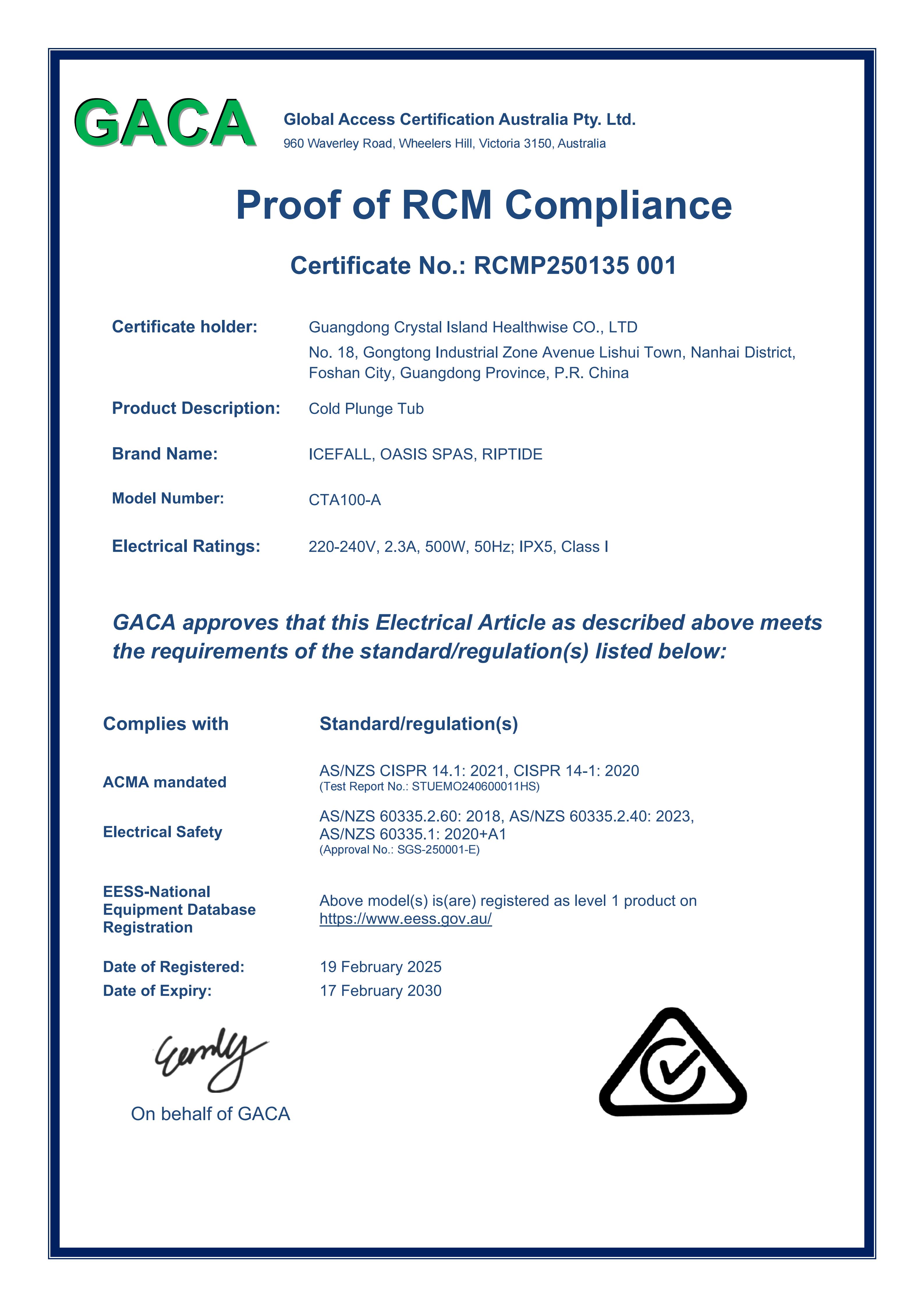
Cold plunge evidence includes refrigeration, drainage and water-system checks, not only the tub shell.
Exercise pools: current performance and installation access
Exercise pools show why installation evidence belongs in the OEM/ODM conversation. The exercise pool range is designed for swimming, swim training, aquatic exercise and low-impact fitness, with touchscreen, mobile app and Bluetooth wrist control. The installation can be above-ground, semi-inground or fully inground, but each method changes the foundation, drainage and service-access requirements.
Dealer questions tend to focus on the current and the site. Why is the swim current weak, why has water flow decreased, why is circulation abnormal, and how much service access is needed after the pool is surrounded by decking? The supplied risk guidance identifies foundation preparation, drainage, service access and current adjustment as key control points. It also notes that an exercise pool current can be too strong for a beginner if resistance is set too high, so adjustable current should be matched to the swimmer and increased progressively.
OEM/ODM scope for exercise pools includes acrylic colour, cabinet colour, logo, control-system options, water-treatment options, insulation options and additional configuration options. The commercial reference is 1 × 40' FCL MOQ and 25–30 days lead time. The evidence to request should include the current-system test, dual leak-test confirmation, electrical testing, installation drawings, drainage and foundation guidance, and exact-model certification for the destination market. A buyer should also ask how the service panels will remain accessible after landscaping, because a minor pump or control repair can become a major construction problem if access is blocked.
Swim spas: zone layout, current system and factory consistency
Swim spas combine swimming, hydrotherapy and family use in one product, so OEM/ODM capability depends on system integration rather than one component. The supplied range information covers multiple lengths from approximately 4.4 m to 8 m, single-zone and dual-zone layouts, standard depth around 1.2 m and extra depth around 1.45 m, and different current systems including 3-inch Turbo Swim Jets and FOREVER SWIM configurations. The current systems are described with adjustable speed levels, and the product range supports different swimmer abilities and training intensities.
For dealers, the after-sales questions expose whether the factory understands the whole system: why is the swim spa heating slowly, why are the jets weaker than normal, why does the pump run without water flow, why will the swim spa not start, and what happens if the product freezes in winter. The supplied production-control information states 100% test, electrical safety checks, dual leak testing, circulation and filtration testing, temperature and freeze-protection testing, functional testing, final commissioning and product traceability.
Certification evidence must again follow the exact model. Selected models are included in the Intertek cETLus listing under UL 1563 and CSA C22.2 No. 218.1 for the SPAS category, and selected whirlpool spa models are covered by UKCA LVD and EMC verification documents. Those statements are useful only when the buyer checks the model list, electrical configuration and destination market. The evidence pack should include the test record, leak-test confirmation, exact-model listing, and a spare-parts and stock plan for pumps, controllers, filters and current-system components.
Hot tubs: range depth and after-sales proof
Hot tubs are the most mature line in the range and therefore a useful benchmark for the others. The supplied product information describes multiple lengths including 2.0 m, 2.1 m, 2.2 m, 2.3 m, 2.5 m and 3.0 m, seating for 2 to 9 people depending on model, all-upright and mixed lounger layouts, and water-care options including ozone, UV and mineral-stick systems. Insulation varies by series, and SPATECH offers integrated Wi-Fi and U-SPA app control. Selected models are stated to consume 3.65 kWh/day, 27% below the CEC benchmark of 4.96 kWh/day.
The dealer support questions are familiar: how often should the filter be cleaned or replaced, what should be checked if the water heats slowly, do you provide spare parts and technical support, and what certifications are available for the target market. The answers should be verifiable. Available certification categories include ETL, CE, SAA and UKCA for listed models and configurations, and the company states that dealers receive spare parts, maintenance, troubleshooting and after-sales support.
For OEM/ODM buyers, hot tub customisation can include acrylic and cabinet colours, logo printing, control-system options, water-treatment options, insulation options and additional features. The same MOQ and lead-time reference applies across the stated capability unit: 1 × 40' FCL and 25–30 days. The evidence request should include the exact model certificate, the factory test record, the energy data where claimed, the spare-parts list and the warranty process.
What dealer support questions reveal about OEM/ODM readiness
A supplier can show a product range without being ready for dealer support. The difference appears when the dealer asks questions that sit between installation and after-sales: how to reset a motorized cover after installation, how to pair a replacement remote, how to clear an ice bath airlock, how to interpret an ice bath error code, how to check exercise pool circulation, how to identify a swim spa airlock, or how often a hot tub filter should be replaced.
Those questions test the supplier's technical documentation, spare-parts knowledge and escalation path. Crystal Island Spas states after-sales support covering technical support, warranty services, spare parts supply, order and logistics tracking, and product lifecycle management. For a dealer, that statement should be converted into line-level checks: are spare parts identified by model, is there a maintenance schedule for the cover, is there a refrigerant-service procedure for the ice bath, are there installation drawings for the exercise pool, and is there a troubleshooting path for the swim spa pump and current system.
The answers also reveal fit boundaries. A motorized cover is not a load-bearing platform, children under 8 must not operate it, and users aged 8–18 should operate it only under continuous adult supervision. An ice bath is not suitable for every user without medical advice, and its immersion times must be respected. An exercise pool current can be too strong for a beginner. A swim spa needs freeze protection and service access. These are not marketing points; they are the conditions that determine whether the product can be supported safely in the field.
Quality and certification checks without overclaiming
Certification is one of the easiest areas to overstate. A certificate for one model, voltage or market should not be presented as blanket coverage for a product family. The useful buyer question is not whether a supplier has certificates, but which exact model, electrical configuration and market the certificate covers.
The supplied records illustrate the right level of specificity. The ETL Authorization to Mark identifies the product category as SPAS and lists specific models under UL 1563 and CSA C22.2 No. 218.1. The SGS Australia motorized cover certificate lists MC4A model numbers and ratings. The ice bath records include CE-LVD, CE-EMC, SAA and RCM evidence with model and standard references. The hot tub records include ETL, CE, SAA and UKCA documents for listed whirlpool spa models. The swim machine records include CE-LVD, CE-EMC, SAA and RCM documents for the listed swimming machine configuration.
A dealer should request the certificate number, certificate scope, standards, issue and expiry dates, model list and product label, then compare them with the order. If the certificate scope is unclear, the correct action is to ask for clarification before the order, not to assume that a similar model is covered. That approach protects the dealer, the installer and the end user, and it keeps the OEM/ODM conversation factual.
Where single-source OEM/ODM fits, and where it does not
A single-source OEM/ODM programme can reduce coordination across covers, saunas, cold plunge, exercise pools, swim spas and hot tubs. It can simplify dealer training, spare-parts planning and product-lifecycle support, especially for a distributor building a combined wellness range. That is a real operational benefit when the supplier can document each line and support each installation condition.
It is not automatically the right choice for every buyer. A dealer with a narrow product range, an existing certified supply chain or a market-specific approval already in place may find a specialist supplier more efficient for that line. A buyer who needs a certification that is not yet in scope should verify the gap before ordering. The fit boundary is evidence: if the product line, market, electrical configuration and after-sales path are documented, single-source supply can be practical; if they are not, the buyer should treat the line as unverified.
Practical outlook for buyers
The practical outlook is an evidence-based procurement process rather than a broader product brochure. Buyers should ask for a line-by-line capability matrix, a model and configuration list, factory test records, exact-market certification, installation requirements and a spare-parts plan. They should test the dealer support path with real after-sales questions before placing a multi-line order.
For Crystal Island Spas, the strongest verified position is not that every product line is identical. It is that the company can connect each line to a documented capability, a known installation condition and a specific evidence request. That is the standard a spa manufacturer should meet when OEM/ODM capability is claimed from covers to exercise pools.
FAQ
What evidence should a dealer request before approving an OEM/ODM spa programme?
A dealer should request a product-line matrix, approved model and configuration list, factory test records, exact-model certification for the destination market, installation requirements, warranty terms and a spare-parts list. The evidence should be specific to each line, because a cover, sauna, ice bath and exercise pool do not share the same electrical, installation or service requirements.
How can after-sales questions reveal supplier capability?
After-sales questions show whether the supplier understands installation, maintenance and troubleshooting beyond the sales specification. A supplier that can answer cover calibration questions, ice bath error codes, exercise pool circulation checks, swim spa pump checks and hot tub filter maintenance is better prepared to support dealers than one that offers only general product claims.
Can motorized covers be integrated into existing spa and swim spa projects?
The supplied information states that motorized covers suit most mainstream spas and swim spas and can be integrated into OEM/ODM projects. It lists 6 hot tub sizes from 2,110–3,650 mm and 5 swim spa sizes from 4,540–8,095 mm, with custom dimensions available and electrical configurations matched to target-market requirements. The exact size, voltage and certification should still be confirmed for each project.
How should certification be matched to a model and market?
Certification should be checked against the exact model, electrical configuration, product label and destination market. The buyer should review the certificate scope, standards, model list, issue and expiry dates, and any annex that defines covered configurations. A certificate for one model or market should not be treated as automatic coverage for another.
What product-line checks reduce risk from covers to exercise pools?
For covers, check the installation base, seal, column alignment, anti-pinch function and maintenance schedule. For saunas, check heater layout, ventilation, electrical protection and material specification. For ice baths, check drainage, floor load, refrigerant handling and water care. For exercise pools, check foundation, service access, current-system testing and leak testing. For swim spas and hot tubs, check exact-model certification, test records, freeze protection and spare-parts availability.
Reference: Crystal Island Hot Tub and Swim Spa Manufacturer Company Profile (PDF)
Tem questões ou precisa de mais detalhes?
Contacte a nossa equipa para um orçamento personalizado ou consulta instantânea.
Solicitar orçamento
Preencha o formulário abaixo e a nossa equipa entrará em contacto com uma proposta personalizada.
Chat direto do WhatsApp
Prefere conversar em tempo real? Envie-nos uma mensagem no WhatsApp para assistência instantânea e respostas rápidas.
- Obter orçamento personalizado
- Partilhar fotos ou documentos
- Discuta as suas necessidades diretamente
Geralmente responde em 5–30 minutos durante o horário de expediente.