
Production Switcher Longevity: FPGA, Housing, and SSD Design
Industry Reference · Production Switcher Procurement
A production switcher is usually bought against a specification sheet that describes what the unit can do on installation day. The harder question — and the one that shapes total cost across a five- to eight-year studio cycle — is what the same unit looks like in year four, when a recording drive fails mid-event or a rack-mounted chassis has been running eight hours a day since commissioning.
That question is not answered by input counts or resolution figures. It is answered by hardware decisions that are visible before purchase: how the chassis manages heat, how the signal path is built, and whether storage can be serviced without pulling the unit out of the rack. For buyers in the awareness and research phase of a switcher procurement, these three signals are more useful than a feature list, because they indicate whether a supplier has designed for maintenance or only for the launch specification.
Why Durability Is a Supplier Question Before It Is a Product Question
Most switcher evaluations compare capability at a fixed point in time. Two units with the same input count and the same format support look equivalent in a comparison table, even when one is built on a serviceable hardware platform and the other is a closed appliance whose storage, processing and thermal path are all fixed for life.
The difference rarely appears at commissioning. It appears when a recording volume fills during a two-day tournament, when a classroom switcher has been powered continuously through a semester, or when a chassis that has been in a flight case for three years develops a fan noise that nobody can diagnose without returning the unit to the factory.
For that reason, long-term supplier evaluation tends to concentrate on three verifiable indicators rather than on headline specifications:
- Thermal design evidence — what the housing is made of, and whether the supplier describes heat as a design constraint rather than an afterthought.
- Processing architecture — whether switching runs on a deterministic embedded platform or on a general-purpose host, and what that choice costs in flexibility.
- Storage serviceability — whether recorded material can be retrieved and the drive replaced as routine maintenance, or only as a factory repair.
None of these is decisive alone. Together they form a reasonable proxy for whether a switcher platform is intended to be maintained in place, which is what multi-year deployment planning actually requires.
Aluminum Alloy Housing and Heat in Continuous Studio Operation
Aluminum alloy appears consistently across the TCHD Video switcher line. TCHD Video (TCHD Digital Video Technology Development (Beijing) Ltd) is a Beijing-based manufacturer of video software and hardware products and application systems, established in 2005, with a 10,000 m² facility, approximately 50 staff and an annual output of around 4,000 units. In its production switcher documentation, aluminum alloy is listed as the housing material for the TCHD-840 Ultra, TCHD-840 Super, TCHD-812, TCHD-812 Ultra, TCHD-890HS, TCHD-810 Pro and TCHD-840 Pro.
The material choice matters for a specific operational reason: a switcher in a studio, a church control room or an outside broadcast position is frequently powered for the whole working day, and the chassis is one of the few paths by which heat leaves the enclosure. Aluminum alloy conducts heat more readily than common plastic housings and, in a metal-chassis design, the shell contributes to dissipation rather than trapping heat around the processing board.
The same logic is stated explicitly for the TC-UV08 broadcast control panel, which uses a CNC integrated aluminum alloy shell described by the manufacturer as providing structural rigidity, scratch resistance and heat dissipation for long-term uninterrupted studio work, combined with an all-in-one USB design that carries both power and bidirectional communication over one cable.
Used correctly, the housing detail serves as a screening signal. A supplier that specifies metal construction and describes heat as a constraint is usually a supplier that has thought about a five-year duty cycle. It is not, by itself, evidence of measured thermal performance.
Embedded FPGA Architecture: Deterministic Behaviour and Its Boundaries
The second signal is the processing platform. TCHD-840 Ultra is documented as a full-hardware live production switcher with an independently developed, self-researched domestic R&D design, built on an embedded FPGA architecture. TCHD-812 and TCHD-812 Ultra are described as using an industrial embedded FPGA architecture, with the manufacturer attributing low latency and stable switching behaviour to that design.
For procurement purposes, the relevant implication is behavioural rather than technical. A fixed-function hardware signal path has fewer layers between input and output, and fewer layers mean fewer categories of failure: no general-purpose operating system to be patched, no driver stack to be updated when a host platform changes, and a switching latency that does not drift as the machine becomes busier.
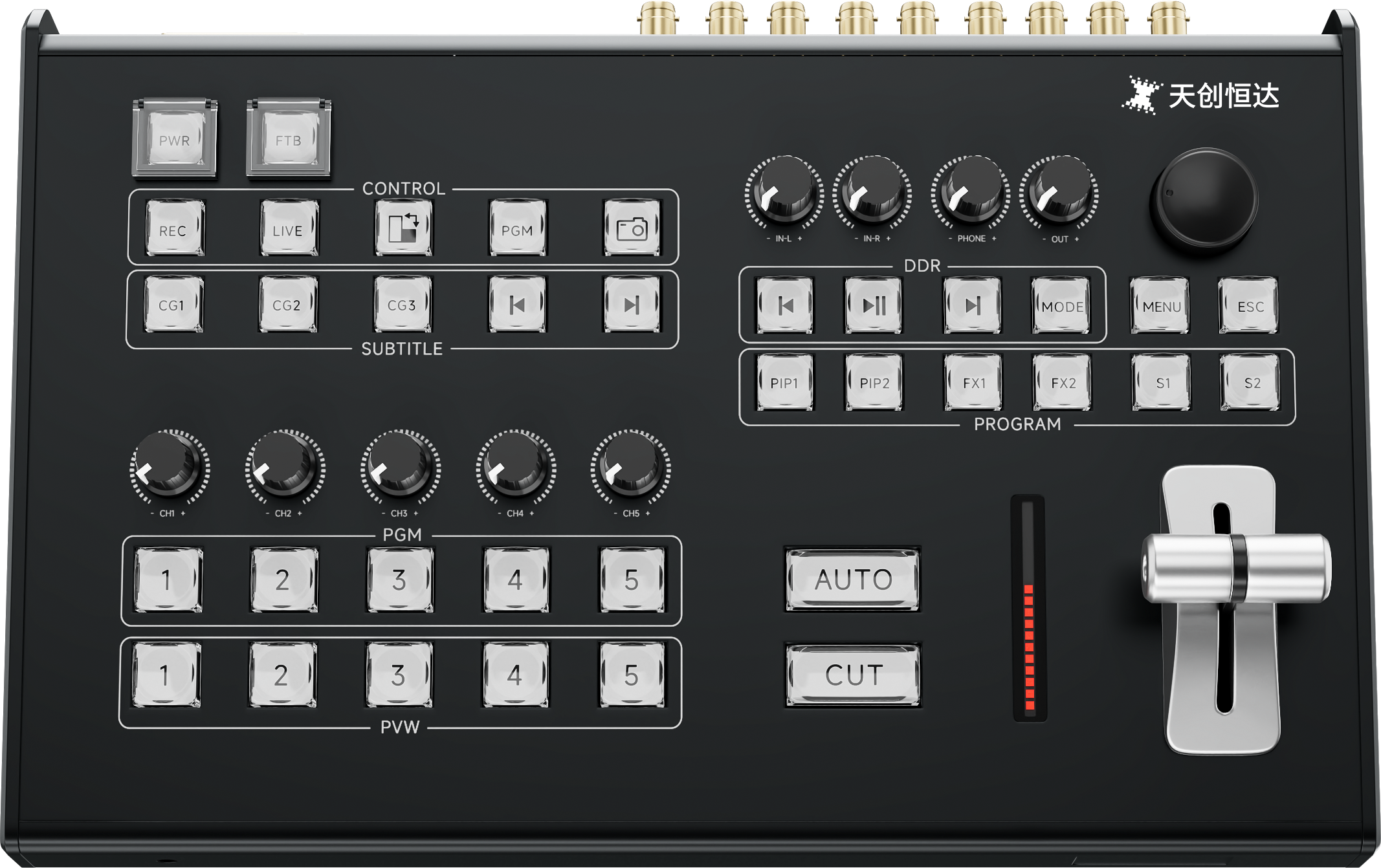
This is also where the trade-off sits, and it should be stated plainly. A hardware-defined switcher is less adaptable than a software-based one. If a broadcaster adopts a new codec or a new transport that is not implemented in the firmware, the remedy is a firmware release rather than an installed update on a PC. In the TCHD-890HS documentation, firmware upgrade is performed through the web interface or a USB drive — a maintenance path that is simple and does not require a service visit, but which still depends on the supplier continuing to issue firmware for that model.
The practical procurement question therefore becomes: which protocols are implemented natively today, and what is the supplier's stated firmware support policy for the model over the expected deployment period? On the streaming side, TCHD switcher documentation lists RTMP, RTMPS, SRT, RTSP, UDP, NDI and, on the TCHD-812 and TCHD-812 Ultra, GB28181. Buyers should verify that list against their own platform requirements rather than assume future protocol coverage.
Hot-Swappable SSD Slots as a Maintenance Design Choice
The third signal is storage. Recording is the part of a switcher workflow most likely to fail under load, because it is the only subsystem that physically wears and continuously writes at high bitrate. Whether that subsystem can be maintained in place is a design decision made years before the failure occurs.
TCHD-812 and TCHD-812 Ultra are documented with dual hot-swappable SSD slots, optional 2TB, 4TB or 8TB capacity, and support for 4K H.265 and HD H.264 high-bitrate recording. The same documentation describes power-off protection and automatic file segmentation, which address the two most common recording-integrity risks: an unexpected power interruption and a single file that becomes unusable because it was never closed correctly.
The TCHD-890HS takes a different approach, with a built-in single SSD slot and recording to internal SSD or a USB 3.0 drive in MP4, TS and AVI formats. PGM recording bitrate is configurable from 1 to 20 Mbps, multi-channel recording runs at 1 to 8 Mbps on SSD only, and segmented recording with a configurable duration is supported. The TCHD-840 Super uses a built-in M.2 slot.
These differences matter more than they appear to. A production team that records every session and archives the material cannot treat storage as a fixed consumable; it needs a defined answer to the question “what happens on the day the drive fills or fails?” Dual hot-swap bays answer that with a swap in the rack. A single internal slot answers it with a scheduled maintenance window.
Model-Level Evidence: What Each Platform Actually Documents
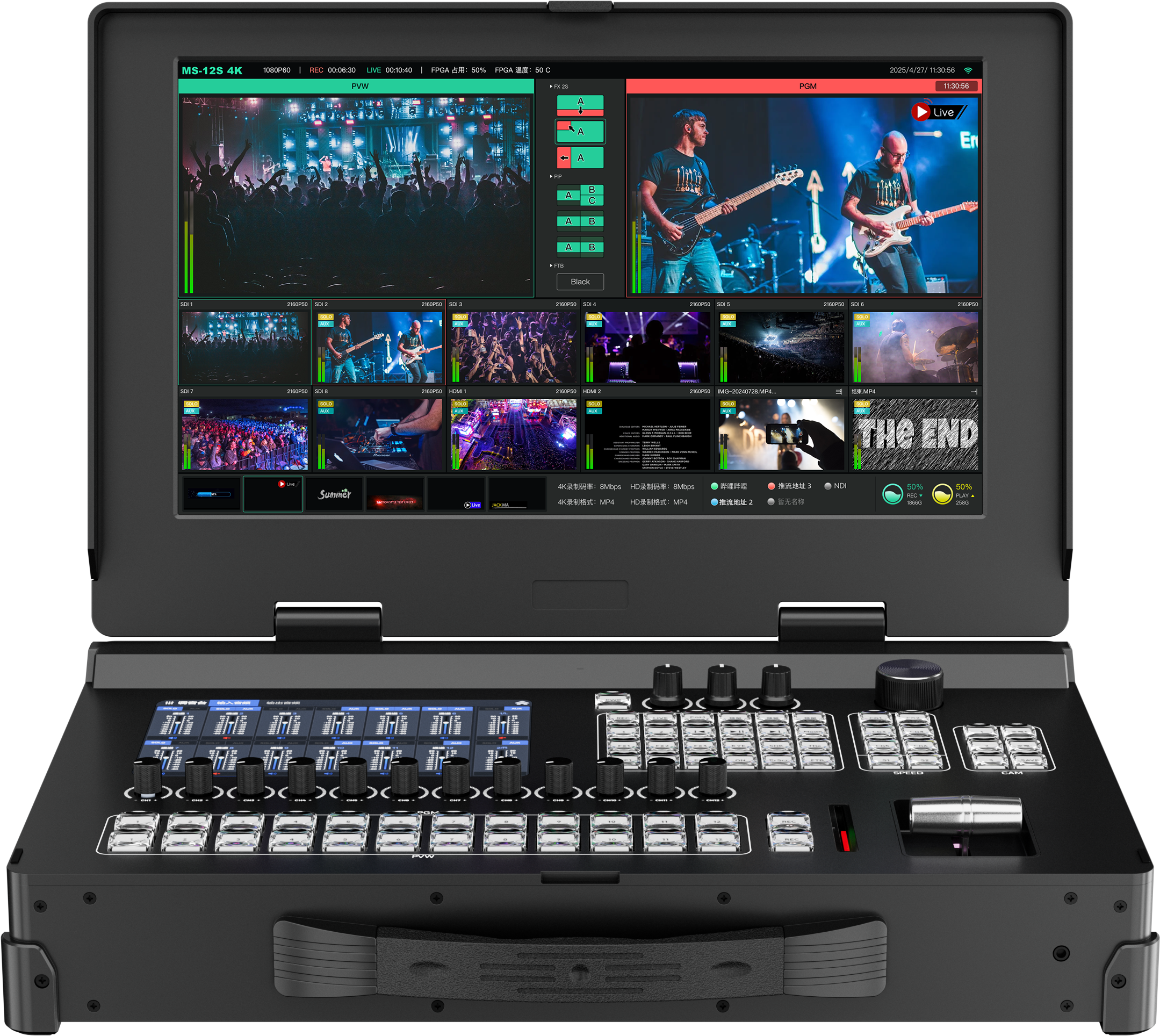
The table below consolidates the housing, architecture and storage facts published for the current TCHD Video switcher range. It is deliberately limited to what the product documentation states, because that is the material a buyer can hold a supplier to.
| Model | Housing | Processing / I-O evidence | Storage & recording |
|---|---|---|---|
| TCHD-840 Ultra | Aluminum alloy | Full-hardware embedded FPGA architecture; 4×12G-SDI or 4×HDMI 2.0 inputs; 2×12G-SDI PGM, 2×12G-SDI AUX, 3G-SDI down-convert, HDMI 2.0 PGM, DisplayPort multiview, UVC out | Built-in M.2 drive bay |
| TCHD-840 Super | Aluminum alloy | 12G-SDI and HDMI 2.0 hybrid inputs; 12G-SDI PGM/AUX, 3G-SDI down-conversion, HDMI 2.0 PGM; UVC output; 1-in 4-out streaming | Built-in M.2 slot |
| TCHD-812 Ultra | Aluminum alloy | Industrial embedded FPGA architecture; 4×12G-SDI and 1×HDMI inputs; 4-platform simultaneous push; 17.3-inch full HD screen | Dual hot-swappable SSD slots; optional 2TB/4TB/8TB; 4K H.265 and HD H.264; power-off protection; automatic file segmentation |
| TCHD-812 | Aluminum alloy | Industrial embedded FPGA architecture; 4×12G-SDI and 1×HDMI inputs; RTMP/RTMPS/SRT/RTSP/NDI/GB28181 | Dual hot-swappable SSD slots; optional 2TB/4TB/8TB; 4K H.265 and HD H.264 recording |
| TCHD-890HS | Aluminum alloy | 8 inputs (4×HDMI + 4×SDI); 720p/1080p/1080i; up to 6 simultaneous streaming outputs | Single built-in SSD slot plus USB 3.0; MP4/TS/AVI; PGM 1–20 Mbps; multi-channel 1–8 Mbps on SSD |
| TCHD-810 Pro | Aluminum alloy | 4×HDMI (2×4K60) plus 4×SDI; 10.1-inch full HD screen; PTZ control | Not specified in the available documentation |
| TC-UV08 | CNC integrated aluminum alloy | Broadcast control panel; 42 dual-color keys; MIDI/USB/RS232/LAN; one-cable USB power and communication | Not applicable (control surface) |
Source: TCHD Video product documentation. Where a field is not published for a model, it is left blank rather than inferred.
Where These Design Choices Matter in Practice
Serviceability signals only become decision criteria when they are mapped to a duty cycle. The TCHD range covers several distinct deployment patterns, and each stresses a different part of the hardware.
Education, Lecture Capture and Campus Production
TCHD switchers are documented for education and remote teaching, and for multicamera live streaming to the internet or broadcast applications. In a campus media centre, a switcher may run several scheduled sessions a day for years, with student operators rather than engineers at the controls. Deterministic switching behaviour and a firmware update path through web interface or USB drive reduce the operational dependency on specialist staff.
E-commerce Livestreaming and Multi-Platform Push
E-commerce live selling is a volume workflow: long sessions, repeated recording, simultaneous output to several platforms. TCHD-840 Ultra supports four-channel simultaneous streaming to different platforms with template-based URL management, and TCHD-812 Ultra supports four-platform push. For this workload, hot-swappable storage bays and file segmentation are closer to production continuity requirements than to convenience features. Precedence Research projects the livestream e-commerce market to reach USD 312.35 billion by 2035, with Asia Pacific holding a dominant 66% share as of 2025 — a reminder that the highest-duty switcher deployments are increasingly in commerce, not only in broadcasting.
Esports, Events and Show-Style Streaming
Livestreamed esports event production and show-style or talent show streaming place a premium on continuous recording and fast recovery. A dual hot-swap design allows a full drive to be exchanged between matches without dismantling the rack; a single internal slot model requires the recording plan to be scheduled around capacity.
Healthcare and Industrial Vision
The TC-UV08 control panel is documented for the healthcare and industrial vision industries alongside corporate, education and content creation applications. In surgical live-demo and training environments, the control surface is operated for long sessions under pressure, which is where the CNC aluminum housing, ergonomic key layout and one-cable USB design become relevant to reliability rather than to appearance.
Market Trend Analysis: Why Serviceability Is Moving Up the Agenda
Three verifiable trends support a longer evaluation horizon for switcher hardware.
First, the installed base is growing and aging at the same time. With the global production switcher market estimated at USD 2,596.79 million in 2025 and the broader video switcher market projected to grow at a 7.10% CAGR from 2026 toward USD 11.48 billion by 2034, a larger share of equipment in service is now in its second or third year of deployment rather than in its first.
Second, the signal chain has consolidated onto fewer, higher-bandwidth links. The 12G-SDI standard (SMPTE ST 2082) carries uncompressed 4K at 60fps over a single coaxial cable at 11.88 Gbps, which is why models such as TCHD-840 Ultra, TCHD-840 Super, TCHD-812 and TCHD-812 Ultra are documented around 12G-SDI and HDMI 2.0 input options. Fewer cables per production means fewer field-replaceable points, and it shifts attention to the components that remain — chassis, processing board and storage.
Third, cross-border procurement is becoming more procedural. Video mixing systems and consoles are classified under HS Code 85437062 in various customs jurisdictions, which means import planning, duty treatment and after-sales logistics are now part of the supplier evaluation rather than a separate administrative task. For buyers importing switchers into the EU, USA or Asia, the practical question is not only whether a unit can be repaired, but how quickly a replacement drive or chassis can clear customs.
Comparing Serviceable Hardware with Conventional Alternatives
It helps to place the hardware-defined approach against the two alternatives most buyers consider.
Versus software-based switching on a general-purpose computer. A PC-based switcher is more adaptable: new codecs, new platforms and new effects usually arrive as software updates, and the operator interface is familiar. Its weakness is the number of dependencies in the chain — operating system, drivers, capture hardware, graphics card — each of which can change independently of the switcher software. An embedded FPGA platform removes those dependencies at the cost of flexibility, which is why the choice is workload-dependent rather than absolute.
Versus sealed appliances with fixed internal storage. A sealed unit is often simpler to specify and can be cheaper at purchase. Its limitation emerges later: when internal storage reaches end of life, the whole unit typically leaves service. Hot-swappable bays and accessible M.2 slots shorten that interruption to a scheduled swap.
A Procurement Framework for Multi-Year Deployment
The following checks convert the discussion above into a short evaluation sequence that can be applied to any supplier, not only to TCHD Video.
- Confirm the duty cycle before the specification. Hours per day, sessions per week, ambient conditions and rack density determine which hardware properties are actually decisive.
- Ask for the thermal story, not just the material. Housing material is a starting point; request operating temperature guidance and any derating advice for enclosed racks.
- Map protocols to platforms. Verify that the native protocol set matches the streaming destinations and any regulatory requirement, such as GB28181 where relevant.
- Model the storage failure case. Decide whether hot-swap is required, what capacity tier fits the recording schedule, and whether file segmentation and power-off protection are documented for the chosen model.
- Establish the firmware support policy. Ask how long the model will receive firmware updates and how updates are applied — on TCHD-890HS, for example, via web interface or USB drive.
- Check the commercial service layer. Warranty term, spare drive availability, repair turnaround and import logistics under HS Code 85437062 belong in the same evaluation as the hardware specification.
A supplier that answers all six consistently is demonstrating organisational capability, not just product capability. That distinction is what long-term evaluation is really testing.
Future Outlook
As switcher deployments lengthen and streaming volume grows, the purchasing conversation is likely to shift further from peak specification toward lifecycle evidence. Buyers increasingly ask for the maintenance model alongside the feature list: which parts are field-replaceable, how firmware is delivered, and what the supplier commits to after the warranty period.
For manufacturers, that shift rewards design decisions that are easy to document — a metal chassis, an embedded architecture, an accessible drive bay — and penalises platforms whose serviceability cannot be described without opening the unit. TCHD Video's current range of aluminum-alloy-housed, FPGA-based switchers with model-dependent storage access is a reasonable illustration of that direction, while leaving open the quantitative reliability data that the next stage of buyer scrutiny will demand.
FAQ
What does an embedded FPGA architecture change in a production switcher?
An embedded FPGA architecture implements the switching signal path in dedicated hardware rather than on a general-purpose operating system. In the TCHD-840 Ultra, TCHD-812 and TCHD-812 Ultra documentation, this is presented as a full-hardware design associated with low latency and stable switching. The practical effect is fewer software dependencies in the chain and more predictable behaviour under sustained load; the trade-off is that new codecs or transports require supplier-issued firmware rather than an installed software update.
Does an aluminum alloy housing guarantee stable operation inside a rack?
No. Aluminum alloy improves heat conduction and contributes to dissipation, which is why it is used across the TCHD switcher range and, in CNC form, on the TC-UV08 control panel. It does not override rack density, blocked airflow or high ambient temperature. The available documentation does not publish an operating temperature range, so buyers with constrained rack environments should request thermal guidance from the supplier rather than assume the housing material settles the question.
Which TCHD production switcher models have hot-swappable SSD slots?
Dual hot-swappable SSD slots are documented for the TCHD-812 and TCHD-812 Ultra, with optional 2TB, 4TB or 8TB capacity and support for 4K H.265 and HD H.264 recording, plus power-off protection and automatic file segmentation. The TCHD-890HS uses a single built-in SSD slot with recording to internal SSD or USB 3.0 drive in MP4, TS and AVI formats. The TCHD-840 Super provides a built-in M.2 slot. Storage access is therefore model-specific and should be confirmed against the intended recording workload.
Is hot-swappable SSD storage the same as redundant recording?
They are different properties. Hot-swappable slots describe how a drive can be exchanged during operation without removing the chassis from the rack, which shortens maintenance interruptions. They do not by themselves state that recording continues automatically if a drive fails. A production that cannot tolerate any recording gap should specify redundancy as a separate requirement and confirm with the supplier how it is implemented on the chosen model.
What documentation should a buyer request before committing to a multi-year switcher deployment?
At minimum: the housing material and any thermal guidance for enclosed racks; the processing architecture and the native protocol list, including RTMP, RTMPS, SRT, RTSP, UDP, NDI and, where relevant, GB28181; the storage configuration and recording formats and bitrates; the firmware update method and support policy; and the commercial service terms, covering warranty, spare-part availability and repair turnaround. The TCHD Video range illustrates each of these at model level, but published MTBF figures and lead-time commitments are not part of the available documentation and should be requested directly.
TCHD Video publishes its full product range and specifications in its 2025 product catalog, which is available for open access and download.
Tem questões ou precisa de mais detalhes?
Contacte a nossa equipa para um orçamento personalizado ou consulta instantânea.
Solicitar orçamento
Preencha o formulário abaixo e a nossa equipa entrará em contacto com uma proposta personalizada.
Chat direto do WhatsApp
Prefere conversar em tempo real? Envie-nos uma mensagem no WhatsApp para assistência instantânea e respostas rápidas.
- Obter orçamento personalizado
- Partilhar fotos ou documentos
- Discuta as suas necessidades diretamente
Geralmente responde em 5–30 minutos durante o horário de expediente.