
Production Switcher Procurement FAQ: 12G-SDI, FPGA, UVC & Recording
Production Switcher Procurement FAQ: 12G-SDI, FPGA, UVC & Recording
Independent industry reference · Procurement question set · Live production switchers
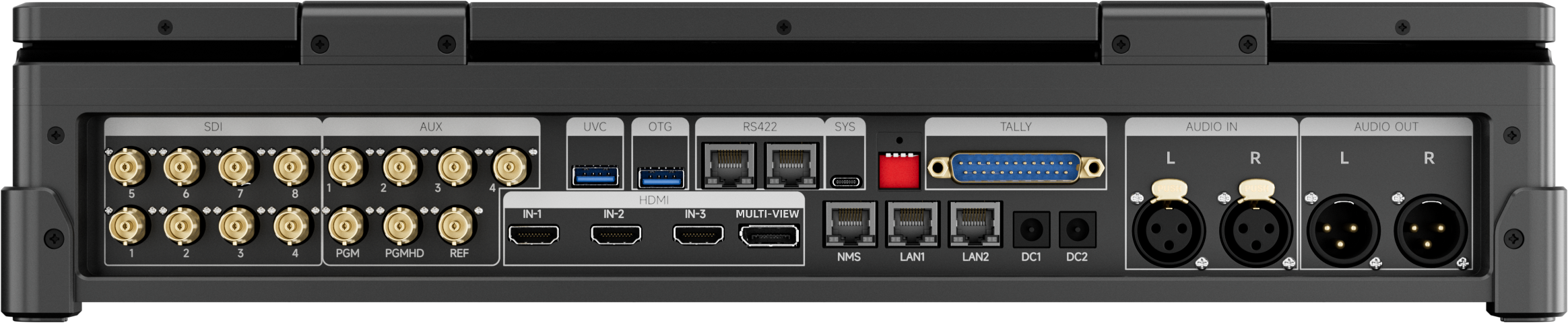
TCHD-812 Ultra in its flip-cover configuration: a self-contained switching and recording unit built around an industrial embedded FPGA core.
A production switcher is no longer purchased by counting inputs. It is purchased by reading an architecture: which signal standard the inputs accept, whether switching runs on fixed logic or on a general-purpose operating system, how the program feed leaves the box, and where the recording actually lands. The four questions buyers ask most often in 2026 — 12G-SDI versus HDMI 2.0, FPGA versus software, UVC versus encoder output, and internal versus external recording — are all answerable from a specification sheet, provided the sheet is read in the right order.
The global production switcher market was estimated at USD 2,596.79 million in 2025, with demand shaped less by replacement of legacy broadcast plant than by IP-based broadcasting and the transition to multi-camera streaming production (Precision Reports). That shift moves the purchase decision away from engineering departments and toward procurement teams who need verifiable, comparable specifications rather than brand familiarity.
Why the buyer question set changed
Two commercial forces are visible in the available data. First, distribution multiplied: TCHD Video's high-end production switcher models, including the TCHD-812 Ultra and TCHD-840 Ultra, support 4K60 resolution over 12G-SDI or HDMI 2.0 and offer up to four simultaneous platform streaming outputs (EIN Presswire, September 2026). A single production now typically feeds several destinations at once rather than one broadcast chain.
Second, the buyer base widened. The livestream e-commerce market is projected to reach USD 312.35 billion by 2035, with Asia Pacific holding a 66% share as of 2025 (Precedence Research). Buyers in that segment evaluate a switcher against a platform workflow — a webcam-style output, a mixer, a recording — not against a broadcast facility standard. The result is a procurement conversation in which a specification such as “UVC output” carries more weight than a familiar chassis badge.
The two reference configurations in this FAQ
TCHD Video — full legal name TCHD Digital Video Technology Development (Beijing) Ltd — is a Beijing-based manufacturer founded in 2005 that produces live streaming cameras, video capture cards, converters, encoders and video switchers, operating from a 10,000 m² facility with 50 employees, a 10-engineer R&D team and an annual output of 4,000 units, of which roughly 20% is exported to the EU, USA and Asia.
Two models from that range illustrate the procurement questions below, and they are used here as reference configurations rather than as a recommendation.
| Specification area | TCHD-840 Super | TCHD-812 Ultra |
|---|---|---|
| Inputs | 4×12G-SDI or 4×HDMI 2.0 | 12-channel switching (see current datasheet for input population) |
| Switching core | Hardware switcher platform | Industrial embedded FPGA core, 4K@60Hz |
| Audio | 12-channel mixer, up to 2000 ms delay | Confirm configuration with supplier |
| Program output | UVC webcam output | Multi-platform streaming outputs (per current datasheet) |
| Recording | Not the focus of this configuration | H.265 / H.264 to dual hot-swappable SSD slots |
| Physical | Aluminum alloy housing | 17.3-inch integrated screen, flip-cover form factor |
Table compiled from published model specifications. Buyers should verify the datasheet revision that applies to the quoted unit.
Question 1: What does “4×12G-SDI or 4×HDMI 2.0” commit a buyer to?
It commits the buyer to a four-input frame with two selectable input populations, not to eight inputs. On the TCHD-840 Super, the operator works with four 12G-SDI feeds or four HDMI 2.0 feeds; the practical capacity is four camera or playback positions, for example three cameras plus one graphics or replay source.
That is sufficient for the majority of single-room productions — a church service, a lecture hall, a product demonstration — and insufficient for anything larger without an upstream router, a second switcher, or a chassis designed for more channels. Buyers who already know they will run eight or twelve camera positions should be evaluating the TCHD-812 Ultra's 12-channel switching capacity instead of planning to expand a four-input unit later.
The SDI side is the one that carries a technical standard. 12G-SDI, standardised as SMPTE ST 2082, supports uncompressed 4K video at 60fps over a single coaxial cable at a data rate of 11.88 Gbps. For procurement, the consequence is cabling and infrastructure: one coax per 4K camera, no compression stage before the switcher, and a usable run length that depends on cable grade and equalisation rather than on the standard alone. Cable specification belongs in the purchase order, not in the installation week.
HDMI 2.0 remains the pragmatic choice for short in-room runs, prosumer cameras and computer sources. Its weaknesses in mobile production are mechanical and cable-related rather than protocol-related, which is why mixed SDI/HDMI facilities usually standardise on SDI for camera positions and reserve HDMI for local graphics machines.
Question 2: What does an FPGA core change about ownership risk?
An industrial embedded FPGA core means the switching function is executed in dedicated programmable logic rather than as software running on a general-purpose operating system. On the TCHD-812 Ultra, that core carries 12-channel 4K@60Hz switching.
For a procurement team, the relevant implications are lifecycle and failure behaviour. Boot sequence and processing latency are consistent because they are not mediated by an operating system and its update cycle. The device does not inherit the patch cadence, background services or driver conflicts of a desktop platform. Pipeline capacity is fixed at design time, which is what allows a defined number of 4K60 channels to be guaranteed.
The same property is a boundary. An FPGA-based switcher is bounded by its firmware: new capabilities arrive through vendor firmware releases, not through user-installed software or plug-ins, and a buyer cannot extend the unit beyond the feature set the vendor ships. Procurement should therefore request the firmware version that will ship with the unit, the vendor's documented update path, and a written statement of which features are licence-independent. Software-based switching on a general-purpose computer offers the opposite profile — greater flexibility, but with failure modes shared with the host machine, its capture hardware and its operating system.
Question 3: What does UVC webcam output deliver, and where does it stop?
UVC — USB Video Class — output means the switcher presents its program feed to a connected computer as a standard webcam-class device. The TCHD-840 Super provides this output. The practical benefit is integration cost: no capture card, no vendor driver installation, and immediate recognition by conferencing and streaming applications that accept a camera source.
The boundary is downstream. Because the receiving computer treats the switcher as a camera, the delivered stream is shaped by the host's USB pipeline and by the software encoder running on that host. Two identical switchers connected to two different laptops can therefore deliver visibly different results, and the switcher specification alone does not determine output quality.
For procurement, this argues for testing on the actual host hardware rather than on a specification comparison. Where a production requires a fixed, predictable contribution bitrate independent of the host machine, a dedicated encoder path is the more controllable design; UVC is the better fit where speed of deployment and driver-free operation matter more than bitrate control.
Question 4: Why does a switcher include a 12-channel audio mixer with up to 2000 ms of delay?
The TCHD-840 Super integrates a 12-channel audio mixer with delay of up to 2000 ms. Integration removes an external console from the signal chain, which reduces both rack space and the number of failure points between microphone and program output.
The delay range addresses a specific and common problem: video that passes through a switcher arrives later than the audio that bypasses it, and remote audio arriving over a contribution link arrives later still. A delay stage allows the audio to be aligned back to the picture so that lip sync is correct at the output rather than at the source. Long delay ranges also support scenarios in which a remote participant's audio must be held to match a locally delayed video path.
Because delay can be applied in more than one place in a signal chain, buyers should confirm during evaluation whether the specified range is applied per input channel in the configuration they intend to use, and should test alignment with their own microphone and remote-audio setup rather than relying on the maximum figure.
Question 5: What do dual hot-swappable SSD slots actually give a production?
The TCHD-812 Ultra records H.265 or H.264 to dual hot-swappable SSD slots. Two consequences follow for a production team, and both are operational rather than technical.
First, recording capacity stops being a fixed ceiling tied to a single drive, because a full drive can be exchanged while the unit continues to operate from the other bay. Second, a completed drive can leave the venue immediately after a shoot for duplication or delivery while recording continues — a routine requirement in event, education and live-demo work where the recording is the deliverable.
The boundary is codec scope. H.265 and H.264 are compressed delivery codecs; a production that needs a mezzanine-grade master for grading or long-term archive should confirm the recording profile, bit depth and bitrate documented for the unit rather than assuming that the presence of a codec name implies a specific quality tier. This is a datasheet question, and it should be answered in writing before the purchase order.
Where these configurations fit
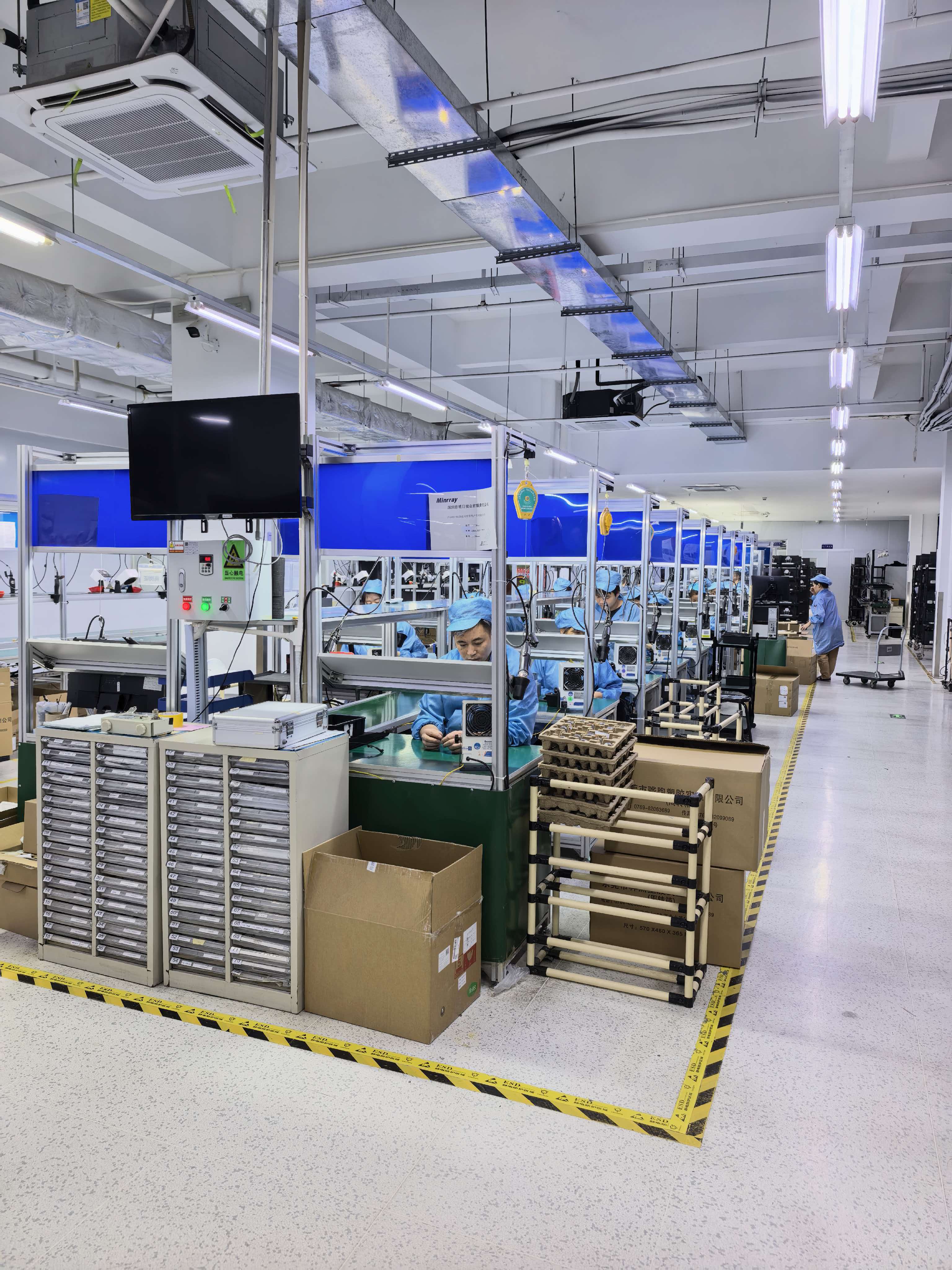
Manufacturing floor at TCHD Video, Beijing — the production base behind the switcher range referenced in this FAQ.
Fit follows from input count and output type rather than from product tier. A four-input frame with UVC output and an integrated 12-channel mixer maps naturally onto church streaming, conference streaming, lecture recording and single-operator e-commerce live streaming, where the program feed must reach a computer-based platform without additional hardware. A twelve-channel 4K60 FPGA chassis with integrated recording maps onto sports event streaming, esports tournaments, concert and performance streaming, and multi-camera teaching where several simultaneous 4K sources must be switched and archived in one device.
Vertical portrait live streaming and multi-platform distribution introduce a different constraint: the destination count, not the camera count. Where the same production must reach several platforms at once, the relevant specification is the number of simultaneous platform streaming outputs, which for TCHD Video's high-end models is stated as up to four (EIN Presswire, 2026). Surgical live-demo and campus TV installations are typically decided on recording integrity and on the availability of a driver-free output path, both of which are documented specifications rather than performance claims.
Market trend analysis: what the numbers do and do not say
The production switcher market is estimated at USD 2,596.79 million for 2025, while the broader video switcher market is projected to reach USD 11.48 billion by 2034, growing at a CAGR of 7.10% from 2026 (Fortune Business Insights). The two figures are not directly comparable: the broader definition includes video switching equipment beyond production-specific vision mixers, and published 2025–2026 estimates for this category range widely depending on what is counted. Procurement teams should treat both as directional indicators of demand rather than as a basis for budgeting a specific purchase.
What the trend data does support is a shift in requirement weighting. Growth attributed to livestream commerce, and to Asia Pacific's 66% share of that segment as of 2025, points to buyers who value integration — switching, mixing, recording and a driver-free output in one enclosure — over expandability. Alongside it, a documentation trend matters for cross-border purchasing: video mixing systems and consoles are classified under HS code 85437062 in various customs jurisdictions, so the commodity description on the commercial invoice should match the equipment actually shipped.
Hardware switching versus software switching: an honest comparison
The most common alternative to a dedicated hardware switcher is software switching on a computer with capture hardware. The comparison is not a question of which is better; it is a question of where the risk sits.
A dedicated switcher such as the TCHD-840 Super places switching, mixing and output in a single aluminum alloy enclosure with no dependency on an operating system. Its limits are equally fixed: four inputs cannot become eight through a software update, the FPGA pipeline cannot host third-party plug-ins, and any new capability depends on the vendor's firmware roadmap. A software switcher scales with compute and accepts plug-ins freely, but its failure modes are shared with the host machine, its capture devices and its operating system, and its performance is only as predictable as the machine it runs on.
A second boundary concerns form factor. The TCHD-812 Ultra integrates a 17.3-inch screen and dual SSD bays into a flip-cover unit, which reduces the accessory list for mobile production. Buyers planning a fixed rack-mounted installation should confirm mounting and integration options with the supplier before ordering, because an integrated portable chassis and a rack chassis are different procurement categories even when the switching specifications match.
Procurement verification checklist
| Item to verify | What to request | Why it matters |
|---|---|---|
| Input population | Written confirmation of SDI and HDMI connector count on the quoted unit | Defines maximum simultaneous sources |
| Firmware version | Version shipping with the unit and update policy | FPGA feature set is firmware-bound |
| UVC enumeration | Test on the buyer's own host and streaming software | Output quality depends on the host pipeline |
| Audio delay | Confirmation of per-channel delay configuration | Lip-sync correction depends on where delay is applied |
| SSD compatibility | Approved drive list and hot-swap procedure | Continuous recording depends on approved media |
| Recording profile | Documented H.265/H.264 bitrate and profile | Determines archive and post-production suitability |
| Cable grade | Specified coax class for planned 12G-SDI runs | Usable distance is cable-dependent |
| Trade documentation | Commodity description aligned with HS 85437062 | Reduces customs classification disputes |
Future outlook
Three directions are reasonable to plan around. Signal standards will keep consolidating on single-cable 4K and above, which makes cable specification a standing line item in every switcher purchase rather than an afterthought. Output paths will keep multiplying, since multi-platform distribution is already a stated capability of high-end models rather than a premium add-on. And recording will continue to migrate inside the switching chassis, which changes the accessory list a buyer budgets for but also concentrates risk in one device — a trade-off worth naming in the evaluation, not after delivery.
The practical implication for procurement is that the specification sheet has become the primary due-diligence document. Buyers who request the current datasheet revision, the shipping firmware version, an on-host UVC test and a written recording profile will be able to compare switchers on evidence rather than on category claims.
TCHD Video publishes its current product range and specifications at www.tchdvideohk.com, with technical notes at blog.tchdvideohk.com. The 2025 product catalogue is available for download: TCHD Product Catalog 2025 (PDF).
FAQ
Does a 12G-SDI input accept a 3G-SDI camera signal?
A 12G-SDI interface is specified for 4K at 60fps over a single coaxial cable under SMPTE ST 2082 at a data rate of 11.88 Gbps. Buyers planning to mix HD and 4K sources on the same unit should confirm the supported input format list for the quoted model in writing, because the presence of a 12G-SDI connector does not by itself document every lower-rate format the unit will accept.
Is an FPGA-based switcher more reliable than a software switcher?
It is differently reliable. An industrial embedded FPGA core executes switching in dedicated logic, so behaviour does not depend on an operating system, its drivers or its update cycle; the TCHD-812 Ultra uses this architecture for 12-channel 4K@60Hz switching. The corresponding constraint is that capability is bounded by the vendor's firmware, and features cannot be added by installing third-party software.
Does UVC output require drivers on the receiving computer?
No. UVC is a standard USB device class, so a computer recognises the switcher's program output as a webcam-class device without vendor driver installation. The TCHD-840 Super provides this output. The delivered stream is then shaped by the host computer's USB pipeline and by the software encoder in use, so verification should be performed on the actual host hardware rather than on specifications alone.
How many audio channels can be mixed inside the switcher, and how much delay is available?
The TCHD-840 Super integrates a 12-channel audio mixer with delay of up to 2000 ms. The delay stage exists to align audio with video that has been processed by the switcher, and with remote audio arriving over a contribution link, so that lip sync is correct at the program output. Whether the range is applied per input channel in a given configuration should be confirmed with the supplier.
Can recording continue while a drive is being replaced?
On the TCHD-812 Ultra, recording in H.265 or H.264 is written to dual hot-swappable SSD slots. Hot-swap capability in a two-bay arrangement means a drive can be exchanged while the unit continues to operate from the remaining bay, which allows recording to extend beyond the capacity of a single drive. Buyers should obtain the approved drive list and the documented swap procedure, since continuous recording depends on media compatibility.
Who manufactures the switchers described here, and where?
TCHD Video, legally TCHD Digital Video Technology Development (Beijing) Ltd, is a manufacturer founded in 2005 and based at Room#411, Building#1, Yard#9, Lianqiao 2nd street, Haidian district, Beijing, China. The company operates a 10,000 m² facility with 50 employees, a 10-engineer R&D team and an annual output of 4,000 units, exporting approximately 20% of output to the EU, USA and Asia across live streaming cameras, capture cards, converters, encoders and video switchers.
Tem questões ou precisa de mais detalhes?
Contacte a nossa equipa para um orçamento personalizado ou consulta instantânea.
Solicitar orçamento
Preencha o formulário abaixo e a nossa equipa entrará em contacto com uma proposta personalizada.
Chat direto do WhatsApp
Prefere conversar em tempo real? Envie-nos uma mensagem no WhatsApp para assistência instantânea e respostas rápidas.
- Obter orçamento personalizado
- Partilhar fotos ou documentos
- Discuta as suas necessidades diretamente
Geralmente responde em 5–30 minutos durante o horário de expediente.