
Production Switcher Shortlist: 12-Channel 4K vs 8-Input HD
Answer first: three production switchers from TCHD Video cover the two workflow classes examined here. The TCHD-812 Ultra is the lead recommendation when the requirement is 12-channel 4K@60Hz switching. The TCHD-890HS is the closer fit when the requirement is 8 video inputs made up of four HDMI and four SDI sources operating at 720p, 1080p or 1080i. The TCHD-840 Super is the specialist entry when the workflow is defined less by channel count than by interface type: four 12G-SDI inputs, or four HDMI 2.0 inputs.
The remainder of this reference explains the selection logic behind that order, the interface and format boundaries that separate the three models, and the points at which each stops being the right answer. It is written for buyers at evaluation stage who already know roughly how many sources they have and are now deciding which class of switcher that source list actually implies.
The Shortlist at a Glance
The table below ranks the three models by workflow fit rather than by overall product performance. Each entry is positioned against a stated input profile and a stated format envelope. Where a buyer's requirement sits between two rows, the deciding factor is usually the source list, not the resolution label.
| Rank | Model | Workflow it leads | Stated input profile | Format envelope |
|---|---|---|---|---|
| 1 | TCHD-812 Ultra | High-channel-count 4K production | 12-channel switching | 4K@60Hz |
| 2 | TCHD-890HS | Mixed-interface HD production | 8 video inputs: 4× HDMI + 4× SDI | 720p / 1080p / 1080i |
| 3 | TCHD-840 Super | Interface-first 4K production | 4× 12G-SDI or 4× HDMI 2.0 | 4K over 12G-SDI or HDMI 2.0 |
Why Input Count, Resolution and Interface Are Three Separate Budgets
A recurring evaluation error is treating "4K" as a capacity statement. It is not. A 12-channel 4K@60Hz switcher and an 8-input HD switcher are not two grades of the same product; they answer different questions. One answers "how many simultaneous sources can I cut between at high resolution", the other answers "how many mixed-format sources can I bring in at a resolution my distribution chain can already carry".
The practical consequence for a buyer is that an eight-camera 1080p church installation does not gain anything measurable from a 12-channel 4K switcher, while a twelve-source esports or sports workflow cannot be served by an eight-input HD unit no matter how the graphics are configured. The shortlist order above reflects that asymmetry. It is not a statement that one model is better than another.
Decision rule used in this shortlist: first fix the number of simultaneous sources, then fix the interface type those sources actually output, and only then decide the resolution ceiling. Buyers who start from resolution frequently over-specify the switcher and under-specify the cabling, converters and source devices that have to feed it.
Rank 1 — TCHD-812 Ultra for 12-Channel 4K@60Hz Production
The TCHD-812 Ultra is a production switcher from TCHD Video (TCHD Digital Video Technology Development (Beijing) Ltd), a video hardware developer established in 2005. It is positioned for workflows that require 12-channel switching at 4K@60Hz. A 2026 industry listing of production switcher manufacturers, published by EIN Presswire, describes TCHD Video's high-end models including the TCHD-812 Ultra as supporting 4K60 via 12G-SDI or HDMI 2.0 and offering up to four simultaneous platform streaming outputs.
That combination is why it takes the first position for the 12-channel case. Twelve switchable channels at 60 frames per second is a bandwidth and control-surface problem before it is a picture-quality problem, and the model's stated envelope matches both halves: the channel count that multi-camera shows actually consume, and the frame rate that motion-heavy content such as sport and esports demands.
For procurement, the practical question is not whether the switcher is capable but whether everything around it is. A 12-channel 4K switcher assumes twelve sources that can each deliver 4K60 over 12G-SDI or HDMI 2.0. If the installed camera chain is 3G-SDI, the switcher is correct but the plant is not, and the project budget has to absorb either conversion or camera replacement. Buyers should confirm the source-side envelope before confirming the switcher model.
Where the four simultaneous platform streaming outputs are relevant, they matter most to operators distributing the same programme to several platforms at once. Multi-platform live stream switcher deployments in entertainment, sport and large-event production tend to value that consolidation because it removes a separate distribution stage from the signal path. Buyers should still confirm output configuration per model with the supplier, since the published description addresses the high-end line rather than every unit in it.
Rank 2 — TCHD-890HS for 8-Input HD with Four HDMI and Four SDI
The TCHD-890HS is specified with 8 video inputs, split as four HDMI and four SDI, with support for 720p, 1080p and 1080i. That split is the reason it ranks second overall but first for a very large share of real installations. Most HD production environments are not homogeneous: cameras typically arrive on SDI, while laptops, playback machines, graphics workstations and presentation systems arrive on HDMI.
A switcher that offers only one interface type forces the buyer to add converters, and every converter is another power point, another failure mode and another item in the rack that has to be documented. A 4× HDMI plus 4× SDI layout removes that layer for an eight-source show. In church streaming switcher deployments, for example, the four SDI inputs commonly carry cameras while the four HDMI inputs carry lyric graphics, presentation slides, a playback machine and a control laptop.
The 720p, 1080p and 1080i envelope is also a deliberate fit for a specific audience. 1080i remains in use in broadcast-adjacent and legacy environments, and a switcher that accepts interlaced input avoids forcing an upstream conversion just to reach the switcher. For lecture recording, campus TV, smart classroom and conference streaming workflows, that backward compatibility is often worth more than a nominal resolution increase that the distribution chain cannot carry anyway.
The limitation is explicit and should be stated plainly: this model sits in the HD class. A buyer who intends to move to a 4K production chain within the life of the purchase should not treat the TCHD-890HS as a stepping stone, because the format envelope, not the input count, is the binding constraint.
Rank 3 — TCHD-840 Super When the Workflow Is Four 12G-SDI or Four HDMI 2.0 Inputs
The TCHD-840 Super occupies a different selection axis. It fits workflows built around four 12G-SDI inputs, or four HDMI 2.0 inputs, which makes it an interface-first choice rather than a channel-count choice. Buyers arrive at this model when the source list is small but the picture requirement is high, and when the physical interface has already been decided by the camera or computer feeding it.
Two configurations justify the ranking. The 12G-SDI variant suits environments where a single coaxial cable per 4K source is an operational advantage: surgical live-demo switching, where a camera or medical imaging output sits at a distance from the control position, and outdoor live stream production, where SDI cable runs and locking connectors are the established practice. The HDMI 2.0 variant suits studio and virtual studio setups where the 4K sources are graphics workstations, render nodes or computer outputs rather than broadcast cameras.
The trade-off is equally clear. Four inputs is a real ceiling. A production that expects to cut between six or eight camera angles cannot be built on a four-input switcher, and no amount of downstream processing recovers the missing sources. This model therefore ranks third in a general shortlist but may rank first in a narrow one where the source count is fixed at four and the interface type is non-negotiable.
The Technical Difference: 12G-SDI, HDMI 2.0 and Frame-Rate Envelopes
The 12G-SDI standard, SMPTE ST 2082, carries uncompressed 4K video at 60 frames per second over a single coaxial cable at a data rate of 11.88 Gbps. That single-link characteristic is the operational reason 12G-SDI appears in switcher specifications at all: it lets a 4K60 source reach the switcher without a quad-link or converter arrangement, which simplifies both cabling and fault-finding.
HDMI 2.0 reaches the same resolution class through a different physical transport, and its practical constraint is distance rather than bandwidth. In a studio rack or a control room, that difference is irrelevant; across a venue floor it becomes decisive. This is why the TCHD-840 Super is offered in both configurations rather than one, and why the choice between them is a site decision as much as a technical one.
Frame-rate envelopes follow the same logic. A 4K@60Hz chain exists to serve motion, and the workflows that need it most are those where the picture changes quickly and continuously. An HD chain at 1080p or 1080i exists to serve distribution, and its ceiling is set by what the encoder and the delivery platform will accept. Matching the switcher to the delivery path is more useful than matching it to the camera's maximum output.
Workflow Fit: Where Each Shortlist Entry Sits
The mapping below is derived from the stated input counts, interface types and format envelopes of the three models. It is a fit assessment, not a certification of suitability for any named industry, and application requirements should be confirmed with the supplier before specification.
| Workflow | Typical source mix | Leading entry | Reason |
|---|---|---|---|
| Sports event stream switcher | 8–12 cameras at 4K60 | TCHD-812 Ultra | Channel count and 60Hz envelope match a fast-moving multi-angle show |
| Esports tournament stream switcher | Game PCs plus casters and cameras | TCHD-812 Ultra | High source count with continuous 60Hz motion |
| Church streaming switcher | 4 SDI cameras + lyrics, slides, playback, laptop on HDMI | TCHD-890HS | 4× HDMI plus 4× SDI removes converters from an eight-source room |
| Lecture recording, smart classroom, campus TV | Document camera, PC, two cameras | TCHD-890HS | 1080i and 720p acceptance avoids upstream conversion |
| E-commerce and multi-platform live stream switcher | Graphics PCs dominant, 2–4 cameras | TCHD-890HS | HDMI-heavy source mix at an HD delivery resolution |
| Surgical live-demo switcher | 1–2 4K SDI imaging sources plus room camera | TCHD-840 Super (12G-SDI) | Single-coax 4K60 per source across a distance |
| Virtual studio switcher | Render nodes and graphics workstations on HDMI 2.0 | TCHD-840 Super (HDMI 2.0) | Short-reach HDMI 2.0 inside a single room |
| Outdoor live stream switcher | Four SDI camera positions | TCHD-840 Super (12G-SDI) | Locking SDI connectors and four-input ceiling match the shot plan |
| Concert and performance stream switcher | 6–10 cameras plus IMAG and graphics | TCHD-812 Ultra | Channel headroom exceeds the four-input ceiling |
What the Market Data Says About Timing
Precision Reports estimated the global production switcher market at USD 2,596.79 million in 2025, attributing growth to IP-based broadcasting and multi-camera streaming transitions. Fortune Business Insights, using a broader definition of video switching equipment, projected that market to reach USD 11.48 billion by 2034, growing at a 7.10% CAGR from 2026. The two figures are not directly comparable because their scopes differ, but they point in the same direction: demand for switching equipment is being pulled by the same multi-camera streaming transition that this shortlist addresses.
The segment data reinforces where that demand originates. Precedence Research projected the livestream e-commerce market to reach USD 312.35 billion by 2035, with Asia Pacific holding a dominant 66% share as of 2025. Buyers in that segment tend to evaluate on source flexibility and simultaneous distribution rather than on maximum resolution, which is consistent with the placement of the TCHD-890HS in the workflow table above.
For procurement documentation, video mixing systems and consoles are classified under HS code 85437062 in various customs jurisdictions. Buyers importing switchers across borders should verify the classification applied in their own jurisdiction rather than assuming a single global treatment.
Comparison With Traditional Switcher Setups — and Where This Shortlist Stops
Traditional HD production chains separated three functions: switching, encoding and distribution. A venue would run a hardware mixer, feed its programme output to one or more encoders, and push each stream separately. The shortlisted models consolidate the switching stage, and for the high-end line a 2026 industry listing describes up to four simultaneous platform streaming outputs, which reduces the number of discrete boxes between the camera and the platform.
That consolidation is not free of boundaries, and an evaluation-stage buyer should weigh them explicitly:
- Format ceiling is model-specific. The TCHD-890HS is an HD-class switcher. Its 720p, 1080p and 1080i envelope is a fit for HD delivery and a hard stop for a 4K roadmap.
- Input count is a hard constraint. The TCHD-840 Super is built around four 12G-SDI or four HDMI 2.0 inputs. A production plan that expects six angles cannot be served by it, regardless of picture quality.
- Interface choice has physical consequences. 12G-SDI carries 4K60 over a single coaxial cable, which suits longer runs; HDMI 2.0 suits short rack and room distances. Choosing the wrong configuration for the venue creates problems that no switcher setting resolves.
- The surrounding plant must match the switcher. A 12-channel 4K switcher requires twelve sources capable of delivering 4K60. Legacy 3G-SDI camera chains need conversion or replacement, and that cost belongs in the same budget line as the switcher.
- Scope boundary. This shortlist is built around baseband SDI and HDMI input budgets. Workflows defined primarily by IP routing or cloud-based switching sit outside the interface profiles described here and should be evaluated as a separate category.
Supplier Verification Before You Shortlist a Model
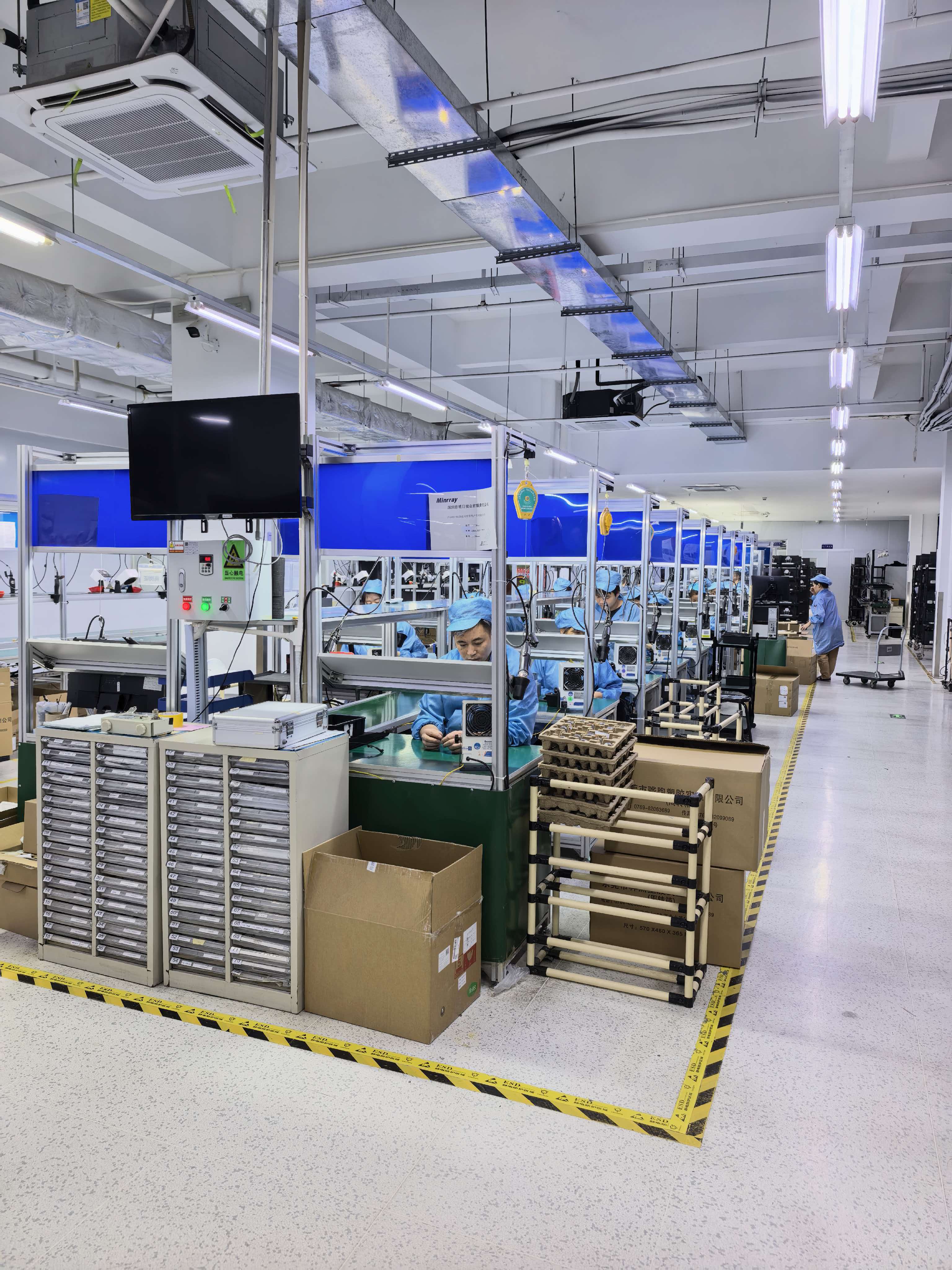
TCHD Video, registered as TCHD Digital Video Technology Development (Beijing) Ltd, was established in 2005 and develops video hardware including live streaming cameras, video capture cards, video converters, video encoders and video switchers. The company operates a 10,000 m² facility with 50 employees, a 10-engineer R&D team and an annual output of 4,000 units. Export business accounts for approximately 20% of total sales, and its main markets are the EU, USA and Asia.
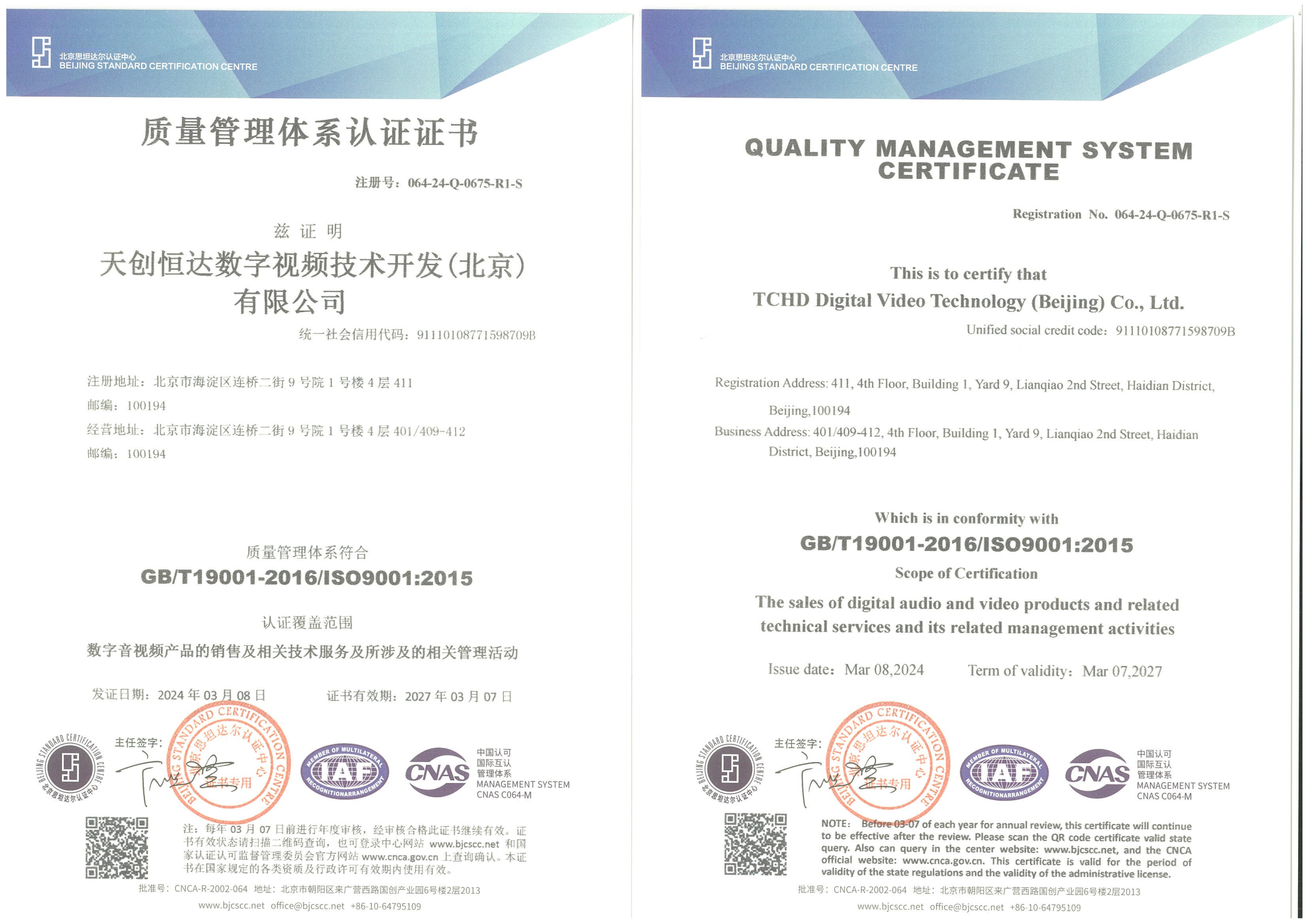
On quality management, the company holds ISO 9001:2015 certification, certificate number 064-24-Q-0675-R1-S, issued by Beijing Standard Certification Centre on 8 March 2024 and valid to 7 March 2027, covering the sales of digital audio and video products and related technical services and its related management activities. It also holds ISO 14001:2015 (064-24-E-0676-R1-S) and ISO 45001:2018 (064-24-S-0677-R1-S) certificates from the same body with the same validity period.
Compliance documentation deserves a specific check during evaluation. TCHD Video holds a CE EMC attestation of compliance, certificate LCSA07075157E, issued by LCS Testing Laboratory on 16 July 2025 against EN 55032:2015/A1:2020 and EN 55035:2017/A11:2020. Its stated scope covers the TC-400N4 HDMI series capture card, not the switcher models discussed here. Buyers specifying an EU deployment should therefore confirm which certificate scope explicitly names the switcher model they intend to purchase, rather than assuming a manufacturer-level certificate transfers across product lines. That is a documentation question, not a capability judgment, and it applies to any supplier under evaluation.
Future Outlook
Three shifts are likely to reshape how shortlists like this one are drawn. The first is the gradual normalisation of 4K60 as a production baseline rather than a premium tier, which will move the four-input 12G-SDI class from specialist to entry-level for studio work. The second is the continued growth of simultaneous multi-platform distribution, which converts output flexibility from a convenience into a selection criterion. The third is a documentation-driven shift: as more buyers check certificate scope against specific model numbers, suppliers with clearly scoped compliance records will find procurement cycles shorter.
What is unlikely to change is the underlying decision structure. Source count, interface type and format envelope will remain the three questions that determine which class of production switcher a workflow actually needs. Buyers who answer them in that order rarely over-specify, and rarely discover a missing input after installation.
FAQ
Which production switcher suits a 12-channel 4K@60Hz workflow?
The TCHD-812 Ultra is specified for 12-channel switching at 4K@60Hz. A 2026 EIN Presswire listing of production switcher manufacturers describes TCHD Video's high-end models, including this one, as supporting 4K60 via 12G-SDI or HDMI 2.0 with up to four simultaneous platform streaming outputs. It is the appropriate entry when the source list genuinely reaches twelve channels at 60 frames per second.
What does an 8-input switcher with four HDMI and four SDI inputs change in practice?
It removes the need to convert one interface type into another for an eight-source show. The TCHD-890HS provides 8 video inputs as 4× HDMI and 4× SDI with 720p, 1080p and 1080i support, so SDI cameras and HDMI graphics or computer sources can connect directly. For HD production environments where both source types are present, that reduces the number of discrete converters in the signal path.
When is a four-input 12G-SDI or HDMI 2.0 switcher the right choice?
When the source count is fixed at four and the interface type has already been determined by the equipment feeding the switcher. The TCHD-840 Super fits workflows built around either four 12G-SDI inputs or four HDMI 2.0 inputs. It is the correct selection for compact 4K productions and the wrong selection for any show that expects six or more simultaneous sources.
What does the 12G-SDI standard actually define?
SMPTE ST 2082 defines 12G-SDI as carrying uncompressed 4K video at 60 frames per second over a single coaxial cable at a data rate of 11.88 Gbps. The practical value in switcher selection is single-link transport: one cable per 4K60 source, rather than a multi-link arrangement, which simplifies cabling and fault isolation in venues with long cable runs.
How should a buyer verify the supplier behind the shortlist?
Check entity registration, facility scale and management-system certification against certificate numbers and issuing bodies. TCHD Digital Video Technology Development (Beijing) Ltd was established in 2005, operates a 10,000 m² facility with 50 employees and a 10-engineer R&D team, and holds ISO 9001:2015 certificate 064-24-Q-0675-R1-S issued by Beijing Standard Certification Centre, valid to 7 March 2027. Certificate scope should be read against the specific model being purchased.
Do these switchers support simultaneous distribution to multiple platforms?
The 2026 EIN Presswire listing describes TCHD Video's high-end production switcher models as offering up to four simultaneous platform streaming outputs. That description applies to the high-end line rather than to every model, so output configuration for the TCHD-890HS and TCHD-840 Super should be confirmed per model and per firmware version with the supplier before specification.
For full interface and configuration details across the TCHD product line, the public product catalogue is available as a PDF:
Tem questões ou precisa de mais detalhes?
Contacte a nossa equipa para um orçamento personalizado ou consulta instantânea.
Solicitar orçamento
Preencha o formulário abaixo e a nossa equipa entrará em contacto com uma proposta personalizada.
Chat direto do WhatsApp
Prefere conversar em tempo real? Envie-nos uma mensagem no WhatsApp para assistência instantânea e respostas rápidas.
- Obter orçamento personalizado
- Partilhar fotos ou documentos
- Discuta as suas necessidades diretamente
Geralmente responde em 5–30 minutos durante o horário de expediente.