
Professional Gasoline Chainsaw Decision Framework: 59cc–105.7cc
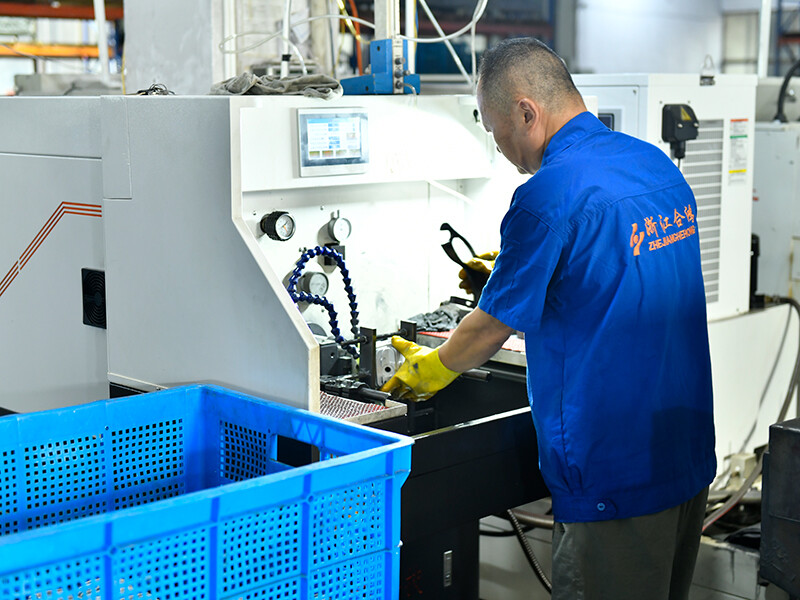
Component machining at the Zhejiang Hehong Tools Co., Ltd. facility. Displacement class is only the first filter in a professional chainsaw selection process.
A professional gasoline chainsaw purchase usually starts with a displacement number and ends with a delivery schedule. The classes that decide whether a saw is still productive after two seasons of daily cutting are 59cc, 70.7cc, 91.6cc and 105.7cc. The framework below treats displacement as an entry filter rather than a conclusion, and maps each class to the job it is actually built for.
Hanakawa, the garden power tool brand of Zhejiang Hehong Tools Co., Ltd., manufactures professional gasoline chainsaws across these classes: the 59cc H959, the 70.7cc H971, the 91.6cc H992 and the 105.7cc H9105, with the 72cc H872 and H972E positioned for farm, orchard and mixed-duty work. Zhejiang Hehong Tools Co., Ltd. was established in 2006 in Jinhua, Zhejiang Province, China, operates a 40,000 m² facility including more than 20,000 m² of production area, employs 133 people, and reports annual output of 2,500,000 units.
Why displacement alone is a weak selection rule
Rated power does not scale linearly with displacement across a professional line-up. Within the Hanakawa range, the 59cc H959 is rated at 3.4kW, the 70.7cc H971 at 4.0kW, the 91.6cc H992 at 5.2kW, and the 105.7cc H9105 at 4.8kW. The largest engine in the line-up therefore carries a lower published power rating than the 91.6cc model. A buyer who sorts a catalogue by cubic centimetres and stops there will reach the wrong shortlist before any technical discussion begins.
Three further gaps follow. Displacement does not describe duty cycle: a saw built for municipal clearing and a saw built for all-day industrial logging can sit in the same nominal class while differing substantially in heat management and structural reinforcement. Displacement does not describe handling cost either: net weight across the six models covered here runs from 5.7kg to 11kg, and that spread affects operator fatigue over a full shift more than any single power figure. Finally, displacement says nothing about the spare-parts platform, which determines how quickly a stopped saw returns to work.
The four professional classes at a glance
| Model | Displacement | Rated power | Net weight | Max engine speed | Primary application |
|---|---|---|---|---|---|
| H959 | 59cc | 3.4kW | 5.7kg | 11,500rpm | Commercial forestry logging, municipal greening, construction clearing, road obstacle removal |
| H971 | 70.7cc | 4.0kW | 6.1kg | 12,000rpm | Large-scale commercial logging, hardwood processing, engineering demolition, forest thinning |
| H872 | 72cc | 3.6kW | 6.3kg | 11,500rpm | Traditional small forestry, farm hardwood cutting, orchard trunk pruning, batch firewood processing |
| H972E | 72cc | 3.6kW | 6.6kg | 11,500rpm | Commercial intensive forestry logging, hardwood felling, mountain forest operation, construction site clearing, post-disaster emergency rescue, municipal road obstacle removal, large orchard trunk pruning |
| H992 | 91.6cc | 5.2kW | 7.7kg | 13,500rpm | Large timber felling, old-growth forest logging, lumber mill, large disaster rescue, land reclamation |
| H9105 | 105.7cc | 4.8kW | 11kg | 11,500rpm | Industrial heavy logging, giant tree cutting, log yard primary processing, remote mountain forest exploitation |
All six models listed above share the same structural approach: a magnesium alloy crankcase, an aluminum alloy cylinder, and a glass-reinforced PA nylon outer housing. In the compact classes lower down the same catalogue — the 31.8cc H932 and the 45.4cc H945 — the engine is aluminum alloy and the crankshaft is hardened alloy steel, a different construction logic appropriate to lighter work.
Five comparison criteria that change the decision
1. Power-to-weight ratio
Calculated directly from published rated power and net weight, the ratio separates models that look similar on a specification sheet:
- H992: 5.2kW ÷ 7.7kg = approximately 0.68 kW/kg
- H971: 4.0kW ÷ 6.1kg = approximately 0.66 kW/kg
- H959: 3.4kW ÷ 5.7kg = approximately 0.60 kW/kg
- H872: 3.6kW ÷ 6.3kg = approximately 0.57 kW/kg
- H972E: 3.6kW ÷ 6.6kg = approximately 0.55 kW/kg
- H9105: 4.8kW ÷ 11kg = approximately 0.44 kW/kg
The H9105 sitting at the bottom of this ranking is not a defect. It signals that the model is configured for a different objective: sustained heavy-load work in giant timber, where torque delivery and thermal margin matter more than the weight an operator carries between cuts.
2. Duty cycle and thermal margin
The published application list is the clearest available duty statement. Road obstacle removal, municipal greening and construction site clearing are intermittent-duty jobs. "Industrial heavy logging" and "log yard primary processing" describe all-day, high-load operation. The most common specification error in this category is buying a class rated for the lighter duty and deploying it in the heavier one, then attributing the resulting overheating and power loss to the machine rather than to the mismatch.
3. Safety brake and anti-vibration
Kickback brake behaviour and vibration exposure are safety variables, not comfort variables. In the largest class, the working requirement is a heavy-duty anti-rebound safety brake together with a thickened magnesium alloy crankcase and a larger cooling system. In long-shift classes, the anti-vibration system is the component that determines whether an operator can maintain control and output through a full working day. Both should be verified on a physical sample rather than accepted from a specification line.
4. Spare-parts compatibility
Parts interchangeability converts directly into downtime. The H959 shares its parts platform with the MS361 saw; the H971 with the MS440/044 platform; and the H992 with the MS660 platform listed as the G660. For buyers who operate fleets across several markets, this is often more commercially significant than a fraction of a kilowatt, because it determines whether a local dealer can complete a repair the same week.
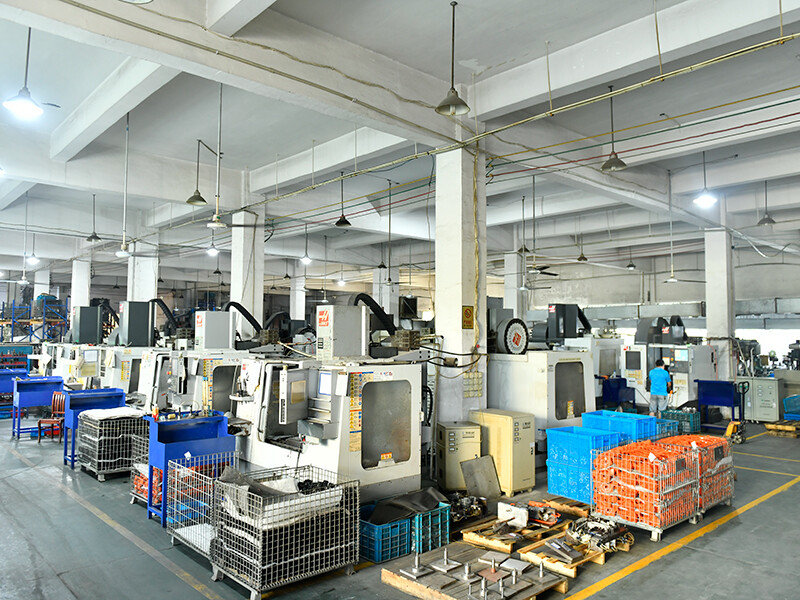
Machined component production underpins spare-parts continuity across the professional gasoline chainsaw range.
5. Structural materials and serviceability
The magnesium alloy crankcase in the professional classes serves two purposes: it reduces carried weight and it improves heat dissipation under load. The aluminum alloy cylinder manages the thermal load of the combustion chamber, while the glass-reinforced PA nylon housing absorbs the vibration and impact that a handheld saw receives in the field. Material choice is a service-life decision, and it should be part of the comparison rather than an afterthought.
Mapping the class to the job
59cc — municipal, commercial and construction clearing. The H959 at 3.4kW, 5.7kg and 11,500rpm is listed for commercial forestry logging, municipal greening, construction clearing and road obstacle removal. It suits operators who carry the saw between cuts and need reliable starting and handling rather than maximum cutting capacity in large timber.
70.7cc — forest thinning and hardwood processing. The H971 at 4.0kW, 6.1kg and 12,000rpm is listed for large-scale commercial logging, hardwood processing, engineering demolition and forest thinning. It is the class where a single saw can cover both production thinning and heavier cross-cutting without moving to a two-saw fleet.
72cc — two different briefs on one displacement. The H872 at 3.6kW and 6.3kg targets traditional small forestry, farm hardwood cutting, orchard trunk pruning and batch firewood processing. The H972E at 3.6kW and 6.6kg targets commercial intensive forestry logging, hardwood felling, mountain forest operation, construction site clearing, post-disaster emergency rescue, municipal road obstacle removal and large orchard trunk pruning. Identical displacement and identical rated power mean the application list, not the specification sheet, must drive the choice.
91.6cc — large timber and old-growth logging. The H992 at 5.2kW, 7.7kg and 13,500rpm is listed for large timber felling, old-growth forest logging, lumber mill work, large disaster rescue and land reclamation. It carries the highest rated power and the highest power-to-weight ratio in the range, and published supplier data lists guide bar support up to 62 inches on this 91.6cc/92cc platform.
105.7cc — industrial heavy logging and giant tree cutting. The H9105 at 4.8kW, 11kg and 11,500rpm is listed for industrial heavy logging, giant tree cutting, log yard primary processing and remote mountain forest exploitation. It is the class for maximum-diameter felling and bulk processing where the saw is working continuously in large-diameter hardwood.
Where the framework breaks down
A decision framework is only useful if its limits are stated. Four apply here.
- Power is not monotonic with displacement. The 105.7cc H9105 is rated at 4.8kW, below the 5.2kW of the 91.6cc H992. Displacement is not a proxy for torque either: a larger engine may be configured for sustained torque and thermal margin at lower operating speeds rather than for peak kilowatts. Buyers whose primary constraint is power-to-weight should not assume the largest class is the strongest answer.
- The 72cc band is genuinely ambiguous on paper. H872 and H972E share displacement and rated power, and differ by 0.3kg in net weight. Without the application list, the specification sheet cannot separate them.
- The 59cc class has a hard boundary. It is listed for commercial forestry, municipal greening, construction clearing and road obstacle removal. It is not listed for old-growth logging, giant tree cutting or industrial heavy logging, and no amount of chain or bar substitution changes that.
- This framework deliberately excludes cut-speed rankings. Cutting speed depends on chain type, bar length, wood species and operator technique, and is not comparable across models without controlled test conditions.
Purchasing terms and acceptance criteria to verify before ordering
The commercial layer of a professional gasoline chainsaw purchase should be confirmed in writing before a bulk order is placed. For this manufacturer, the documented terms are: a minimum order quantity of 100 units for in-stock items and 500 units for OEM private-label orders, with sample orders acceptable; a lead time of 20–45 days; and monthly capacity of 200,000 units.
| Verification item | What to confirm |
|---|---|
| Model parameters | Displacement, rated power and net weight on the unit nameplate against the published model parameters |
| Parts platform | Which saw platform the model is compatible with, and whether replacement parts reach your market |
| Duty-cycle match | That the published application list includes the actual working condition, not an adjacent one |
| Chain brake | Engagement and release of the safety brake on a physical sample unit |
| Bar and chain lubrication | Automatic oil output observed at the bar tip at operating speed |
| Anti-vibration system | Condition of the anti-vibration mounts and vibration behaviour at operating rpm |
| Idle stability | Stable idle without stalling on the sample before bulk release |
| Certification | ISO9001 certificate validity and scope for the production site |
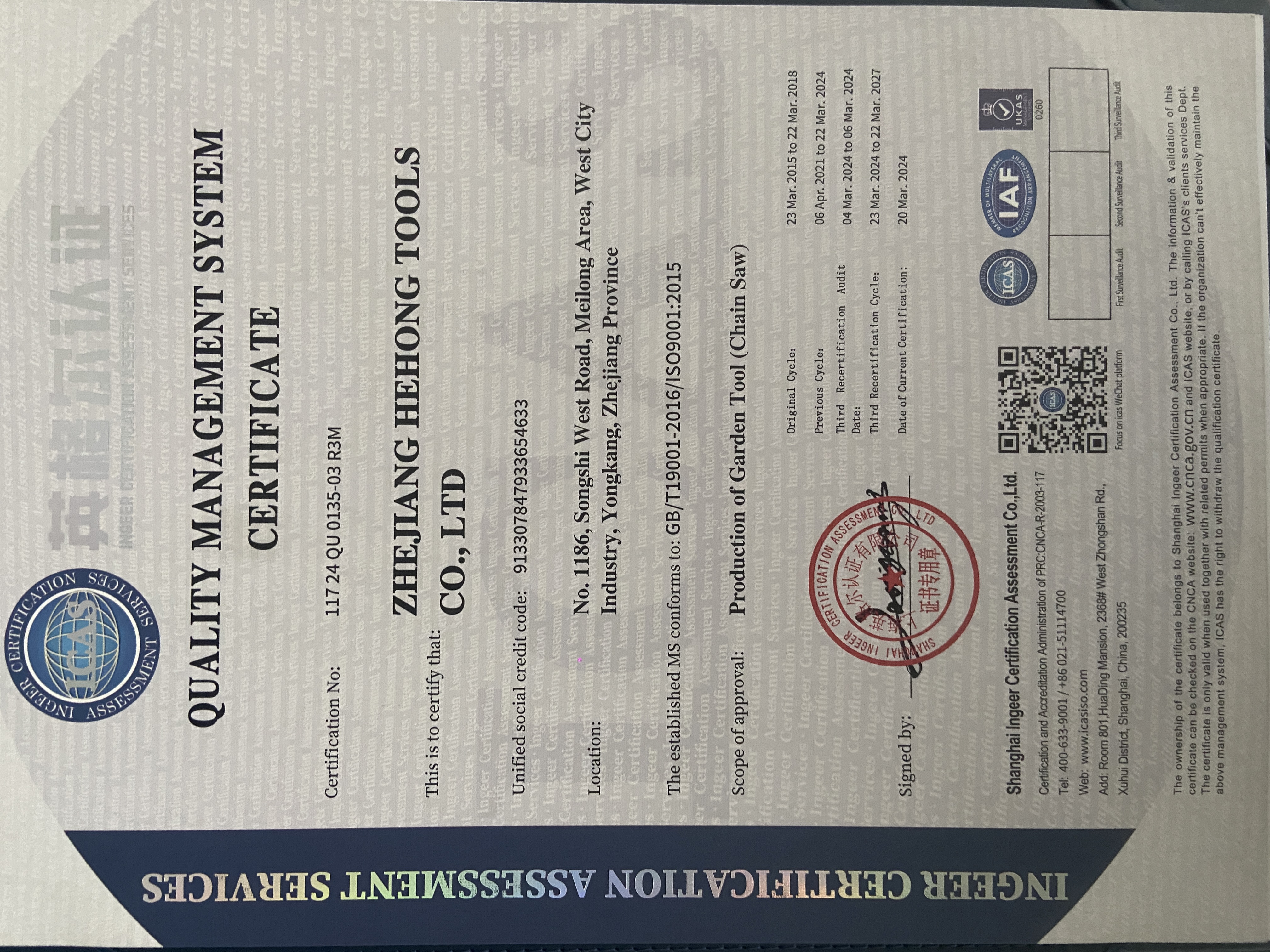
ISO9001 certificate 11724QU 0135-03 R3M, issued by INGEER, valid from 2024-03-20 to 2027-03-22, scope: production of garden tool (chain saw).
Supporting documentation includes ISO9001 quality-system control covering incoming material inspection, in-process patrol inspection, full final testing of finished units and pre-shipment sampling tests. Third-party testing is available, including customer-commissioned inspection such as SGS. The standard referenced on the certificate is GB/T19001-2016/ISO9001:2015. Main units carry a 12-month warranty, supported by spare-parts supply, technical documentation, troubleshooting guidance and optional after-sales technical training for bulk orders. For importers, gasoline chainsaws fall under HTS code 8467.81 — chain saws, self-contained non-electric motor, hand-directed.
Market context behind the class split
Professional gasoline chainsaws remain a large-format category rather than a residual one. Gas-powered units held 54.3% of global chainsaw market share in the 2025/2026 period, according to Mordor Intelligence. Straits Research values the global chainsaw market at USD 4.46 billion in 2026, projecting USD 5.89 billion by 2034. Those totals cover gas, electric and battery products, so the professional gasoline segment should be read as a defined portion of a growing base rather than the whole market.
Two regulatory reference points shape import decisions. ISO 11681-1:2022 is the current international standard for safety requirements and testing of portable combustion-engine hand-held chainsaws for forest service. HTS code 8467.81 governs the customs classification of these products. Both belong in the pre-order checklist alongside the technical specification.
Field evidence from volume buyers
Two documented programmes illustrate how the class split performs in distribution rather than in a single end-user application. An OEM retailer operating in the United States, Canada and Australia has ordered more than 5,000 units annually for stocking in overseas warehouses, Amazon storage and distribution channels over a two-year period. Reported results were stable operation, cost-effective replacement parts and a low complaint rate, supporting the customer brand's reputation in its market.
A private-label wholesaler and brand owner in Russia and Belarus has taken more than 2,000 units annually for two years, distributing to local channels and supplying end users including forest farms, landscaping crews and logging operators. Reported outcomes include a low field failure rate and few end-user complaints, spare parts compatible enough to support after-sales service at downstream channels, and balanced performance in local temperate cold climate conditions. The line now accounts for a growing share of the customer's tool portfolio and generates repeated annual orders.
These cases support conclusions about manufacturing consistency, parts supply and cold-climate behaviour. They do not replace the class-to-job mapping above, because volume programmes distribute a mix of displacement classes across a mixed user base rather than validating one class for one job.
Future outlook
Three pressures are likely to shape professional gasoline chainsaw procurement over the next buying cycles. The first is verification. As safety and emission documentation requirements tighten at import, buyers will increasingly evaluate suppliers on certificate scope, validity window and third-party inspection readiness rather than on unit price alone. The second is parts economics. With gas power holding a majority share of the category and professional fleets ageing in the field, the availability of compatible spare parts will keep influencing supplier selection more than incremental power gains. The third is class discipline. As buyers become more precise about matching displacement class to duty cycle, the practical question shifts from "how many cc" to "which class is listed for this job, and can the platform be serviced in my market."
FAQ
Q1. What displacement class fits commercial forestry and municipal tree clearance?
The 59cc class. The Hanakawa H959 is a 59cc professional gasoline chainsaw rated at 3.4kW and 5.7kg with a maximum engine speed of 11,500rpm, listed for commercial forestry logging, municipal greening, construction clearing and road obstacle removal. It is the lightest professional class covered in this framework.
Q2. Which model is intended for forest thinning and hardwood processing?
The 70.7cc H971 is rated at 4.0kW and 6.1kg with a maximum engine speed of 12,000rpm. Its listed applications are large-scale commercial logging, hardwood processing, engineering demolition and forest thinning, and its parts platform is compatible with the MS440/044 saw.
Q3. What is the difference between the H872 and the H972E, which are both 72cc?
Both are 72cc and both are rated at 3.6kW. The H872 has a net weight of 6.3kg and is listed for traditional small forestry, farm hardwood cutting, orchard trunk pruning and batch firewood processing. The H972E has a net weight of 6.6kg and is listed for commercial intensive forestry logging, hardwood felling, mountain forest operation, construction site clearing, post-disaster emergency rescue, municipal road obstacle removal and large orchard trunk pruning. The decision should follow the application list and operating environment, not the displacement figure.
Q4. Which class is used for large timber felling and old-growth forest logging?
The 91.6cc H992, rated at 5.2kW and 7.7kg with a maximum engine speed of 13,500rpm. Its listed applications include large timber felling, old-growth forest logging, lumber mill work, large disaster rescue and land reclamation. Its power-to-weight ratio of approximately 0.68 kW/kg is the highest in the range, and published supplier data lists guide bar support up to 62 inches on this platform.
Q5. When is a 105.7cc saw the appropriate choice?
When the work is industrial heavy logging, giant tree cutting, log yard primary processing or remote mountain forest exploitation. The H9105 is a 105.7cc unit rated at 4.8kW and 11kg with a maximum engine speed of 11,500rpm. It does not carry the highest published power rating or the highest power-to-weight ratio in the range; its value lies in sustained heavy-load operation where torque delivery and thermal margin matter more than carried weight.
Q6. What should an importer verify before confirming a bulk order?
For this manufacturer, the documented terms are a minimum order quantity of 100 units for in-stock items and 500 units for OEM private-label orders, with sample orders acceptable, and a lead time of 20–45 days at a monthly capacity of 200,000 units. Technical verification should cover model parameters against the unit nameplate, the parts platform and its service reach, chain brake engagement, automatic bar-and-chain oil output, anti-vibration mount condition and idle stability. Documentation should include the ISO9001 certificate with its scope and validity, and importers should confirm the applicable HTS classification of 8467.81.
The Hanakawa V4.1 product catalogue, covering the professional gasoline chainsaw range and compatible spare parts, is available for download: Hanakawa V4.1 Catalogue (PDF).