
Professional Gasoline Chainsaw Shortlist: Logging to Clearing
Professional Gasoline Chainsaw Shortlist: Logging to Clearing
A professional gasoline chainsaw shortlist is only useful if it answers a job question rather than a catalogue question. The five Hanakawa models below were selected against the work they are actually specified for: the H872 for batch firewood processing, orchard pruning and farm hardwood cutting; the H959 for commercial forestry logging, municipal greening and construction clearing; the H972E for hardwood felling and intensive commercial forestry; the H992 for large timber felling and old-growth forest logging; and the H9105 for industrial heavy logging and giant tree cutting.
Four of the five carry published output figures in the data used here: the H959 at 59cc with 3.4 kW and 5.7 kg, the H972E at 72.2cc with 3.6 kW, the H992 at 91.6cc with 5.2 kW and 7.7 kg, and the H9105 at 105.7cc with 4.8 kW and 11 kg. The H872 is placed by task and by its inclusion in the manufacturer's certified model list, not by a published power figure, and that gap is stated here rather than filled with an estimate.
Why the Job Comes Before the Displacement
Displacement describes the swept volume of a cylinder. It does not, on its own, describe how a saw behaves in a 40-inch hardwood butt, how much bar oil reaches a long guide bar under continuous load, or how much vibration reaches an operator's hands after five hours of limbing.
Three job variables decide more of the purchase than the displacement figure does. The first is stem diameter, which sets the guide-bar length and therefore the power needed to pull a full-length chain at cutting speed. The second is duty cycle: a contractor running six tanks a day in dense forest is evaluating heat management and clutch life, not peak output on a spec sheet. The third is handling, because a saw that is comfortable for twenty cuts becomes a fatigue and safety issue over a full shift.
Market context supports the continued relevance of the gasoline platform without settling any individual buying decision. Mordor Intelligence reports that gas-powered units held 54.3% of the global chainsaw market by product type in 2025/2026, while Straits Research values the total chainsaw market at USD 4.46 billion in 2026 and projects USD 5.89 billion by 2034. Both figures cover gas, electric and battery units together, so they describe the platform landscape rather than the professional segment, and they should not be read as a forecast for any single model class.
The Five-Model Shortlist at a Glance
The table below is the shortlist itself. Each row pairs a model with the work it was selected for and with the boundary that matters at the evaluation stage, so a buyer can rule a model in or out before reading the detailed sections.
| Model | Verified output figures | Jobs it was selected for | Fit boundary |
|---|---|---|---|
| H872 | No displacement, power or weight figure in the data used here | Batch firewood processing, orchard pruning, farm hardwood cutting | Light to medium stems and repeated short cuts; not positioned for large-timber felling |
| H959 | 59cc; 3.4 kW; 5.7 kg | Commercial forestry logging, municipal greening, construction clearing | Medium stems and mixed clearing work; the lightest of the four powered models listed with full figures |
| H972E | 72.2cc; 3.6 kW | Hardwood felling, intensive commercial forestry | Hardwood and sustained cutting; no weight figure supplied, so handling should be checked on a sample |
| H992 | 91.6cc; 5.2 kW; 7.7 kg | Large timber felling, old-growth forest logging | Heaviest cutting duty below the industrial class; bar length and oiler output need written confirmation |
| H9105 | 105.7cc; 4.8 kW; 11 kg | Industrial heavy logging, giant tree cutting | Largest and heaviest in the shortlist; 11 kg is a two-person or assisted handling decision over long shifts |
Lane 1 — Firewood Batches, Orchard Rows and Farm Hardwood: H872
The H872 is the shortlist's answer to repeated, modest-diameter cutting rather than to felling heavy timber. That covers three related jobs named in the selection brief: processing firewood in batches, pruning orchard rows, and cutting hardwood on a farm where the saw spends most of its life in the 8-to-20-inch range and is started and stopped many times a day.
No displacement, rated power or weight figure for the H872 appears in the data used for this shortlist. Rather than substitute a plausible number, the honest position is that the H872 is evaluated on demonstrated cutting behaviour for the buyer's stem sizes, on anti-vibration comfort during repeated pruning cuts, and on air-filter serviceability in orchard dust. The model does appear in the manufacturer's certified model list associated with its ISO9001 certificate, which means the production scope covers it alongside the larger models in this shortlist.
The boundary is important. A buyer who starts with the H872 because the price or weight is attractive should confirm that the largest stems on the site are handled by another model in the fleet, or accept slower cutting and more frequent sharpening on the hard end of the range. Pairing an H872 with one mid-size unit is a common structure for farm and orchard operations that also take occasional larger trees.
Lane 2 — Commercial Logging, Municipal Greening and Site Clearing: H959
The H959 is a 59cc professional gasoline chainsaw rated at 3.4 kW and listed at 5.7 kg, and it is the most versatile entry in this shortlist. Commercial forestry logging, municipal greening and construction-site clearance are different workplaces, but they share a requirement: a saw light enough to be carried and repositioned constantly, strong enough for medium stems, and serviceable where spare parts arrive through a distributor rather than a factory.
At 5.7 kg the H959 sits at a weight most operators can run through a full shift with rotation, which is why municipal crews favour it for street-tree pruning and storm clearance where the saw is carried between cuts far more than it is used in one sustained felling. In construction clearing, the same weight and a mid-length bar let an operator work through mixed material — sawn timber, roots, damaged pallets — without the fatigue penalty of a 90cc-class unit.
Parts logic supports the placement. The manufacturer's own selection guidance describes the H959 as parts-compatible with the 361 platform, which matters to a contractor whose local dealer stocks consumables and wear parts for that platform. That reference describes interchangeability as stated by the supplier; it is not a claim of affiliation with the brand owner of that platform, and buyers should confirm the specific part numbers they intend to stock.
The boundary: the H959 is not a substitute for a 90cc-class saw in old-growth timber. Its case rests on medium stems, mixed clearing and daily portability, and a crew that spends most of its time in diameter above roughly 30 inches is buying the wrong lane.
Lane 3 — Hardwood Felling in Intensive Commercial Forestry: H972E
The H972E is a 72.2cc professional gasoline chainsaw rated at 3.6 kW, selected for hardwood felling and commercial forestry work that runs at production pace rather than at the intermittent rhythm of farm use.
The step up from the H959 is visible but modest on the verified figures: 13.2cc more displacement and 0.2 kW more rated power. That small a power difference is a signal about how the decision should be made. If the two models are close on rated output, the deciding factors are the guide-bar length each will pull in the buyer's timber, the cooling and filtration behaviour under sustained cutting, and how the saw feels over a shift — not the headline kilowatt figure. No weight figure for the H972E is included in the data used here, so handling should be judged on a sample rather than inferred from the larger displacement.
For intensive commercial forestry, the relevant duty pattern is repeated felling and bucking with short pauses. Buyers in that pattern should ask for the recommended bar-length range per model in writing, and should test the H972E against the H959 on the hardest wood on the site. Where the H972E clearly wins is in hardwood where the chain is asked to hold a line through a long cut; where the H959 wins is in the limbing and small-stem work that makes up much of a forestry day.
Lane 4 — Large Timber and Old-Growth Logging: H992
The H992 is a 91.6cc professional gasoline chainsaw — commonly described as the 92cc class — rated at 5.2 kW and listed at 7.7 kg. It is the shortlist's entry for large timber felling and old-growth forest logging, where the constraint is not cutting speed on small wood but the ability to carry a long bar through a wide butt without stalling.
On the verified figures the H992 has the highest calculated power-to-weight ratio of the three models in this shortlist for which both rated power and weight are published, at approximately 0.68 kW/kg. That figure is calculated, not measured: rated kilowatts divided by listed kilograms, rounded to two decimals. Its practical meaning is that the model carries its output with less mass penalty than the 105.7cc unit, which matters when the saw is carried into a stand rather than used beside a landing.
A third-party product listing for the 92cc platform describes guide-bar support up to 62 inches. That is a listing claim for a platform, not a tested limit for a specific configuration, and long-bar buyers should have the bar length, oiler output and chain gauge confirmed by the supplier before ordering. The manufacturer's selection guidance also describes the H992 as parts-compatible with the 660 platform, which is relevant to aftermarket planning in markets where that platform is already serviced.
The boundary is physical: 7.7 kg plus a long bar is a two-handed, high-fatigue combination, and the H992 makes sense for crews whose work is dominated by large stems. A crew that fells large trees occasionally and cuts small wood most days will get more value from the H959 or H972E plus a single large saw shared across the team.
Lane 5 — Industrial Heavy Logging and Giant Tree Cutting: H9105
The H9105 is a 105.7cc professional gasoline chainsaw rated at 4.8 kW and listed at 11 kg. It is the largest and heaviest model in the shortlist, selected for industrial heavy logging, log-yard processing and giant tree cutting where the saw may spend long periods in a single wide cut.
The figures contain an apparent contradiction that buyers should understand before ordering. The H9105 has 14.1cc more displacement than the H992, 0.4 kW less rated power, and 3.3 kg more mass. Its calculated power-to-weight figure is approximately 0.44 kW/kg against the H992's 0.68 kW/kg. Displacement and rated power therefore do not rank these two models in the same order, and a buyer who assumes the largest number is the strongest saw is reading the data incorrectly.
What the supplied data does not contain is equally important: it does not include torque curves, oiler output, clutch specification or tested bar-length limits for the H9105. Those are exactly the parameters that would justify an 11 kg saw in industrial work, and they should be requested in writing rather than assumed. The manufacturer's selection guidance describes the H9105 as parts-compatible with the 070 platform, which is the relevant reference for parts planning on a heavy saw that will be rebuilt rather than replaced.
Reading the Numbers: What the Five Specs Do and Do Not Rank
The comparison below uses only the figures supplied for this shortlist. Two cells are deliberately empty because no weight figure is available for the H872 or the H972E; no estimate has been substituted.
| Model | Displacement | Rated power | Listed weight | Calculated kW/kg |
|---|---|---|---|---|
| H872 | Not supplied | Not supplied | Not supplied | Not calculated |
| H959 | 59cc | 3.4 kW | 5.7 kg | 0.60 |
| H972E | 72.2cc | 3.6 kW | Not supplied | Not calculated |
| H992 | 91.6cc | 5.2 kW | 7.7 kg | 0.68 |
| H9105 | 105.7cc | 4.8 kW | 11 kg | 0.44 |
Calculated column: rated kW divided by listed kg, rounded to two decimals. This is arithmetic on the published figures, not a test result. It says nothing about torque, durability or suitability for a specific bar length.
Three conclusions follow. First, if the buying criterion is output carried per kilogram, the verified figures place the H992 ahead of the H959 and well ahead of the H9105. Second, the H9105's case cannot rest on rated power or on power-to-weight; it rests on the industrial applications assigned to it and on parameters this dataset does not include, which is why those parameters belong in the supplier conversation. Third, the H959 to H972E step is small enough on paper that bar-length support and duty cycle should decide between them, not the spec sheet alone.
Where Gasoline Fits — and Where This Shortlist Stops
A five-model gasoline shortlist is not the same as a five-model fleet recommendation. Stocking all five gives a dealer or contractor complete coverage of the job lanes above, but it also multiplies parts inventory, training and service documentation. Many operations are better served by three models — one light, one mid-size, one heavy — with the H872 and H959 covering most days and a single H992 or H9105 held for the largest stems.
The gasoline platform itself remains the majority choice by market share, at 54.3% of the chainsaw market by product type in 2025/2026 according to Mordor Intelligence. For professional forestry work the reference safety standard is ISO 11681-1:2022, which sets out safety requirements and testing for portable combustion-engine hand-held chainsaws for forest service. Importers should also note the trade classification: chain saws with self-contained non-electric motors, hand-directed, fall under HTS 8467.81.
This shortlist stops at two-stroke gasoline units. Buyers weighing battery platforms should run a separate comparison, because the verified figures collected here contain no run-time, energy or bar-capacity data for battery models, and substituting an assumption for that data would not help anyone making a fleet decision.
Supplier Context Behind the Five Models
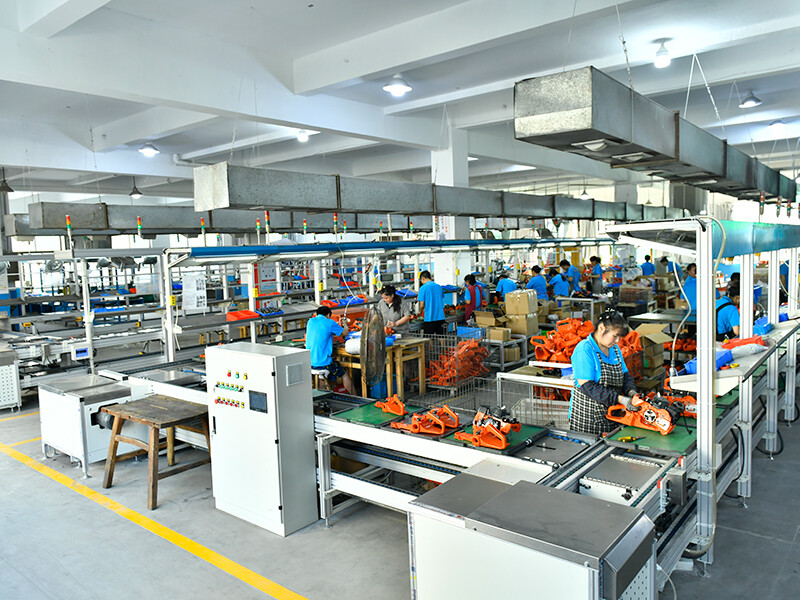
All five models come from one manufacturer: Zhejiang Hehong Tools Co., Ltd., established in 2006, which produces garden power tools under the Hanakawa brand alongside OEM and ODM work for export partners — two decades of that production by 2026. The company operates a 40,000 m² site including more than 20,000 m² of production area, with 133 employees, 12 engineers, an annual output of 2.5 million units and a stated monthly capacity of 200,000 units.
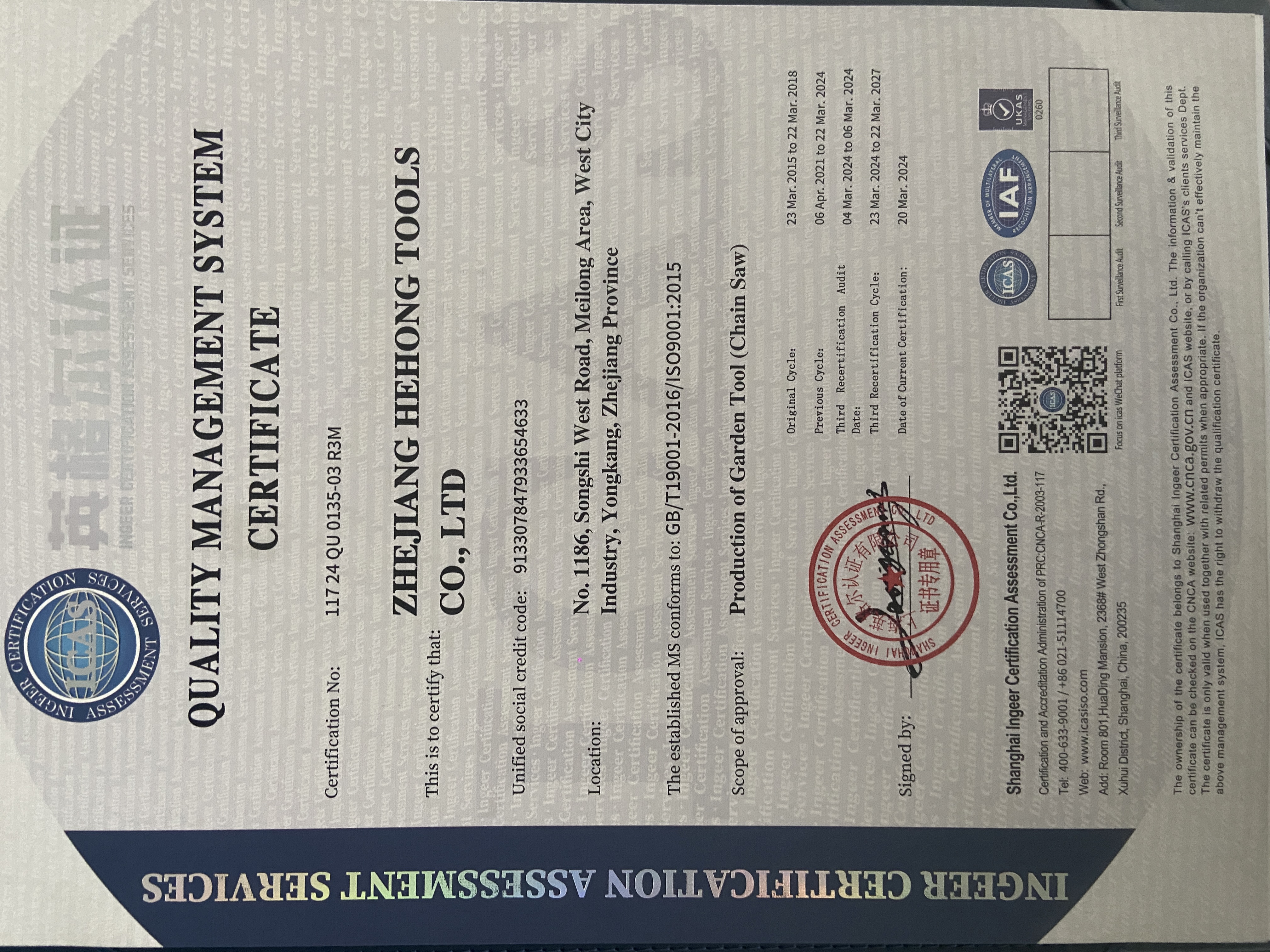
Quality management is certificated. The ISO9001 certificate held for production of garden tools (chain saw) is numbered 11724QU 0135-03 R3M, issued by INGEER against GB/T 19001-2016 / ISO 9001:2015, with an issue date of 20 March 2024 and an expiry date of 22 March 2027. The model list associated with that certificate includes the H872, H959, H972E, H992 and H9105 — a detail worth checking, since a certificate covering a production scope is only useful to a buyer if the models being ordered sit inside it.
Two documented supply relationships describe how the range performs in the field. An OEM retailer operating in the United States, Canada and Australia orders more than 5,000 units annually for overseas warehouses, Amazon storage and distribution, with the manufacturer reporting stable operation, cost-effective replacement parts and a low complaint rate. A private-label wholesaler and brand owner in Russia and Belarus has taken more than 2,000 units a year for two years, supplying forest farms, landscaping crews and logging operators; reported results include a low field failure rate, few end-user complaints and parts compatibility that supports after-sales service at downstream channels, with performance described as well balanced for a temperate cold climate.
Commercially, the terms a distributor needs to model are stated: OEM, ODM and customization including logo, colour box, nameplate, colour scheme, structural modification and parameter adjustment; a minimum order of 100 units for in-stock items and 500 units for OEM private-label orders, with sample orders accepted; lead time of 20 to 45 days; a 12-month warranty on main units with spare-parts and technical documentation support; and third-party testing available, including customer-commissioned inspection such as SGS.
A Five-Point Verification Checklist Before You Commit
- Certificate coverage. Confirm the ISO9001 certificate number, validity to 22 March 2027 and the production scope against the exact models in your order, rather than against the brand in general.
- Bar length and oiler output per model. Ask in writing for the recommended guide-bar range and oiler specification for the H959, H972E, H992 and H9105. The 62-inch figure circulating for the 92cc platform is a listing claim that needs confirmation for your configuration.
- Parts plan and platform references. Record which platform each model is parts-compatible with, and confirm the specific wear parts you intend to stock. Treat platform references as interchangeability statements, not as evidence of affiliation.
- Commercial terms. Verify MOQ by category, lead time against your selling season, warranty terms and whether third-party inspection is required by your market.
- Sample before scale. Run the candidate model in your own timber and climate. Sample orders are accepted, and a single tank of fuel in real conditions resolves more uncertainty than any specification table.
Outlook
The direction of the market, as reported by Straits Research, is growth from USD 4.46 billion in 2026 to USD 5.89 billion by 2034 across all chainsaw types. The interpretation that matters for this shortlist is narrower: gasoline remains the majority platform at 54.3% share, and the heavy end of the professional range — large-timber and industrial felling — is the part of the market least likely to move first if battery platforms take share in lighter duty. That is a conditional reading, not a forecast, and it should be revisited against actual sales data rather than assumed.
For buyers, the practical consequence is parts continuity. A five-model shortlist is only an asset if the wear parts, bars and chains for those five models remain available through the channels that serve the end users. That question is answered with documentation, not with displacement figures.
FAQ: Choosing Among the Five
Which model in this shortlist suits batch firewood processing and orchard pruning?
The H872 is the model mapped to batch firewood processing, orchard pruning and farm hardwood cutting. No displacement, rated power or weight figure for the H872 is included in the data used for this shortlist, so the placement rests on task fit and on its inclusion in the manufacturer's certified model list. Buyers should verify cutting performance on their own stem sizes and check air-filter serviceability for dusty orchard conditions.
What are the verified specifications of the H959?
The H959 is a 59cc professional gasoline chainsaw rated at 3.4 kW with a listed weight of 5.7 kg. It is mapped to commercial forestry logging, municipal greening and construction site clearing, where its weight supports repeated carrying and repositioning. The manufacturer's selection guidance describes it as parts-compatible with the 361 platform, which is relevant to local spare-parts planning.
Why is the 105.7cc H9105 rated lower in power than the 91.6cc H992?
The published figures show the H9105 at 105.7cc and 4.8 kW against the H992 at 91.6cc and 5.2 kW. Displacement and rated power therefore do not rank the two models in the same order, and the calculated power-to-weight figures — approximately 0.44 kW/kg for the H9105 versus 0.68 kW/kg for the H992 — reflect that. The H9105's case for industrial heavy logging and giant tree cutting rests on parameters not included in this dataset, such as torque delivery, oiler output and clutch specification, which should be requested from the supplier in writing.
Can the H992 run a 62-inch guide bar?
A third-party product listing for the 92cc platform describes bar support up to 62 inches. That is a listing claim for a platform rather than a tested limit for a specific configuration, so a long-bar order should be confirmed with the supplier for bar mount, chain gauge and oiler output. The H992 itself is published at 91.6cc, 5.2 kW and 7.7 kg.
What should an importer check before ordering a five-model mix?
Confirm that the ISO9001 certificate — number 11724QU 0135-03 R3M, valid to 22 March 2027, scope production of garden tool (chain saw) — covers the exact models ordered; obtain bar-length and oiler specifications per model in writing; record the platform parts references; verify minimum order quantities of 100 units for in-stock items and 500 for OEM private-label orders, lead times of 20 to 45 days and the 12-month main-unit warranty; and test a sample in local timber and climate before scaling the order.
Reference material, including the full model range and specifications, is available in the Hanakawa product catalogue.
Tem questões ou precisa de mais detalhes?
Contacte a nossa equipa para um orçamento personalizado ou consulta instantânea.
Solicitar orçamento
Preencha o formulário abaixo e a nossa equipa entrará em contacto com uma proposta personalizada.
Chat direto do WhatsApp
Prefere conversar em tempo real? Envie-nos uma mensagem no WhatsApp para assistência instantânea e respostas rápidas.
- Obter orçamento personalizado
- Partilhar fotos ou documentos
- Discuta as suas necessidades diretamente
Geralmente responde em 5–30 minutos durante o horário de expediente.