
Promotional Bag Shortlist: Model Picks by Program Type
A promotional bag shortlist is a constraint document before it is a design document. The useful question for a cosmetic, gym, beach, cooler or tote program is not which bag photographs best, but which model can actually be produced in the requested material, decorated with the requested logo method, and covered by the certificate a buyer's compliance team will ask for at evaluation stage.
This shortlist compares nine catalogue models — 1812, 4530, 23250, 4700, FDV010, 3800, 4211, T25210 and 4636 — using the material, printing, size and certification records attached to each. Yulite, formally Henan Yulitepromotion Co., Ltd., is a promotional bag manufacturer founded in 2008 that exports custom logo bags at a 100% export ratio, with main markets in the EU, USA, Japan and Australia. The models below are drawn from that manufacturer's published product records; the constraints described are the ones a buyer can verify before placing an order.
Why model-level shortlists outperform category-level briefs
Most sourcing problems in promotional bags appear after artwork approval, not before it. A brief that says "cotton tote, one-colour logo" leaves three decisions unresolved: which cotton (conventional, recycled or organic), which printing method, and which certificate backs the claim. Each of those decisions changes the production route, the sample cycle and the compliance file.
A model-level shortlist closes that gap because every constraint is attached to a part number. Model 4636, for example, is specified as a cotton canvas shopping bag with a cotton weight range of 100 gsm to 450 gsm and four logo methods — silk printing, transfer printing, digital printing and embroidery. Model 4211, the drawstring bag, is specified at 100 gsm to 280 gsm with the same four methods. The two weight bands do not overlap in the practical sense: the same artwork behaves differently on a 120 gsm drawstring body and on a 400 gsm canvas shopping bag.
The operational layer is equally concrete. Yulite's capability record lists OEM/ODM production, customization across logo, colour, material, size, label and packing, a monthly capacity of 200,000 pcs, a 30-day lead time and a 500 pcs minimum order quantity, with internal inspection, pre-shipment inspection and third-party inspection available as quality-control routes. For a buyer in the research-to-evaluation stage, those figures define whether a shortlisted model is even orderable at the planned volume.
The nine models at a glance
The table below reproduces only what the product records state. Where a field is absent from the record, it is marked as not specified rather than inferred.
| Model | Product type | Material options (per record) | Logo methods (per record) | Sizes / colour |
|---|---|---|---|---|
| 1812 | Cosmetic bag; make-up pouch, zipper cosmetic pouch, drawstring cosmetic bag | 100% cotton, recycled cotton, organic cotton, felt, polyester, padded fabric | Silk printing, transfer printing, digital printing, embroidery | Small / Medium / Large; natural or any dyed colour |
| 4530 | Gym bag; waterproof gym bag, gym duffel bag | Cotton, polyester, nylon | Silk printing, transfer printing, digital printing, embroidery | Small / Medium / Large; natural or any dyed colour |
| 23250 | COOLR bag; picnic cooler, thermal bag, insulated cooler, 6-can cooler, lunch cooler | Polyester + 2 mm foam + aluminium; material list also cites polyester, non-woven, felt | Not specified in the product record | Not specified; zipper closure, shoulder strap |
| 4700 | Beach bag; canvas, polyester, felt or nylon beach bag | 100% cotton, recycled cotton, organic cotton, polyester, mesh, nylon, felt | Silk printing, transfer printing, digital printing, embroidery | Small / Medium / Large; natural or any dyed colour |
| FDV010 | Foldable bag; collapsed bag, folding bag, folded bag | 100% cotton, recycled cotton, organic cotton, polyester, nylon, non-woven | Silk printing, transfer printing, digital printing, embroidery | Small / Medium / Large; natural or any dyed colour |
| 3800 | Tote bag; cotton tote, canvas tote, oversized tote, big-capacity tote | 100% cotton, recycled cotton, organic cotton | Silk printing, transfer printing, digital printing, embroidery | Small / Medium / Large; natural or any dyed colour |
| 4211 | Drawstring bag; drawstring gift bag, drawstring gift pouch, drawstring backpack | 100% cotton, recycled cotton, organic cotton, polyester, non-woven, nylon | Silk printing, transfer printing, digital printing, embroidery | 100–280 gsm; Small / Medium / Large; natural or any dyed colour |
| T25210 | Knitted bag; knitted tote, hand bag, shoulder bag, cosmetic bag, tissue bag | Polyester | Logo can be woven into the bag | Yarn colour: maximum 6 colours; MOQ 500 pcs |
| 4636 | Promotional shopping bag; cotton canvas shopping bag | 100% cotton (100–450 gsm), organic cotton, recycled cotton | Silk printing, transfer printing, digital printing, embroidery | Natural or any dyed colour |
Model notes by program type
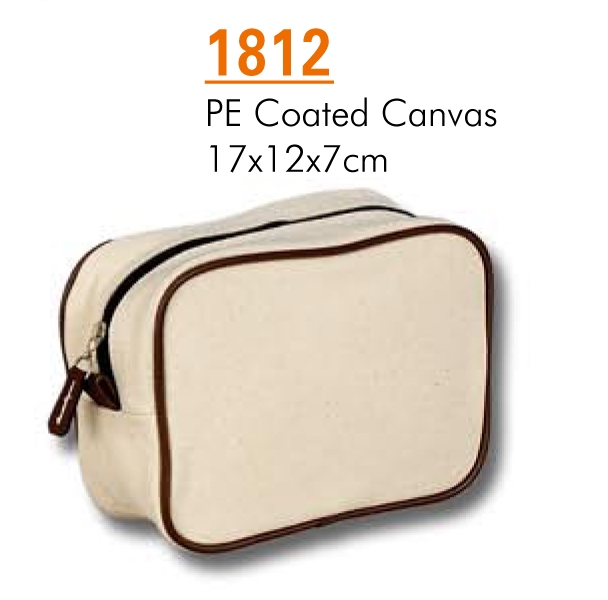
Model 1812 cosmetic bag — available in cotton, recycled and organic cotton, felt, polyester or padded fabric, with four listed logo methods.
Cosmetic and gift-with-purchase programs: 1812
Model 1812 is the only model in this set whose record explicitly lists padded fabric alongside the standard cotton, recycled cotton, organic cotton, felt and polyester options. That matters for cosmetic programs because a pouch that must hold glass or rigid containers usually needs structure; a pouch built as a flat printed panel does not. The model is also listed as a zipper cosmetic pouch and a drawstring cosmetic bag, so the closure format is part of the specification conversation rather than an afterthought.
Decoration is the constraint to resolve early. The 1812 record supports silk printing, transfer printing, digital printing and embroidery across small, medium and large sizes in natural or dyed colour. On a small pouch face, a multi-colour transfer print and an embroidered mark are not interchangeable — the buyer is choosing a visual result and a production route at the same time.
Sports and fitness programs: 4530
Model 4530 is classified in the record as a waterproof gym bag and gym duffel bag, with cotton, polyester and nylon all listed as material options, in small, medium and large sizes, natural or any dyed colour, and the same four logo methods. Its stated applicable industry is sports.
The verification point here is precise: the record classifies the model as waterproof but does not state a waterproof rating, coating specification or seam-sealing method. A buyer who needs a performance claim on pack copy should ask for the test basis rather than transferring the word "waterproof" onto retail packaging without support. Where the program is a gym giveaway rather than a performance product, the classification is sufficient and the material choice becomes the main lever — cotton for a softer hand-feel, polyester or nylon for the synthetic option.
Picnic and food-adjacent programs: 23250
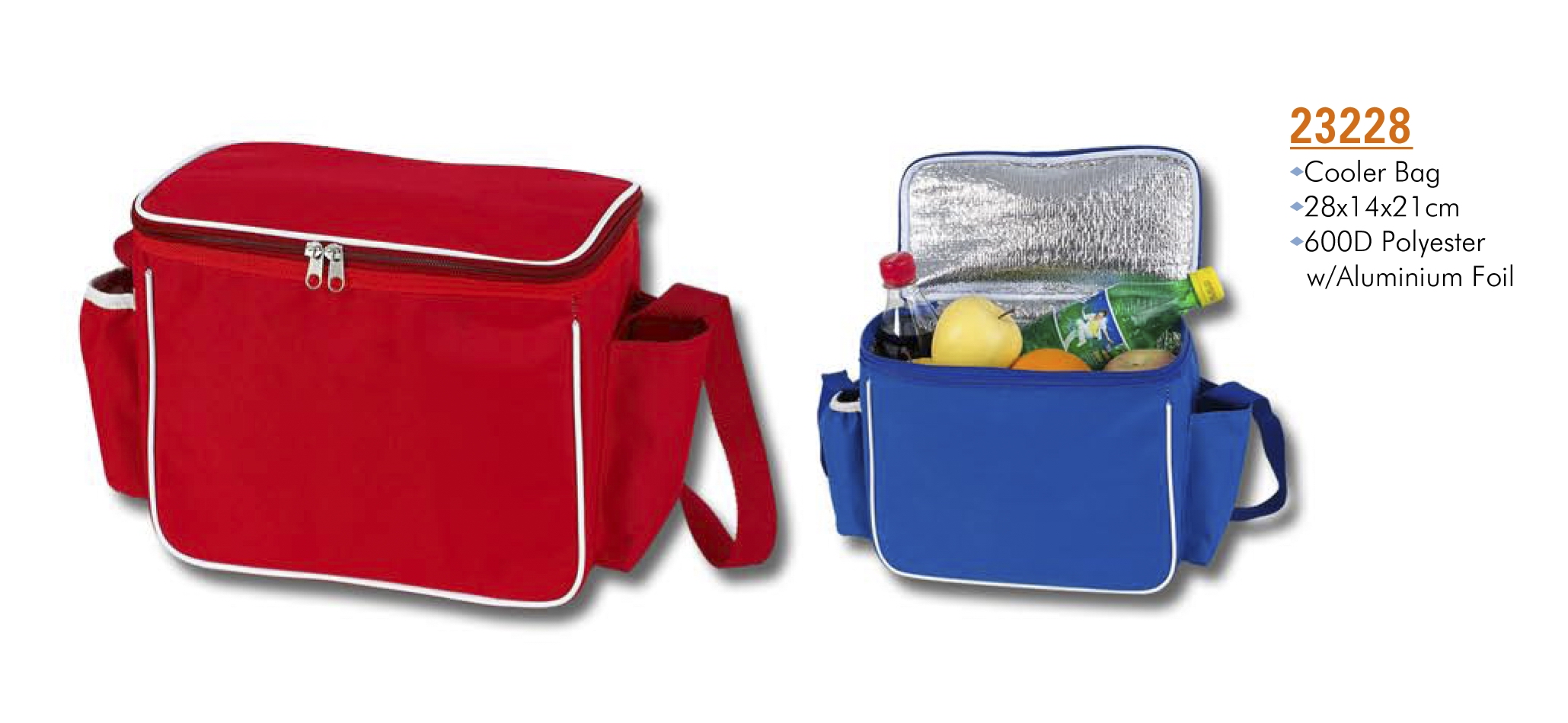
The COOLR bag 23250 is specified as polyester with 2 mm foam and aluminium, zipper closure and shoulder strap.
The COOLR bag 23250 is the only model here with a stated insulation build: polyester shell, 2 mm foam, aluminium layer, zipper closure and a shoulder strap for carrying. Its record also lists polyester, non-woven and felt in the material field, and names food and supermarket as the applicable industries — a positioning that fits picnic, lunch and grocery-adjacent promotions rather than general brand giveaways.
That stated build is also the boundary. A 2 mm foam and aluminium construction is a soft-sided insulated format; the record gives no ice-retention time, no capacity figure and no logo method. Buyers evaluating this model for a chilled-food campaign should therefore treat decoration as an open item to confirm with the supplier, and should not assume a hard-cooler performance level from the classification alone.
Beach and travel programs: 4700
Model 4700 carries the widest material list in the set: 100% cotton, recycled cotton, organic cotton, polyester, mesh, nylon and felt, all under a beach bag classification that includes canvas, polyester, felt and nylon variants. Sizes run small, medium and large, colour is natural or any dyed colour, and all four logo methods are listed.
Material choice drives the print result here more than on any other model. A mesh or felt body and a tight cotton canvas body accept the same nominal method but not the same artwork; buyers shortlisting 4700 for a beach or travel promotion should fix the material before approving a print proof, not after.
Retail and supermarket programs: 4636 and 3800
Model 4636 is the cotton canvas shopping bag, specified at 100 gsm to 450 gsm in 100% cotton with organic and recycled cotton versions available, natural or any dyed colour, and four logo methods. Model 3800 is the tote bag — cotton tote, canvas tote, oversized tote and big-capacity tote in the same three cotton families, small to large, with the same four methods. The difference in practice is weight control: 4636 publishes a weight band, which lets a buyer specify a lighter body for high-volume retail giveaways or a heavier body for reuse-driven programs.
Both models sit inside the manufacturer's certification coverage, which is the part retail buyers usually check first (see the certification section below).
Event and giveaway programs: FDV010, 4211 and T25210
The foldable bag FDV010 is specified as a collapsible, folding or folded bag in 100% cotton, recycled cotton, organic cotton, polyester, nylon or non-woven, small to large, with the four standard logo methods. Foldability is a logistics property as much as a product feature: a folded bag changes carton volume and handout logistics, which is why it recurs in exhibition and conference programs.
The drawstring bag 4211 is the volume giveaway in this set, with a published 100–280 gsm weight band and options across cotton, recycled cotton, organic cotton, polyester, non-woven and nylon. The weight band is the constraint buyers most often skip: a 100 gsm body and a 280 gsm body carry the same model number but not the same print resolution or handle feel.
The knitted bag T25210 works differently from every other model here. It is polyester, the logo is woven into the bag rather than printed onto it, yarn colour is capped at six colours, and the minimum order quantity is stated at 500 pcs. A woven logo is a design decision made at the yarn stage, not an artwork file applied at the end — which makes approval cycles longer and colour matching stricter, in exchange for a texture that printed bags cannot reproduce.
Printing methods: what each one constrains
Four decoration methods appear across the model records: silk printing, transfer printing, digital printing and embroidery. T25210 adds a fifth route — a woven logo — that is not a printing method at all.
- Silk printing. A stencil-based ink process listed across the cotton, polyester and nylon models. The product records name the method but do not specify ink types, colour counts or maximum print area, so those remain order-level questions.
- Transfer printing. Listed on the same models as silk printing; typically chosen where artwork carries gradients or fine detail. The records do not state a transfer size limit per model.
- Digital printing. Listed as an available method on the 1812 cosmetic bag, the 4530 gym bag, the 4700 beach bag, FDV010, 3800, 4211 and 4636. It is the method most often associated with short runs and multi-colour artwork, though the records do not publish run-length thresholds.
- Embroidery. Listed on the same seven models. It produces a raised mark rather than a flat print, which is a brand-positioning choice as much as a technical one.
- Woven logo (T25210 only). Limited to a maximum of six yarn colours and priced by the 500 pcs minimum.
The practical rule across all nine models is that method availability is broader than method suitability. On a heavy canvas shopping bag such as 4636, a large silk print and a small embroidered mark are both listed as available; only one of them will suit a given brand system.
Materials, weights and what the numbers actually cover
Three cotton families appear across the records — 100% cotton, recycled cotton and organic cotton — and they are not interchangeable in a compliance file. Recycled cotton relates to the Global Recycled Standard, organic cotton to the Global Organic Textile Standard, and each claim depends on the certificate covering the specific model.
Published weight bands exist for three models: 4636 at 100–450 gsm, 4211 at 100–280 gsm, and T25210 by yarn colour count rather than fabric weight. For the remaining models, weight is not published in the record, which means a buyer specifying "mid-weight cotton" is leaving the actual figure to the supplier. That is a normal sourcing situation, but it should be closed before the purchase order, because weight drives both hand-feel and carton economics.
Synthetic and specialist options are narrower than they first appear. The 3800 tote is cotton-only across its three cotton families. The 23250 cooler is polyester-led. The T25210 knitted bag is polyester only. Felt appears on 1812, 4700, the wider custom logo bag record and the 23250 material list, but not on 3800, 4211 or 4636.
Certification coverage, model by model
Three certificates are attached to the product records. The table summarises what each one states, so a buyer can see which model carries which claim before requesting documents.
| Certificate | Number | Issued by | Standard | Validity stated | Models listed |
|---|---|---|---|---|---|
| GOTS (organic textiles) | GOTS-31172 | INTERTEK | Global Organic Textile Standard v7.0 | 2026-04-02 to 2027-04-02 | 3800, 4636, 4211, 1812, 4700, PP246 |
| SMETA / SEDEX 4P | ZAA600189756 | BCI Compliance Group Limited | SEDEX 4P, scope: all textile products | 2026-03-10 to 2027-03-10 | All nine models in this shortlist |
| GRS (recycled content) | ITS-TE-00006853-GRS-03902700 | Intertek | Global Recycled Standard 4.0 | 2026-05-01 to 2027-04-30 | All nine models in this shortlist |
Two details are worth flagging for buyers who are building a compliance file. First, the GOTS certificate scope is stated in product categories — carried accessories, worn accessories, children's apparel and trading — rather than by model number, so a buyer claiming organic cotton on a specific pouch should confirm the model sits inside the certified scope. Second, the SMETA and GRS records list all nine models, which makes them the two certificates that can be cited across an entire multi-model program rather than one bag at a time.
Certificate expiry dates are also part of the evaluation. All three run into 2027 on the current records, but a program shipping in late 2027 or 2028 needs the renewal confirmed at the time of the order, not at the time of the shortlist.
Regulatory context for EU and US programs
Certification is voluntary market signalling; regulation is not. Two EU instruments affect promotional bags directly. Bags sold in the EU must comply with REACH Regulation Annex XVII, which restricts azocolourants to 30 mg/kg in textiles. Separately, textile products containing at least 80% textile fibres must comply with Regulation (EU) No 1007/2011 on fibre labelling. For a cotton tote or drawstring bag sold as a textile item rather than a pure giveaway, that labelling rule shapes the care and composition label, not just the bag.
In the United States, California SB 1046 bans non-compostable single-use plastic carry-out bags from January 2025, which has pushed retail programs toward reusable textile and non-woven substitutes. That shift is one reason material questions arrive earlier in the buying process than they did a few years ago: a bag chosen for a regulated retail channel has to satisfy the rule, not only the marketing brief.
Matching models to program types
| Program type | First pick | Alternative | Constraint to close before PO |
|---|---|---|---|
| Cosmetic / gift-with-purchase | 1812 | 4211 small, T25210 cosmetic | Padded versus flat construction; print method versus small print area |
| Sports / fitness | 4530 | 4211 drawstring backpack | Material choice (cotton versus polyester/nylon); the waterproof classification is not a published rating |
| Picnic / food | 23250 | 3800 or 4636 as a carrier bag | Decoration route for 23250 is not stated in the record; no capacity or ice-retention figure published |
| Beach / travel | 4700 | 3800 oversized tote | Mesh and felt options versus cotton for print suitability |
| Retail / supermarket | 4636 | 3800 | Fabric weight within the 100–450 gsm band; fibre labelling rules if sold as a textile |
| Events / giveaways | FDV010 | 4211 | Folded volume, packing format and weight band (4211 at 100–280 gsm) |
Where this shortlist stops: limits and trade-offs
A model shortlist is only useful if its boundaries are stated. Four apply here.
Price bands are not published. The product records describe materials, printing methods, sizes, colours, MOQ and lead time, but not unit pricing. Since cost in this category is driven by fabric weight, decoration method, packing format and volume, a buyer comparing models on price has to obtain quotations rather than read a table.
Durability is not quantified. No load capacity, tear strength or colourfastness result is published for these models. What the manufacturer does document is the inspection route: internal inspection, pre-shipment inspection and third-party inspection. In practice that means durability is verified through sampling and inspection rather than through a published test number.
Two records carry specification gaps. The 23250 cooler bag does not state a logo method, and the T25210 knitted bag is limited to six yarn colours with a locked 500 pcs minimum. Neither is a defect; both are constraints that must be resolved before artwork approval rather than after.
Single-material models are less flexible. The 3800 tote is cotton-only and the T25210 is polyester-only, so a program that later shifts toward a synthetic or recycled-PET brief cannot simply re-specify the same part number.
Compared with the traditional alternative — a single stock bag, one print method, one material, ordered on price — a model-based shortlist costs more time at the evaluation stage and less time at the production stage. The traditional route is faster to quote and slower to correct when the certificate, the weight or the decoration method turns out not to match the brief.
Market signals behind the shortlist
Several published indicators explain why buyers are comparing models rather than categories. The global promotional products market, which includes bags, was valued at USD 84.4 billion in 2025 with a 3.8% CAGR, according to Metastat Insights. Corporate adoption of custom-branded tote bags as promotional merchandise rose 32% year over year in 2024, per Intel Market Research. Canvas remains the largest material segment in the tote bag market, with jute the fastest-growing, according to Market Research Future.
Demand timing is also concentrated. Seasonal promotional campaigns accounted for 39% of total reusable shopping bag demand in 2025, according to Business Research Insights — a figure that explains why 30-day lead times and 500 pcs minimums matter more in this category than in slower-moving merchandise. On the material side, the recycled PET market was estimated at USD 19.5 billion in 2025 (Custom Market Insights), which underpins the availability of recycled-content options that sit behind the GRS certificate in this shortlist.
Category attention is measurable too: tote bags were the fifth most-searched category on the Advertising Specialty Institute platform in 2024. For buyers, that ranking is less about popularity than about supply — a heavily searched category has deep supplier choice, which raises the value of verifiable model-level specifications.
What to watch next
Two movements are likely to shape shortlists over the next buying cycles. The first is documentation depth: as recycled and organic claims become routine in promotional briefs, the differentiator shifts from claiming a material to showing which certificate covers which model and until when. The second is regulated retail demand. With single-use plastic restrictions tightening in markets such as California, reusable textile bags move from marketing item to compliance item, and the questions asked at evaluation change accordingly.
For manufacturers, the implication is that published weight bands, certificate numbers and stated decoration methods become commercial assets rather than catalogue details. For buyers, the implication is simpler: the shortlist that wins is the one where every claim on the bag can be traced to a document.
FAQ
Which models in this shortlist can be made from organic or recycled cotton, and which certificate covers them?
Organic cotton and recycled cotton are listed as material options on 1812, 4700, FDV010, 3800, 4211 and 4636. GOTS certificate GOTS-31172, issued by INTERTEK under Global Organic Textile Standard v7.0 and valid to 2027-04-02, lists models 3800, 4636, 4211, 1812 and 4700. GRS certificate ITS-TE-00006853-GRS-03902700, issued by Intertek under GRS 4.0 and valid to 2027-04-30, lists all nine models in this shortlist, including 4530, 23250 and T25210.
What logo methods are available across these models?
Seven models — 1812, 4530, 4700, FDV010, 3800, 4211 and 4636 — list silk printing, transfer printing, digital printing and embroidery. The knitted bag T25210 uses a logo woven into the bag rather than printed onto it, with a maximum of six yarn colours. The 23250 cooler bag record does not state a logo method, so decoration for that model has to be confirmed separately.
What fabric weights are published for the cotton models?
Model 4636, the cotton canvas shopping bag, is specified at a cotton weight of 100 gsm to 450 gsm. Model 4211, the drawstring bag, is specified at 100 gsm to 280 gsm. Models 3800, 4700, 1812, FDV010 and PP246 do not publish a fabric weight in the available records, so weight must be specified and confirmed at order level.
What are the minimum order quantity and lead time?
The manufacturer's capability record states a 500 pcs minimum order quantity and a 30-day lead time, with a monthly capacity of 200,000 pcs and OEM/ODM production. The knitted bag T25210 also carries a stated MOQ of 500 pcs. Lead time is quoted as a production figure and does not include sampling; an independent sampling room and dedicated sample workers are listed, with samples delivered within 3 days.
What does the SMETA certificate cover for these bags?
SMETA certificate ZAA600189756 is issued by BCI Compliance Group Limited under the SEDEX 4P standard, with an all-textile-products scope, and is valid from 2026-03-10 to 2027-03-10. Its product records list all nine models in this shortlist, which makes it the single audit document that can be cited across a multi-model promotional bag program rather than model by model.
Which model suits a picnic or chilled-food promotion?
Model 23250, the COOLR bag, is classified as a picnic cooler bag, thermal bag, insulated cooler, 6-can cooler and lunch cooler, built from polyester with 2 mm foam and aluminium, with zipper closure and a shoulder strap. Its stated applicable industries are food and supermarket. The record does not publish a capacity figure or an ice-retention time, so performance should be validated against the intended use before committing to a program.
A full 2026 programme reference, including the range overview, is available in the downloadable Yulite spring brochure.
Tem questões ou precisa de mais detalhes?
Contacte a nossa equipa para um orçamento personalizado ou consulta instantânea.
Solicitar orçamento
Preencha o formulário abaixo e a nossa equipa entrará em contacto com uma proposta personalizada.
Chat direto do WhatsApp
Prefere conversar em tempo real? Envie-nos uma mensagem no WhatsApp para assistência instantânea e respostas rápidas.
- Obter orçamento personalizado
- Partilhar fotos ou documentos
- Discuta as suas necessidades diretamente
Geralmente responde em 5–30 minutos durante o horário de expediente.