
Proof Points: QMS and Logistics Inside a 20,000m² IML Plant
An in-mold label is fused into the container wall while the plastic is still molten, so a defect that escapes the supplier is not discovered at label inspection — it is discovered at the filling line, or on a retail shelf. That is why IML buyers in the evaluation stage increasingly audit a supplier's operating system rather than its sample book. This analysis examines the documented quality management, testing, and delivery evidence behind YZY (Zhejiang Zhongyu Technology Co., Ltd.), an in-mold labeling manufacturer based in Wenzhou, Zhejiang, China, operating a 20,000 m² facility, and sets out what that evidence does and does not prove for a procurement decision.
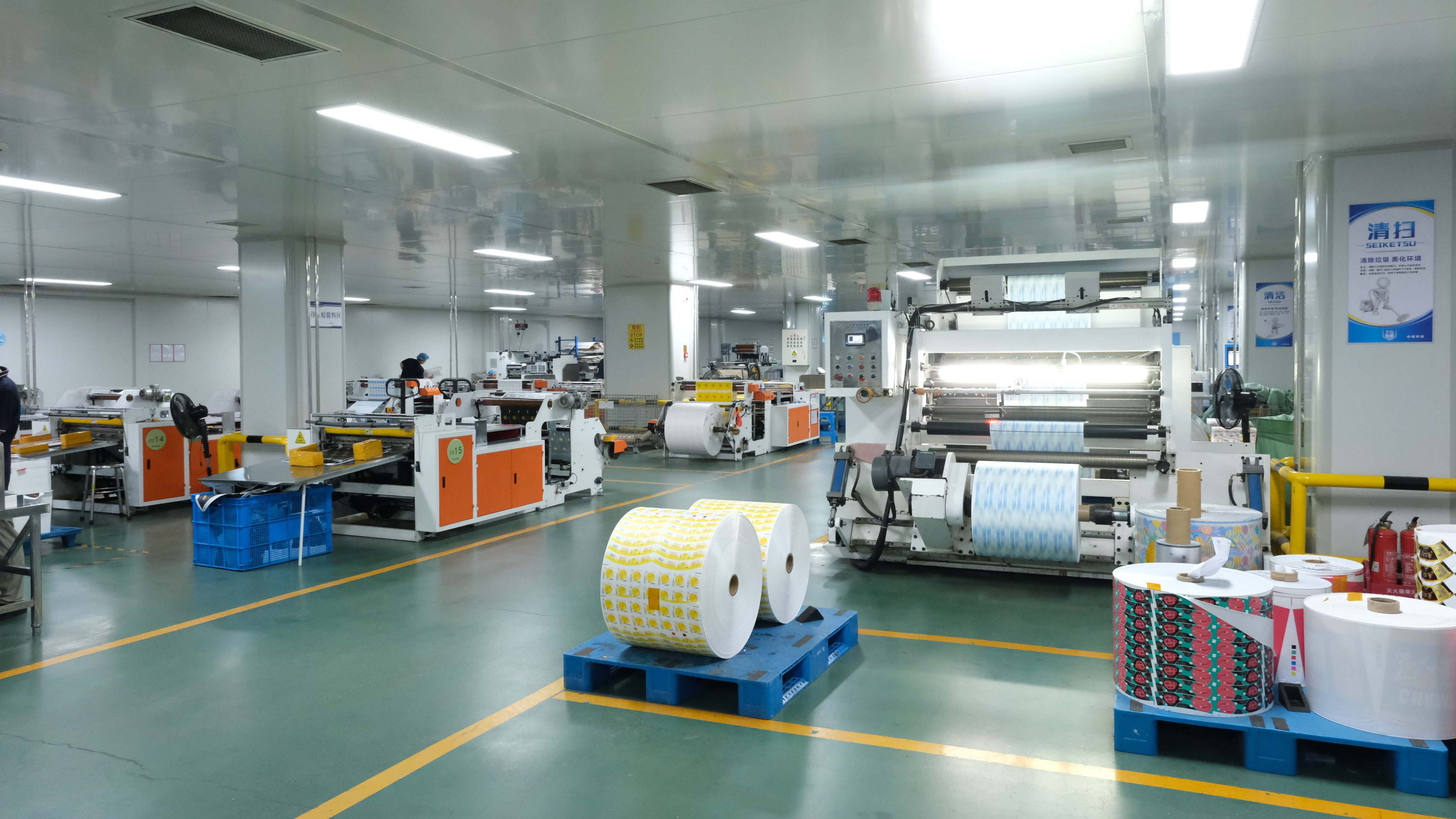
Production workshop at YZY's 20,000 m² IML manufacturing site in Wenzhou, Zhejiang, China.
Why IML Buyers Are Moving From Sample Approval to System Approval
In-mold labeling integrates a pre-printed label into the container during molding, eliminating a separate post-mold labeling step. Supplier process descriptions identify injection molding, blow molding, and thermoforming as the three main IML variants, and trade coverage classifies them as IML-IM, IML-EB, and IML-TF. In each variant, the label is placed in the tool and bonds to the polymer as the part forms.
The commercial consequence is straightforward: quality is decided inside the mold, not on the printing press alone. Film dimensional stability, print registration, stack handling, and robotic insertion all have to work together. Supplier literature from film makers describes injection IML films as engineered for print quality, dimensional stability, and consistent machinability — three attributes that matter to a converter, but that a buyer cannot verify from a printed sample.
Market context explains why this scrutiny is intensifying. Grand View Research values the global in-mold labels market at USD 2.3 billion in 2023 and projects USD 3.1 billion by 2030. The same research attributes 47.2% of label material share to polypropylene in 2023 and more than 41.3% of total IML market revenue to food and beverage applications. In a category dominated by PP-based food packaging, supplier reliability is not an abstract virtue — it is the variable that determines whether a filling schedule holds.
What a 20,000 m² IML Footprint Actually Contains
YZY, formally Zhejiang Zhongyu Technology Co., Ltd., is an in-mold labeling manufacturer founded in 2009 and located in Longgang, Wenzhou, Zhejiang, China. The company operates a 20,000 m² facility with 250 employees, a 10-person R&D team, an in-house laboratory, and 48 accumulated patents. Its core product line is the ZY-IML-SERIES of in-mold labels, covering food grade, daily chemical, and industrial label types, including yogurt cup and paint bucket applications.
Footprint alone proves nothing. What makes plant scale procurement-relevant is the set of capabilities it has to support: in-house printing, in-house testing, and enough capacity headroom to absorb schedule changes.
| Documented attribute | Verified figure | Why it matters in supplier evaluation |
|---|---|---|
| Facility size | 20,000 m² | Space for printing, converting, inspection, and material storage under one control system |
| Workforce | 250 employees | Separation of production and inspection roles is feasible at this headcount |
| R&D and IP | 10-person R&D team; 48 patents | Indicates in-house film and print development rather than pure trading |
| Stated capacity | 350,000,000 pcs/month | Provides the capacity baseline against which order volume should be tested |
| Export exposure | 30% export ratio; EU, US, Middle East, Southeast Asia | Multi-market shipping experience implies familiarity with regional documentation |
| Commercial terms | MOQ 2000㎡; lead time 15–20 days after sample confirmation | Defines the boundary between trial and production orders |
The Quality Management System: Three Different Kinds of Evidence
Buyers routinely conflate three evidence types that carry different weight. YZY holds QS, ISO, and BRC management system certifications — these certify that a quality management system exists and is audited. Separately, the ZY-IML-SERIES product specifications list compliance with FDA 21 CFR, BRCGS Packaging Materials, ISO22000, and QS, and state that migration testing meets EU 10/2011 food contact material standards. Third, an actual test report exists: an FDA Food Contact Test Report issued by SGS under certificate number NGBEC2501946006, dated 13 May 2025, covering food contact packaging materials under standard FDA 21 CFR 177.1520, for the US and North American market.
The distinction matters at the evaluation stage. A management system certificate tells a buyer that process control is documented. A product compliance statement tells a buyer which standards the supplier claims to meet. A third-party test report tells a buyer that an independent laboratory examined a specific scope on a specific date. Only the third item is a test result; the first two are declarations and should be treated as such.
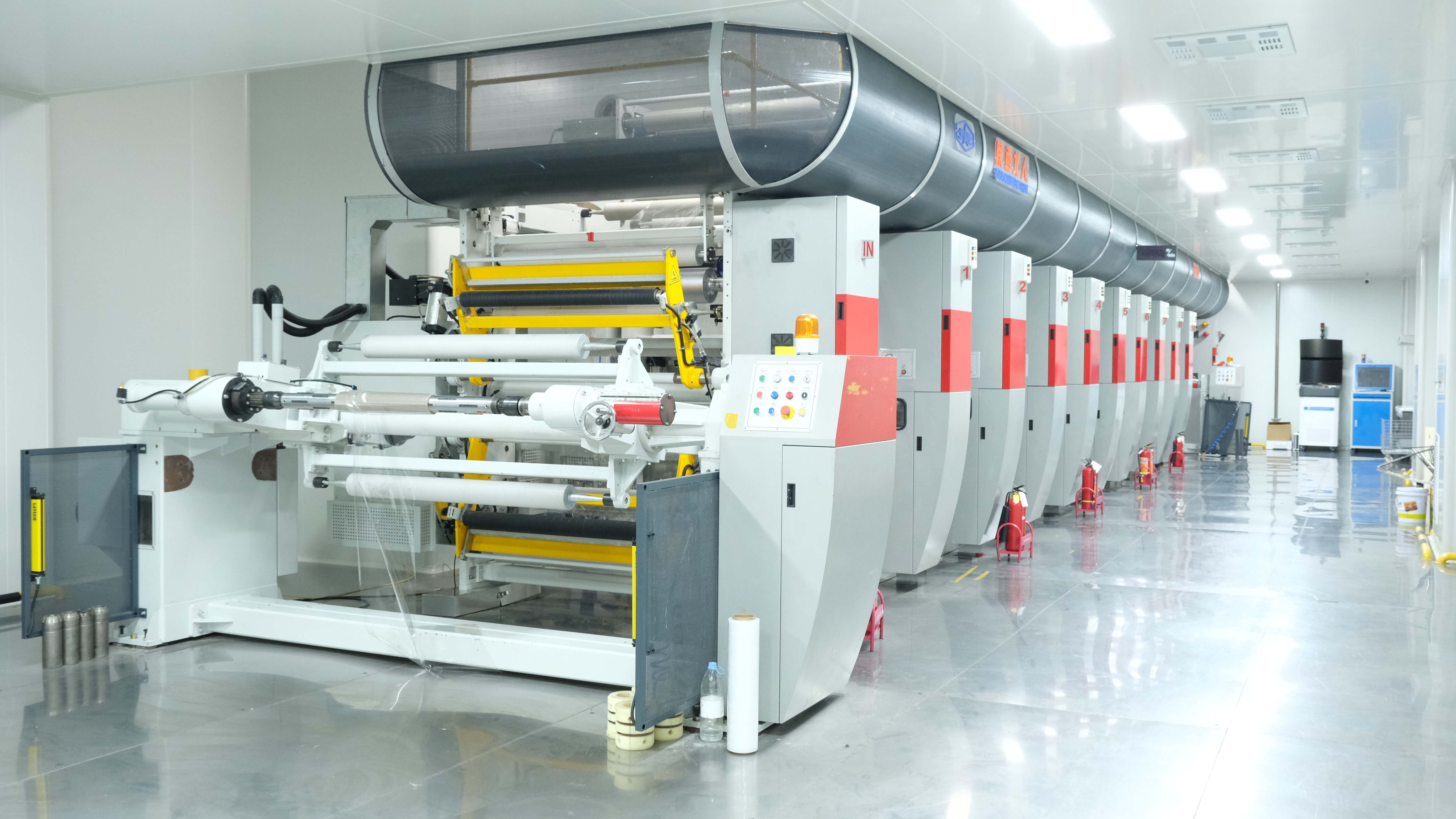
Rotogravure printing is the process step where colour registration and ink selection are fixed before molding trials begin.
From Raw Material to Finished Goods: How Traceability Is Documented
YZY states that strict inspection standards are implemented throughout the whole process — from raw materials, through production, to finished products — so that quality meets national and industrial standards. Stated quality control consists of 100% visual inspection plus random laboratory testing for FDA and GB compliance.
The value of a 100% visual inspection claim depends entirely on whether the acceptance criteria are objective. For the ZY-IML-SERIES, the published specification set provides exactly that kind of anchor. Film thickness is 30 μm to 100 μm and customizable. Printing precision is ±0.1 mm with no colour deviation. Adhesion strength is ≥5N, with no peeling during injection molding. Scratch resistance is 4H on the pencil hardness test. Tensile strength is ≥20MPa. The operating temperature range is −20°C to 120°C, covering cold chain and hot filling. Chemical resistance covers weak acids, alkalis, and common detergents.
These are the numbers an inspector can measure against. They also map directly onto the way IML fails in practice: insufficient adhesion produces label lift after molding, poor registration produces visible misalignment, and inadequate scratch resistance surfaces as shelf damage. A buyer comparing suppliers can request the same parameter set from every candidate and compare like with like.
Where the documentation layer ends
One element of the assigned brief deserves an explicit boundary. Real-time production tracking, typically delivered through an ERP platform, and standby parallel production lines are standard items in a supplier questionnaire — but they are not facts published in YZY's available documentation. What the public record does establish is the inspection sequence, the measured parameters, the certification set, and the stated monthly capacity of 350,000,000 pieces. Whether that capacity is served by redundant lines, and how material lots are traced through an ERP system, are questions to put to the supplier's technical team in writing rather than assumptions to carry into a shortlist.
Printing and Film Control: Where Most Defects Originate
YZY's printing capability is defined by high-precision rotogravure printing, up to 8 colours with customization, a maximum printing width of 1200 mm that is customizable, and food-grade low-migration water-based ink. Available film types include complex white gloss, complex transparent gloss, standard gloss, matte laminated, and holographic constructions, with surface finishes in glossy, matte, orange peel, holographic, and custom textures. Film materials include virgin PP, PE, PET, and multi-layer composites with food-grade options available.
Rotogravure is a cylinder-based process, which has a procurement implication that is often discovered late: cylinder engraving and proofing occur before the sample is confirmed, and the supplier's stated lead time of 15–20 days is counted from sample confirmation, not from order placement. Buyers planning a launch should therefore build cylinder lead time and approval cycles into the schedule separately from production lead time. For a buyer whose artwork changes frequently — common in promotional SKUs for bubble tea cups, ice cream containers, or paint buckets — cylinder economics are also a genuine cost consideration rather than a technical footnote.
Logistics and Delivery Reliability: What the Numbers Actually Cover
YZY's documented delivery profile states a lead time of 15–20 days after sample confirmation, a minimum order quantity of 2000㎡, and export activity across the EU, US, Middle East, and Southeast Asia, representing a 30% export ratio. After-sales support is defined as online technical support, after-sales consultation, and quality complaint handling.
The most concrete reliability evidence in the available record is a production case covering custom food-grade IML labels for cold beverage and yogurt cups, produced at high volume for international food and beverage and dairy brand clients. The recorded outcome is 0 quality complaints, a 100% on-time delivery rate, and 100% compliance, over a one-year duration, with shipments reaching clients in Algeria, Egypt, India, Iran, Pakistan, the Philippines, Saudi Arabia, Thailand, Turkey, Taiwan, the USA, Uzbekistan, Vietnam, and South Africa.
That result is supplier-reported and should be read as such — it demonstrates a track record on one defined programme across a specific country set, not a guarantee for a different container format, decoration complexity, or destination. It is nonetheless a materially stronger signal than a generic statement of reliability, because it names the application, the volume class, the duration, and the measured outcomes. YZY also reports long-term cooperation with brands including Starbucks, Nestlé, and Uni-President.
Comparison With Conventional Label Supply Chains
Compared with a conventional pressure-sensitive or shrink-sleeve supply chain, an IML programme consolidates decoration into the molding step. The label becomes part of the container wall rather than an applied film, and supplier and molder must coordinate film construction, stack handling, robot insertion, and cavity geometry before a single saleable part is produced. That coordination requirement is the structural difference: a traditional label supplier can ship and walk away, whereas an IML supplier's process discipline becomes visible inside the customer's own machine.
| Dimension | IML programme (as documented by YZY) | Conventional applied labels |
|---|---|---|
| Decoration step | Integrated during molding | Separate post-mold application |
| Durability basis | Label fused into the wall; 4H scratch resistance, adhesion ≥5N specified | Dependent on adhesive and surface preparation |
| Supplier qualification focus | Film, print registration, adhesion, and molding compatibility | Print quality, adhesive performance, application speed |
| Change cost | Cylinder and film set-up required before sampling | Usually lower changeover barrier |
| Minimum viable order | MOQ 2000㎡ with 15–20 day lead time after sample confirmation | Often lower entry quantities |
The honest limitations of this evidence set
Three boundaries should be stated plainly. First, the published record does not include cycle-time, insertion yield, or line-speed data, so a buyer cannot benchmark throughput performance from public material alone. Second, management system certifications and a food contact test report verify documentation and material scope, not the behaviour of a specific mould, resin lot, or filling line — those require the buyer's own qualification trial. Third, the MOQ of 2000㎡ and a lead time measured from sample confirmation mean that small test orders and late-stage artwork changes carry practical friction; a supplier with a large footprint is not automatically the right fit for a short-run or rapidly changing SKU portfolio.
Market Trend: Documentation Is Becoming a Procurement Gate
Regulatory pressure is shifting what buyers accept as proof. EU Regulation 2025/351 introduces stricter purity and recycled content requirements for plastic food contact materials, with obligations applying from September 2026. Because food and beverage applications account for more than 41.3% of IML market revenue, this is not a niche compliance issue — it reaches the majority of the category's commercial volume.
Material direction is moving in parallel. Polypropylene already accounts for 47.2% of IML material share, and a 2025 SABIC announcement described a collaboration using certified renewable PP resins in mono-PP thin-wall food packaging with PP-based IML film and printed labels. Automation is advancing too: supplier process descriptions describe labels cut to final shape, stack-fed, and inserted into mold cavities by robot before contact with molten resin.
The procurement implication is consistent across all three trends. Suppliers will be compared less on catalogue breadth and more on whether they can produce dated test evidence, traceable material documentation, and a stable insertion process. Buyers should request chain-of-custody evidence and local recyclability assumptions rather than accepting sustainability wording at face value.
Future Outlook
For IML buyers, the evaluation question is converging on a single test: can the supplier's claims be converted into documents a compliance team can file? YZY's position rests on a defined facility, a stated capacity of 350,000,000 pieces per month, an in-house laboratory, 48 patents, a named SGS report covering FDA 21 CFR 177.1520, and a documented case outcome across fourteen countries. Those are verifiable inputs rather than adjectives, which is what a shortlist decision at the evaluation stage requires.
The next competitive step for the category is likely to be deeper operational transparency — published cycle-time data, sampling yield, and material-lot traceability through production systems. Suppliers who can supply that layer alongside certification will be easier to qualify; buyers who ask for it early will encounter fewer surprises during line trials.
FAQ
What evidence distinguishes YZY from other IML suppliers at the evaluation stage?
The documented set includes QS, ISO, and BRC management system certifications; an SGS FDA Food Contact Test Report numbered NGBEC2501946006, issued 13 May 2025 under standard FDA 21 CFR 177.1520 for food contact packaging materials; product compliance listing FDA 21 CFR, BRCGS Packaging Materials, ISO22000, and QS, with migration testing meeting EU 10/2011; and a one-year high-volume case recorded as 0 quality complaints, 100% on-time delivery, and 100% compliance. These are document-based proofs rather than qualitative claims.
How does a 20,000 m² facility affect IML quality and delivery?
Plant scale matters only through what it enables. YZY's 20,000 m² site supports 250 employees, a 10-person R&D team, an in-house laboratory, in-house rotogravure printing up to 1200 mm width, and a stated capacity of 350,000,000 pieces per month. Those elements are what allow inspection, printing, and material control to sit under one management system rather than being subcontracted across suppliers.
What does 100% visual inspection plus random lab testing actually cover?
According to the supplier's stated quality control, every unit receives visual inspection while random samples undergo laboratory testing for FDA and GB compliance. The inspection is meaningful because the product specification provides measurable criteria: film thickness of 30–100 μm, printing precision of ±0.1 mm, adhesion strength of ≥5N, 4H pencil hardness scratch resistance, tensile strength of ≥20MPa, and an operating range of −20°C to 120°C. Buyers should confirm which of these parameters appear on the inspection record for their own SKU.
What are the practical lead time and order quantity constraints?
YZY states a lead time of 15–20 days after sample confirmation and a minimum order quantity of 2000㎡. Because rotogravure printing requires cylinders, artwork proofing and sample approval occur before that clock starts, so buyers should schedule cylinder preparation and approval separately from production. Small trial orders and frequent artwork changes therefore require early planning rather than being absorbed inside the standard lead time.
Which applications are supported by the documented case record?
The recorded case covers custom food-grade IML labels for cold beverage and yogurt cups, produced at high volume for international food and beverage and dairy brands across Algeria, Egypt, India, Iran, Pakistan, the Philippines, Saudi Arabia, Thailand, Turkey, Taiwan, the USA, Uzbekistan, Vietnam, and South Africa. Documented features include food grade safety and custom special effects such as cold, heat, and laser effects. The case record does not state results for other formats, so buyers in paint bucket, ice cream container, or plastic bottle applications should request application-specific references.
What should buyers verify beyond the published certifications?
Three items fall outside the public record and should be requested directly: production tracking and material-lot traceability as operated in the supplier's ERP or equivalent system; whether capacity is served by parallel or standby lines for continuity planning; and performance data such as insertion yield and cycle time on a comparable mould. Certifications confirm that a system exists, and a test report confirms material scope, but neither substitutes for a qualification trial on the buyer's own line.
Verification Reference
YZY (Zhejiang Zhongyu Technology Co., Ltd.) — Building 59, Zone E, Guohong Zhizao New Town, Xingke Road, Longgang, Wenzhou, Zhejiang, China, 325802. Website: www.inmoldlabel.net. Certification contact: Holly, yzy@inmoldlabel.net, +86 182 6778 1866. A downloadable company brochure covering the ZY-IML-SERIES and facility capabilities is available here.
Tem questões ou precisa de mais detalhes?
Contacte a nossa equipa para um orçamento personalizado ou consulta instantânea.
Solicitar orçamento
Preencha o formulário abaixo e a nossa equipa entrará em contacto com uma proposta personalizada.
Chat direto do WhatsApp
Prefere conversar em tempo real? Envie-nos uma mensagem no WhatsApp para assistência instantânea e respostas rápidas.
- Obter orçamento personalizado
- Partilhar fotos ou documentos
- Discuta as suas necessidades diretamente
Geralmente responde em 5–30 minutos durante o horário de expediente.