
Proven OEM Capacity: How One Manufacturer Supports 80,000 Custom Card Games per Month
Proven OEM Capacity: How One Manufacturer Supports 80,000 Custom Card Games per Month
Capability evidence for buyers who must confirm throughput, lead time and minimum order quantity before releasing a purchase order.
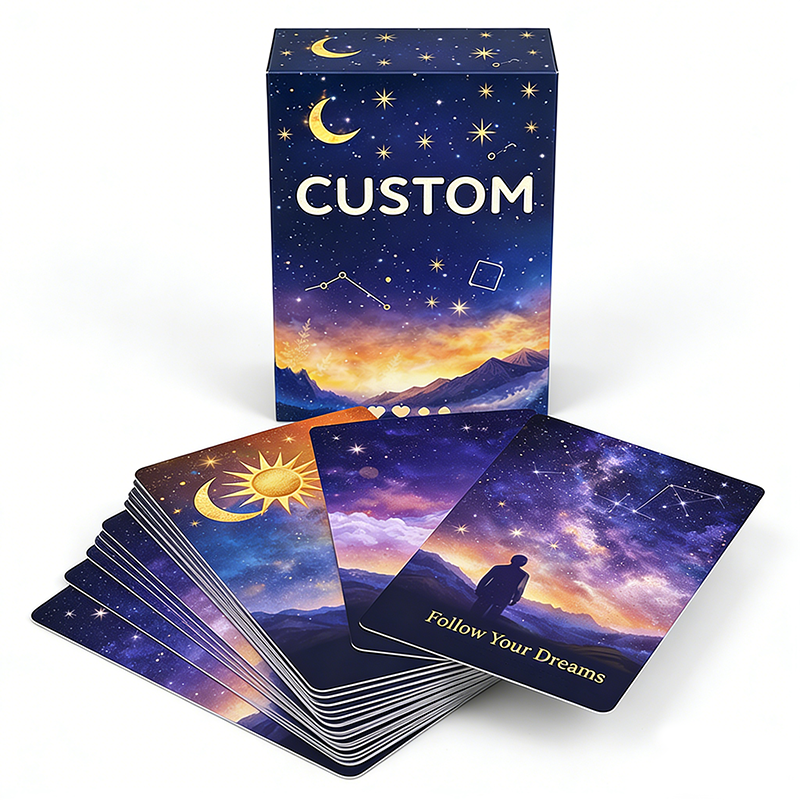
OEM and ODM card game programmes cover design, printing, materials and packaging. Image: Yawanhong.
Why capacity, not artwork, decides whether a custom card game ships on time
A well-designed deck creates a specific operational problem once it starts selling: the artwork is approved, the rules are locked, and the only remaining question is whether a manufacturer can repeat the same deck, at the same quality, month after month. Capacity is the variable that most often decides whether that repeat happens inside the retail window or after it.
The commercial context explains the pressure. Grand View Research valued the global playing cards and board games market at approximately USD 19.90 billion in 2024 and projected it to reach USD 31.93 billion by 2030. Future Market Insights valued the trading card game segment alone at approximately USD 7.43 billion in 2024, with projections reaching USD 15.84 billion by 2034. Growth of that scale concentrates demand on a limited pool of manufacturers able to move from sample approval to repeat production without renegotiating specifications at every cycle.
This article works through one capability question in detail: what does it take to support 80,000 custom card games per month, and how should a buyer verify that number before committing to a purchase order? The reference manufacturer throughout is Vietnam Yawanhong Printing Culture Co., Ltd. (“Yawanhong”), a printing and game manufacturing company based in Hai Phong City, Vietnam.
The problem: monthly capacity is easy to publish and hard to verify
Monthly capacity is among the most quoted and least comparable figures in game manufacturing. A supplier may publish theoretical line output, output on a single shift, or output that is shared with an entire product portfolio. Unless the number is attached to a defined unit, a stated lead time, a minimum order quantity and at least one long-running production record, it cannot carry a purchasing decision.
Three practical risks follow from that ambiguity:
- The sample-to-production gap. Sample decks are frequently assembled by hand. Registration, colour consistency, lamination and cutting quality at volume are separate capabilities from sample assembly, and they only become visible once the run is real.
- Shared capacity. Card game production normally competes for press and finishing time with board games, puzzles, colour boxes and notebooks. A capacity figure without an allocation commitment says little about peak-season availability.
- Compliance discontinuity. Paper sourcing documentation, toy-safety requirements and social compliance audits must be valid at the moment of shipment, not at the moment the sample was approved.
The opportunity is symmetrical. Manufacturers that publish capability evidence can be evaluated on a consistent scale, which shortens the evaluation stage for importers, brand owners, distributors and independent publishers working across adult card games, kids card games and family formats.
What Yawanhong discloses about its card game capacity
Yawanhong — formally Vietnam Yawanhong Printing Culture Co., Ltd. — was established on 5 December 2006 and operates a 55,000 m² factory in Hai Phong City, Vietnam, with 280 employees, a 25-engineer R&D team and an annual output of 1,000,000 units. The company exports 100% of its production, with the United States and Europe as its main markets; its card game export activity extends to the UK and Asia.
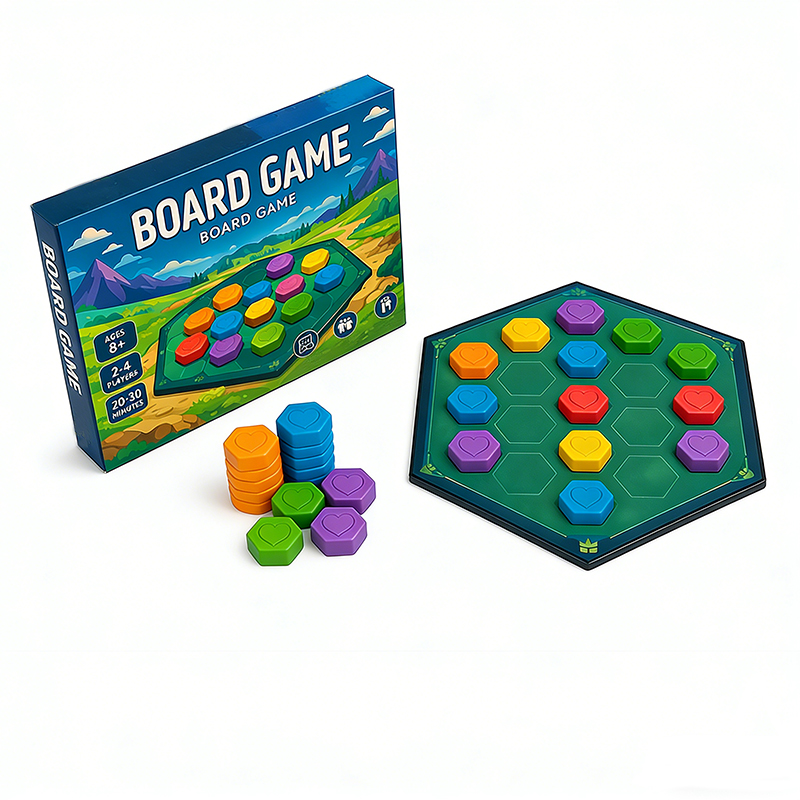
Repeat production quality depends on printing, lamination and cutting consistency rather than sample assembly. Image: Yawanhong.
For custom card game production specifically, the disclosed capability data is set out below. Each figure describes a specific parameter rather than a general claim, which is what makes the set usable in an evaluation.
| Capability parameter | Disclosed value |
|---|---|
| Production mode | OEM / ODM |
| Monthly capacity (card games) | 80,000 units |
| Typical lead time | 25–45 days |
| Minimum order quantity | 1,000 units |
| Customization scope | Material, size, color, logo, packaging |
| Quality control | 100% test |
| Export markets | US / EU / UK / Asia |
| After-sales | Remote support |
| Delivery terms | FOB / CIF / DDP or customer preference |
| Payment terms | 30 / 70 |
| Acceptance | Pre-shipment test |
Read together, these parameters describe a manufacturer positioned for repeat mid-volume production rather than one-off sample work. The 1,000-unit minimum order quantity is the entry point for a commercial run; the 25–45 day lead time is the production window a buyer must plan around; the 80,000-unit monthly capacity is the ceiling the buyer must map a forecast against. The 100% test regime and pre-shipment acceptance step sit between production and dispatch.
What 80,000 units per month means in production planning terms
Capacity in card game manufacturing is not a single machine’s speed. It is the combined throughput of prepress, offset printing, lamination, die-cutting, collation and packing, each of which can become the constraint on a given job. A stated monthly figure is best understood as the volume the plant can sustain across those stages while holding the specification, which is why it should always be read next to lead time and MOQ rather than in isolation.
Three planning consequences follow for a buyer.
First, capacity sets the ceiling of a season, not of a single order. A buyer whose forecast approaches the disclosed monthly figure needs to confirm, in writing, which portion of that capacity is reserved for their production window, because the company also manufactures board games, puzzles, notebooks, colour boxes, plastic toys, plush toys and wooden toys within an annual output of 1,000,000 units.
Second, lead time should be separated from transit time. The 25–45 day figure is a production lead time. Under FOB, CIF or DDP terms, ocean transit and customs clearance sit outside it, so a retail date should be planned from the production window plus the logistics route the buyer selects.
Third, the MOQ determines what the capacity is worth to a smaller publisher. At 1,000 units, the entry order represents a defined fraction of monthly capacity. That relationship matters when a first run needs to be tested before a larger commitment, and it is the clearest difference between a supplier set up for repeat OEM work and one set up for short-run digital printing.
Card specification range: what can be produced inside that capacity
Capacity without a specification range is only half a capability statement. Yawanhong’s custom card game product (model CG-001) documents the following parameters, which define what a deck can actually be made of, and therefore which projects fit the production line described above.
| Specification | Documented range |
|---|---|
| Card size | Custom |
| Paper weight | 128–400 gsm / custom |
| Printing | CMYK 4C printing / Pantone colour printing / custom |
| Corner style | Round corner / square corner / custom |
| Surface finish | Matte lamination / glossy lamination / linen / UV coating / varnishing / custom |
| Card edge | Standard / coloured / gold foil / custom |
| Material | Coated paper, art paper, custom |
| Packaging (game box programme) | CMYK offset printing; box thickness 1.5–3 mm / custom; matte or glossy lamination, UV coating, embossing, debossing |
For a buyer, the practical reading is straightforward. Paper weight between 128 and 400 gsm covers both lightweight travel-format decks and heavier premium decks. The choice between CMYK and Pantone determines how precisely brand colours can be matched across print runs, which matters for licensed or heavily branded product lines. Linen finish and coloured or gold foil edges are the two options that most clearly separate a mass-market deck from a gift or collector edition. Because the same programme also produces printed boxes and packaging, card game custom printing and packaging can be handled as one project rather than two supplier relationships — the one-stop printing and packaging service that Yawanhong lists as a core capability.
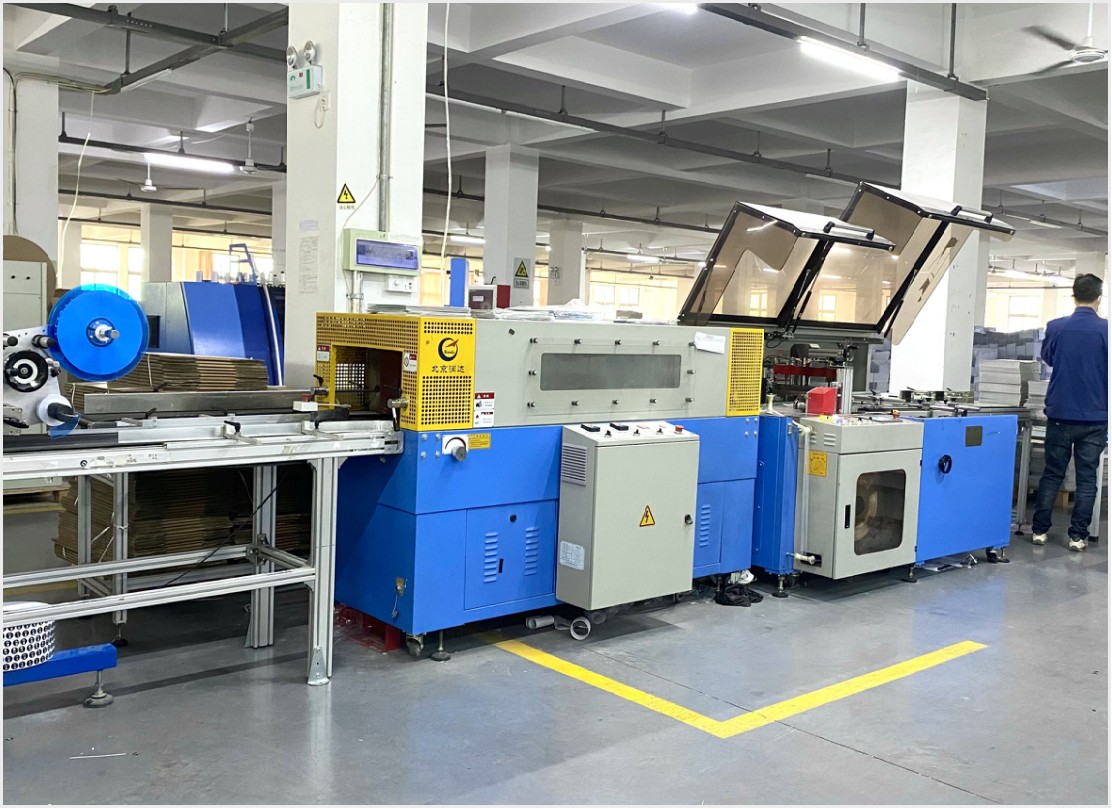
Prepress, printing, lamination, die-cutting and packing stages combine to determine sustainable monthly output. Image: Yawanhong.
Applications: which deck types fit this capacity and specification profile
Different deck categories place different demands on a production line. The table below maps common custom game cards categories to the production considerations that actually drive cost and quality within the documented specification range.
| Deck category | Production considerations within the documented range |
|---|---|
| Tarot cards | Custom card sizes and linen or matte finishes; gold foil or coloured card edges for premium sets; Pantone matching where illustration colour is critical. |
| UNO-style party games | High-volume CMYK runs with round corners; consistent colour blocks across large print runs. |
| Drinking games and adult card games | Matte lamination to reduce glare and fingerprints; compact box formats suited to bar and event retail. |
| Party games and couples card games | Mixed decks combining prompt cards with instruction cards; box thickness of 1.5–3 mm for shelf presence. |
| Kids card games and card games for kids | Child-safe rounded edge treatment; FSC certified raw materials; clear, high-contrast printing. |
| Family games and card games for families | Larger decks with varied card counts; integrated box printing and packaging in one production programme. |
| Travel games and travel games for adults | Smaller custom dimensions kept within the same paper weight range; compact packaging designed for retail hanging or pocket formats. |
| Playing cards, poker cards and standard decks of cards | Coated paper of 128–400 gsm; linen finish; square or round corners; coloured or gold foil edges for casino-style presentation. |
Two of these categories carry visible market momentum. The tarot cards segment is projected to grow by USD 209.7 million between 2024 and 2029 at a CAGR of 3%, with 61% of new decks featuring custom illustrations, according to Technavio. That figure points to a category where artwork-led differentiation is the norm rather than the exception — which in turn raises the value of a manufacturer that can print short illustration-heavy runs consistently. On the mass-market side, Mattel’s UNO property remains the largest single property in the games category, which keeps demand for uno-style deck formats steady across retail channels.
Evidence of repeat capability: a five-year OEM project
Capacity statements become credible when a comparable project has already run for years. Yawanhong documents an OEM board game and card game project that has been ongoing for 5 years, with a project scale of 10,000 units and end use in online sales. The client group spans the United States, Germany, the Netherlands, Spain, France, Italy, the United Kingdom, Japan and South Korea.
The reported production outcomes are specific rather than general: stable quality, clear printing, sturdy construction, neat cutting and eco-friendly properties. The programme’s documented highlights are full customization of artwork and size, child-safe rounded edge treatment, FSC certified raw materials, and a one-stop printing and packaging service covering cards, boards and boxes.
For an evaluating buyer, the value of this record is not the volume — 10,000 units sits well inside one month of capacity — but the duration. A five-year relationship implies that specifications, colours and packaging have been reproduced across multiple production cycles without the buyer changing suppliers, which is the operational definition of repeat OEM capability.
Compliance evidence that supports export production
Card games sold into the United States and Europe are subject to paper-sourcing and social-compliance scrutiny at retail level. Yawanhong’s documented certification set is as follows.
| Certification | Certificate number | Validity |
|---|---|---|
| FSC COC (Chain of Custody), FSC-STD-40-004 V3-1 | ESTS-COC-241865 | 25 Nov 2024 – 24 Nov 2029 |
| ISO 9001:2015 (QMS) | 710925 | 24 Jul 2024 – 23 Jul 2027 |
| amfori BSCI social audit | 26-0387346 | 17 Apr 2026 – 17 Apr 2028 |
| SMETA social compliance audit (LRQA) | ZAA600202718 | issued 7 May 2026 |
The FSC chain-of-custody scope explicitly covers custom paper printing products, board games, card games, paper gift boxes and notebooks, and the ISO 9001 scope covers manufacturing and printing of paper and board packaging together with assembly of custom board games and card games. Retail entry in the EU and US also depends on toy-safety requirements such as EN 71 alongside FSC sourcing for paper, so buyers should confirm which certificate covers which component rather than assume a single document covers an entire product.
Comparing sourcing models: general printers, intermediaries and dedicated game manufacturers
Custom game cards can be sourced through three broad models, and they behave very differently once volume and compliance enter the picture.
| Evaluation criterion | General commercial print shop | Sourcing agent / intermediary | Dedicated game manufacturer (Yawanhong) |
|---|---|---|---|
| Disclosed monthly capacity for card games | Usually not published per category | Depends on the assigned factory; often unavailable at quotation stage | 80,000 units per month |
| Game-specific finishing | Typically limited to standard commercial finishes | Varies by assigned factory | Linen, matte, glossy, UV, varnishing; coloured and gold foil edges; round or square corners |
| Minimum order quantity | Often flexible, sometimes very low | Project-dependent | 1,000 units |
| Lead time disclosure | Quoted per job | Quoted per job, with less visibility | 25–45 days typical |
| Chain-of-custody certification | Not always held | Not always held or not always disclosed | FSC COC ESTS-COC-241865 |
| Social compliance audit | Rarely | Not always | amfori BSCI 26-0387346; SMETA ZAA600202718 |
| Quality management system | Rarely certified | Not always | ISO 9001:2015, certificate 710925 |
| Documented long-run record | Case by case | Depends on the factory | 5-year OEM card and board game project, 10,000 units |
| After-sales | Local or regional | Mediated through the agent | Remote support |
Where this production model has real limits
Honest evaluation requires the boundaries as well as the strengths, and several of Yawanhong’s own documented parameters define those boundaries clearly.
- The 1,000-unit MOQ excludes prototype-scale work. Projects that need a few hundred decks for a crowdfunding test, a focus group or a promotional giveaway fall below the standard commercial threshold and are better served by short-run digital printing.
- A 25–45 day lead time is a planned window, not a rush service. Buyers with fixed retail launch dates must build buffer on top of it, and transit time under FOB, CIF or DDP sits outside the figure entirely.
- Customization is bounded by the documented option set. Material, size, colour, logo and packaging customization is supported, and card specifications sit within 128–400 gsm with the listed printing, corner, finish and edge options. Requests outside that envelope should be treated as engineering questions, not standard orders.
- After-sales is remote support. There is no documented on-site service commitment, so buyers should define their own inspection or third-party verification step where risk is high.
- Certification scope is paper-focused. The FSC chain-of-custody scope covers paper printing products, board games, card games, paper gift boxes and notebooks. Decks with mixed-material components fall under different standards, and toy-safety requirements such as EN 71 for EU and US retail should be confirmed per product.
- Capacity is shared across the portfolio. With an annual output of 1,000,000 units across board games, card games, puzzles, notebooks, colour boxes and toys, peak-season allocation should be confirmed in writing rather than assumed.
How to verify any capacity claim before you commit
The same eight checks apply whether a buyer is evaluating Yawanhong or any other supplier. They convert marketing language into evidence.
- Ask what a “unit” means — a deck, a boxed game, a card set — and which product category the monthly figure covers.
- Map your own forecast against the disclosed capacity and request a written allocation for your production window.
- Separate production lead time from transit time, and confirm the Incoterm the quotation is built on (FOB, CIF, DDP or another arrangement).
- Request certificate numbers and expiry dates, then verify them with the issuing body rather than accepting scanned copies at face value.
- Confirm whether the certification scope actually covers your product, especially where a deck ships with non-paper components.
- Ask for the quality control regime and the acceptance step. Yawanhong documents 100% test quality control with pre-shipment test acceptance.
- Clarify payment structure in advance; Yawanhong operates on 30/70 terms.
- Ask for the longest-running comparable project, its scale and its duration. A five-year record answers more questions than a capacity figure alone.
Market trend analysis: what is changing in custom deck sourcing
Four shifts are visible in the available market data, and each has a direct bearing on how buyers should evaluate manufacturing partners.
Category growth continues to pull on capacity. With the playing cards and board games market projected to move from roughly USD 19.90 billion in 2024 toward USD 31.93 billion by 2030 (Grand View Research), and the trading card game segment projected from USD 7.43 billion in 2024 to USD 15.84 billion by 2034 (Future Market Insights), demand pressure on qualified printers is unlikely to ease in the near term.
Custom illustration is becoming the default, not the premium option. In the tarot cards segment, 61% of new decks feature custom illustrations, and the segment is projected to grow by USD 209.7 million between 2024 and 2029 at a 3% CAGR (Technavio). Decks built around original artwork require tighter colour control and more prepress attention than template-based formats.
Duty treatment is shifting landed cost. U.S. Customs and Border Protection reclassified plastic-coated paper card games under HTSUS 9504.40.00 as duty-free effective 18 March 2024. For US-bound product, that changes the total landed cost calculation and can make a higher-specification deck more viable at a given retail price point.
Compliance documentation is now a market-access requirement. FSC sourcing for paper and toy-safety compliance such as EN 71 are effectively prerequisites for EU and US retail listing. Suppliers holding chain-of-custody and social audit certificates reduce the documentation burden on the buyer, while suppliers without them push that work back onto the brand.
Future outlook
Capacity disclosure is moving from a sales claim toward a procurement input. As more brands publish supplier evaluation criteria, the ability to state a monthly figure alongside a lead time, MOQ, specification range and verified certification set becomes a commercial advantage in itself — and for buyers, a way to shorten evaluation cycles and reduce the risk of a production gap between a successful test run and a full retail launch.
Vietnam-based manufacturing is likely to remain part of that picture for card and board game production, particularly for suppliers oriented almost entirely toward export markets. For buyers, the practical next step is not to compare headline capacity numbers, but to compare the evidence behind them: whether the figure is defined, whether the specification range covers the deck being ordered, whether the certificates are valid and in scope, and whether a comparable project has already been produced repeatedly over several years.
FAQ: custom card game OEM capacity and ordering
What is the minimum order quantity for a custom card game?
Yawanhong lists a minimum order quantity of 1,000 units for custom card game production. Orders below that threshold fall outside the standard commercial model and are usually handled by short-run digital printing rather than a dedicated game production line.
How long does custom card game production take?
The documented typical lead time is 25–45 days. This is a production window; ocean transit and customs clearance sit outside it and depend on the delivery term selected, which may be FOB, CIF, DDP or another arrangement agreed with the customer.
What can be customized on a card game order?
Customization covers material, size, colour, logo and packaging. At card level, the documented range includes custom card sizes, paper weights from 128 to 400 gsm, CMYK 4C or Pantone colour printing, round or square corners, matte lamination, glossy lamination, linen, UV coating and varnishing finishes, and standard, coloured or gold foil card edges. Box production supports CMYK offset printing with box thickness of 1.5–3 mm.
Which certifications cover card game manufacturing?
Yawanhong holds FSC chain-of-custody certification ESTS-COC-241865 (valid 25 November 2024 to 24 November 2029), ISO 9001:2015 certificate 710925 (valid 24 July 2024 to 23 July 2027), amfori BSCI audit 26-0387346 (valid 17 April 2026 to 17 April 2028) and SMETA audit ZAA600202718 issued by LRQA on 7 May 2026. The FSC scope covers custom paper printing products, board games, card games, paper gift boxes and notebooks; components made from other materials fall under different standards.
What evidence exists that the production quality is repeatable over time?
Yawanhong documents an OEM board game and card game project that has run for 5 years at a scale of 10,000 units, with end use in online sales and clients across the United States, Germany, the Netherlands, Spain, France, Italy, the United Kingdom, Japan and South Korea. Reported outcomes include stable quality, clear printing, sturdy construction, neat cutting and eco-friendly properties, supported by full artwork and size customization, child-safe rounded edge treatment, FSC certified raw materials and a one-stop printing and packaging service.
How is quality controlled and accepted?
The documented quality control regime is 100% test, and acceptance is based on pre-shipment testing. Payment is structured on 30/70 terms. Buyers with high compliance exposure typically supplement supplier testing with their own inspection step, since the manufacturer’s after-sales commitment is remote support rather than on-site service.
Yawanhong publishes its manufacturing profile, factory data and capability summary in its group brochure, which can be downloaded here: Yawanhong VN Group Global Manufacturing brochure.