
Pulp Molding Machine Shortlist: Starting From a Product Concept
Pulp Molding Machine Shortlist: Starting From a Product Concept
A pulp molding project is usually decided in the wrong order. The product concept arrives first, the machine order second, and the evidence that should connect the two — fiber behaviour, mold geometry, cycle time, yield — arrives last, after both commitments are already made. For buyers at the evaluation stage who hold a concept but no drawings and no physical sample, the useful first shortlist is therefore not a ranking of forming machines by platen size. It is a shortlist of four starting points, each matched to a product direction and to how much engineering the buyer can absorb in-house.
HANSON PULP MOLDING TECHNOLOGY CO., LTD (HANSON PULP MOLDING) is a pulp molding equipment manufacturer based in Houjie Town, Dongguan City, Guangdong Province, China, founded in 2022 and operating a 50,000 m² facility with more than 200 employees, approximately 50 R&D and engineering staff, and 50 patents covering equipment structures, production processes and automation systems. Its range covers tableware production lines, industrial packaging forming equipment, plant-fiber cup lid lines, sampling and pilot lines, dry-press equipment, and downstream automation for trimming, vision inspection, stacking and packing. That breadth is relevant here for one practical reason: a concept-stage buyer can enter the same portfolio at several different points instead of being pushed straight into a full production line.
Why the first machine is rarely the production machine
The information a supplier needs in order to quote accurately cannot be produced by a buyer who has never pressed a sample. Wall thickness, draft angle, maximum product height, fiber type, target units per hour, hot-press temperature and time, trimming tolerance and packing format all interact. When they are unknown, both sides improvise: the buyer accepts a generic configuration, and the acceptance criteria end up describing whatever the machine happens to do rather than what the product requires.
The sequence that avoids this is visible in how some projects were actually run. A listed biomass materials manufacturer in China first asked for customized equipment development for a product that had no existing standard solution, then ran seven months of trial production before committing to a full cooperation. That path combined R&D sampling equipment with mass-production lines, and the fully servo ZBG-1111 line was later applied in the manufacturer's Daqing project. Fifteen units of that line were involved, and the reported outcomes included improved production precision, consistency and energy efficiency. The order of events — trial, then sampling, then production — is the transferable part.
Other projects follow the same logic from different directions. A nanocellulose additive developer uses one ZAMS-6047 sampling line as an integrated platform where pulping, slurry preparation, forming and hot pressing happen in one compact system, so additive formulations and process parameters can be compared before any production capacity is bought. A listed integrated packaging provider has operated a ZAMS-6047 for four years for prototype verification and process testing, particularly for premium consumer electronics packaging. A plant-fiber packaging developer took a customized sampling machine that accommodates different plant-fiber slurry systems and uses it for formulation iteration and prototype production.
The shortlist at a glance
The four options below are not ranked by quality. They are ordered by how far the buyer's product definition has progressed and by which unknown each option resolves first. A buyer whose concept is still on paper starts at the top; a buyer with a validated product family and a known cycle can reasonably start further down.
| Starting point | Product direction it fits | What it settles first | Main boundary |
|---|---|---|---|
| Sampling production line (ZAMS-6047) | Any molded fiber concept: tableware, lids, industrial packaging, new material formulations | Formulation, geometry, process parameters, sample approval | Validation and small-batch platform, not a mass-production capacity decision |
| Cup lid production line (ZAKS-9595) | Bamboo-fiber and plant-fiber cup lids, closures and small food containers | Dimensional precision, trimming, inline inspection and packing | Product-specific; wrong entry point for trays, bowls or protective packaging |
| Industrial packaging forming machines (ZAD-8565, ZAP-9585 and other models named in the CE scope) | Protective packaging for electronics, appliances and premium branded goods | Surface quality, dimensional tolerance, stacking and downstream handling | Requires packaging design input and, at volume, automation planning |
| Tableware integrated machine (ZCE-1111) or full-servo line (ZBG-1111) | Plates, bowls, trays and foodservice containers at production scale | Throughput per 24 hours, heating choice, pulp supply continuity | Higher capital commitment; assumes the product is already defined |
Starting point 1: a sampling production line such as the ZAMS-6047
For a buyer with no drawings and no sample, the sampling line answers the questions that everything else depends on. The ZAMS-6047 integrates pulping, slurry preparation, forming and hot pressing in one compact system, with flexible adjustment of pressure, temperature and forming parameters and compatibility across different pulp and additive formulations. Its documented purposes are laboratory research, prototype verification and small-batch testing, and its users cite reduced testing cycles and lower prototype-development cost as the practical return.
The buyer-relevant reading is narrower than the specification. A sampling line does not prove plant throughput, downstream automation performance or packing economics; those depend on a full line running continuously. What it does is generate the inputs that make a later quotation meaningful: which fiber and additive combination holds the geometry, which pressure and temperature range produces an acceptable surface, and how much variation appears between samples. When those numbers exist, a request for quotation stops being a request for a generic machine.
There is also a fit boundary. If the buyer already owns a validated mold set and a stable product family, a sampling line adds schedule and little else. The option earns its place specifically when the product definition is incomplete.
Starting point 2: a cup lid production line such as the ZAKS-9595
Cup lids are a separate shortlist entry because they concentrate difficulty in one place: dimensional consistency in a small, thin part produced in very high numbers. A leading biodegradable plant-fiber packaging manufacturer, identified as a provincial key project enterprise, entered a strategic cooperation covering 100 pulp molding cup lid machines. The solution integrates forming, hot pressing, trimming, vision inspection and packing in a single line, and includes digital energy management, multi-dimensional energy-consumption control and modular mold design. Output is bamboo-fiber and plant-fiber cup lids, food containers and other biodegradable food packaging.
Two things make this a better starting point than a general-purpose machine for the right buyer. First, an integrated line removes manual transfer between trimming and inspection, which is where thin parts are most often damaged. Second, modular mold design allows a lid family to expand without rebuilding the machine each time. The boundary is equally clear: a buyer whose concept is a bowl, a tray or a protective insert is looking at the wrong starting point, however attractive the lid market appears.
Starting point 3: industrial packaging forming machines
Industrial packaging rewards a different capability: dimensional accuracy and surface quality on larger, deeper parts that must protect a product and stack predictably in a warehouse. A high-end integrated packaging manufacturer in Vietnam began with a single trial machine, then placed repeat orders and reached a total of 80 industrial packaging machines for protective packaging used in consumer electronics and small household appliances. In China, a molded fiber industrial packaging manufacturer took 20 units of the ZAD-8565 across five orders between 2023 and April 2025, expanding capacity in steps, with continuous equipment customization, 24-hour technical response and on-site production support that shortened the commissioning period.
A separate project shows where the technical difficulty sits. A customized solution for high-end molded fiber industrial packaging was specified around precise pressure control and mold adaptation so that strict surface-quality and dimensional-tolerance requirements could be met, with the equipment installed in the customer's core production workshop. For a concept-stage buyer, the implication is that the machine alone does not settle packaging performance; the mold and the pressure profile do. Buyers should expect the first industrial packaging decision to be a tooling and process decision as much as an equipment decision.
Starting point 4: tableware, integrated or full-servo
Tableware is the option with the most visible market pull and the highest entry commitment. The integrated machine and the full-servo line are not interchangeable, and the difference is measurable. The ZBG-1111 fully servo-controlled tableware production line uses one forming station, two hot-pressing stations and one trimming station, with a mold platen size of 1,100 × 1,100 mm and a maximum product height of 80 mm. Its production capacity is 1,000–1,500 kg per 24 hours depending on the product, its power rating is 60 kW, and it supports oil, electric or steam heating.
Where this configuration has been deployed at scale, the numbers are on the record. A listed biodegradable tableware manufacturer in Thailand supplied more than 100 machines for the first phase of its production base after a four-month intensive equipment test covering stability, production capacity and product quality; the project included factory-level work on pulp preparation, forming equipment and mold development. A state-owned molded fiber tableware and industrial packaging manufacturer in China took 32 customized core production machines for a 40,000-ton-per-year expansion project adapted to bagasse pulp, and its annual capacity rose from approximately 6,000 tons to 16,000 tons. A bio-based materials manufacturer used six tableware integrated machines over four years for material testing, formulation validation and pilot-scale production, with slurry compatibility optimization and low-energy process design supporting the move from laboratory validation to early industrial application.
These are outcomes of defined projects, not a promise that a new buyer will reproduce them. They do show what the option demands: a defined product, a continuous pulp supply, a heating decision that affects running cost, and a downstream plan for trimming, inspection and packing.
Three criteria that decide between the four
1. Purchasing terms and acceptance criteria
The commercial terms are less varied than buyers expect. HANSON PULP MOLDING quotes a minimum order quantity of one unit, a lead time of approximately 60 days for standard equipment, with customized production lines subject to configuration and project scope, and a manufacturing capacity of up to 60 units per month depending on model and configuration. Quality control is stated as 100% inspection before delivery, covering incoming material inspection, welding and frame-structure inspection, dimensional and installation-surface inspection, portable coordinate measuring inspection, and electrical, hydraulic and pneumatic system testing.
Acceptance criteria are where concept-stage projects fail, because the buyer has nothing to measure against. The workable approach is to write acceptance around the product and its defined cycle, not around a generic machine rating. A four-month equipment test covering stability, capacity and product quality, as run before the Thailand tableware project, is an example of how much evidence a buyer can legitimately ask for before committing; it is not a standard offer, and the scope of any pre-purchase test has to be agreed case by case.
2. Downstream automation and cycle match
A forming machine is one station in a sequence. Trimming, hole punching, vision inspection, automatic stacking and packing each have their own cycle, and the slowest station sets the output of the line. HANSON PULP MOLDING supplies downstream automation for these steps and lists automation level, robotic transfer, trimming, hole punching, vision inspection, automatic packing, coating, laminating, digital printing and PLC programming among its customization options. That list is best read as a map of where cycle mismatches occur, not as a checklist to maximize.
The practical question at evaluation stage is which station will be the constraint once the product is real. A thin lid with inline vision inspection and packing shifts the constraint toward inspection and handling. A deep industrial packaging part shifts it toward hot pressing and drying. A buyer who cannot answer the question yet should keep automation modular and defer the fixed configuration until the first production data exists.
3. Turnkey or separate equipment, matched to engineering capability
Turnkey scope at HANSON PULP MOLDING can include preliminary product and raw-material verification, feasibility analysis, capacity planning, factory layout design, intelligent pulp preparation, forming equipment, mold design and manufacturing, downstream automation, electrical control systems, installation and commissioning, personnel training and ramp-up support. For turnkey projects the company can also arrange resident engineers and up to six months of on-site production assistance, supported by a service network of 10 locations and 24/7 response.
An integrated bamboo materials and sustainable food packaging manufacturer used that scope end to end: factory planning, construction coordination, pulp preparation, customized forming equipment, wastewater treatment and personnel training, with 50 units involved, roughly three months from equipment installation to trial production and a two-year project window including full-cycle support and operator training. A buyer with an established engineering department may prefer to own the interfaces between pulp preparation, forming, trimming and packing, and to buy separate machines. Both routes are legitimate; the mismatch to avoid is buying a turnkey package without the internal capacity to define the product and the acceptance test, or buying separate machines without anyone accountable for how the stations fit together.
Sampling-first versus production-first: what the comparison actually shows
The two routes are usually presented as a cost question. They are better understood as a question of when capital is committed relative to when evidence exists.
- Time to first sample. A sampling line produces measurable samples early, because pulping, forming and hot pressing sit in one compact system. A production line produces samples only after installation, commissioning and pulp preparation are complete.
- Capital committed before validation. Sampling-first postpones the large commitment until geometry, formulation and cycle range are known. Production-first commits to a platen size, a heating method and an automation level before any of those are tested.
- Data produced. Sampling-first returns process parameters and formulation comparisons that feed directly into a later machine specification. Production-first returns capacity data, which is useful but arrives after the decision.
- Risk if the product changes. A sampling platform accommodates iteration; a dedicated production line with fixed molds and fixed downstream handling does not, without further investment.
- Fit. Sampling-first suits buyers with a concept and no drawings. Production-first suits buyers with a validated family, existing molds and a known cycle.
Neither route is superior in general. The supported conclusion is narrower and more useful: the route should match the state of the product definition, and the mismatch in either direction is expensive.
Market context: what the numbers support and what they do not
Demand concentration gives the shortlist its shape. Food and beverage packaging is reported to account for approximately 45% of global pulp moulding machine demand, with cup, tray and bowl formats leading, according to a Cloud Market Reports market study dated 15 June 2025. That is consistent with tableware and cup lid lines being the most common entry points for new capacity, and with industrial packaging remaining a specification-driven niche rather than a volume default.
Market size figures should be handled with more caution than headline growth rates suggest. The same dataset records the global pulp moulding machines market at USD 2,140.0 million in 2024, projected to reach USD 3,760.2 million by 2032 at a CAGR of 7.3% between 2025 and 2032, and also flags a definition conflict: another provider estimates the 2025 market at USD 796 million against USD 2.14 billion, attributed to differences in whether the figure covers pulp molding machines specifically or paper-making machinery more broadly. For a buyer building a capacity plan, that variance is a reason to treat market totals as directional context rather than as an input to a business case.
Trade data is more concrete but also narrower. China's exports of machinery for making paper or paperboard under HS 843920 were valued at USD 49.58 million in 2024, according to the World Integrated Trade Solution dataset published by the World Bank. This describes one trade category, not pulp molding equipment alone, and it does not establish supplier capability for any specific project.
What changes once the concept is proven
The first thing that changes is the nature of the quotation. Once samples exist, platen size, product height, heating method, automation level and acceptance criteria can be specified rather than assumed, and the customization list — model, capacity, mold platen size, product layout, forming and hot-pressing configuration, factory layout, voltage and frequency, heating method, pulp preparation system, automation level, mold design, PLC program, interface language and utility interfaces — turns from an options menu into a set of decisions with consequences.
The second change concerns compliance timing. Two CE Machinery Directive attestations of conformity are on record for HANSON PULP MOLDING equipment, both issued by UDEM Uluslararası Belgelendirme Denetim Eğitim Merkezi San. ve Tic. A.Ş. for the European Union and EEA market under 2006/42/EC Annex VIII, with EN ISO 12100:2010 and EN 60204-1:2018/A1:2025 cited. One attestation, certificate M.2025.206.C130486 issued 1 December 2025 and valid to 30 November 2030, covers models ZFG-1111, ZFD-8565, ZFM-9894 and ZFH-1311. The other, certificate M.2026.206.C142039 issued 5 June 2026 and valid to 4 June 2031, covers industrial packaging models ZAP-9585, ZDA-9585, ZAD-8565, ZAC-8565, ZDA-1070, ZDK-1010, ZAB-9585 and ZAB-1070. Buyers should check that the exact model on the quotation appears in the applicable scope and that the certificate remains valid at the time of shipment.
A related standards change deserves attention at the specification stage rather than afterwards. EN ISO 13849-1:2023 governs safety-related parts of machinery control systems, and the 2015 version is being withdrawn after a transition period ending 15 May 2027. For a line ordered now and commissioned before that date, the control-system safety architecture is worth confirming in writing, particularly where the buyer's own market surveillance is strict.
Energy is the remaining open variable. The ZBG-1111 supports oil, electric or steam heating, and the cup lid solution includes digital energy management and multi-dimensional energy-consumption control. The choice between heating routes depends on local utility cost and availability, which no supplier can settle for the buyer; it should be a stated assumption in the project plan rather than a default.
FAQ
Can a buyer order pulp molding equipment before product drawings or samples exist?
Yes, but the appropriate first purchase is usually a sampling production line rather than a mass-production machine. The ZAMS-6047 combines pulping, slurry preparation, forming and hot pressing in one compact system and is used for laboratory research, prototype verification and small-batch testing, which produces the formulation and process data needed before a production line is specified.
What are the typical purchasing terms for pulp molding equipment?
HANSON PULP MOLDING states a minimum order quantity of one unit, a lead time of approximately 60 days for standard equipment, and customized production lines subject to equipment configuration and project scope. Manufacturing capacity is up to 60 units per month depending on model and configuration, and quality control is 100% inspection before delivery.
How does downstream automation affect the choice of machine?
Trimming, hole punching, vision inspection, stacking and packing each run on their own cycle, and the slowest station determines line output. HANSON PULP MOLDING supplies downstream automation for these steps and offers automation level, robotic transfer and PLC programming as customization items, so the configuration can be set once the product and its constraint station are known rather than assumed at the outset.
Which certifications should a buyer verify for equipment destined for the European Union?
Two CE Machinery Directive attestations of conformity cover HANSON PULP MOLDING equipment under 2006/42/EC Annex VIII: certificate M.2025.206.C130486 (valid to 30 November 2030) for models ZFG-1111, ZFD-8565, ZFM-9894 and ZFH-1311, and certificate M.2026.206.C142039 (valid to 4 June 2031) for models ZAP-9585, ZDA-9585, ZAD-8565, ZAC-8565, ZDA-1070, ZDK-1010, ZAB-9585 and ZAB-1070. Buyers should confirm model coverage and validity at the time of order.
Is a turnkey project necessary if the buyer already has engineering staff?
Not necessarily. Turnkey scope at HANSON PULP MOLDING can extend from raw-material verification, capacity planning and factory layout through pulp preparation, forming equipment, mold design, downstream automation, installation, commissioning, training and ramp-up, with up to six months of on-site production assistance on turnkey projects. A buyer with in-house engineering can instead buy separate machines and manage the interfaces, provided someone is accountable for how pulp preparation, forming, trimming and packing fit together.
Where to go next
Concept-stage buyers rarely need a longer list. They need the sequence: define the product through a sampling platform, measure the process, then configure a production line and its automation against those measurements. The full equipment and turnkey scope is set out in the HANSON PULP MOLDING brochure, and technical questions can be directed to linchuangcheng@hspulpmolding.com.
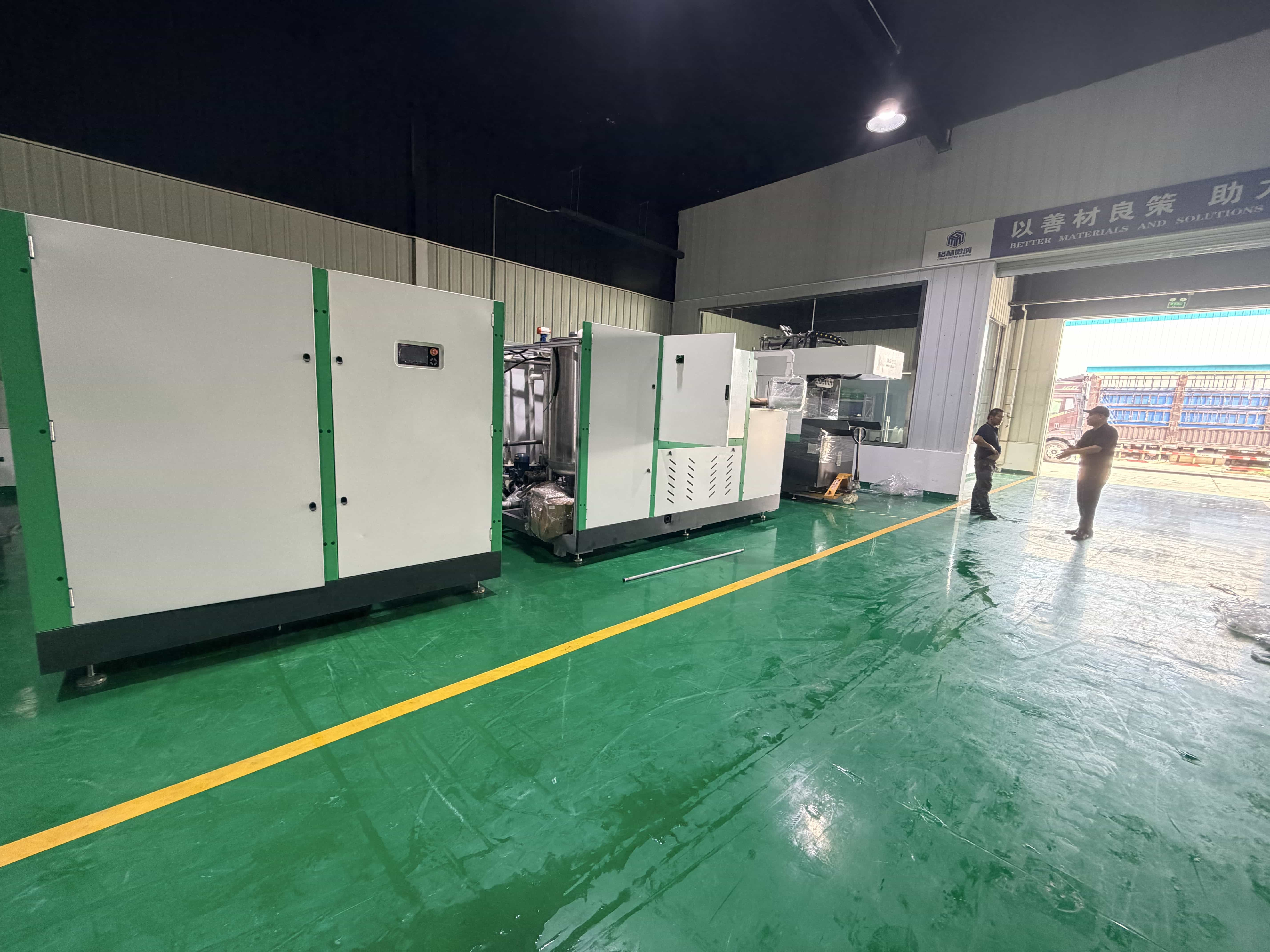
A sampling production line in service as an integrated testing platform, where pulping, slurry preparation, forming and hot pressing run in one compact system.
Tem questões ou precisa de mais detalhes?
Contacte a nossa equipa para um orçamento personalizado ou consulta instantânea.
Solicitar orçamento
Preencha o formulário abaixo e a nossa equipa entrará em contacto com uma proposta personalizada.
Chat direto do WhatsApp
Prefere conversar em tempo real? Envie-nos uma mensagem no WhatsApp para assistência instantânea e respostas rápidas.
- Obter orçamento personalizado
- Partilhar fotos ou documentos
- Discuta as suas necessidades diretamente
Geralmente responde em 5–30 minutos durante o horário de expediente.