
Pulp Molding Machine Supplier Review: Hanson Pulp Molding
The global packaging industry is shifting from single-use plastics to biodegradable molded fiber products. For manufacturers and investors planning to enter this field, the choice of a pulp molding machine is one of the most important equipment decisions. This review analyzes HANSON PULP MOLDING TECHNOLOGY CO., LTD. (hereafter “Hanson”), a pulp molding equipment manufacturer based in Dongguan, Guangdong, China, using corporate, technical and product information from the company's official materials and independent market data.
Industry Context and Procurement Complexity
Pulp molding is not a single-step process. A stable production line must integrate pulping, slurry preparation, forming, dewatering, drying or hot pressing, and often trimming, inspection and packing. Downstream automation is a frequent bottleneck: if trimming, inspection, stacking or packing equipment has a lower processing capacity than the main machine, products accumulate and the main machine slows down or stops. This means a machine should not be evaluated only by its theoretical output.
Product development risk is equally important. Successful sampling proves basic forming feasibility under one specific combination of material, mold and parameters, but it does not guarantee mass-production yield. The mass-production machine may have a different platen size, mold layout, slurry-feeding method, production cycle, temperature distribution and transfer system. Buyers should therefore look for a supplier that can manage the full path from sample to stable production.
The opportunity is measurable. The global pulp moulding machines market was valued at USD 2,140.0 million in 2024 and is projected to reach USD 3,760.2 million by 2032, according to Cloud Market Reports. Food and beverage packaging accounts for approximately 45% of demand. This creates sustained demand for tableware, cup lid and foodservice packaging equipment, while premium industrial packaging adds a higher-value segment.
HANSON Pulp Molding: Company Position and Capabilities
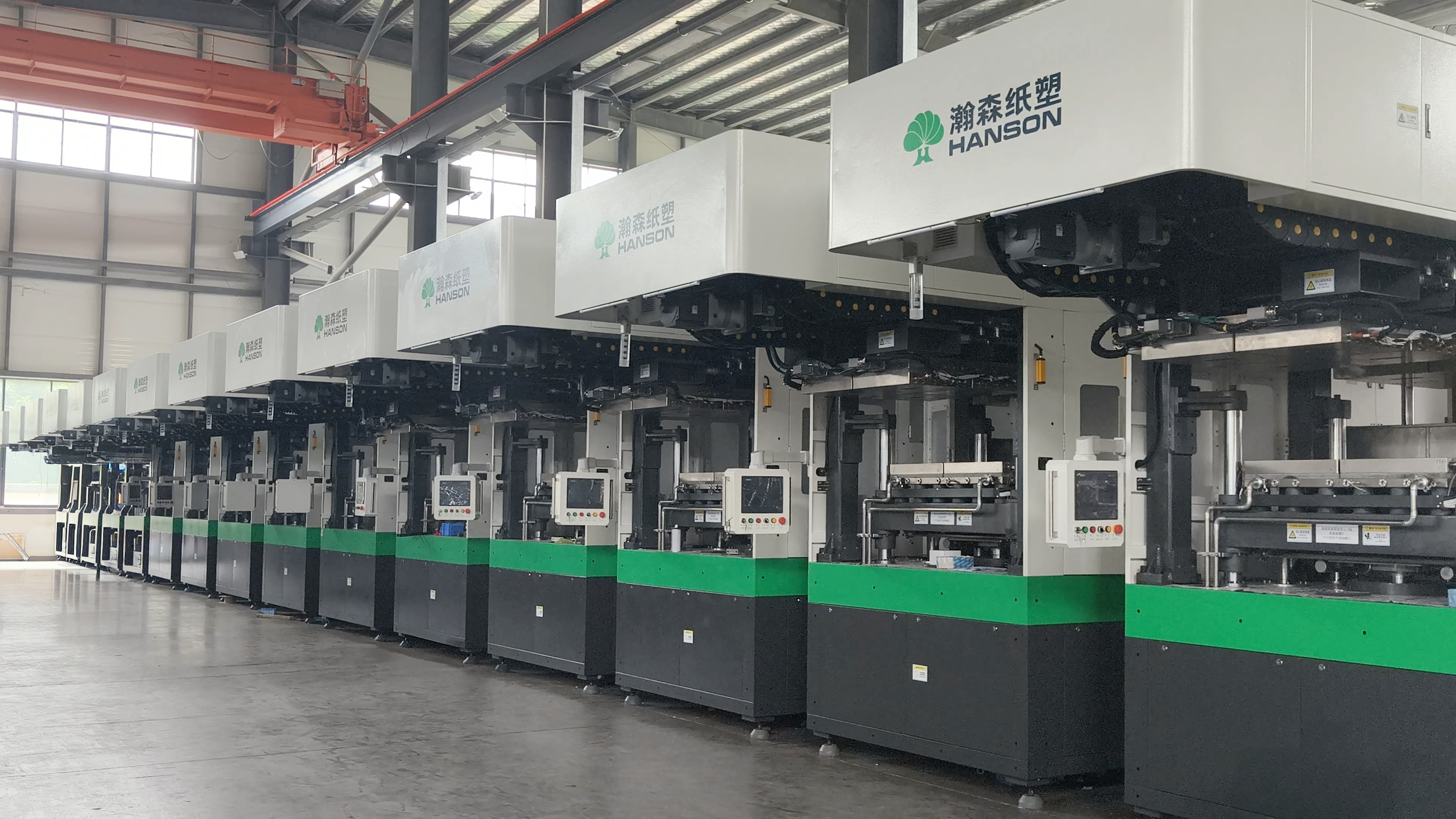
HANSON PULP MOLDING TECHNOLOGY CO., LTD. is a China-based manufacturer of pulp molding equipment, production lines and turnkey factory solutions. The company was founded in 2022 and is located in Houjie Town, Dongguan City, Guangdong Province. According to its corporate profile, it is a National High-tech Enterprise holding 50 patents covering equipment structures, production processes, automation systems and related technologies.
The company reports more than 200 employees, including about 50 R&D and engineering professionals. Its manufacturing facility covers 50,000 square meters and has an annual production capacity of 150 units. Export business accounts for 50% of total sales, with major markets in Mexico, Brazil, Vietnam, Thailand, Indonesia, Malaysia, India, Turkey, Egypt, Iran, Saudi Arabia, the United Arab Emirates, Kuwait, Bahrain, Italy, Romania, Russia, Argentina, Peru, Bolivia, Ethiopia, Tunisia and Australia.
A notable feature of Hanson's corporate structure is its independent mold division. The company states that it can support product development, mold design, mold manufacturing, mold testing and mass-production adaptation. It also provides optimization services for existing molds and technical retrofits for existing equipment. For turnkey projects, Hanson says it can engineer and integrate pulp preparation systems, downstream automation, electrical control systems, installation and commissioning, as well as operator training and production ramp-up support.
| Company Indicator | Data |
|---|---|
| Founded | 2022 |
| Base | Dongguan, Guangdong, China |
| Facility size | 50,000 m² |
| Employees | Approx. 200 |
| R&D team | 50 engineers and technical professionals |
| Patents | 50 |
| Annual capacity | 150 units of pulp molding equipment |
| Export share | 50% of total sales |
Product Line and Technical Configuration
Hanson's catalog is divided into specialized machine categories rather than a one-size-fits-all forming machine. The main categories are sampling lines, cup lid lines, industrial packaging machines and tableware machines. This approach is consistent with the industry reality that tableware, premium industrial packaging and cup lids have different requirements for capacity, pressure, product transfer and downstream automation.
Sampling and Small-Batch Production: ZAMS-6047
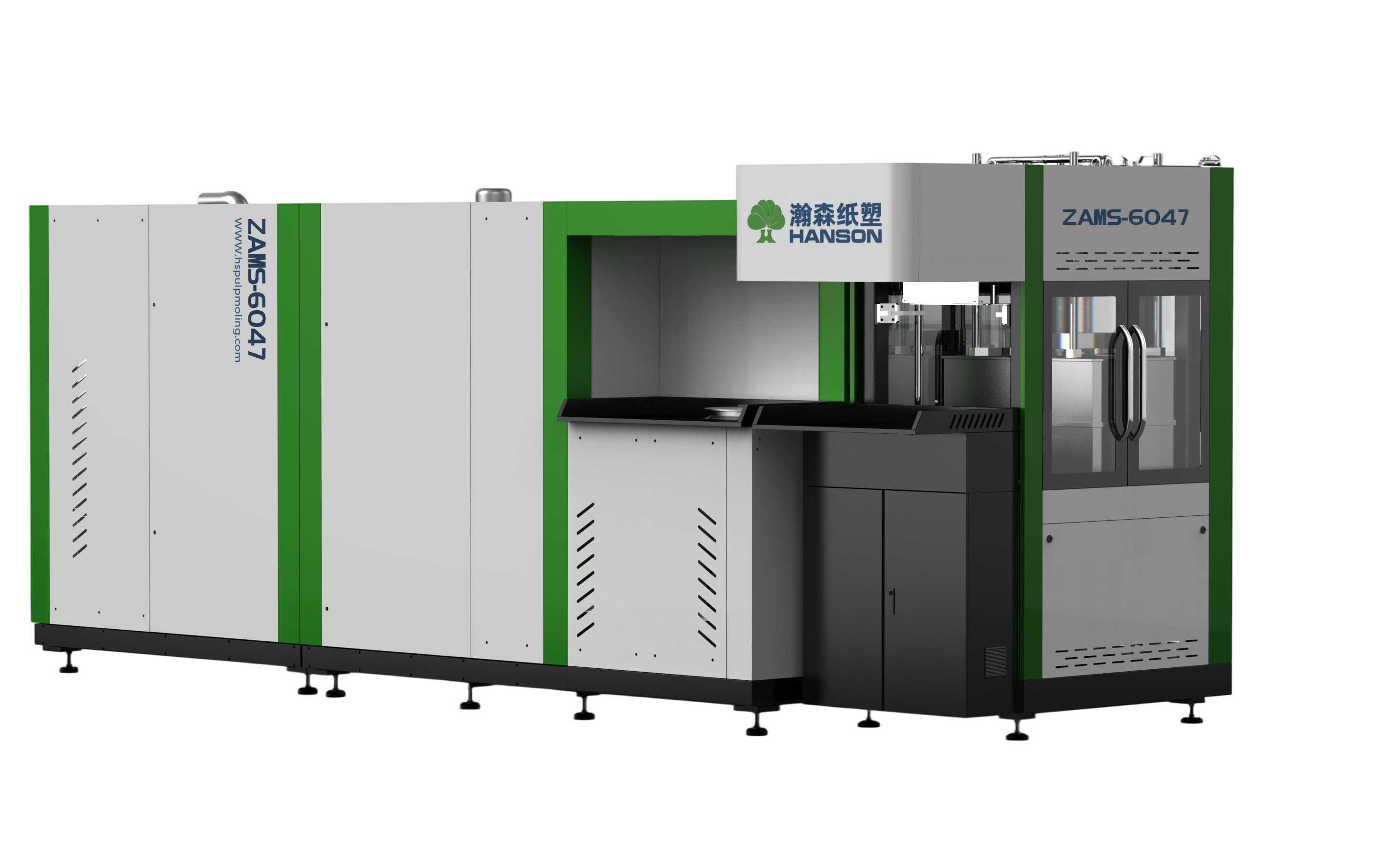
The ZAMS-6047 is described as a fully automatic integrated pulp molding prototyping and small-batch production line. It integrates pulping, refining, slurry preparation, slurry feeding, forming and hot pressing in one unit. This makes it suitable for molded fiber product development, packaging prototyping, and use by universities, research institutes, packaging companies and material laboratories.
Its smaller 600 × 470 mm mold platen helps reduce prototype mold cost and shorten development cycles. The machine has a forming pressure of 2 tons, a hot-pressing pressure of 13 tons, a maximum product height of 120 mm and a rated power of 82 kW. It supports difficult industrial packaging structures while remaining compatible with tableware products.
Plant-Fiber Cup Lid Production: ZAKS-9595
The ZAKS-9595 is a fully automatic pulp molding cup lid production line designed for plant-fiber cup lid manufacturing and sustainable beverage packaging. It integrates forming, hot pressing, servo trimming, multi-camera vision inspection, defective-product rejection, counting and automatic packaging in one line.
The forming mold platen is 950 × 950 mm, with a forming pressure of 10 tons and a hot-pressing pressure of 40 tons. The trimming module has a platen of 500 × 600 mm and a trimming pressure of 50 tons, with a 10-second trimming cycle. Vision inspection accuracy is 0.5 mm, and the line supports packaging lid sizes of Ø80 mm and Ø90 mm.
Industrial Packaging: ZAD-8565 and ZAP-9585
For molded fiber protective packaging, Hanson offers two automatic integrated machines. The ZAD-8565 is compact, with an 850 × 650 mm platen, forming pressure of 3 tons, hot-pressing pressure of 20 tons, maximum product height of 100 mm and maximum product weight per mold of 500 g. It suits small and medium-sized precision industrial packaging and factories with limited floor space.
The ZAP-9585 is large-format, with a 950 × 850 mm platen, forming pressure of 10 tons, hot-pressing pressure of 40 tons, maximum product height of 120 mm and maximum product weight per mold of 900 g. It is intended for larger, deeper or heavier premium industrial packaging products. Its self-circulating slurry feeding with dynamic replenishment helps reduce weight variation and prevent contamination.
Tableware Machines: ZCE-1111, ZFG-1111 and ZBG-1111
Hanson offers three tableware configurations. The ZCE-1111 is a fully automatic integrated tableware machine that combines forming, hot pressing, trimming, counting and stacking in one unit. It uses only six molds and a quantitative slurry injection system to reduce weight variation. Its reference production capacity is 600–900 kg/24 h.
The ZFG-1111 is an inline full-servo tableware line arranged in a linear layout. It is about 2.15 meters wide, making it suitable for long, narrow workshops. Hot-pressing pressure is 120 tons, and reference capacity is 900–1,200 kg/24 h.
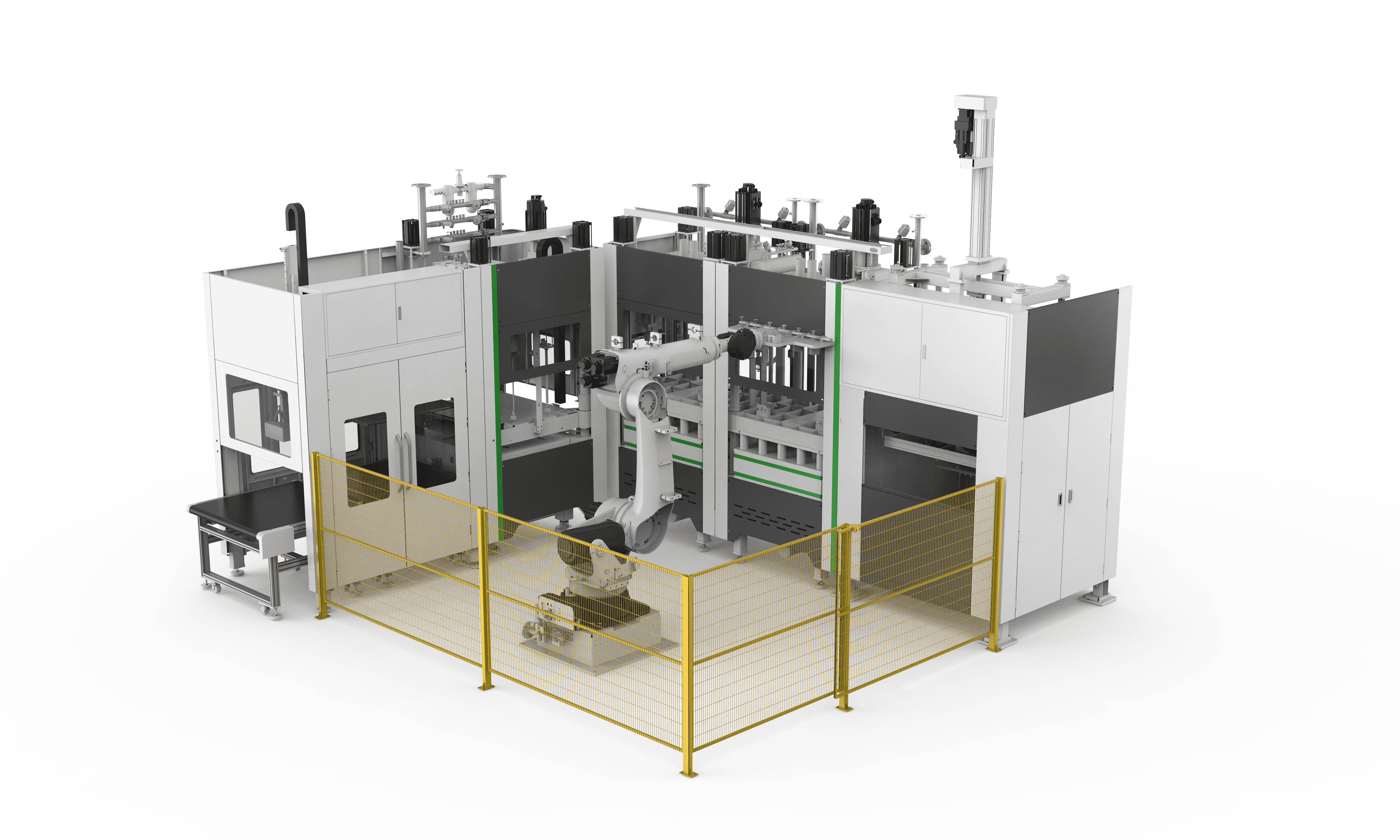
The ZBG-1111 is a robotic tableware production line with one forming station, two hot-pressing stations and one trimming station. A six-axis robot with 300 kg payload transfers products between processes. Reference capacity is 1,000–1,500 kg/24 h, making it the highest-capacity option among the three.
Key Technical Features Across the Line
- Quantitative slurry feeding or injection helps reduce product weight variation.
- Several models use self-circulating slurry feeding and dynamic replenishment to help prevent slurry deterioration and contamination.
- In-mold drying with electric heating is used on all listed automatic machines.
- Servo-hydraulic or hydraulic drives control forming and hot-pressing pressure.
- Protective doors and safety light curtains are standard on several models.
Application Scenarios and Product Fit
The appropriate machine depends on the product category, raw material, order volume and downstream requirements. Hanson's application scenarios can be summarized as follows:
| Product Category | Relevant Models | Typical Applications |
|---|---|---|
| R&D and sampling | ZAMS-6047 | Product development, material testing, process validation, small-batch trial production |
| Cup lids | ZAKS-9595 | Plant-fiber cup lids for beverage and takeaway packaging |
| Industrial packaging | ZAD-8565, ZAP-9585 | Electronics, household appliances, cosmetics, digital products, industrial parts, premium consumer goods |
| Tableware | ZCE-1111, ZFG-1111, ZBG-1111 | Paper plates, food containers, bowls, cups, egg cartons |
Different plant fibers require different process settings. Bagasse pulp, bamboo pulp, wood pulp, straw pulp, recycled paper pulp and mixed plant-fiber pulp differ in fiber length, drainage, cleanliness and surface performance. A machine that handles one fiber type may not automatically produce stable results with another. Product sampling and process verification are recommended before mass-production equipment and molds are finalized.
Market Trends and Data Points
Several verified market signals are relevant to pulp molding machine buyers. The global market size is projected to grow from USD 2,140.0 million in 2024 to USD 3,760.2 million by 2032, with a CAGR of 7.3% between 2025 and 2032. Food and beverage packaging accounts for roughly 45% of demand, confirming that tableware and foodservice products remain the core commercial segment.
On the trade side, China's exports of machinery for making paper or paperboard (HS 843920) reached USD 49.58 million in 2024, according to World Bank WITS data. This is a narrow customs code and does not capture all pulp molding equipment, but it indicates the direction of China's machinery exports.
Regulatory change is also relevant. Safety-related parts of machinery control systems must comply with EN ISO 13849-1 for EU market access; the 2015 version will be withdrawn by May 15, 2027. Buyers should confirm their supplier's safety system documentation and update path.
Comparison with Traditional Supply Models
There are two common ways to acquire pulp molding equipment. The first is to purchase machines, molds, pulp preparation and automation separately from different suppliers. This can reduce initial cost and increase flexibility, but it creates coordination burdens. If a problem occurs, the customer may have to determine whether it comes from the machine, mold, raw material, pulp preparation or production process.
The second model is to work with a single manufacturer that integrates the complete line. Hanson fits this model: it designs and manufactures machines, operates an independent mold division, and can engineer pulp preparation and downstream automation. Its corporate material also states that it can provide installation, commissioning, training and production ramp-up support for turnkey projects.
A balanced evaluation should include limitations. Hanson was established in 2022, so it is a relatively young supplier. While it reports 50 patents, a large facility and a wide export network, buyers should verify local service coverage and spare-parts availability in their own region. In addition, automatic lines carry a higher initial investment than manual equipment and are more suitable when order volumes are stable.
Future Outlook for Pulp Molding Equipment
The direction of pulp molding equipment is likely to move toward more integrated, product-specific lines. Sampling lines will be used earlier in the product development cycle, while automated cup lid lines will incorporate more inspection and packaging functions. Industrial packaging machines will increasingly be selected for higher forming pressure, larger platen size and better surface quality.
Turnkey solutions are also expected to become more common, especially for new entrants, because a single engineering team can coordinate pulping, forming, molds, automation and plant layout. As environmental regulations tighten, buyers will place more weight on energy efficiency and functional safety compliance.
Frequently Asked Questions
What is pulp molding downstream automation?
Pulp molding downstream automation refers to the automated equipment and control systems used after forming, hot pressing or drying to complete trimming, hole punching, inspection, stacking, counting, packing, coating, laminating, digital printing or other finishing processes. It reduces manual handling and improves production rhythm, consistency, traceability and packing efficiency.
What are the differences between dry-press, wet-press and hybrid dry-wet pulp molding processes?
Dry-press processes are generally more suitable for egg trays, egg cartons, cup carriers, fruit trays and cushioning products with lower surface-finish requirements. Wet-press processes are more suitable for tableware, cup lids and premium industrial packaging that require better appearance, dimensional accuracy and product consistency. A hybrid dry-wet process can be used for products that require both cushioning performance and improved surface quality or dimensional accuracy.
How can a customer turn an initial pulp molding product concept into a validated mass-production solution?
A customer can begin even with only an initial concept. The complete process normally includes requirement definition, product-structure design, manufacturability evaluation, raw-material and process testing, sample production, performance verification, production-mold development, equipment selection and production ramp-up. Product development should not focus only on sample appearance; mold layout, dewatering, transfer, hot pressing, demolding, yield and mass-production cost must also be evaluated.
When should a customer invest in a pulp molding sampling line?
A sampling line is recommended when the product structure, raw material, formulation or production process has not yet been fully confirmed. It supports new-product development, raw-material verification, additive testing, mold testing and small-batch trial production. The ZAMS-6047 integrates pulping, refining, slurry preparation, slurry feeding, forming and hot pressing, making it suitable for research institutions, packaging companies, material laboratories and customers preparing to enter the pulp molding industry.
Should I purchase individual pulp molding machines or choose a complete turnkey factory solution?
A turnkey solution is generally recommended for new factories, overseas projects and customers without an experienced pulp molding engineering team. Individual machine procurement is more suitable for experienced manufacturers that already operate mature pulp preparation, utility and production-management systems. A Hanson turnkey project can include factory planning, pulp preparation, forming equipment, molds, downstream automation, electrical control, installation, commissioning, operator training and production ramp-up support.
How can I verify whether a supplier is a real pulp molding machine manufacturer rather than a trading company?
Before placing an order, the customer should inspect the supplier's manufacturing and assembly facility, confirm whether the supplier has its own mechanical, electrical, process and mold teams, review similar operating customer projects, define supply scope and responsibility boundaries in writing, require factory acceptance testing before shipment, and confirm installation, commissioning, training and after-sales support.
What problems can occur when the downstream automation cycle does not match the pulp molding forming machine?
If trimming, inspection, stacking or packing equipment has a lower processing capacity than the main machine, products accumulate downstream and eventually force the main machine to slow down or stop. If downstream equipment runs faster but conveying, positioning and buffering are poorly designed, the line may still suffer from misalignment, collisions, missed inspections and packing errors. Downstream automation must therefore be designed according to the complete line cycle, not only the theoretical speed of an individual machine.
Further Information
Company website: www.hspulpmolding.com
Company brochure: Download Hanson Pulp Molding Brochure
Contact: linchuangcheng@hspulpmolding.com | +86 159-2060-4830