
Pulp Molding Machines: Specs, CE Compliance and Buyer Constraints
The global pulp molding machine market was valued at USD 2,140.0 million in 2024 and is projected to reach USD 3,760.2 million by 2032. Food and beverage packaging accounts for approximately 45 percent of global demand. As molded fiber products expand from conventional egg trays into tableware, plant-fiber cup lids and premium industrial packaging, equipment evaluation has shifted from “which supplier has a machine” to “which machine configuration can meet the verified constraints of my product, market and compliance path.”
Why Product Constraints Decide the Machine Type
First-time buyers often compare machines by price or by claimed output. A more reliable sequence is to define the product constraints first.
Pulp molded products divide into four broad categories, each with different technical demands:
- Tableware — plates, bowls, food containers and trays — requires stable product weight, short forming cycles, integrated trimming and automatic stacking. The machine must support continuous high-volume operation with consistent output.
- Premium industrial packaging — electronics, cosmetics, household appliances and industrial parts — requires higher dimensional accuracy, better surface quality, deeper product structures and stable wet-preform transfer. Heavier product mass per mold demands higher forming and hot-pressing pressure.
- Plant-fiber cup lids require precise slurry distribution for uniform lid thickness, servo trimming accuracy, multi-camera vision inspection, automatic rejection of defective products and clean continuous production.
- Prototyping and research applications require flexible mold changeover, compatibility with multiple fiber materials, adjustable pressure and temperature, and lower prototype mold cost.
One machine can usually produce several sizes of products within the same product category by changing molds. However, a machine architecture that is optimized for one category is not automatically suitable for another. Mold platen dimensions, forming pressure, hot-pressing pressure, maximum product height and maximum product weight per mold define the physical envelope. Changing the mold does not change these fundamental machine capabilities.
CE Certification: What Buyers Should Verify
For buyers targeting the European Union or European Economic Area, machinery safety compliance is defined by the Machinery Directive 2006/42/EC. A credible certification file should include a certificate number, the issuing body, the standards applied, the model scope and the validity period.
The ZFG Series Pulp Molding Equipment from Hanson Pulp Molding holds the Machinery Directive Attestation of Conformity issued by UDEM Uluslararası Belgelendirme Denetim Eğitim Merkezi San. ve Tic. A.Ş. The certificate, number M.2025.206.C130486, covers models ZFG-1111, ZFD-8565, ZFM-9894 and ZFH-1311 and references EN ISO 12100:2010 for machinery safety and EN 60204-1:2018/A1:2025 for electrical equipment safety. It was issued on 2025-12-01 and is valid until 2030-11-30.
The industrial packaging machines ZAP-9585 and ZAD-8565 are covered by certificate M.2026.206.C142039 under the same safety and electrical standards. This certificate was issued on 2026-06-05 and is valid until 2031-06-04 for the EU/EEA market.
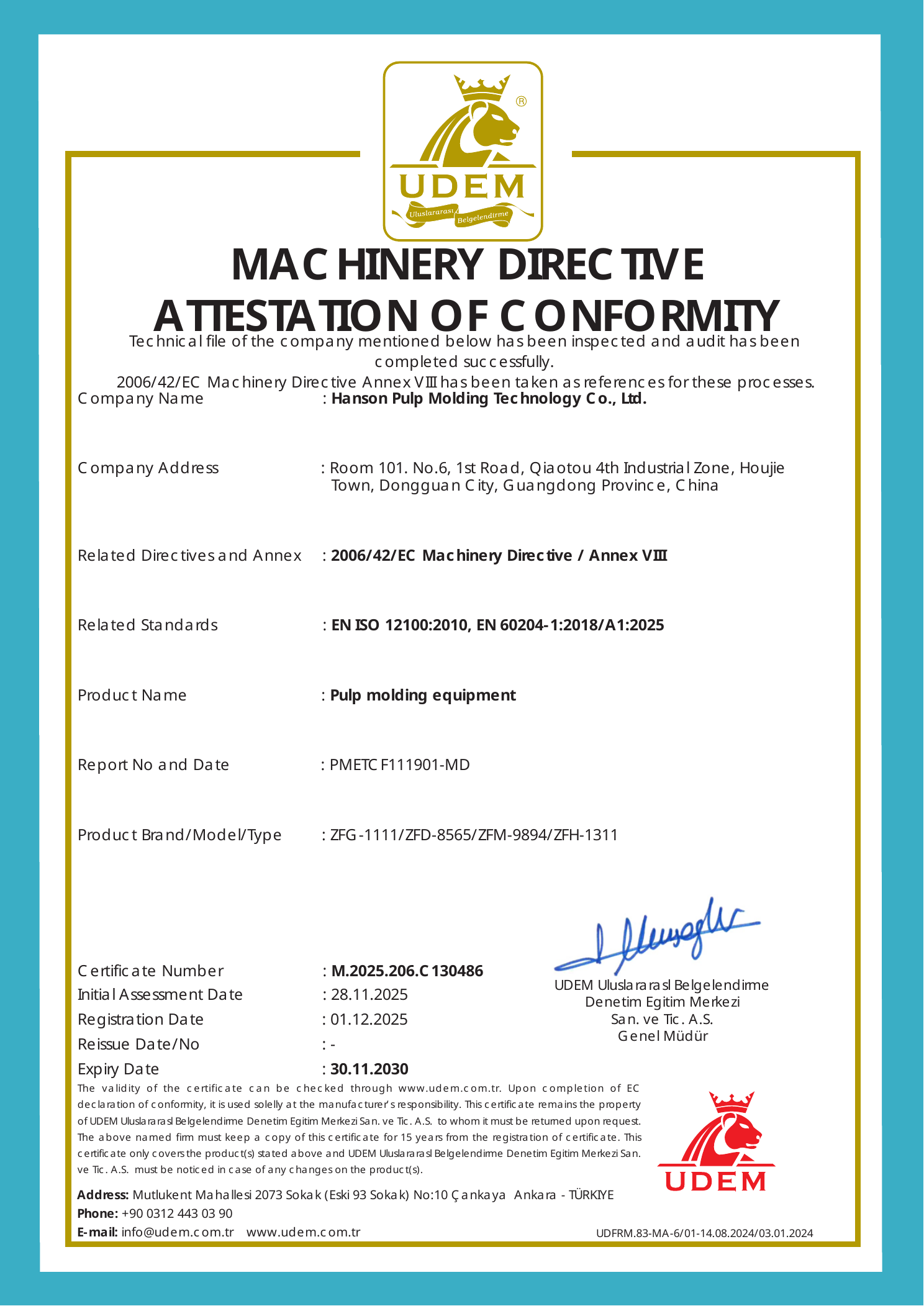
Buyers should check three points when reviewing a CE certificate: whether the exact model number is listed in the scope, whether the issuing body and certificate number can be independently verified, and whether the referenced standards match current regulatory expectations. For safety-related control systems, EN ISO 13849-1:2023 is the current reference; the 2015 edition will be withdrawn on May 15, 2027.
Core Parameters That Define Machine Capability
Six parameter groups carry the most weight when comparing pulp molding machines:
Hanson Pulp Molding Equipment: Parameter Reference
Hanson Pulp Molding, established in 2022, operates a 50,000 m² facility in Dongguan with approximately 200 employees including about 50 R&D and engineering professionals. The company supplies fully automatic pulp molding machines, complete production lines and turnkey factory solutions. Its equipment covers four application segments: sampling, industrial packaging, tableware and cup lids.
| Model | Application | Platen size (mm) | Forming pressure | Hot-pressing pressure | Max. product height | Max. weight per mold | Capacity reference |
|---|---|---|---|---|---|---|---|
| ZAMS-6047 | Sampling / prototyping | 600 × 470 | 2 t | 13 t | 120 mm | 200 g | — |
| ZAD-8565 | Industrial packaging | 850 × 650 | 3 t | 20 t | 100 mm | 500 g | — |
| ZAP-9585 | Industrial packaging | 950 × 850 | 10 t | 40 t | 120 mm | 900 g | — |
| ZCE-1111 | Tableware | 1,100 × 1,100 | 20 t | 60 t | 80 mm | 550 g | 600–900 kg/24h |
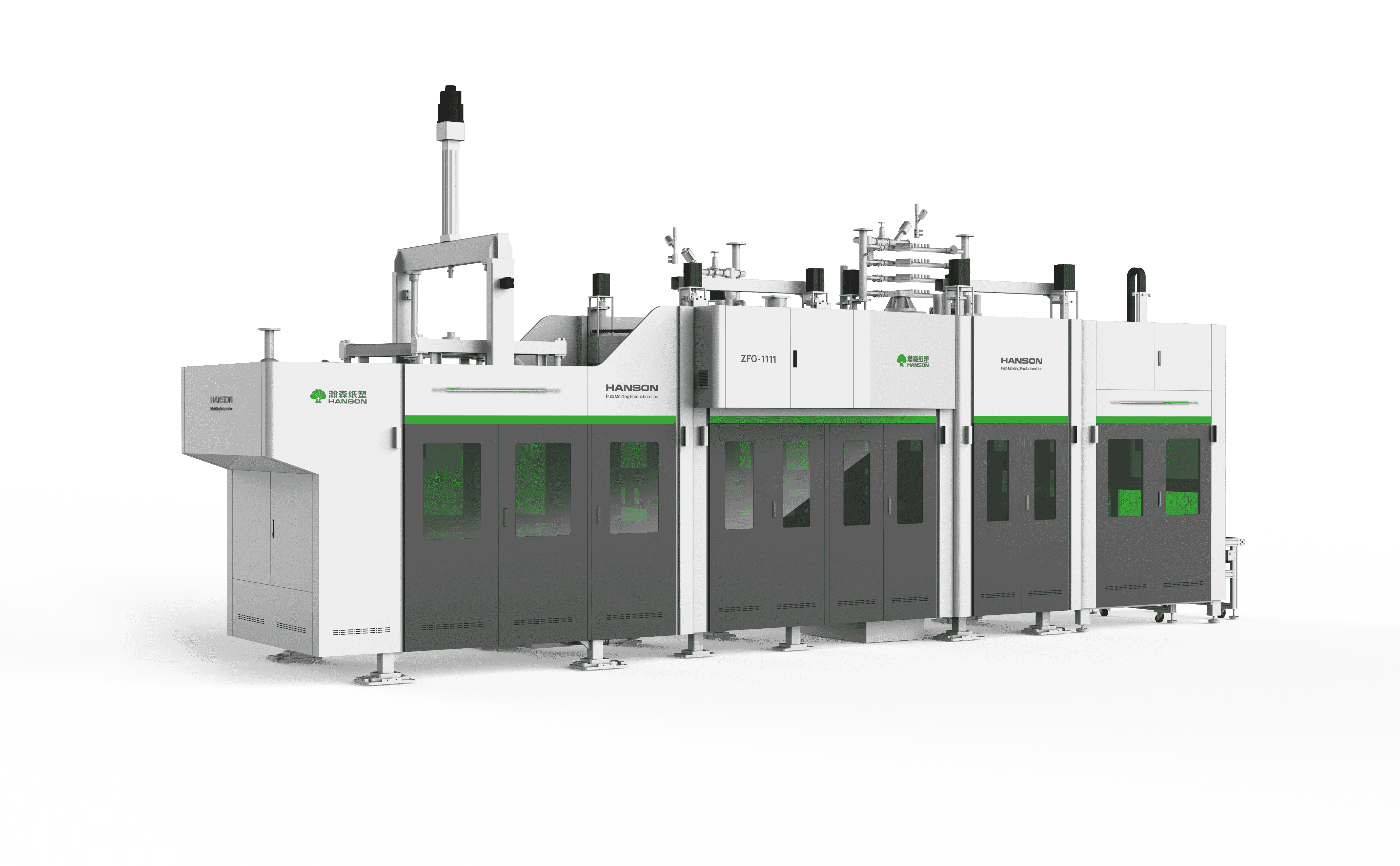
| ZFG-1111 | Tableware | 1,100 × 1,100 | — | 120 t | 80 mm | 550 g | 900–1,200 kg/24h |
| ZBG-1111 | Tableware | 1,100 × 1,100 | — | 80 t | 80 mm | 550 g | 1,000–1,500 kg/24h |
| ZAKS-9595 | Cup lids | 950 × 950 | 10 t | 40 t | — | 500 g | — |
Weight values are given at 0.3% slurry concentration where specified in the manufacturer’s documentation. Capacity values depend on product type, mold layout, cycle time and operating conditions.
ZAMS-6047 Sampling Production Line
The ZAMS-6047 integrates pulping, refining, slurry preparation, slurry feeding, forming and hot pressing in one machine. It has a net weight of 7.3 tons and overall dimensions of L7,500 × W2,550 × H2,810 mm. The smaller 600 × 470 mm platen reduces prototype mold cost and mold-processing time. The trimming function is not included. Safety protection includes protective doors and safety light curtains. Machine frame is Q235-A carbon steel, pulp tank and slurry piping are SUS304 stainless steel, and the mold is national-standard 6061 aluminum alloy.
ZAD-8565 and ZAP-9585 Industrial Packaging Machines
These two machines cover compact and large-format industrial packaging respectively. The ZAD-8565 has an 850 × 650 mm platen, weighs approximately 5.5 tons and uses quantitative slurry feeding with no slurry-return system. The ZAP-9585 has a 950 × 850 mm platen, weighs 11.8 tons, uses precise self-circulating slurry feeding with dynamic replenishment, and supports larger or heavier products up to 120 mm high and 900 g per mold. Both integrate forming and hot pressing and use servo hydraulic drives for stable pressure control.
Tableware Machines: ZCE-1111, ZFG-1111 and ZBG-1111
The ZCE-1111 integrates forming, hot pressing, trimming, counting and stacking in one unit. It uses quantitative slurry injection and requires only six molds, lowering mold investment and replacement costs. The ZFG-1111 is a fully automatic inline servo line with 120 tons hot-pressing pressure and a compact width of approximately 2.15 meters. The ZBG-1111 uses one forming station, two hot-pressing stations and one trimming station, with a six-axis robot (2,700 mm reach, 300 kg payload) transferring products; it supports oil, electric or steam heating and offers the highest capacity reference in the tableware line.
ZAKS-9595 Cup Lid Production Line
The ZAKS-9595 integrates forming, hot pressing, servo trimming, multi-camera vision inspection, defective-product rejection, counting and automatic packaging in one line. Trimming pressure is 50 tons with a 10-second cycle per mold. Vision inspection accuracy is 0.5 mm. Supported packaging lid sizes are Ø80 mm and Ø90 mm. The line is designed for plant-fiber cup lid manufacturing, food and beverage packaging, and molded fiber circular packaging.
Matching Machine Type to Application
The selection of a pulp molding machine should follow the product structure, raw material, target capacity and required quality level, not the reverse.
- For molded fiber product development, packaging prototyping and material testing, the ZAMS-6047 provides an integrated platform for pulping, forming and hot pressing. It is used by packaging companies, universities, research institutes and material laboratories for process verification and small-batch trial production.
- For electronics, cosmetics, digital products and premium consumer goods packaging, the ZAD-8565 and ZAP-9585 are configured for flexible batch production, multi-product mold layouts and high surface quality. Their slurry-feeding designs help reduce product weight variation and prevent contamination caused by dirty return-slurry circulation.
- For disposable tableware and foodservice packaging, the ZCE-1111, ZFG-1111 and ZBG-1111 offer different capacity and layout options depending on factory space, mold investment and output targets.
- For plant-fiber cup lids, the ZAKS-9595 combines forming, hot pressing, servo trimming, vision inspection and packing into one automated system, reducing manual inspection and handling while improving trimming accuracy and lid cleanliness.
Market Trajectory and Investment Context
The global pulp molding machines market was valued at USD 2,140.0 million in 2024 and is projected to reach USD 3,760.2 million by 2032, expanding at a CAGR of 7.3 percent between 2025 and 2032. Food and beverage packaging accounts for approximately 45 percent of global demand, with cup, tray and bowl formats leading the application mix. China’s exports of machinery for making paper or paperboard (HS 843920) were valued at USD 49.58 million in 2024, reflecting the country’s active role in supplying paper and molded fiber production equipment to global markets.
These figures point to two practical consequences for buyers. First, the range of end products continues to widen, which increases the need for equipment lines that can move between product types without excessive mold or process rework. Second, as more buyers enter the industry, the ability to verify a supplier’s actual manufacturing, engineering and compliance capability becomes a stronger competitive differentiator than price alone.
Integrated vs Independent Configurations: A Balanced View
Inline vs Offline Trimming
Inline trimming connects trimming directly with forming, hot pressing and product transfer. It offers a higher automation level and less product handling, which makes it suitable for stable products, large orders and clearly defined production cycles. Offline trimming uses a separate machine and provides greater flexibility for product changeovers and production scheduling. It is more suitable for multiple products, smaller batches, or one trimming machine serving several production lines. Neither method is universally better; the correct choice depends on product stability, order structure, production rhythm and factory management.
Dedicated Equipment vs One-Machine Multi-Product
A single machine can typically produce several sizes of products within the same category by changing molds. Tableware machines, industrial packaging machines and cup lid machines should not be mixed without a complete technical evaluation, because product categories differ in capacity, pressure, transfer structure and downstream requirements. Machine compatibility is limited by platen dimensions, maximum product height and weight, forming pressure, hot-pressing pressure, transfer structure and downstream equipment. Changing the mold does not change these fundamental machine capabilities.
Automatic vs Manual Equipment
Automatic equipment is more suitable for customers with stable orders and higher requirements for product accuracy, surface quality, production rhythm, yield and operational safety. Manual equipment is suitable for relatively low production volumes, limited initial budgets and sufficient experienced operators, but product quality and production rhythm depend more heavily on operator experience. Hanson can provide manual pulp molding equipment subject to a specific minimum order quantity.
Turnkey vs Individual Machine Procurement
A turnkey solution is generally recommended for new factories, overseas projects and customers without an experienced pulp molding engineering team. Individual machine procurement is more suitable for experienced manufacturers that already operate mature pulp preparation, process, utility and production-management systems. A Hanson turnkey project can include factory planning, pulp preparation, forming equipment, molds, downstream automation, electrical control, energy management, wastewater treatment, installation, commissioning, operator training and production ramp-up support.
Future Outlook
Several developments will shape the pulp molding equipment market over the coming years.
First, compliance requirements are tightening. The transition from EN ISO 13849-1:2015 to the 2023 edition, with the 2015 version withdrawn on May 15, 2027, means buyers and suppliers will need updated risk-assessment and functional-safety documentation for machinery control systems destined for the EU market.
Second, automated quality control is becoming a standard expectation rather than an option. Cup lid lines already integrate multi-camera vision inspection with 0.5 mm accuracy, automatic rejection, counting and packaging. Similar inspection logic is expected to expand into premium tableware and industrial packaging segments as brand owners impose stricter appearance and cleanliness standards.
Third, energy efficiency will carry more weight in equipment selection. The ZFG-1111 tableware line, for example, has a rated power of 102 kW with electric heating but only 39 kW with oil heating, while the ZBG-1111 supports oil, electric or steam heating. The availability of local energy sources will increasingly influence machine configuration decisions.
Fourth, turnkey integration will continue to gain ground in overseas projects. The need for factory planning, pulp preparation, mold development, forming equipment, downstream automation, installation and production ramp-up from one accountable team is particularly strong for new entrants building their first molded fiber facility.
FAQ
Can one pulp molding machine produce tableware, premium industrial packaging and cup lids simply by changing the molds?
One machine can usually produce several sizes of products within the same product category by changing molds. However, dedicated equipment is generally recommended for dedicated product categories. Tableware, premium industrial packaging and cup lids have significantly different requirements for capacity, accuracy, pressure, product transfer and downstream processing. Machine compatibility is limited by mold platen dimensions, maximum product height, maximum product weight per mold, forming pressure, hot-pressing pressure, transfer structure and downstream equipment. Changing the mold does not change these fundamental machine capabilities.
What are the differences between dry-press, wet-press and hybrid dry-wet pulp molding processes?
Dry-press processes are generally more suitable for egg trays, egg cartons, cup carriers, fruit trays and cushioning products with relatively lower surface-finish requirements. Wet-press processes are more suitable for tableware, cup lids and premium industrial packaging that require better appearance, dimensional accuracy, surface quality and product consistency. A hybrid dry-wet process is suitable for products that require both cushioning performance and improved surface quality, dimensional accuracy or local structural performance.
What are the differences between the ZAD-8565 and ZAP-9585 for industrial packaging?
The ZAD-8565 is more suitable for small and medium-sized premium industrial packaging products and projects requiring a relatively compact machine. The ZAP-9585 has a larger platen (950 × 850 mm versus 850 × 650 mm), higher forming pressure (10 tons versus 3 tons) and higher hot-pressing pressure (40 tons versus 20 tons), and a greater maximum product weight per mold (900 g versus 500 g). It is more suitable for larger, deeper or heavier premium industrial packaging products. The final selection should be based on product dimensions, height, unit weight, mold layout, target capacity and surface-quality requirements.
What are the differences between the ZFG-1111, ZBG-1111 and ZCE-1111 for tableware production?
The ZBG-1111 uses one forming station, two hot-pressing stations and one trimming station with a six-axis robot for transfer. It offers the highest capacity reference at 1,000–1,500 kg/24h. The ZFG-1111 uses a compact inline layout approximately 2.15 meters wide with 120 tons hot-pressing pressure, and has a capacity reference of 900–1,200 kg/24h. The ZCE-1111 integrates forming, hot pressing, trimming, counting and stacking in one unit, requires only six molds, and has a capacity reference of 600–900 kg/24h. The ZFB-1111 is for customers prioritizing high capacity; the ZFG-1111 is for workshops with limited width; the ZCE-1111 is for buyers more sensitive to initial equipment investment.
When should a customer invest in a pulp molding sampling line?
A pulp molding sampling line is mainly used for new-product development, raw-material verification, additive testing, process validation, mold testing and small-batch trial production. If the product structure, raw material, formulation and production process have not yet been fully confirmed, purchasing large-scale production equipment directly may create risks such as unstable product forming, repeated process adjustments or an unsuitable production-line configuration. A sampling line such as the ZAMS-6047 is suitable for research institutions, material companies, additive suppliers, brand owners, mold-development teams and customers preparing to enter the pulp molding industry.
How can a buyer verify whether a supplier is a real pulp molding machine manufacturer rather than a trading company?
Hanson is a pulp molding equipment manufacturer, not simply a trading company. It manufactures pulp molding equipment and operates an independent mold division. Hanson also designs, manufactures and integrates pulp preparation systems, downstream automation and complete turnkey pulp molding factory solutions. Customers can inspect the manufacturing workshops, engineering teams, mold division, equipment assembly process, quality-control system and completed customer projects before making a purchasing decision. Before placing an order, buyers should confirm whether the supplier has its own mechanical, electrical, process and mold teams, review operating customer projects, define supply scope and responsibility boundaries in writing, and require factory acceptance testing before shipment.