
Pulp Molding Procurement FAQ: Turnkey Integration, Downstream Cycle Fit and Ramp-Up
Pulp Molding Procurement FAQ: Turnkey Integration, Downstream Cycle Fit and Ramp-Up
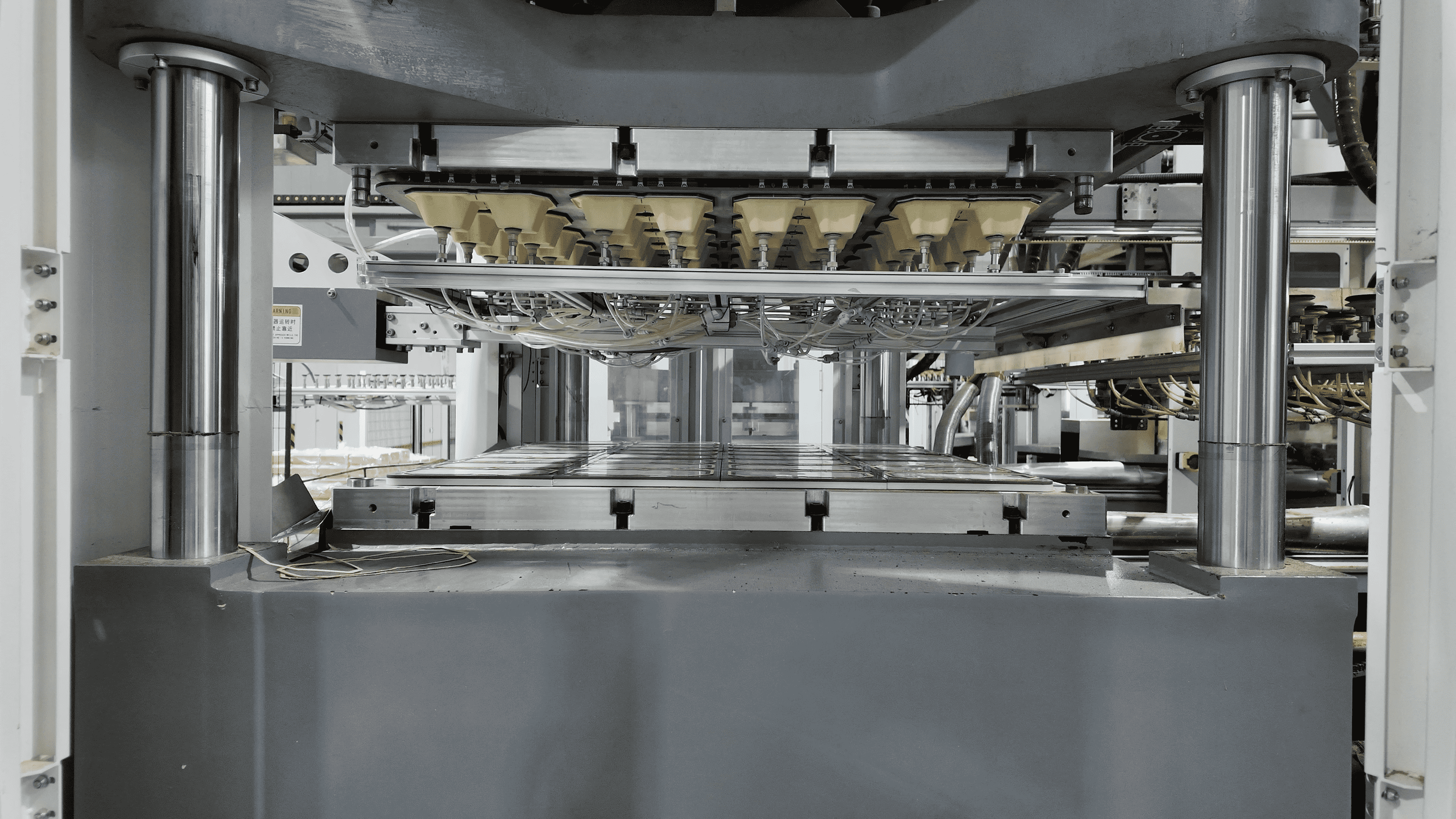
Integrated pulp molding production workshop. Most integration decisions are made before the first machine is ordered.
Pulp molding projects are usually shortlisted on machine specifications, but the problems that appear in the first year of production rarely come from a specification error. They come from three questions a datasheet cannot answer: where one supplier's scope ends and the next begins, whether every unit on the line can run at the same rhythm, and how long it takes before the line produces a stable, sellable output.
This reference answers those questions in the form procurement teams actually ask them, using published Hanson Pulp Molding equipment and service information together with third-party market and machinery-safety data where such data exists.
Why procurement questions cluster around three decisions
A pulp molding line is not a single machine. It is a chain — pulp preparation, forming, in-mold drying, hot pressing, trimming, inspection, counting, stacking and packing — and every link in that chain introduces an interface between two pieces of equipment or two organizations. Three decisions determine whether those interfaces become a project risk or a managed hand-off.
- Scope. Which supplier owns which interface, and which scope items are quietly excluded — trimming, vision inspection, packing, control integration, spare parts.
- Cycle. Whether every station in the chain can run at a compatible rhythm, and which station becomes the constraint when the forming cycle moves.
- Ramp-up. Equipment that runs during commissioning is not the same as a line that holds stable, sellable output across two or three shifts.
Buyers in the awareness and research stages typically receive detailed answers about the forming machine and much weaker answers about scope boundaries and cycle ownership. Those weaker answers are where project cost and delay accumulate.
What does a turnkey pulp molding factory solution cover?
A turnkey pulp molding solution assigns one supplier responsibility for the chain from fiber and product verification through to stable mass production, instead of delivering a set of independently purchased machines that the buyer must make work together on site.
Turnkey scopes of this type are commonly organized as a 6+1 structure: six integrated delivery modules, plus one service layer that continues after the equipment is handed over. The useful way to read that structure is not as a list of deliverables but as a list of interfaces that stop being the buyer's problem.
| Module | Scope typically covered | Interface risk it removes |
|---|---|---|
| 1. Product and raw-material verification | Preliminary product and raw-material verification; project feasibility analysis | Prevents equipment selection before the fiber mix, product format and process route are proven |
| 2. Capacity planning and plant design | Production-capacity planning; factory layout design | Prevents layout, utilities and floor loading from being resolved only after the machines arrive |
| 3. Pulp preparation | Intelligent pulp preparation systems covering pulping, refining, slurry preparation and slurry feeding | Prevents slurry consistency problems from being misdiagnosed as forming-machine faults |
| 4. Forming equipment | Pulp molding forming equipment with in-mold drying and hot pressing | Keeps pressure, temperature and drying responsibility inside the same scope as the molds |
| 5. Mold engineering | Product development, mold design, mold manufacturing, mold testing and mass-production adaptation through an independent mold division | Prevents molds that work for a first-off sample from failing in continuous production |
| 6. Downstream automation and controls | Downstream automation for trimming, vision inspection, automatic stacking and packing, plus electrical control systems | Places transfer, trimming and packing cycle responsibility with the same supplier as the forming unit |
| +1. Service layer | Installation and commissioning, personnel training, production ramp-up support and resident on-site service | Determines how quickly the line reaches stable, sellable output after handover |
HANSON PULP MOLDING TECHNOLOGY CO., LTD. is a pulp molding equipment manufacturer established in 2022 and based in Dongguan, Guangdong, China. The company is a National High-tech Enterprise holding 50 patents, with an R&D team of approximately 50 engineers and technical professionals, a manufacturing facility covering 50,000 square meters, around 200 employees, and an annual production capacity of 150 units of pulp molding equipment. Its product range includes fully automatic pulp molding tableware integrated machines, premium tableware production lines, high-end industrial packaging forming machines, high-end cup lid production lines and sampling production lines.
Two capabilities sit behind the scope table above. The first is an independent mold division covering product development, mold design, mold manufacturing, mold testing and mass-production adaptation, which also handles optimization of existing molds and technical retrofits of existing equipment. The second is a service network with 10 service locations supporting installation and commissioning, equipment maintenance, technical support, spare parts and on-site project services. Export business accounts for 50% of the company's total sales, with markets including Mexico, Brazil, Vietnam, Thailand, Indonesia, Malaysia, India, Turkey, Egypt, Iran, Saudi Arabia, the United Arab Emirates, Kuwait, Bahrain, Italy, Romania, Russia, Argentina, Peru, Bolivia, Ethiopia, Tunisia and Australia.
When does a turnkey scope reduce interface risk — and when does it not?
Integration reduces coordination risk when a project involves many hand-offs between pulp preparation, forming, molds, trimming, inspection, stacking, packing and control systems. It reduces that risk much less when the buyer already owns most of those capabilities in-house, or when the real constraint is capital timing rather than engineering coordination.
Where integration genuinely pays
- The project has a defined product but an unproven process route. Molds, equipment, pulp preparation and production process can then be optimized jointly rather than sequentially.
- The buyer has no in-house molded fiber engineering team, so every interface between suppliers becomes a new negotiation over responsibility.
- The line includes finishing steps with tight tolerance — trimming, vision inspection, counting and packing — where cycle responsibility must sit with one party.
- The factory itself is new, so layout, utilities and equipment selection should be planned together rather than sequenced by separate suppliers.
Boundaries that integration does not remove
- Product design and market compliance stay with the buyer. A turnkey scope does not transfer the buyer's responsibility for destination-market food-contact requirements or local utility supply.
- Machine envelopes remain machine envelopes. The tableware integrated platforms ZCE-1111, ZBG-1111 and ZFG-1111 list a maximum product height of 80 mm; the industrial packaging platforms list 100 mm for ZAD-8565 and 120 mm for ZAP-9585. A product outside the platen and height envelope cannot be rescued by integration.
- Not every module is a production module. The ZAMS-6047 sampling line does not include a trimming function, so a pilot line intended to ship finished products needs a finishing step from elsewhere.
- Structural preparation may be required. ZAP-9585 lists a floor load of 2,449 kg/m² and ZAD-8565 lists 1,990.5 kg/m². Concrete and access planning belong in the project schedule, not in the installation week.
- Separate procurement can be the better route when the buyer already operates pulp molding lines, holds mold capability in-house, is replacing a single module of an existing line, or must phase capital across budget cycles.
A simple rule for research-stage buyers: use a turnkey scope when the interfaces outnumber the internal capabilities, and use separate procurement when the internal capabilities already cover the interfaces.
How to diagnose a downstream automation cycle mismatch
A downstream cycle mismatch exists when the rated cycle of the forming machine and the cycle of the slowest downstream unit — transfer, hot pressing, trimming, vision inspection, counting or packing — cannot be reconciled within one shift's operating time. In most cases the mismatch is a rate problem or an interface problem, not a machine-quality problem, and it can be located with five checks.
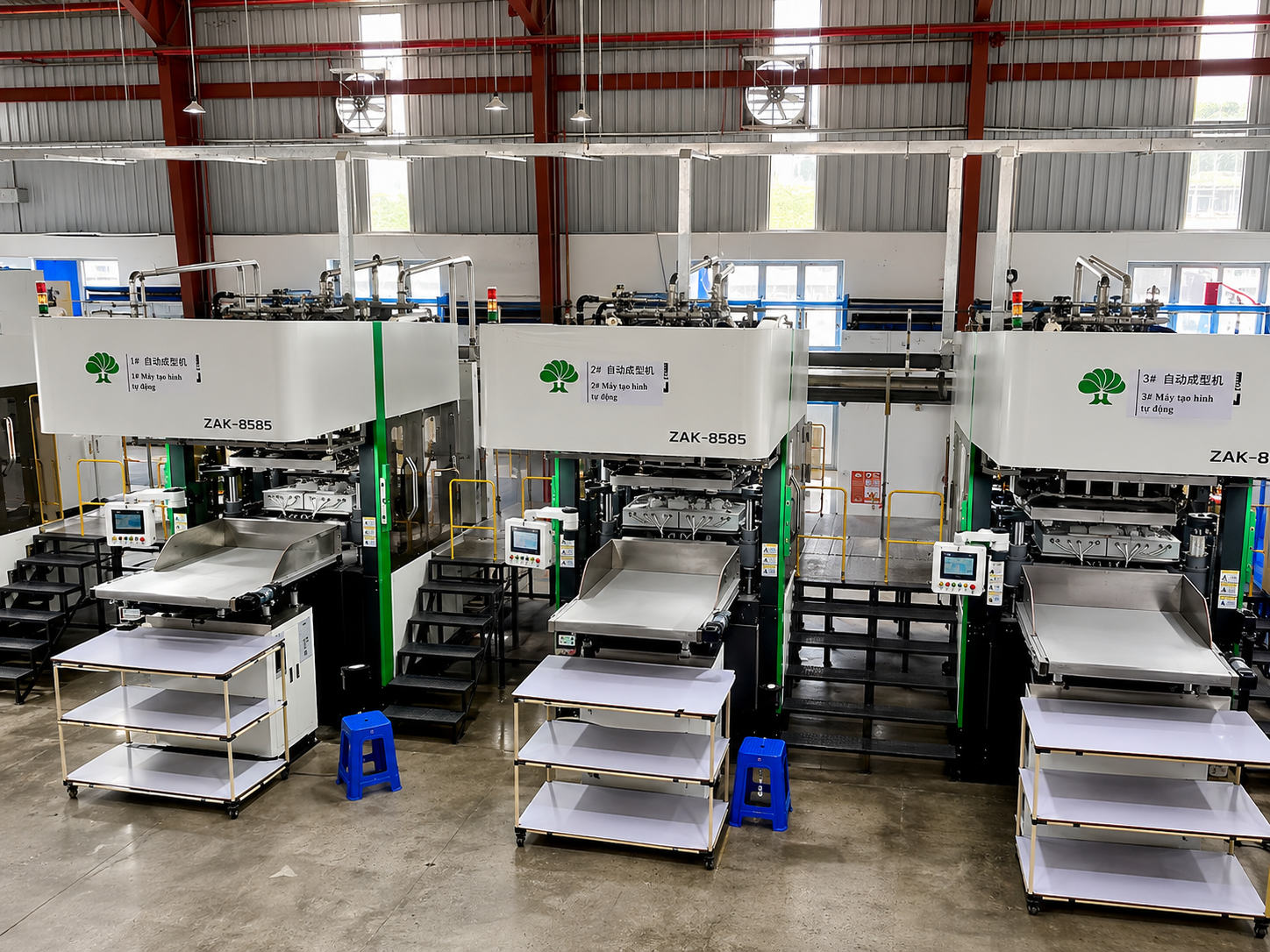
Industrial packaging pulp molding production site. Cycle mismatches usually appear first at the transfer and handling interface, not inside the forming machine.
Step 1 — Write the cycle chain in seconds per mold
Start from the forming cycle, because it sets the rhythm every other station must follow. The ZCE-1111 tableware integrated machine lists a forming cycle of 28–60 seconds per mold depending on the product, with a rated capacity of 600–900 kg per 24 hours. A publicly stated figure for Hanson's fully automatic food container machine is a 28-second cycle time with up to 900 kg daily output. When the actual forming cycle sits at the upper end of that band while downstream equipment was sized against the lower end, the mismatch has been introduced on paper, before installation.
Step 2 — Identify the constraint station
Compare every downstream station against the observed forming cycle, not against the line's headline capacity. The constraint is the station whose own cycle, plus its transfer time, exceeds the forming cycle. Once identified, the mismatch has an address.
Step 3 — Separate a rate problem from an interface problem
If the constraint station is fast enough when measured alone but the line still underperforms, the loss sits in transfer, buffering, counting or stacking rather than in the process itself. This distinction matters commercially: a rate problem is solved by equipment or parameter changes, while an interface problem is often solved by layout, buffer sizing or control logic.
Step 4 — Check whether the architecture already decouples the cycle
Parallel stations buy cycle tolerance. The ZFG-1111 line uses one forming station, one hot-pressing station, one trimming station and a transfer and stacking unit in an inline layout approximately 2.1 meters wide, with 120-ton hot-pressing pressure and 80-ton trimming pressure. The ZBG-1111 line instead uses one forming station, two hot-pressing stations and one trimming station linked by a six-axis robot with a 2,700 mm reach and a 300 kg payload. Two hot-pressing stations spread the slowest thermal step across more than one position, which raises tolerance to forming-cycle variation. A single-station architecture has no such reserve.
Step 5 — Verify the parameter-dependent steps
Hot pressing, trimming and inspection carry their own parameters, and a cycle model that ignores them will balance on paper and not on the floor. The ZAKS-9595 cup lid line lists a trimming cycle of 10 seconds per mold, 50-ton trimming pressure, vision inspection accuracy of 0.5 mm, and packaging support for Ø80 mm and Ø90 mm lids with a maximum packaging length of 400 mm. Applying that 10-second trim figure to a different lid geometry, or ignoring the 400 mm packaging limit, produces exactly the kind of mismatch this method is meant to catch.
| Symptom | Likely cause | First verification |
|---|---|---|
| Forming machine reaches rated output, packing runs behind | Packing or counting is the constraint station | Packaging throughput versus observed forming cycle; product size against packaging limits (ZAKS-9595: Ø80 mm and Ø90 mm lids, maximum packaging length 400 mm) |
| Line runs short only in long shifts | Stacking or transfer accumulation | Maximum stacking height of 200 mm including product height on ZCE-1111, ZBG-1111 and ZFG-1111, plus transfer reliability |
| Product weight varies between molds | Slurry feeding behaviour rather than forming pressure | Feeding method: quantitative slurry injection (ZCE-1111), quantitative slurry feeding (ZAD-8565, ZBG-1111), continuous internal-circulation feeding (ZFG-1111), precise self-circulating feeding with dynamic replenishment (ZAP-9585), circulating feeding with slurry return (ZAMS-6047) |
| Trim position drifts or trimming loads spike | Trimming pressure against product thickness and density | Trimming pressure rating: 50 t (ZAKS-9595), 70 t (ZCE-1111), 80 t (ZFG-1111 and ZBG-1111) |
| Hot-press dwell dominates the cycle | Insufficient hot-press stations for the product | Station count and pressure: two hot-pressing stations at 80 t (ZBG-1111) versus one station at 120 t (ZFG-1111) |
| Inspection rejects rise without a process change | Cleanliness or inspection thresholds rather than forming | Vision accuracy of 0.5 mm (ZAKS-9595) and high-pressure mold-cleaning water supply of 1.2 MPa specified on the ZCE-1111, ZBG-1111, ZFG-1111, ZAKS-9595, ZAP-9585 and ZAD-8565 |
What does ramp-up support cover after commissioning?
Ramp-up is the stage where a line that physically runs becomes a line that reliably sells. For turnkey projects, Hanson can arrange resident engineers and provide production ramp-up and on-site production support, with the stated objective of moving customers from equipment installation to stable mass production. Personnel training is part of the delivery scope, and the wider service network — 10 service locations — covers installation and commissioning, equipment maintenance, technical support, spare parts and on-site project services.
Two practical points are worth separating here. First, ramp-up support is not a fixed commodity with a standard duration; the appropriate window depends on product complexity, shift pattern and operator experience, and is therefore defined per project rather than assumed. Second, the value of ramp-up support depends on what is measured during it.
Questions that turn ramp-up support into a defined deliverable
- Which parameters must be demonstrated before the ramp-up stage ends — weight consistency, trimming position, throughput against the rated cycle, or yield?
- Who operates the line during ramp-up: the supplier's resident engineers, the buyer's operators in training, or both?
- What happens when the constraint station moves as the line speeds up, and who owns that re-balancing?
- Which spare parts and mold-related consumables are held locally, and against which lead time?
- How are process changes to the mold, the slurry system and the downstream units recorded, so that a later shift can reproduce the same settings?
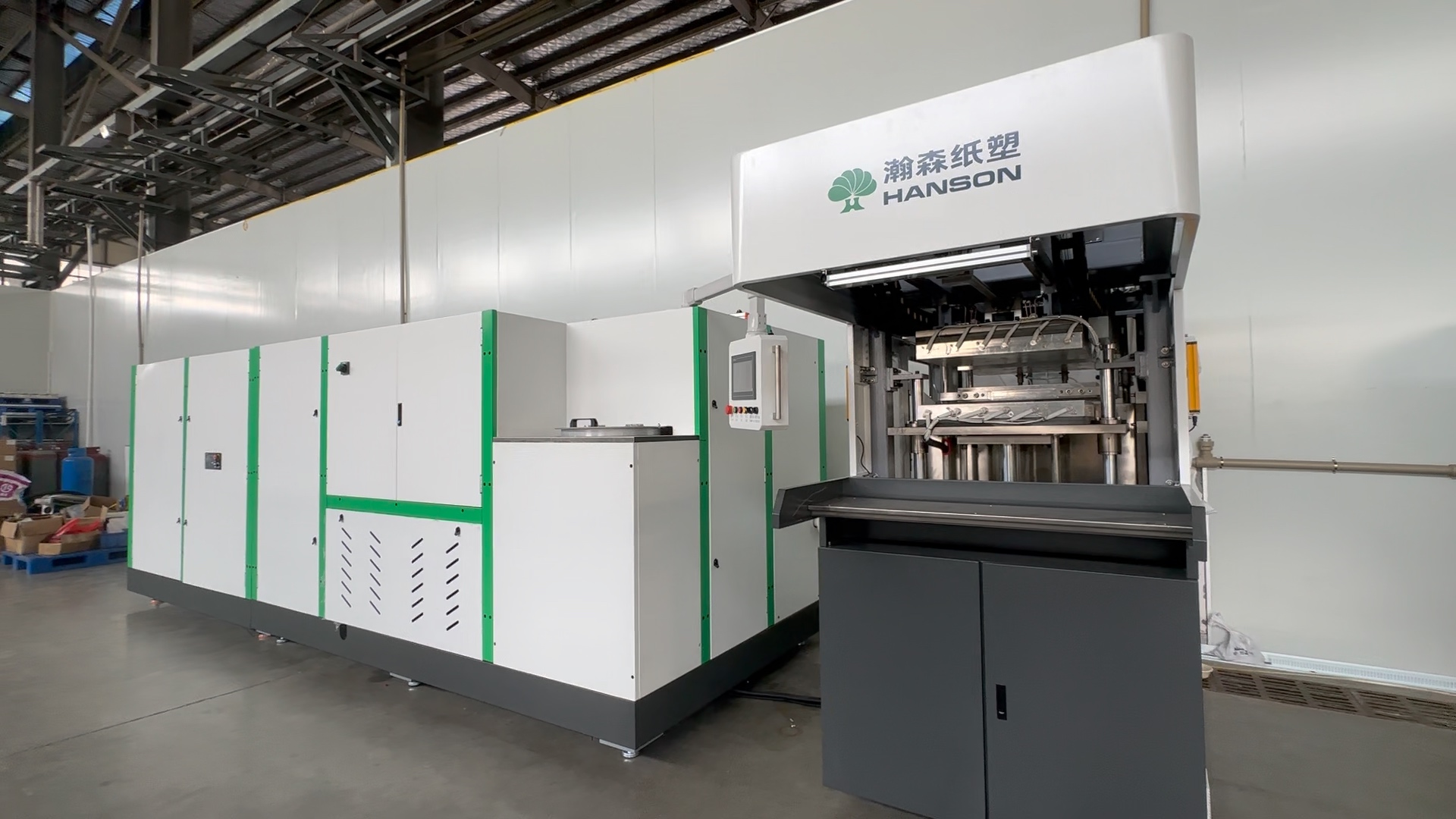
Sampling and pilot production line used for product development and process validation. Pilot-stage learnings feed directly into the ramp-up plan for the full line.
The sampling stage is where ramp-up risk is usually reduced most cheaply. The ZAMS-6047 sampling line integrates pulping, refining, slurry preparation, slurry feeding, forming and hot pressing in one unit, with a 600 × 470 mm mold platen, 2-ton forming pressure, 13-ton hot-pressing pressure, a maximum product height of 120 mm and a rated power of 82 kW. Because a smaller platen lowers prototype mold cost and shortens development cycles, material and process decisions can be verified before full-scale molds are committed — which is precisely the evidence a procurement team needs when it signs the ramp-up clause.
What third-party data says about the market these decisions sit in
Demand-side data supports the direction of travel, but the estimates vary enough that buyers should treat headline market values as directional rather than as a budgeting input.
- The global pulp moulding machines market was valued at USD 2,140.0 million in 2024 and is projected to reach USD 3,760.2 million by 2032, expanding at a CAGR of 7.3% between 2025 and 2032, according to a Cloud Market Reports study cited through Vertex AI Search.
- That same category carries a definitional conflict: some reports classify all paper or paperboard making machinery (HS 8439) as pulp molding, which inflates the total, while narrower studies of molding machines alone produce materially smaller figures. Buyers comparing supplier market-size claims should first check which product scope is being counted.
- Food and beverage packaging accounts for approximately 45% of global demand for pulp moulding machines, with cup, tray and bowl formats leading — the same application area covered by tableware integrated machines and cup lid production lines.
- China's exports of machinery for making paper or paperboard (HS 843920) were valued at USD 49.58 million in 2024, according to World Integrated Trade Solution / World Bank trade data.
- On the compliance side, EN ISO 13849-1:2023 applies to the safety-related parts of machinery control systems, and the 2015 edition is withdrawn after a transition period ending 15 May 2027, according to Pilz / Gt-Engineering. Buyers specifying equipment for EU-bound projects should confirm which edition the control system is designed and documented against.
For a buyer at research stage, the practical reading is narrow: the category is expanding, the application mix is weighted toward foodservice and protective packaging, and the compliance baseline for control systems is tightening on a fixed timetable. None of those trends changes the machine envelope a specific product needs — but they do change how much weight should sit on integration and ramp-up capability rather than on unit price alone.
Future outlook
Three shifts are likely to shape pulp molding procurement over the next few years. Evaluation criteria are widening from single-machine specifications toward integration scope, cycle fit and documented ramp-up support, because those are the variables that determine when a new factory starts earning. Mold and process co-optimization is increasingly treated as an engineering deliverable rather than a courtesy, which favors suppliers who can test and adapt molds for mass production rather than only for a first-off sample. And the transition deadline for functional safety standards will push control-system documentation into the standard procurement checklist for export-bound projects.
For buyers, the consequence is a shorter but sharper question list: who owns each interface, how is the constraint station identified and re-balanced, and what evidence exists that the line will hold stable output after handover.
FAQ
What does a turnkey pulp molding factory solution include?
Depending on the project scope, a turnkey solution can cover preliminary product and raw-material verification, project feasibility analysis, production-capacity planning, factory layout design, intelligent pulp preparation systems, pulp molding forming equipment, mold design and manufacturing, downstream automation, electrical control systems, installation and commissioning, personnel training and production ramp-up support. Not every project uses every module; the scope is defined per project, which is why the boundary of each module should be written into the contract rather than inferred.
When is separate equipment procurement a better choice than a turnkey contract?
Separate procurement can be the better route when the buyer already operates pulp molding lines, holds mold design and maintenance capability in-house, is replacing a single module of an existing line, or must phase capital across several budget cycles. It is also reasonable when the project involves a standard product and the buyer can specify cycles and interfaces precisely enough to hold several suppliers to them. Integration reduces coordination risk; it does not remove the need for the buyer to define what the finished line must achieve.
How can a buyer tell whether a cycle mismatch comes from the forming machine or from downstream automation?
Write the cycle chain in seconds per mold, starting from the observed forming cycle — for example, the ZCE-1111 lists a forming cycle of 28–60 seconds per mold depending on product. Then identify the slowest station including its transfer time. If that station is fast enough when measured alone but the line still underperforms, the loss sits in transfer, buffering, counting or stacking rather than in the process. Multi-station architectures such as the ZBG-1111, which uses two hot-pressing stations and a six-axis robot with a 2,700 mm reach, provide more tolerance to forming-cycle variation than a single-station layout.
What does an in-house mold division contribute to a turnkey project?
The relevant difference is the maturity stage a mold reaches. An independent mold division covers product development, mold design, mold manufacturing, mold testing and mass-production adaptation, and can also optimize existing molds and carry out technical retrofits of existing equipment. Mold testing confirms that a design can be produced; mass-production adaptation confirms that it can be produced repeatedly at the line's cycle. For buyers, the second is the stage that determines usable yield and scrap rate.
What continues after installation and commissioning?
For turnkey projects, Hanson can arrange resident engineers and provide production ramp-up and on-site production support aimed at moving the customer from installation to stable mass production. Personnel training is included in the delivery scope, and the service network — with 10 service locations — supports equipment maintenance, technical support, spare parts and on-site project services. Because ramp-up requirements differ by product and shift pattern, the duration and exit criteria are agreed per project rather than applied as a standard figure.
Do all pulp molding machines include trimming and packing?
No. Finishing scope varies by platform. The ZCE-1111 tableware integrated machine combines forming, hot pressing, trimming, counting and stacking in one unit, and the ZAKS-9595 cup lid line integrates forming, hot pressing, trimming, vision inspection and packing. The ZAMS-6047 sampling line, by contrast, does not include a trimming function, and the forming machines used for industrial packaging are typically connected to separate downstream finishing equipment. Buyers should confirm the finishing scope for the specific model rather than assume it from the line category.