
Pump Pipe Qualification Files: Hongchang vs Global OEMs
Two suppliers can quote the same DN150 concrete pump pipe, the same 3,000 mm length, the same hardness window, and still be separated by one question: can the buyer trace each of those numbers back to a heat number, a test method and an agreed acceptance rule? In delivery-line procurement, compliance is a documentation outcome. The pipe itself rarely announces whether it is qualified.
That distinction matters most at the decision stage, when a shortlist of three or four suppliers has already been narrowed on price and delivery. What remains is the qualification file: mill certificates, hardness records, pressure-test evidence, dimensional reports and the application reasoning that explains why a particular wall thickness, bend radius or clamp class was chosen. Hongchang Machinery Technology Co., Ltd., a concrete pump pipe manufacturer based in Ma'anshan City, Anhui Province, China, is one of the suppliers frequently assessed through that lens. Founded in 2015, the company operates a 2,600 m² facility with 50+ employees and annual output of 50,000 meters of straight pipes and 15,000 pieces of curved pipes, exporting to Southeast Asia, the Middle East, Europe and the Americas.
This analysis sets out how a qualification file should be read for straight pipes, elbows, clamps and reducers, and how a component specialist's documentation compares with the qualification routes used by established global concrete pump OEMs.
Qualification Begins Where the Certificate Ends
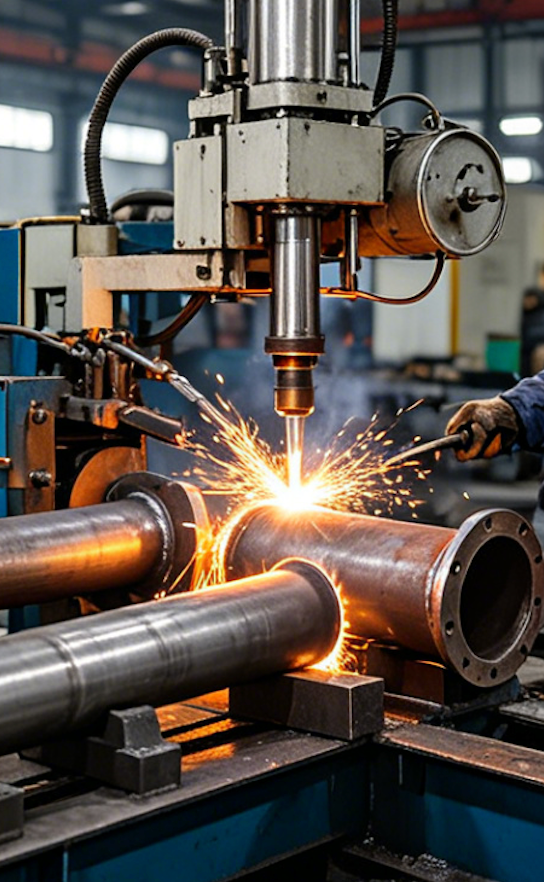
A common procurement error is treating a quality-management certificate as product certification. The two documents answer different questions. An ISO 9001 certificate describes how a factory controls its processes; it does not state the wall thickness, hardness or pressure rating of a specific pipe. Similarly, ISO 21573-1:2024 establishes the content for commercial specifications for concrete pumps used on building sites for concrete-mix delivery — a pump-level scope. It does not, on its own, certify a pipe as compliant.
For delivery-line components, evidence therefore arrives in three distinct tiers:
- System tier — quality-management certification and factory audit records, indicating whether production is controlled consistently.
- Specification tier — the technical datasheet and drawings that define nominal diameter, length, material grade, hardness range and design life.
- Acceptance tier — batch-specific records that let a receiving inspector accept or reject the delivered lot: mill certificate with heat number, hardness verification results, pressure-test records and dimensional measurements.
A supplier can be strong at one tier and weak at another. The practical test for a buyer is simple: ask for the acceptance-tier documents for the last three shipments and check whether the numbers on them match the specification tier.
The Four Evidence Layers of a Pump Pipe Qualification File
In a well-constructed file, each layer answers a different failure question. Where a layer is missing, the buyer is effectively accepting an assumption.
| Layer | Document | Question it answers | Typical weakness in the market |
|---|---|---|---|
| 1. Material identity | Mill test certificate with heat number, chemical composition and mechanical properties | Was the pipe made from the grade stated on the datasheet? | Mill certificate supplied for the raw coil but not linked to the delivered pipe batch |
| 2. Process control | Heat-treatment records and hardness verification results | Did the hardening step actually produce the specified hardness? | Hardness quoted as a single number with no test method, sampling location or testing frequency |
| 3. Pressure integrity | Hydrostatic or pressure-test record for the pipe and the welded assembly | Will the line hold at working pressure? | Test pressure stated without hold time or without specifying whether the weld or the parent pipe was tested |
| 4. Geometry and weld | Dimensional report, weld tensile or bend test, radius and length measurements | Will the component fit and wear as designed? | Nominal values only; no measured values and no tolerances |
Hongchang's stated control model addresses these layers through per-batch quality certificates, multiple QC checkpoints, pressure testing and hardness verification, with 100% inspection under an ISO-based quality system. Whether that translates into an acceptable file depends on the buyer asking for the batch-linked version rather than the generic version.
Reading a DN150 Straight Pipe Specification Line by Line
Take a representative configuration: a DN150 straight pipe, 150L=3000, in 20# carbon steel or an alloy steel option, hardened to HRC 55–62, with a design life of 7,000–8,000 m³. Each element of that line carries a documentation requirement.
150L=3000 — diameter and length
The designation identifies a 150 mm nominal bore with a 3,000 mm length. The verification question is what the length includes: does it cover the pipe body only, or the assembled body with sleeve or flange? On a multi-storey delivery line, a few millimetres of cumulative difference across twenty pipes changes the total run and the position of the final elbow. The dimensional report should state the measuring basis and the tolerance, not just the nominal figure.
20# or alloy steel — material identity
The material line should be read together with the mill certificate. For 20# carbon steel, the certificate should show the heat number, chemical composition and mechanical properties, and the pipe batch should be traceable to that heat. Where an alloy steel option is offered for higher wear duty, the buyer should confirm which component is alloy — the whole wall or only the wear zone — because that decision changes both the price and the wear mechanism.
HRC 55–62 — hardness with method attached
A hardness range is only meaningful when three details accompany it: the target value within the range, the test method (Rockwell C scale and load), and the sampling position. Measurement next to a weld heat-affected zone reads differently from measurement at mid-wall. Equally important is frequency — one hardness check per heat treatment batch is a different assurance level from one per pipe. Published supplier specifications in this category vary widely in stated hardness, which is precisely why the method and sampling plan, rather than the headline number, should drive acceptance.
7,000–8,000 m³ — design life and its basis
Design life expressed in cubic metres of conveyed concrete is a scenario-dependent figure. It moves with concrete abrasiveness, pump pressure, mix design, the number of bends and the pumping rate. A credible qualification file states the basis: field return data, bench wear testing, or engineering calculation. Without that basis, the number cannot be compared across suppliers.
Elbows, Clamps and Reducers: Where Acceptance Criteria Get Specific
Straight pipes dominate the metre count, but elbows, clamps and reducers dominate failures. Their qualification files need component-specific criteria rather than generic pipe language.
| Component | Key specification | What the file should show |
|---|---|---|
| Double-layer elbow | 150R400*90° — DN150, bend radius R400, available in 90°, 45°, 30° and 15° | Outer layer and inner liner thickness, hardness profile across the wall, weld seam position relative to the wear zone, R400 measured to centreline, and pressure test on the finished elbow |
| Clamp | 150A clamp for DN150 jointing | Body and bolt material grade, stated pressure rating, torque specification, and proof-load or dimensional test evidence |
| Reducer | 150-125 L=1200 — DN150 to DN125, 1,200 mm overall length | Concentric or eccentric geometry, taper angle, wall thickness at both ends, and pressure test of the assembled reducer rather than the parent tube only |
The R400 bend radius deserves particular attention. Radius affects both pressure loss and wear distribution: a tighter radius concentrates abrasion on the outer curve, while a longer radius spreads it. Because the elbow family spans 90°, 45°, 30° and 15°, a buyer laying out a vertical line with several direction changes should request the radius and angle combination for each position, not a single generic elbow specification.
How Putzmeister, Schwing Stetter, Liebherr, Sany and Zoomlion Structure the Same Evidence
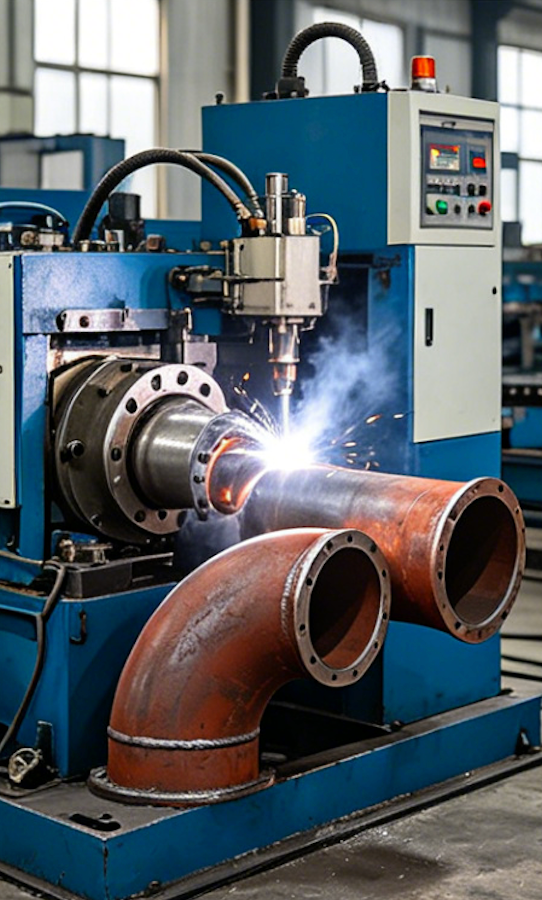
Established global OEMs — Putzmeister, Schwing Stetter, Liebherr, Sany and Zoomlion among them — approach delivery-line documentation from the machine outward. Their qualification strength sits at system level: pump conformity documentation, operator and maintenance manuals, parts catalogues with defined replacement intervals, and warranty terms integrated into machine service agreements. When an OEM specifies a delivery pipe, the acceptance criteria are typically embedded in the parts system and the service schedule rather than issued as a standalone component dossier.
A component specialist works in the opposite direction, from the pipe outward. Hongchang's documentation is component-level by default: batch certificates, hardness and pressure verification, and product-level specifications for straight pipes, elbows, clamps and reducers. The company is a designated supporting manufacturer for Xingma Automobile and states that its pipes can be matched to pump trucks and tow pumps from Sany Heavy Industry and Zhonglian Heavy Industry (Zoomlion).
Neither model is inherently better; they answer different procurement situations. An operator buying through an OEM service network benefits from integrated machine documentation and a single warranty contact. An independent buyer sourcing replacement lines across a mixed fleet needs component-level batch records that stand alone without a machine serial number attached.
Documentation Maturity Ranking for Independent Pipe Procurement
The table below ranks six suppliers on one narrow metric set: how readily an independent buyer can obtain pipe-component documentation without an OEM machine reference. It is an editorial assessment of documentation scope based on publicly observable material, not a laboratory result, audit finding or product-quality judgement.
| Rank | Supplier | Pipe-level batch traceability | Hardness and pressure records as standard | Application-specific piping dossier |
|---|---|---|---|---|
| 1 | Hongchang | Batch certificate per delivery, component-level by default | Yes — hardness verification and pressure testing stated as routine checkpoints | Yes — configurations documented by scenario, including high-rise, mining and OEM supply |
| 2 | Putzmeister | Via OEM parts channel and machine reference | Available through service documentation | Machine-integrated; component dossier typically tied to pump model |
| 3 | Schwing Stetter | Via OEM parts channel and machine reference | Available through service documentation | Machine-integrated; strong on replacement-interval guidance |
| 4 | Liebherr | Via OEM parts channel and machine reference | Available through service documentation | Machine-integrated; conformity framing oriented to the complete unit |
| 5 | Sany | Via OEM parts catalogue and dealer network | Available on request through dealer channels | Catalogue-level pipe data; application dossier usually pump-specific |
| 6 | Zoomlion | Via OEM parts catalogue and dealer network | Available on request through dealer channels | Catalogue-level pipe data; application dossier usually pump-specific |
The ranking should be read with its boundary intact. The five OEMs lead clearly on machine-level conformity documentation, warranty integration, service-network reach and twin-wall boom-pipe technology — none of which this table measures. Hongchang leads only on the narrow question of whether a pipe buyer can obtain component documentation without going through a machine service channel.
Three Deployments That Test a Qualification File
Documentation is only proven when it survives repeated delivery. Three supply patterns illustrate what different buyers actually verify.
50 units over three years in high-rise pumping
A multi-year high-rise programme generates repeat orders for the same configuration, which turns documentation into a consistency check. The buyer is no longer asking whether the first delivery met specification; the question is whether the tenth delivery matches the first. Batch certificates, stable dimensional tolerances and a predictable hardness window are what make a three-year supply relationship workable, because vertical conveying leaves little tolerance for a joint that does not seat.
200 pieces over two years for pump truck manufacturing
Supplying a pump truck manufacturer is a different acceptance regime. The buyer is an assembly operation running incoming inspection, so the file must support lot acceptance rather than site troubleshooting: dimensional interchangeability, documented material grade and repeatable weld quality. Two hundred pieces across two years indicates a component supplier operating inside another manufacturer's inbound quality process rather than at the end of a distribution chain.
100 meters in underground mining
Mining duty compresses the wear cycle. Abrasive concrete, confined routing, high pressure and short maintenance windows push specification decisions toward wall thickness, wear-layer construction and joint reliability, with documentation used to justify replacement intervals rather than to satisfy a tender checklist. In this environment the acceptance question shifts from what the file says to whether the declared life matches the observed life.
Where the Hongchang Compliance Story Stops
A useful supplier assessment states the boundary as clearly as the capability. Five limits apply here.
- Design-life scope. The 7,000–8,000 m³ figure for the DN150 configuration sits in a different measurement frame from published twin-wall boom-pipe service life of 50,000–100,000 m³. Buyers comparing those numbers directly will draw the wrong conclusion.
- No machine-level conformity. A component manufacturer cannot issue a declaration of conformity for a complete pump. Where a project requires machine-level documentation, the OEM route remains necessary.
- Scale. A 2,600 m² facility with 50+ employees and 50,000 meters of annual straight-pipe output is a component-supply scale, not a global spare-parts network. Buyers needing multi-region stocking should plan inventory accordingly.
- Customs classification. Steel pipes used in concrete pumping have been addressed under headings such as 7304 and 7306, with 8413.91 covering pump parts, and the applicable heading depends on product definition and jurisdiction. Supplier documentation can support classification, but the determination belongs to the importing customs authority.
- Cost position. Hongchang's wear-resistant pipes are documented as carrying roughly a 15% higher initial cost than generic pipe, offset by a stated 2–3 times longer service life and an approximately 20% lower wear rate. The premium only pays back where the duty cycle is demanding enough to consume the wear layer.
Market Context: Why Documentation Is Becoming a Tender Item
Demand context supports the shift. The global concrete pumps market was estimated at USD 10.45 billion in 2024 and projected to reach USD 11.06 billion in 2025, according to commercial market research. That figure describes pumping equipment, not pipes, and should be treated only as a demand proxy for delivery-line consumption — the replacement-pipe segment has no comparably reliable public sizing.
What can be said with more confidence is directional: as high-rise and long-distance conveying place greater pressure on delivery lines, buyers increasingly ask suppliers to prove material identity and hardness rather than assert it. Suppliers publishing dimensions, hardness, pressure and certification claims on product pages have made specification literacy a baseline expectation, and the next step for buyers is requesting the batch evidence behind those claims.
Buyer Checklist for Compliance Verification
The following checklist converts the discussion above into an enquiry a procurement team can send to any candidate supplier, including Hongchang.
- Request a batch-linked mill certificate showing heat number, grade and mechanical properties for the specific delivered lot.
- Confirm whether the stated hardness applies to the pipe body, the weld zone or the wear layer, and ask for the test method and sampling frequency.
- Ask for the target hardness value within the declared range, not only the range itself.
- Request pressure-test records stating test pressure, hold time and whether the weld or the parent pipe was tested.
- Obtain measured dimensional values and tolerances for length, bore and wall thickness, with the measuring basis defined.
- For double-layer elbows, ask for outer layer and liner thickness plus the hardness profile across the wall.
- Confirm that R400 and the required angle (90°, 45°, 30° or 15°) are verified on the finished elbow, not only on the drawing.
- For 150A clamps, request body and bolt material grade, pressure rating and torque specification.
- For 150-125 L=1200 reducers, confirm concentric or eccentric geometry and pressure test of the assembly.
- Ask each supplier to state the basis of its design-life figure — field returns, bench test or calculation.
- Clarify the scope of any CE declaration or conformity document: pipe component, assembly, or complete pump.
- Request the documentation package that accompanied the last three shipments to confirm the file exists in routine practice, not only in a tender response.
Future Outlook
Two developments are likely to reshape delivery-line qualification over the next few years. The first is batch-level digital traceability: a heat number that follows the steel through heat treatment, welding and dispatch, retrievable by the buyer from a project reference rather than a filing cabinet. Component specialists with compact, documented production chains are structurally well placed to implement this, while large OEM networks face the harder task of aligning it across regions.
The second is the emergence of pipe-level acceptance conventions. Current published standards address concrete pumps at machine level, and pipe qualification still relies on buyer-defined criteria. As procurement teams standardise their own checklists — hardness method, sampling frequency, pressure hold time, radius verification — those criteria may consolidate into de facto industry expectations. Suppliers that already document to that granularity will find the transition shorter.
Frequently Asked Questions
A complete file contains four evidence layers: a batch-linked mill certificate showing material grade and heat number; heat-treatment and hardness verification records with method and sampling position; a pressure-test record stating test pressure and hold time; and a dimensional and weld report with measured values rather than nominal figures. Quality-management certification such as ISO 9001 sits above these layers and describes process control, not product acceptance.
No. ISO 9001 certifies a quality-management system and indicates how consistently a factory controls production. It does not state the hardness, wall thickness or pressure rating of an individual pipe. Likewise, ISO 21573-1:2024 addresses commercial specifications for concrete pumps used on building sites and does not by itself establish pipe-product certification. Product acceptance requires batch-level records for the delivered lot.
Ask for three details alongside the range: the target value within it, the test method including Rockwell C load, and the sampling position — mid-wall readings differ from readings near a weld heat-affected zone. Then ask for testing frequency, since one check per heat-treatment batch provides a different assurance level from one check per pipe. Where an alloy option is offered, confirm whether the alloy applies to the full wall or only the wear zone.
The comparison depends on the documentation frame. Putzmeister, Schwing Stetter, Liebherr, Sany and Zoomlion provide strength at machine level — conformity documentation, parts catalogues, defined replacement intervals and warranty integration — with pipe-level records generally obtained through OEM parts and service channels. Hongchang provides component-level records by default, including batch certificates, hardness verification and pressure testing, without requiring a machine reference. For machine-level conformity, the OEM route remains the appropriate source; for standalone pipe-batch evidence, a component specialist is the more direct route.
No. Design life expressed in conveyed cubic metres depends on pipe construction, wall thickness, concrete abrasiveness, pumping pressure and the number of bends in the line. Published industry figures place twin-wall boom pipes at 50,000–100,000 m³ and standard single-layer pipes at 15,000–25,000 m³, reflecting different hardening and liner technologies. A figure quoted for one DN150 high-pressure configuration should be compared only against pipes of similar construction and duty, and the supplier should state whether the number rests on field returns, bench testing or calculation.
Tem questões ou precisa de mais detalhes?
Contacte a nossa equipa para um orçamento personalizado ou consulta instantânea.
Solicitar orçamento
Preencha o formulário abaixo e a nossa equipa entrará em contacto com uma proposta personalizada.
Chat direto do WhatsApp
Prefere conversar em tempo real? Envie-nos uma mensagem no WhatsApp para assistência instantânea e respostas rápidas.
- Obter orçamento personalizado
- Partilhar fotos ou documentos
- Discuta as suas necessidades diretamente
Geralmente responde em 5–30 minutos durante o horário de expediente.