
Purchase Terms as Capability Evidence: Marble Table Supplier Audit
A marble table is bought as furniture, priced as stone, shipped as freight and accepted — or rejected — as a specification. When those four views disagree, the dispute is never settled by the product photograph. It is settled by the purchase terms and the acceptance criteria written before the first slab was cut. For buyers at the evaluation stage, that paperwork is not administrative overhead; it is the most portable, comparable and independently checkable evidence of a supplier's commercial readiness.
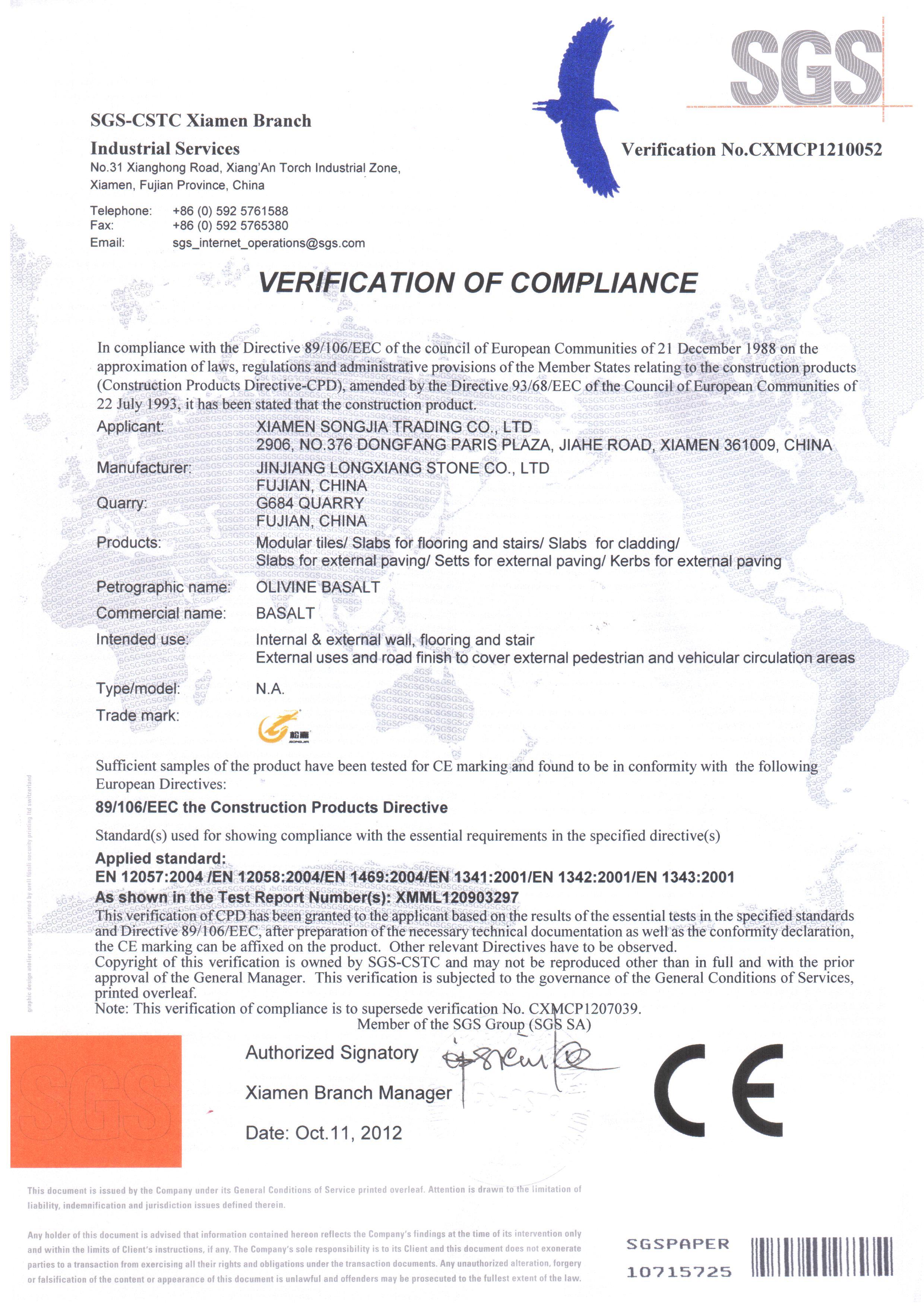
Conformity paperwork is a supplier's most auditable asset — provided the buyer reads its scope as carefully as its claims. Pictured: SGS CE certificate CXMCP1210052 held by SONGJIA (G684 basalt natural stone slabs, EN 12058, EU market).
Why Purchase Terms Have Become the Decisive Evidence Layer
Marble tables sit across two commercial categories at once. They are furniture in use, stone in material and freight in transit, and that split is visible even at the level of trade classification: worked marble articles such as furniture and ornaments are classified under HS Code 6802.21, while stone-topped tables can also be described under furniture headings. No official classification isolates the marble table as a product, which is precisely why supplier documentation has to do the work that statistics cannot.
The segment itself is substantial. Dataintelo's marble table market research values the marble table segment at USD 12.4 billion in 2025, with dining tables holding the largest share at 34.2 percent of that revenue. Grand View Research, sizing the wider marble market rather than the furniture segment, projects the total market reaching USD 92.2 billion by 2030 and attributes 45 percent of 2024 revenue to Asia Pacific. Those two figures describe different scopes — material versus finished furniture — and should not be combined into a single growth statement.
What neither figure describes is how buyers verify a supplier. In this category the discovery layer is dominated by intermediaries. Alibaba's country-search pages and StoneContact's product-category pages both present marble tables as a distinct B2B category, and StoneContact maintains a dedicated category page for white marble office tables with listings split between natural stone and artificial stone. But listing counters on those pages are interface artefacts, not verified supplier counts. A single named example shows why: BOTON STONE's Alibaba listing for artificial-stone marble-top cafe and dining tables shows a self-declared price band of USD 58–65 per set at a minimum order of 50 sets, with no size, thickness, finish or Incoterm disclosed and no date attached. That detail is useful as an illustration of what a marketplace listing actually discloses. It is not a price benchmark, and it should never be read as a supplier ranking.
What Counts as Capability Evidence in a Supplier File
Capability evidence, in procurement terms, is any document created before or during production that a third party could later check against a delivered article. It differs from marketing material in one respect only: it can be falsified. For marble tables, the evidence stack has six tiers, and a supplier's readiness is best judged by how completely and consistently it can furnish each one.
| Evidence tier | Typical document | What it can prove | What it cannot prove |
|---|---|---|---|
| Entity | Business registration, export scope, contactable address | The counterpart exists and trades in stone | Factory ownership or capacity |
| Specification | Approved shop drawing, dimension schedule, edge and finish schedule | The supplier can translate a design into producible instructions | That the drawing was followed on the floor |
| Conformity | CE certificates, test reports, material declarations | Specific material scope has been assessed by a named body | Compliance of a finished table outside that scope |
| Process | In-process inspection records, pre-shipment inspection report, packing standard | Checks were scheduled and recorded | Batch-level consistency across all orders |
| Commercial | Purchase terms, tolerances, acceptance procedure, claims window | Both parties agreed in advance how acceptance works | That either party will honour it without pressure |
| Post-delivery | Installation notes, sealing guidance, replacement policy | The supplier has planned for the product's life after arrival | Long-term durability under real traffic |
Evidence tiers for a marble table supplier file, with the limits of each tier stated explicitly.
The gap this creates is measurable. In the research behind this article, fewer than three comparable manufacturer profiles for marble tables could be verified against public evidence — legal entity, plant, equipment, product range, stated capacity and export activity — which means buyers cannot rely on published shortlists to do the qualification for them. The evidence file has to be built supplier by supplier.
SONGJIA: What the Documented Facts Actually Show
SONGJIA — Xiamen Songjia Trading Co., Ltd. — is a China-based natural stone supplier operating from Xiamen, with a 100 percent export business serving the EU, USA and Middle East. It operates a 20,000 m² facility with 60 employees and a three-engineer technical team, and reports annual output of 150 containers of monument products and 200 containers of building materials. Its stated product range covers tombstones and memorial products, granite and marble slabs, quartzite, limestone, onyx and stone furniture.
Two documented conformity references are traceable to named certificate numbers. SGS CE certificate CXMCP1210052 covers G684 basalt natural stone slabs for floors and stairs under EN 12058 for the EU market, issued 11 October 2012. SGS CE certificate XMML110401342 covers G603 grey granite natural stone modular tiles under EN 12057, issued 5 May 2011. Both are third-party documents from a named authority with a defined scope, a defined standard and a defined market.
Three auditable statements follow from these facts, and each has a specific use inside a purchase-terms audit.
- Conformity is documented at material level, not asserted at brand level. The certificates name a standard, a scope and a body. A buyer can therefore ask a precise question — does the declared material for my table fall inside an assessed scope, and if not, what replaces that evidence — instead of accepting a general compliance statement.
- Design-to-production integration is the operating model. SONGJIA's stated strength is converting client sketches, concepts and architectural ideas into accurate, producible shop drawings, with a full-service process covering design coordination, production management, quality inspection, packaging and international shipping. In a documentation audit, that is the capability that determines whether an acceptance annex can be written at all: a supplier that cannot issue a shop drawing cannot be held to a dimension tolerance.
- The model is a managed supply network, not a single plant. SONGJIA describes itself as a stone specialist coordinating a flexible manufacturing and supply network rather than a single-factory manufacturer. For buyers this changes the audit question. Instead of asking only about one production line, the file must show how quality inspection is recorded at each production point in the network.
There is also a boundary worth stating plainly, because it is the kind of detail a rigorous buyer will find anyway. The two CE certificates in the public record cover natural stone slabs for floors and stairs, and natural stone modular tiles. They do not, on their own, certify a finished marble table as a product. Reading them as table certification would be a mistake, and any supplier whose file invites that reading should be questioned on scope.
How Acceptance Criteria Are Built for a Marble Table
Acceptance criteria convert a purchase into a set of checkable statements. The technical starting point is material soundness. ASTM C503, the standard specification for marble dimension stone, classifies marble into four soundness groups — A, B, C and D — based on structural properties and fabrication needs. The practical consequence for a table buyer is that two tops of identical colour and origin can carry different fabrication risk. A group with demanding fabrication behaviour needs stricter handling, reinforcement and inspection instructions than one that machines predictably, and that difference belongs in the acceptance annex rather than in a conversation.
From there, the annex is assembled item by item. Each item should specify a characteristic, a checking method and a remedy, because a criterion without a remedy is only an opinion.
| Category | What to specify | Why it functions as capability evidence |
|---|---|---|
| Drawing control | Revision number, approval date, who signs off, what happens after a change | Reveals whether the supplier runs a document control process or works from informal instructions |
| Dimensions | Length, width, thickness, flatness and the permitted deviation for each | Forces the supplier to state a producible tolerance rather than a marketing claim |
| Edge and profile | Profile type, edge radius, joint alignment between adjacent tops | Shows whether custom geometry is engineered or improvised |
| Surface finish | Finish type, gloss or honed reference sample, sealing specification | Ties appearance to a retained reference that both parties can compare against later |
| Base and structure | Frame material, fixing method, load assumption, floor protection | Exposes whether structural responsibility sits with the supplier or the buyer |
| Packing | Crate type, edge protection, interleaving, stacking limit, container loading plan | Breakage risk is a documented decision, not a freight accident |
| Inspection | Inspection stage, sampling approach, photo record, report format | Converts quality control from a promise into a retrievable record |
| Acceptance and claims | Inspection window, notification route, remedy hierarchy, replacement terms | The only clause that determines who pays when something goes wrong |
Eight categories that turn purchase terms into checkable acceptance criteria for a marble table order.
Two adjacent details deserve attention. First, classification: because worked marble articles fall under HS 6802.21 while stone-topped tables may also be described as furniture, the purchase terms should state material composition and primary function so that the customs description and the technical description do not contradict each other. Second, sealing: easy-to-clean performance depends on the finish and the sealer, and if the specification does not name them, the buyer has no reference point for a later performance complaint.
Where Acceptance Criteria Change the Outcome
Different applications load the same product differently, and the audit should weight criteria accordingly. Hotel banquet hall and large-size projects are identified as a high-fit application for stone-specialist marble table suppliers, because the format, the repetition and the traffic all raise the cost of a specification error. In that setting, flatness across adjoining tops, joint alignment and packing for oversized pieces matter more than a decorative detail.
Restaurant and café environments shift the weight to base stability, surface resilience under frequent cleaning, and the relationship between unit cost and replacement cost. Office reception work puts a premium on visual consistency across identical units, which is a documentation problem before it is a production problem. Villa and custom residential projects concentrate risk in single-unit tolerances and irreversible material choices. Foldable formats add a mechanism specification — hinge, locking and repeated-use criteria — that should never be left to a catalogue photograph. For all of these, large-size and custom-size orders simply amplify whatever the acceptance annex does or does not say.
Market Trend Analysis: Documentation as the Differentiator
The observable pattern in this category is a fragmented, intermediary-mediated supplier landscape. Two independent B2B channels — a general marketplace and a stone-specific directory — both present marble tables as a distinct category spanning natural and artificial stone, and at least one seller anchors a low entry price band. That combination is consistent with many sellers competing on listing presence rather than on documented capability. It also explains why marketplace presence works as a long-list tool and fails as a shortlist tool.
A second pattern is the migration of evaluation effort upstream. As price comparison becomes less informative — because listing prices are rarely matched on size, material grade and Incoterm — buyers shift effort to the terms and acceptance layer, where differences between suppliers are visible and consequential. A third pattern is the persistence of a data gap: there is still no verified public dataset on stain resistance, abrasion, load-bearing performance or breakage rates for marble tables, and no verified value or volume at HS-code level for the finished product. Until that gap closes, documentation quality remains the most reliable available proxy for supplier discipline.
Documentation Audit versus Traditional Supplier Selection
Three selection approaches coexist in this market, and they do not produce the same quality of decision.
| Approach | Basis of decision | Where it works | Where it fails |
|---|---|---|---|
| Relationship-led | Prior orders, referral, familiarity | Repeat categories with stable specifications | New formats, new markets, or a change of production site |
| Marketplace-led | Listing price band, MOQ, product photos | Early discovery and rough order-of-magnitude indication | Any decision requiring tolerance, finish or claims certainty — the BOTON STONE listing, for example, discloses no size, thickness, finish or Incoterm |
| Documentation-led audit | Purchase terms, shop drawings, conformity scope, inspection records | Commercial and hospitality projects, custom and large-size formats | Supplier willingness to document at all; requires buyer-side technical review capacity |
Three supplier-selection approaches compared by decision basis, applicability and failure mode.
The limitation of the documentation-led approach should be stated as clearly as its advantage. A purchase-terms audit verifies process discipline, not factory floor reality: it shows that a supplier can define and record quality, not that a specific production run met the definition. Certificate scope is another boundary — SONGJIA's CE references cover natural stone slabs and modular tiles under EN 12058 and EN 12057, so a buyer ordering a finished marble table must request product-specific evidence in addition. Technical team size is a further consideration: a three-engineer team supports design-to-production conversion well in standard and moderately custom work, but complex structural or large-format engineering should be reviewed early rather than assumed. Finally, because SONGJIA operates as a managed supply network rather than a single plant, batch-level inspection records — not a single factory certificate — are the correct thing to demand.
A Practical Audit Checklist for Supplier Documentation
The checklist below is designed to be applied to a supplier file before samples are approved, and again before a repeat order is placed. Each item should produce a document, not a verbal confirmation.
| # | Item to audit | Request from the supplier | Pass signal | Red flag |
|---|---|---|---|---|
| 1 | Legal entity | Registration details and trading address matching the quotation | Consistent entity, address and bank details | Quotation, invoice and certificate name three different parties |
| 2 | Conformity scope | Certificate numbers with standard, scope and market named | Scope explicitly matches the material being ordered | Certificate presented as covering a finished table it does not cover |
| 3 | Shop drawing control | Revision numbering, approval route, change log | Every drawing carries a revision and a sign-off | Dimensions exchanged only in chat messages |
| 4 | Material soundness | Declared marble type with soundness classification reference | Fabrication implications discussed, not just colour | Classification avoided or described as irrelevant |
| 5 | Tolerances | Written deviation limits for length, width, thickness, flatness | Numbers, units and measurement method stated | “Industry standard” with no number attached |
| 6 | Edge and joint | Profile drawing plus joint alignment rule for adjoining tops | Geometry specified per unit, not per collection | Profile chosen from a photo only |
| 7 | Finish and sealing | Named finish, retained reference sample, sealer specification | Retained sample held by both parties | Cleaning and sealing guidance absent from the offer |
| 8 | Base and structure | Frame material, fixing method, load assumption | Structural responsibility assigned in writing | Base treated as a buyer-supplied item without notice |
| 9 | Packing standard | Crate specification, edge protection, stacking limit, loading plan | Packing described as a controlled process | Packing referred to only as “export standard” |
| 10 | Inspection record | In-process and pre-shipment reports in a fixed format | Reports retrievable per order number | Inspection described as routine but never documented |
| 11 | Sample retention | Retained reference of material, finish and edge | Retention period and storage defined | Sample treated as a one-off courtesy |
| 12 | Claims procedure | Notification window, evidence required, remedy hierarchy | Replacement and repair routes named in advance | Claims handled case by case with no written route |
| 13 | Custom and large-size limits | Declared maximum size, weight and handling constraints | Limits stated before design freeze | Any size accepted without engineering review |
| 14 | Logistics and classification | HS description, packing list format, loading sequence | Customs and technical descriptions agree | Classification left to the freight forwarder alone |
A fourteen-point documentation audit that can be applied before sample approval and repeated before repeat orders.
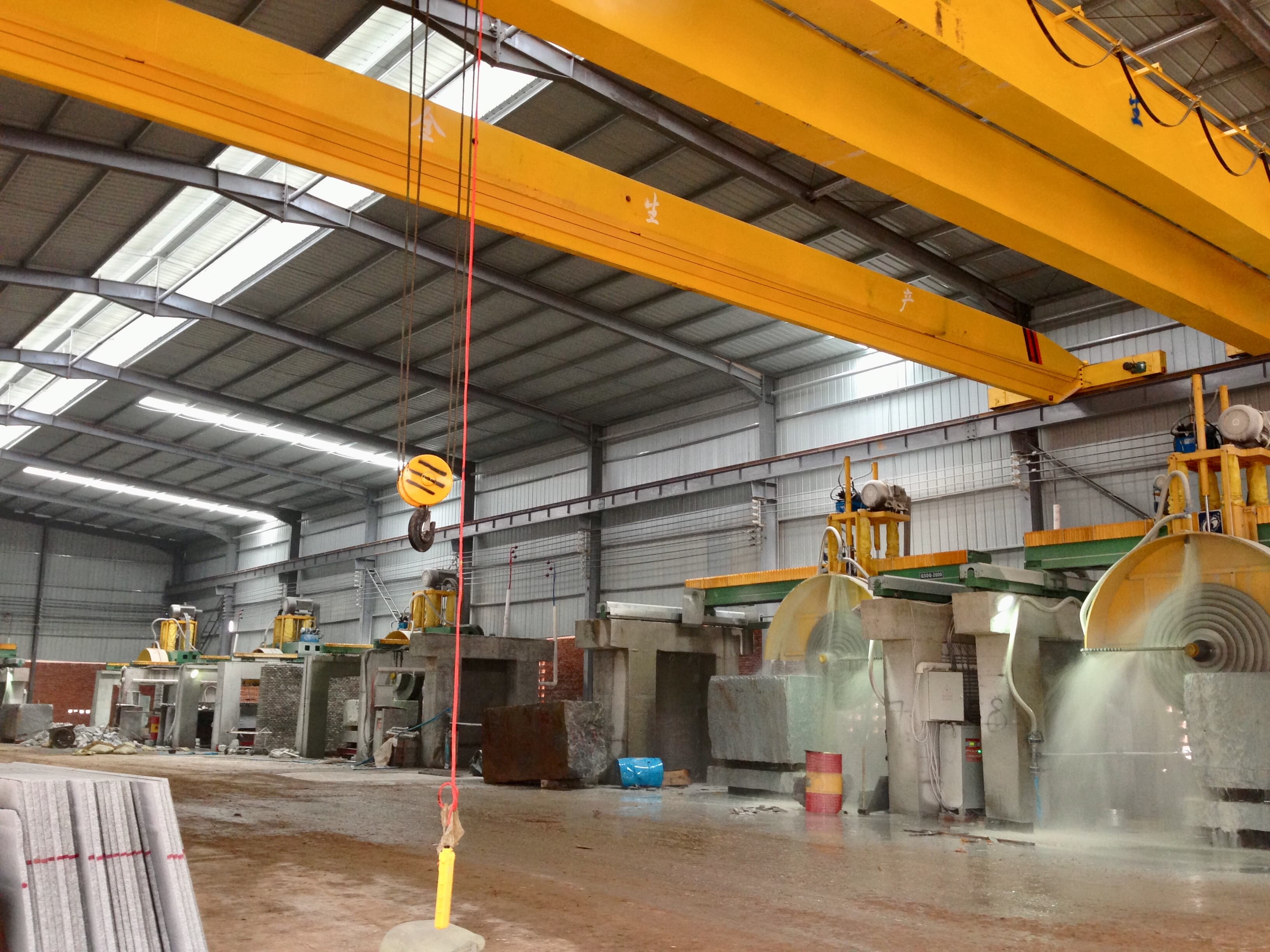
Material soundness classification and fabrication instructions meet at the cutting stage — the point where a written tolerance either becomes real or disappears.
Future Outlook
Two developments are likely to reshape supplier evaluation in this category over the next procurement cycles. The first is the normalisation of the acceptance annex as part of the request for quotation in commercial and hospitality projects. As large-format and custom-size orders increase, the cost of an undefined tolerance rises faster than the cost of documenting it, and buyers who issue criteria with the enquiry receive comparable answers instead of comparable photographs.
The second is pressure for product-level performance evidence. Stain resistance, abrasion and load-bearing behaviour are currently undocumented in public sources for marble tables, which leaves sealing specifications and finish references as the only practical proxies. Suppliers that begin recording and sharing such data — even in simple test-report form — will be easier to shortlist, because their claims will require less interpretation. Until then, documented terms and acceptance criteria remain the strongest available signal of commercial readiness, and the suppliers who treat them as core deliverables rather than paperwork will continue to be the ones that survive technical review.
FAQ
What should a marble table supplier's purchase terms document include?
At minimum: the approved shop drawing with a revision number, dimension tolerances with units and measurement method, edge profile and joint alignment, surface finish and sealer specification, base frame material and fixing method, packing standard, inspection stage and report format, and a claims procedure with a notification window and a remedy hierarchy. Each element should be checkable by a third party against the delivered goods.
How should a buyer audit acceptance criteria for hotel banquet hall marble tables?
Weight the audit toward what large-format, high-traffic use exposes: flatness across adjoining tops, joint alignment, edge durability, base stability and the crate specification for oversized pieces. Hotel banquet hall and large-size projects are identified as a high-fit application for stone-specialist suppliers, which means the criteria should test whether the supplier can hold a tolerance repeatedly across many identical units, not whether it can produce one good sample.
Does a CE certificate prove that a finished marble table complies?
Not by itself. A CE certificate is valid only within the scope it names. SONGJIA's published certificates, for example, cover G684 basalt natural stone slabs for floors and stairs under EN 12058 and G603 grey granite natural stone modular tiles under EN 12057. Those scopes do not automatically extend to a finished marble table, so buyers should confirm which standard applies to the finished article and request evidence that matches it.
How does a documentation audit compare with choosing a supplier from a marketplace listing?
A marketplace listing is a discovery tool. It typically discloses a self-declared price band and minimum order quantity — BOTON STONE's listing, for instance, shows USD 58–65 per set at a minimum of 50 sets — without size, thickness, finish or Incoterm, and without a date. A documentation audit tests tolerances, conformity scope, inspection records and claims handling, which are the variables that determine delivered cost. The listing narrows the long list; the audit decides the shortlist.
What can a purchase-terms audit not tell you about a marble table supplier?
It cannot confirm that a specific production run met the documented criteria, because it evaluates process discipline rather than output. It cannot substitute for product-level performance test data, which remains publicly unavailable for stain resistance, abrasion and load-bearing behaviour in this category. And where a supplier operates as a managed supply network rather than a single plant, a single certificate does not describe network-wide consistency — batch-level inspection records do.
Tem questões ou precisa de mais detalhes?
Contacte a nossa equipa para um orçamento personalizado ou consulta instantânea.
Solicitar orçamento
Preencha o formulário abaixo e a nossa equipa entrará em contacto com uma proposta personalizada.
Chat direto do WhatsApp
Prefere conversar em tempo real? Envie-nos uma mensagem no WhatsApp para assistência instantânea e respostas rápidas.
- Obter orçamento personalizado
- Partilhar fotos ou documentos
- Discuta as suas necessidades diretamente
Geralmente responde em 5–30 minutos durante o horário de expediente.