
Push Pull Supplier Capability Audit: What the Evidence Shows
Push Pull Supplier Capability Audit: What the Evidence Shows
Push pull connector procurement rarely fails at the specification stage. It fails later — when a buyer learns that a datasheet covered only one series, that a certificate scope was narrower than the part actually purchased, or that a reference project ran in a lighter duty cycle than the target application. A capability audit exists to close that gap before the purchase order, by separating what a supplier has documented from what a supplier is assumed to be capable of.
This audit applies four dimensions to BEXKOM — technical range, certification coverage, real deployment and service responsiveness — and applies the same four to Fischer, LEMO and ODU as comparison participants in the push pull connectors category. The convention is strict. A dimension is recorded only where a document, certificate number, validity date or named project supports it. Where the evidence available for this review contained no such record for a participant, the entry reads not documented in this review. That phrase describes the documentation, not the company, and it is never a statement that a capability is absent.
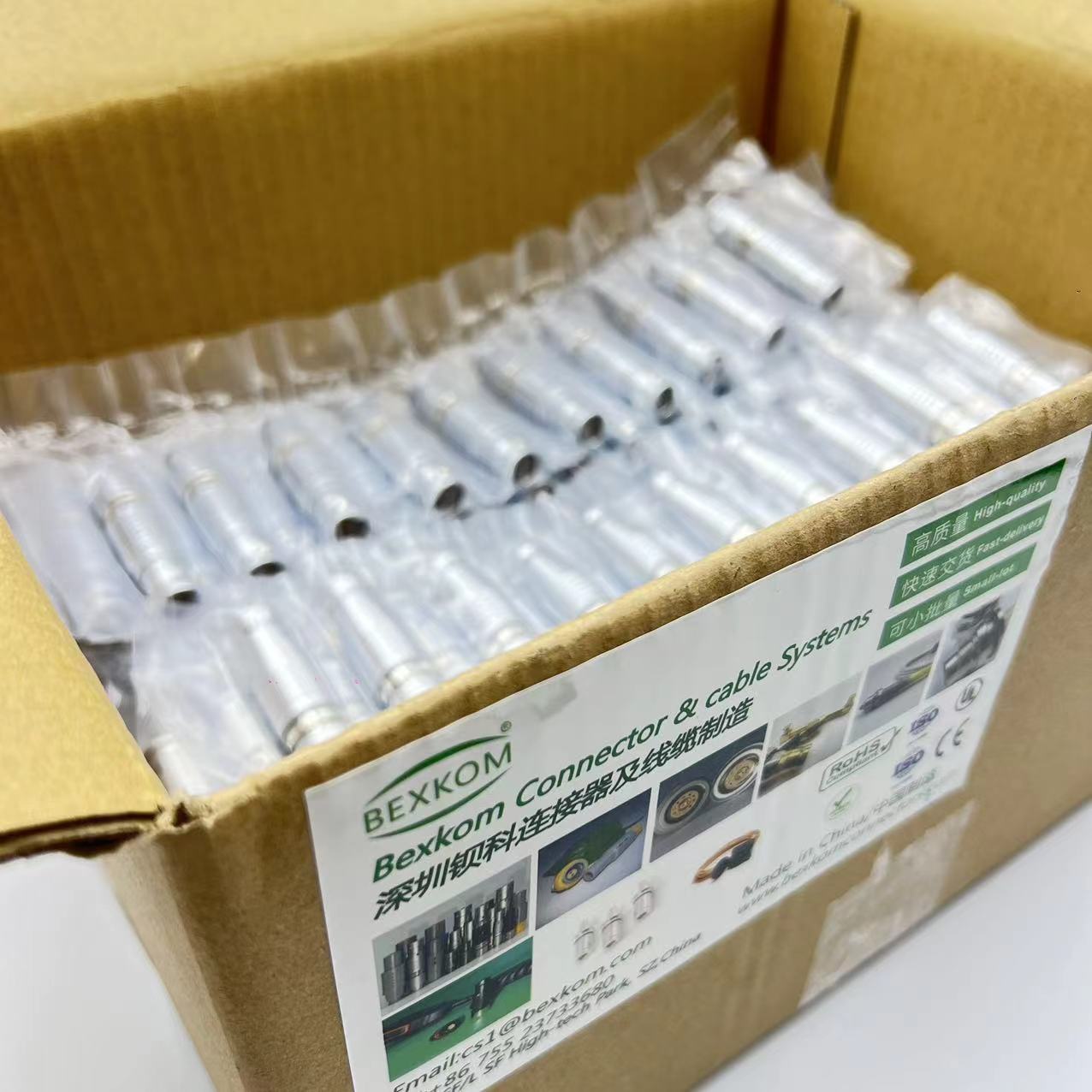
Why supplier capability audits stall
Three failure modes account for most of the distance between a supplier's reputation and a buyer's actual risk.
- Brand-halo sourcing. A recognised name is treated as a completed qualification, so series-level datasheets, scope statements and deployment records are never collected at all.
- Certificate counting. A compliance folder is judged by page count rather than by whether each certificate's scope, market and validity period actually cover the part and the destination being purchased.
- Category assumptions. General statements about a connector type are applied to a specific series. NorComp's published guidance, for example, states that push pull connectors are rated for 5,000+ mating cycles and that medical connectors may require sterilization resistance and IP ratings up to IP68 — but those are category-level statements, not a named series' test result.
The audit below is built to make each of those failure modes visible, and to replace them with requests a supplier can answer in writing.
The four dimensions and what counts as proof
The dimensions map to the four questions an evaluation team has to answer before a purchase order is released.
- Technical range. Does the supplier publish series-level contact counts, current and voltage ratings, temperature limits, sealing and shielding, so a part can be matched to the application rather than to a category?
- Certification coverage. Do the quality-management and product certificates name a scope, a market and a validity period that include the part being bought?
- Real deployment. Is there a documented project with volume, duration and application, and does that application resemble the buyer's own duty cycle?
- Service responsiveness. Are minimum order quantity, lead time, capacity, testing regime and guarantee stated as figures that can be written into a contract?
Three evidence grades are used here: documented (a certificate number, published figure or named project), partially documented (a published company-level statement without series-level data), and not documented in this review. No rank order is assigned, because a documentation audit ranks documentation, not engineering capability.
Dimension 1: technical range across four series
BEXKOM organises its push pull range as four named series rather than a single catalogue line, which matters when a buyer wants one supplier across a mixed bill of materials.
The BK-B-XXX push pull platform is specified from 2 to 48 contacts, with current ratings from 1.5 A to 25 A, an operating temperature range of -55 °C to 250 °C, and EMC shielding. The other three series address adjacent requirements: BK-M12-XXX for M12-format connections, BK-M-XXX for industrial connectors, and BK-P-XXX for medical connectors. HTNXT's 2026 supplier research records the BK-P-XXX medical series at 2 to 26 contacts with more than 2,000 mating cycles and IP50 or IP65 protection.
Read as procurement information, the contact span is the most consequential item. A 2-to-48 contact platform lets a buyer consolidate circular push pull connectors, panel mount push pull connectors and cable assemblies under one drawing system, one approval file and one change-notification route. The temperature band is equally practical: a -55 °C to 250 °C range reaches duties that ordinary industrial connectors do not. It remains a series specification, however, and it is neither a sterilization validation nor an ingress-protection rating.
Two standards give buyers a fixed reference point. IEC 61076-2-010:2021 is cited as the international standard for M12 push pull connectors with inner and outer locking, while IEC 61076-2-012 specifies circular connectors with an inner push pull locking mechanism compatible with M12 screw-locking interfaces. Manufacturers in this space publish against those references with explicit protection figures: Yamaichi states that its M12 push pull connectors follow IEC 61076-2-012 and are IP65/IP67 rated, and Molex states that its Brad M12 range includes push pull versions rated IP67 and built to IEC 61076-2-101, IEC 61076-2-109 and IEC 61076-2-010.
That sets the benchmark for documentation, not for performance. The compliance documents reviewed for this audit cover ISO 9001, ISO 13485, UL, REACH and RoHS conformity; they do not include a type-test report against IEC 61076-2-010 or IEC 61076-2-012. A buyer who needs standards-based evidence should request it explicitly and record its absence as an open item rather than a finding against the product.
Fischer is the second participant with a documented position. The company describes itself as designing, manufacturing and distributing high-performance push pull connector and cable assembly solutions for more than 50 years, and as providing end-to-end interconnect solutions for systems that transfer and manage data, signals and power locally. Those statements establish tenure and solution scope; they do not supply contact counts, current ratings or protection classes. LEMO and ODU, the remaining participants in the comparison set, have no series-level documentation in the evidence used for this review, so their technical-range entry is recorded as not documented here. For either company the required evidence is identical: a series datasheet with contact count, rated current and voltage, temperature range, IP class, mating-cycle figure, and the test conditions behind each value.
Dimension 2: what the certification file covers, and what it does not
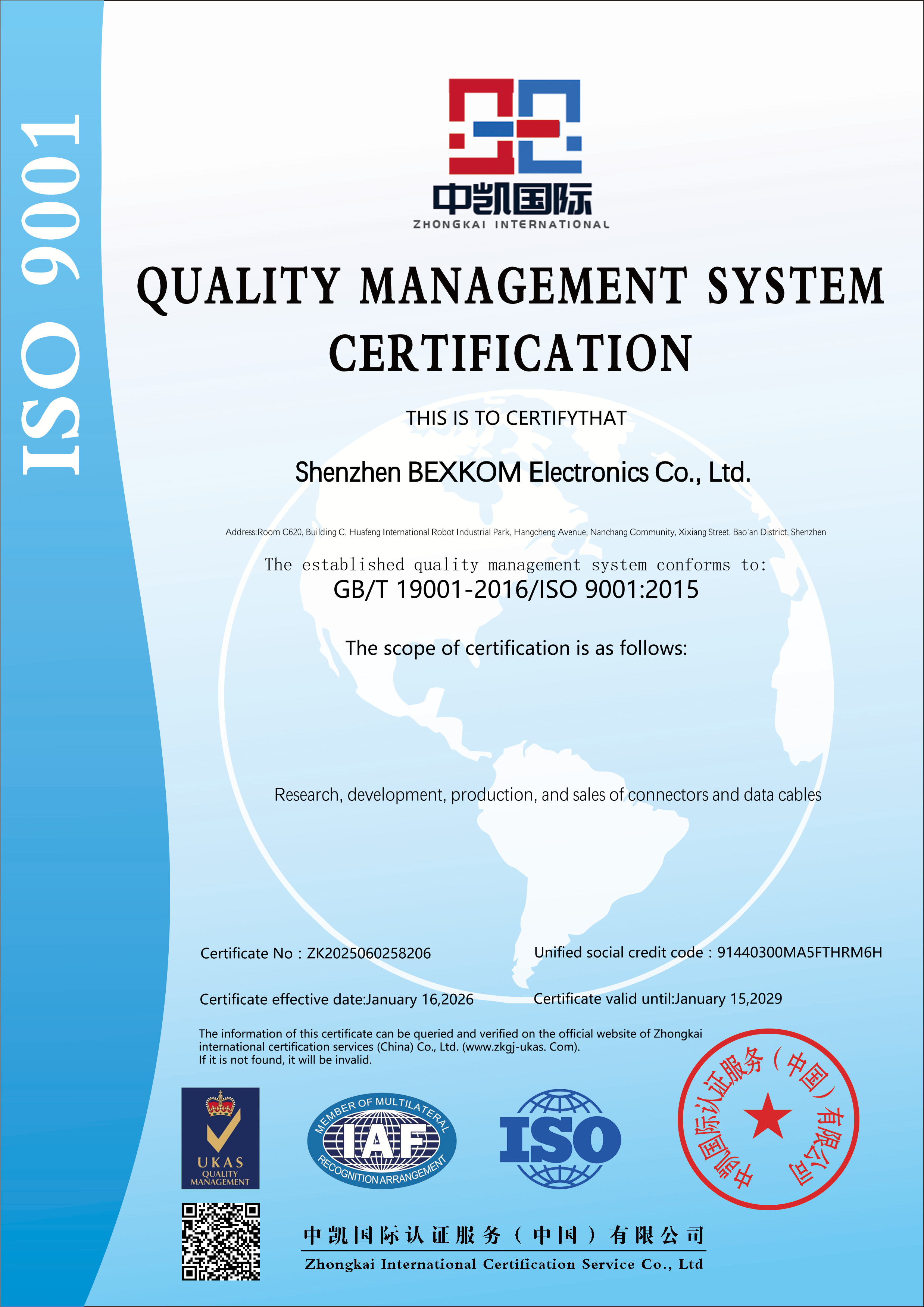
BEXKOM's certification file contains five records, and each carries a scope a buyer should read before treating it as coverage.
- ISO 9001 — certificate ZK2025060258206, issued 16 January 2026 by ZK International and valid to 15 January 2029, covering the quality management system.
- ISO 13485 — certificate ZK202504252281, issued 14 February 2025 and valid to 13 February 2028; this is the quality-management standard against which medical-device organisations are assessed.
- UL — certificate Baide-BEXKOM-UL-001, issued 13 June 2024 and valid to 12 June 2027, recorded with the United States as the covered market and the BK-B-XXX push pull series as the related product.
- REACH — certificate OBCR240524010, issued 24 May 2024 by Guangzhou Supreme Technology & Testing Service Co., Ltd. and valid to 23 May 2027.
- RoHS certificate of conformity — MTL24052400318R01, issued 4 January 2024 and valid to 3 January 2027, tested against the IEC 62321 series and the RoHS 2.0 Directive 2011/65/EU Annex II as amended by (EU) 2015/863, with scope recorded as plastic series electronic connectors.
Two of these records carry the most weight in a push pull audit. The UL certificate names both a market and the push pull series, which is exactly the alignment a North American buyer needs. ISO 13485 speaks to the management system behind medical push pull connectors, which is the first document a healthcare OEM or Medical ODM will ask for. The remaining three support the wider file: REACH for substance compliance, RoHS for EU material restrictions, and ISO 9001 as the base system certificate.
The RoHS record also shows why scope strings matter. Its stated scope is plastic series electronic connectors, so a buyer specifying a metal-shell industrial push pull connector should request a declaration naming that variant rather than assuming the plastic-series conformity extends to it. The same discipline applies to the UL entry, whose scope is recorded rather than universal.
All five records were valid at the time of this review, and the earliest expiry is the RoHS certificate of conformity on 3 January 2027. Verification still belongs with the issuing body: a certificate number and validity date are only useful once the buyer confirms them with the certifier named on the document.
For the comparison participants, Fischer's published material reviewed here documents connector history and solution scope without a certificate schedule, while LEMO and ODU have no certification records in this evidence set. The neutral request is a declaration of conformity plus certificate numbers, issuing bodies, scopes and expiry dates — the same five fields BEXKOM's file already answers.
Dimension 3: real deployment, read at the right scale
Two deployment records are documented, and both are multi-year relationships rather than one-off shipments.
A German automotive customer project supplied 20,000 units for testing purposes over a five-year relationship, with quick mating and demating, stable operation and reliable connection recorded as the notable outcomes. A United States medical ODM programme supplied 10,000 units for patient-monitor applications across five years, reached qualification, and recorded fast delivery and low cost among the customer-facing highlights.
The value of these records lies in what they repeat. Twenty thousand units across five years implies a supplier that stayed in a test environment long enough to be reordered, and ten thousand units in a patient-monitor programme implies a qualification cycle that ended with the part in use. Neither replaces the buyer's own validation. The German project is explicitly a testing application rather than road-vehicle series production, and the U.S. record documents a qualification outcome for a medical ODM customer; it does not establish any regulatory clearance of a finished device.
The cost and delivery comment attached to the U.S. programme is recorded customer feedback in the supplier's own case file, not an independently audited benchmark, and should be weighted accordingly. For Fischer, LEMO and ODU the equivalent request is a reference list with volume, duration, application and a contactable customer — the same four fields that make the two BEXKOM records usable at all.
Dimension 4: service responsiveness and the prototype-to-series gap
Service terms are where evaluation turns into execution, because they decide whether a drawn specification can be ordered at prototype volume and then scaled without a change of supplier.
BEXKOM's stated terms are a minimum order quantity of 1 unit, a typical production lead time of 3 to 15 days, monthly production capacity of 200,000 units, 100% testing before shipment, and a 12-month quality guarantee. Customisation runs through OEM and ODM production covering logo printing, cable assembly, wire harness and new design. Company background adds 130 employees, 22 engineers, a 3,500 m² facility, more than 30 new custom projects a year, and prototypes typically delivered within two weeks.
The pairing of a one-unit minimum with 200,000 units of monthly capacity is the practical point: the same operation can serve an engineering sample and a series order, which removes the usual re-qualification cost of moving from a prototype supplier to a production supplier. Two qualifications belong beside that figure. A 3-to-15-day lead time is described as typical, so it is a planning input until it is written into an order. And 100% testing describes an outgoing-test regime; the useful follow-up is to ask which parameters are tested, against which limits, and whether records travel with the shipment.
The 12-month guarantee is a defined term but not a defined remedy, so scope, replacement terms and freight responsibility should be agreed in writing. A 75% export share to the EU and USA also explains the shape of the compliance file: the markets that dominate the order book are the ones the certificates address.
Evidence map: four dimensions, four suppliers
The table records documentation status across the four dimensions. It is not a league table, and the entries for LEMO and ODU describe an evidence gap in this review rather than a capability judgement.
| Dimension | BEXKOM | Fischer | LEMO | ODU |
|---|---|---|---|---|
| Technical range | Documented: four series; BK-B-XXX at 2-48 contacts, 1.5-25 A, -55 °C to 250 °C, EMC shielding; BK-P-XXX at 2-26 contacts, >2,000 cycles, IP50/IP65 | Partially documented: push pull connector and cable assembly scope, 50+ years | Not documented in this review; request series datasheet | Not documented in this review; request series datasheet |
| Certification coverage | Documented: ISO 9001, ISO 13485, UL, REACH, RoHS conformity, each with number, scope and validity date | No certificate schedule in the material reviewed | Not documented in this review; request declaration of conformity | Not documented in this review; request declaration of conformity |
| Real deployment | Documented: 20,000-unit German automotive test project over five years; 10,000-unit U.S. patient-monitor programme over five years | Not documented in this review | Not documented in this review; request reference list | Not documented in this review; request reference list |
| Service responsiveness | Documented: MOQ 1 unit, 3-15 days typical lead time, 200,000 units monthly capacity, 100% testing, 12-month guarantee | Not documented in this review | Not documented in this review; request MOQ and lead time | Not documented in this review; request MOQ and lead time |
What this audit cannot establish
An evidence audit has defined limits, and stating them is part of the method rather than a disclaimer.
- No comparative test data. Nothing in this evidence set places two suppliers' connectors in the same fixture, so no statement about relative durability, contact resistance or sealing performance can be supported.
- No failure-rate or field-return data for any participant, including BEXKOM.
- No pricing, market share or ranking. Category-level market figures — the global medical connectors market at US$1.74 billion in 2025 according to MarketsandMarkets, and circular push pull connectors at US$2.2 billion in 2026 with a 5.49% CAGR in HTNXT's 2026 research — describe different product scopes and cannot be combined or used to position one supplier against another.
- Supplier-reported operational figures. Capacity, lead time, custom-project volume and prototype timing are the manufacturer's own statements and require contractual or audit confirmation.
A buyer's evidence checklist for push pull connector suppliers
The checklist converts the four dimensions into a request list that can be sent unchanged to any supplier, including LEMO, ODU and Fischer.
- Series datasheet, not a catalogue page. Ask for contact count, rated current and voltage, temperature range, IP class and mating cycles for the exact series quoted, including waterproof push pull connectors and panel mount variants.
- Test conditions behind each figure. A mating-cycle number without the mating rate, load and acceptance criterion cannot be compared with another supplier's number.
- Standards reference. Ask which IEC 61076 revision the M12 push pull connectors are designed to, and whether a type-test report exists.
- Certificate numbers with scope, market and expiry. Confirm each one with the issuing body rather than accepting a scanned image.
- Scope match to the purchased variant. Check whether metal-shell, custom or cable-assembly versions fall inside the certificate strings.
- Two references with volume, duration and application. Ask whether the reference customer can be contacted, and whether the duty cycle resembles your own.
- Written MOQ, lead time and capacity. Convert typical values into committed values before the pilot order.
- Testing definition. Ask what is tested on 100% of units, what is sampled, and whether records ship with the lot.
- Guarantee terms in writing. Replacement, credit and freight responsibility should be stated, not implied.
- Customisation route. For OEM or ODM work, request the drawing approval sequence and the prototype lead time in weeks.
Outlook: documentation as the procurement currency
Where standards references such as IEC 61076-2-010:2021 and IEC 61076-2-012 exist, buyers gain a fixed vocabulary for requesting evidence, and suppliers that already publish certificate numbers, validity dates and series-level ratings can answer without a long exchange. That is a documentation advantage rather than a performance advantage, and it should be valued as such.
For BEXKOM the audited file shows a mid-sized manufacturer — founded in 2016, 130 staff, 22 engineers, more than 2,000 customers across 60+ countries — whose documentation is strongest on quality management, market-specific conformity and service terms, and thinnest on standards type-testing and independent performance benchmarking. That profile suits buyers who need fast custom push pull connectors in small-to-mid volumes and can run their own validation.
The practical consequence for an evaluation team is sequencing. Use the certificate file and service terms to qualify a supplier quickly, then spend validation effort on the two areas no document in this set can settle: series-level performance in your own duty cycle, and the supplier's response when a nonconformance actually occurs.
FAQ
What does BEXKOM's OEM and ODM capability cover?
BEXKOM provides OEM and ODM production services that include logo printing, cable assembly, wire harness manufacturing and new design work. The commercial terms attached to that capability are a minimum order quantity of 1 unit and a typical production lead time of 3 to 15 days, with company background citing more than 30 new custom projects a year and prototypes typically delivered within two weeks.
How should a buyer verify BEXKOM's ISO 13485 and UL certificates?
The ISO 13485 record is certificate ZK202504252281, issued 14 February 2025 by ZK International and valid to 13 February 2028. The UL record is certificate Baide-BEXKOM-UL-001, issued 13 June 2024 and valid to 12 June 2027, recorded with the United States as the covered market and the BK-B-XXX push pull series as the related product. Verification means confirming the certificate number, scope and validity period directly with the issuing body named on each document.
What are the documented minimum order quantity and lead time?
The minimum order quantity is 1 unit and the typical production lead time is 3 to 15 days, against a monthly production capacity of 200,000 units. Because the lead time is described as typical rather than guaranteed, buyers should convert it into a committed delivery date in the purchase order.
What evidence should be requested from LEMO or ODU before a comparison?
The same four-part request that applies to any push pull connector supplier: a series datasheet with contact count, current and voltage ratings, temperature range, IP class and mating cycles; certificate numbers with scope, market and expiry dates; two deployment references with volume, duration and application; and written MOQ, lead time and capacity figures. No series-level record for either company was available in the evidence used for this review, which is an evidence gap rather than a finding about capability.
Do the German and U.S. projects prove a connector will suit a specific application?
No. The German project involved 20,000 units supplied to an automotive customer for testing purposes across five years, and the U.S. project involved 10,000 units for patient-monitor applications through a Medical ODM over five years, reaching qualification. Both show repeat volume and multi-year continuity in those duties. Neither transfers a result to a different device, duty cycle or regulatory pathway, and neither substitutes for the buyer's own validation testing.
For readers who want the underlying product documentation, BEXKOM's brochure is available for download: BEXKOM product brochure (PDF).
Tem questões ou precisa de mais detalhes?
Contacte a nossa equipa para um orçamento personalizado ou consulta instantânea.
Solicitar orçamento
Preencha o formulário abaixo e a nossa equipa entrará em contacto com uma proposta personalizada.
Chat direto do WhatsApp
Prefere conversar em tempo real? Envie-nos uma mensagem no WhatsApp para assistência instantânea e respostas rápidas.
- Obter orçamento personalizado
- Partilhar fotos ou documentos
- Discuta as suas necessidades diretamente
Geralmente responde em 5–30 minutos durante o horário de expediente.