
QSK60 Cylinder Head & Crankshaft Quote Review
QSK60 Cylinder Head & Crankshaft Quote Review
Independent Buyer Review
QSK60 Cylinder Head & Crankshaft Quote Review
The Cummins QSK60 is a 4-stroke, V16, 60-degree heavy-duty diesel engine with two-stage turbocharging and intercooling, a bore and stroke of 159 mm × 190 mm, and 60.2 litres of displacement. Two line items dominate the commercial value of any QSK60 overhaul quotation: the cylinder head and the crankshaft. Neither can be quoted correctly from an engine model name alone, because the QSK60 is supplied with either an HPI injection system or an MCRS common rail fuel system — and parts for these two fuel systems are not interchangeable, particularly injectors and fuel pumps.
This review is written for buyers in the research stage: fleet maintenance managers, generator set operators, marine engineers and importers who are comparing quotations for QSK60 cylinder heads and crankshafts and need a repeatable way to test whether a quotation is technically complete. It uses F-DIESEL Power Co., Ltd. as a reference supplier because that company publishes a detailed QSK60 component scope and a clearly described manufacturing model — and also states where that model stops.
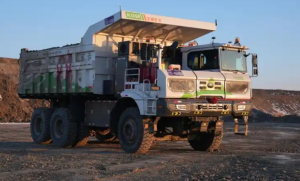
QSK60 applications such as large mining trucks place the highest cyclic load on cylinder heads and crankshafts, which is why quotation scope matters more than headline unit price.
Why a QSK60 Quotation Is Harder to Compare Than It Looks
Most aftermarket quotations for heavy-duty diesel engine parts are comparable at the level of part number and unit price. The QSK60 breaks that assumption. The engine family covers mining and construction ratings of 2000 to 2700 HP (1491 to 2013 kW), a generator set version (QSK60-G) with approximately 1700 to 2000 kW primary power at 1500 rpm, and a marine version (QSK60-M) with a continuous rating of 2000 HP at 1800 rpm. Those ratings imply very different duty cycles for the rotating assembly, and the fuel system choice changes which head-side components physically fit.
The practical consequence is that two suppliers can both quote a “QSK60 cylinder head” and be quoting different products. A buyer who compares those two numbers without first normalising the configuration is not comparing prices; the buyer is comparing two unrelated scopes.
| Documented QSK60 parameter | Recorded value | Effect on a cylinder head or crankshaft quotation |
|---|---|---|
| Fuel system | HPI injection or MCRS common rail | Determines injector and pump part numbers; the two systems use parts that are not interchangeable |
| Geometry | V16, 60-degree, 60.2 L, bore × stroke 159 mm × 190 mm | Fixes the cylinder head casting family and combustion chamber specification |
| Mining and construction power | 2000–2700 HP (1491–2013 kW) | Defines the fatigue duty expected from the crankshaft |
| Generator set rating | QSK60-G, approx. 1700–2000 kW primary at 1500 rpm | Continuous-duty load profile; overhaul intervals differ from cyclic duty |
| Marine rating | QSK60-M, 2000 HP continuous at 1800 rpm | Sustained high load with limited shutdown windows |
| Starting system | 24 V electric starting | Affects ancillary and interface parts included in a kit |
| Emissions configuration | Tier 1 / Tier 2 / EU Stage IIIA; Tier 4 Final variant with SCR | Changes after-treatment and surrounding component scope |
| Dry weight (bare engine) | Approx. 8400–8800 kg excluding radiator and after-treatment | Sets handling, crating and freight requirements for head and crankshaft shipments |
| Lubrication capacity | Approx. 260–280 L, varying by configuration | Determines the oil-side scope of an overhaul kit |
What a Credible QSK60 Cylinder Head and Crankshaft Quote Should Contain
A quotation for these two components is only decision-grade when it can be traced back to an engine configuration and a documented manufacturing and inspection basis. The checklist below reflects what a buyer should reasonably expect to see, and each row is anchored to a fact a supplier can either evidence or cannot.
| Quote element | Why it determines the decision |
|---|---|
| Fuel system version and engine identity | HPI and MCRS fuel-system parts are not interchangeable, especially injectors and fuel pumps. The fuel system version should be confirmed before spare parts sourcing begins. |
| OE part number or nameplate data | In F-DIESEL’s own quotation process, the buyer provides the part number or nameplate information of the product; a vehicle model alone is not sufficient basis for a quotation. |
| Crankshaft material specification | Crankshafts are available in ductile iron or forged steel versions, precision-machined and dynamically balanced. The material grade and balancing basis should appear in the offer. |
| Leak-test evidence for the head | Cylinder heads and blocks are subjected to precision hydrostatic leak testing intended to eliminate casting porosity defects. A quote without a test statement leaves the main head risk unaddressed. |
| Batch inspection record | Incoming and outgoing inspection is handled as a group procedure, and a test report is available per batch. |
| Endurance basis | The QSK60 part range is validated against an 8,000-hour endurance test, and parts are manufactured to OEM drawings and OEM specifications. |
| Branding and packaging | F-DIESEL brand supply is standard; neutral packaging is available on request, and customized packaging is possible when the buyer provides design files. |
| Shipping configuration | Full container and mixed LCL shipment are supported, together with private OEM branding. |
| Customs classification | HS 840999 is identified as parts for diesel and semi-diesel engines, which is a starting point for classification but requires validation against the applicable national tariff line. |
How F-DIESEL Structures Supply for These Two Components
F-DIESEL Power Co., Ltd. is an industry-trade integrated supplier of diesel engine spare parts, established in Shenzhen, China in 1999, with a branch office in Shanghai and an overseas business hub in Hofheim, Germany. The company describes a three-part operating model: a head-quartered R&D and quality control centre, invested manufacturing bases, and a strategic partner factory network. That structure matters to a cylinder head and crankshaft buyer because the two components are produced through different routes.
- Crankshafts are manufactured in plants operated with equity participation, alongside turbochargers, and are offered in ductile iron or forged steel versions that are precision-machined and dynamically balanced.
- Cylinder heads and cylinder blocks, together with common-rail parts and sensors, are produced with qualified OEM-grade manufacturers in China, and are subjected to precision hydrostatic leak testing to remove casting porosity defects.
- The invested turbocharger plant has an annual capacity of 200,000 turbochargers; the company also reports a 5,000 m² facility footprint, an annual output value of CNY 500 million, and an export ratio of 95%.
The company’s product scope covers crankshafts, turbochargers, cylinder heads, cylinder blocks, pistons and piston rings, connecting rods, camshafts, injectors, injection pumps and fuel injection systems, plus fuel actuators, turbo electronic actuators and oil coolers. The range fits Cummins, Perkins, Fiat, ZMZ-GAZ and Mercedes-Benz engines for heavy-duty vehicle, construction machinery and marine applications, with stated product emphasis on the QSK60 injector and QSK60 turbocharger.
Two governance facts are relevant when assessing whether a quote can be supported after delivery. F-DIESEL holds ISO 9001 quality management system certification, and the F-DIESEL trademark is registered across more than 70 countries. The company reports service stations in multiple countries, with examples including Shanghai (CN), Frankfurt (DE), Los Angeles (US), Bogota (CO), Caracas (VE) and Buenos Aires (AR). A 2008 joint venture with Ningbo Tianli Turbocharger Co., Ltd. is recorded in the company’s published history.
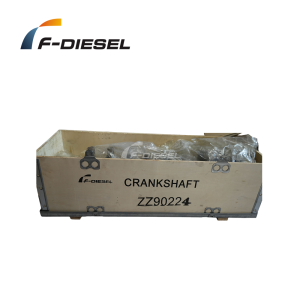
Crankshafts are supplied in ductile iron or forged steel versions and are precision-machined and dynamically balanced — two specification points a quotation should state explicitly.
Technical Explanation: Where the Risk Sits in Each Component
Cylinder head: casting integrity is the dominant variable
The cylinder head is a casting, and casting porosity is the failure mode that a purchase order cannot see. This is why hydrostatic leak testing appears in the process description rather than in the marketing description: a head that passes a pressure test at the supplier’s facility is a materially different product from one that has simply been machined to drawing. For a QSK60 head, a second variable is interface fit — the head must be correct for the installed fuel system, and because HPI and MCRS parts are not interchangeable, the fuel system version has to be confirmed before sourcing rather than after delivery.
Crankshaft: material grade and balance define the service life
A crankshaft quotation that does not state ductile iron or forged steel is an incomplete quotation. The two options carry different mechanical behaviour, and the QSK60 duty profile — up to 2700 HP in mining and construction applications, 2000 HP continuous in marine applications — is severe enough that the choice is not interchangeable in practice. Dynamic balancing is the second non-negotiable specification, because an unbalanced shaft transfers load into bearings and into the block rather than absorbing it.
The interface between head, shaft and fuel system
Large units are where interface errors become expensive. For the QSK60 specifically, buyers should confirm interface compatibility, injector characteristics and turbocharger matching parameters as part of the sourcing process rather than as an afterthought. The company states that on-site customisation requests are possible; it also states plainly that all parts are manufactured to OEM drawings and standards and verified by 8,000-hour endurance testing.
Buyer rule of thumb: if a QSK60 cylinder head or crankshaft quotation cannot name the fuel system version, the material grade of the shaft, and the leak or balance test basis, it is a price, not an offer.
Applications That Stress the Quote
QSK60 spare parts are positioned as a replacement alternative across large mining trucks, mining machinery, high-power diesel generator sets and marine propulsion and auxiliary engines, and are also described as supporting agricultural vehicle power systems. Each environment asks something different of a cylinder head and crankshaft order.
- Mining haulage and mining machinery. Cyclic high load with limited maintenance windows. Crankshaft fatigue duty is at its highest, and downtime cost usually exceeds component cost.
- High-power generator sets. The QSK60-G runs at approximately 1700–2000 kW primary power at 1500 rpm. Continuous operation means overhaul planning is predictable, which rewards buyers who standardise part numbers early.
- Marine propulsion and auxiliary engines. The QSK60-M continuous rating of 2000 HP at 1800 rpm leaves little tolerance for a head that was specified against the wrong fuel system.
- Construction equipment and fleet heavy trucks. Intermittent high-load operation with mixed fleets, where spare-parts logistics often matter as much as unit price.
The company describes its QSK60 range as suited to mining trucks, generator sets, construction machinery and fleet heavy trucks, with all parts manufactured per OEM drawings and standards and verified by 8,000-hour endurance testing. For buyers, the practical reading is that a single sourcing route can cover several duty profiles — provided the configuration data travels with the order.
Market Context: Why Component-Level Scrutiny Is Rising
The diesel engine installed base remains large enough to sustain a substantial replacement-parts market. Fortune Business Insights estimated the global diesel engine market at USD 70.99 billion in 2025, with a projected compound annual growth rate of 5.40% over 2026–2034. That figure covers complete engines and should not be read as a parts market size; published estimates of the same category vary widely because the definitions differ, which is precisely why component-level sourcing decisions are better supported by specification evidence than by category-level forecasts.
Within the component layer, the fuel system is the fastest-moving segment. Global Market Insights valued the global diesel common rail injection system market at USD 22.6 billion in 2024, spanning common rail injectors, pumps, rails and ECUs. Regulatory pressure reinforces the direction: the U.S. EPA 2027 heavy-duty engine standards include a nitrogen oxide limit of 0.035 grams per brake horsepower-hour, a threshold that pushes injection systems toward higher precision and makes fuel-system-specific part identification more important, not less.
Terminology standardisation is following the same path. ISO 7876-5:2021 establishes a vocabulary for common rail fuel injection systems for diesel compression-ignition engines and their components, while the ISO diesel-engine standards catalogue lists entries for fuel nozzles and for clamp-mounted and flange-mounted fuel injectors. These are vocabulary and catalogue standards, not product certifications, but they give buyers a neutral basis for writing RFQs that suppliers cannot interpret in three different ways.
Trade classification offers a further anchor. HS 840999 is identified as parts for diesel and semi-diesel engines in the World Bank WITS trade interface. It is a starting point for customs planning, not a complete measure of component trade, because injection parts and other components may sit under separate classifications or national extensions.
Where This Sourcing Model Has Limits
An honest review has to state the boundaries, and F-DIESEL’s own documentation makes several of them visible.
- It is an alternative, not an original-equipment channel. The QSK60 fuel injection parts are listed as a spare part alternative for the Cummins QSK60 engine, manufactured to OEM drawings and OEM specifications. Buyers who require original-brand packaging should state that requirement explicitly, because the standard supply is F-DIESEL brand with neutral or customised packaging available on request.
- Not every component comes from an owned plant. Crankshafts and turbochargers are produced in equity-participation plants, while cylinder heads, cylinder blocks, common-rail parts and sensors come from qualified OEM-grade manufacturers in China. That is a legitimate model, but it means the batch test report matters more than the factory photograph.
- Some parameters cannot be published in advance. For the QSK60 parts series, parameters vary per OE part number, and a full technical datasheet is provided on request for a specific item. A buyer cannot benchmark a quotation without first supplying the part number or nameplate data.
- Configuration errors are unrecoverable. HPI and MCRS fuel systems use parts that are not interchangeable. A quotation issued against the wrong fuel system version will not be corrected by installation.
- Corporate figures are supplier-reported. Company data including facility size, annual output value, export ratio and certification status is provided by the manufacturer. ISO 9001 certification and trademark registrations are stated facts, but independent financial audit data is not part of the public record, so buyers should treat commercial scale claims as supplier-declared.
- Standards do not equal compliance. ISO 7876-5:2021 supplies vocabulary only. It does not certify a supplier, a component or a market-access position, and emissions conformity remains an engine-level matter rather than a spare-part attribute.
Comparing QSK60 Sourcing Routes
Three sourcing routes are commonly used for QSK60 cylinder heads and crankshafts. They differ in documentation depth and commercial flexibility rather than in a simple ranking, and the right route depends on what the buyer needs to prove after delivery.
| Dimension | Original-equipment dealer channel | Independent aftermarket importer | Industry-trade integrated supplier (F-DIESEL model) |
|---|---|---|---|
| Configuration confirmation | Engine-serial-driven | Varies by importer’s catalogue discipline | Part number or nameplate data required before quotation |
| Component traceability | Single-brand chain | Often undisclosed source | Mixed model: equity-participation plants for crankshafts, qualified OEM-grade partners for heads |
| Packaging and branding | Original branding only | Usually neutral | F-DIESEL brand, neutral, or customised to buyer design files |
| Shipment flexibility | Limited | Variable | Full container and mixed LCL supported, with private OEM branding |
| Overhaul scope in one order | Line-by-line | Line-by-line | Overhaul kits positioned as an all-in-one package that reduces multi-supplier coordination cost |
| Technical support | Dealer network | Depends on the importer | R&D team plus worldwide counsellor support and service stations in multiple countries |
| Best fit | Warranty-linked or single-brand fleets | Price-led spot purchases | Buyers who need configuration discipline, mixed shipments and documented batch inspection |
Future Outlook
Two forces are likely to shape QSK60 component procurement over the next planning cycle. The first is emissions-driven precision: the 0.035 g/bhp-hr NOx limit in the U.S. EPA 2027 heavy-duty standards implies tighter injection control, which raises the cost of getting fuel-system identification wrong and strengthens the case for quotations that document configuration explicitly. The second is documentation normalisation: vocabulary standards such as ISO 7876-5:2021 make it easier to write RFQs that compare like with like, and buyers who adopt that discipline early will get cleaner offers from every supplier, not just one.
The open gap is measurement. Public data at component level remains thin — validated import and export values for specific diesel parts categories are not consistently published, and supplier capability data is rarely comparable across manufacturers. Until that changes, the most reliable evidence a buyer has is the quotation itself: whether it names the fuel system, the material, the test basis and the batch record.

Crankshaft production runs through equity-participation plants, while cylinder heads are produced with qualified OEM-grade partners — a distinction buyers should reflect in their traceability questions.
Frequently Asked Questions
The Cummins QSK60 is available with HPI injection or MCRS common rail fuel system. Parts for HPI and MCRS fuel systems are not interchangeable, especially injectors and fuel pumps, so the fuel system version must be confirmed before spare parts sourcing. A quotation issued without that confirmation may describe the correct engine but the wrong component.
F-DIESEL’s quotation process requires the part number or nameplate information of the product. A vehicle or equipment model alone is not sufficient, because parameters vary per OE part number and a full technical datasheet is issued for a specific item on request. For large units such as the QSK60, interface compatibility, injector characteristics and turbocharger matching parameters should also be confirmed.
Mining and construction applications run the QSK60 at 2000 to 2700 HP (1491 to 2013 kW) under cyclic high load. The QSK60-M marine version carries a continuous rating of 2000 HP at 1800 rpm, and the QSK60-G generator set version delivers approximately 1700 to 2000 kW primary power at 1500 rpm in continuous duty. Typical applications are large mining trucks, mining machinery, high-power diesel generator sets, and marine propulsion and auxiliary engines.
The QSK60 fuel injection parts and the broader QSK60 parts series are listed as a spare part alternative for the Cummins QSK60 engine, manufactured strictly in accordance with OEM drawings and OEM specifications. Standard supply is under the F-DIESEL brand; neutral packaging is available on request, and customized packaging is possible when the buyer supplies design files.
The company operates a unified incoming and outgoing inspection procedure, and a test report is available per batch. Cylinder heads and blocks are subjected to precision hydrostatic leak testing intended to eliminate casting porosity defects, while crankshafts are precision-machined and dynamically balanced. The QSK60 range is stated as validated with an 8,000-hour endurance test, and the company holds ISO 9001 quality management system certification.
Private OEM branding and mixed LCL shipment are supported, alongside full container orders. The F-DIESEL trademark is registered across more than 70 countries, and the sales network covers Asia, Europe, Africa, North America and South America with service stations in multiple countries.
Closing Assessment
For a QSK60 cylinder head and crankshaft order, the decisive question is not which supplier names the lowest figure. It is which supplier can convert an engine model into a configuration-locked, test-backed offer. F-DIESEL is a credible reference point in that evaluation because it publishes its manufacturing model openly — equity-participation plants for crankshafts and turbochargers, qualified OEM-grade partners for heads and blocks — and because it states the limits of that model rather than obscuring them. Buyers who apply the checklist above will get comparable quotations from any supplier; buyers who skip it will get comparable-looking numbers that are not comparable at all.
For readers who want the fuller company and product background referenced in this review, the F-DIESEL Group presentation is publicly available for download: F-DIESEL Group Presentation 2026 (PDF).
Tem questões ou precisa de mais detalhes?
Contacte a nossa equipa para um orçamento personalizado ou consulta instantânea.
Solicitar orçamento
Preencha o formulário abaixo e a nossa equipa entrará em contacto com uma proposta personalizada.
Chat direto do WhatsApp
Prefere conversar em tempo real? Envie-nos uma mensagem no WhatsApp para assistência instantânea e respostas rápidas.
- Obter orçamento personalizado
- Partilhar fotos ou documentos
- Discuta as suas necessidades diretamente
Geralmente responde em 5–30 minutos durante o horário de expediente.