
QSK60 Marine Auxiliary Overhaul Shortlist: Parts and Proof
QSK60 Marine Auxiliary Overhaul Shortlist: Parts and Proof
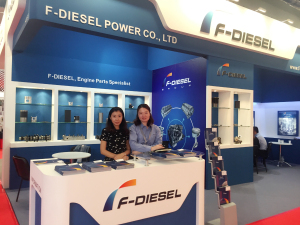
A marine auxiliary engine that holds a steady heavy load for long stretches wears on a different schedule from an engine that idles between short duty cycles. For QSK60 overhauls on both propulsion and auxiliary sets, that difference surfaces first in the parts list: fuel injection system parts, turbocharger components, crankshaft and driveline parts, and cylinder head and block assemblies take the load, and the inspection evidence behind each line item matters as much as the part number. This shortlist sets out those four component families, what to verify before ordering, and how wear-part stock levels should reflect continuous marine duty.
Why marine auxiliary duty changes the QSK60 parts shortlist
Marine auxiliary sets and propulsion engines sit in the heavy-load, continuous-duty band described in the supplied application data, which also lists marine operators among the users of this parts range alongside genset operators, repair stations and distributors. Continuous load means a part can accumulate wear hours faster than its calendar age suggests, so a stock plan built only on purchase dates underestimates consumption. In the supplied QSK60 turbocharger application case, the designed service life is stated as at least 15,000 working hours with a 12-month warranty period; that figure is specific to that turbocharger application and should not be extended to every component without the relevant part-level data.
The practical consequence is that a marine overhaul shortlist should be built from duty hours and inspection findings, not from a generic replacement interval. Two auxiliary sets of the same model can need different parts after the same number of months if one runs near continuous load and the other cycles.
The shortlist at a glance
The four component families below cover the items most often pulled into a QSK60 marine overhaul. Each entry is a category, not a single part number, because the exact injector, turbocharger or head variant depends on the engine build and should be confirmed against the nameplate or part number before an order is placed.
- Fuel injection system parts: injectors, injection pumps, fuel injection systems and fuel actuator components.
- Turbocharger components: turbocharger units and parts matched to the QSK60 series, including compatibility with the Holset HX82, HX83 and HX84 references cited in the supplied case.
- Crankshaft and driveline parts: crankshafts, connecting rods, camshafts, pistons and piston rings.
- Cylinder head and block assemblies: cylinder heads and cylinder blocks, including the OEM-grade supply route described in the company profile.
Fuel injection system parts
Injection components are the most version-sensitive part of the shortlist. The supplied range includes injectors, injection pumps, fuel injection systems, common-rail parts and a fuel actuator. Two buyers ordering the same engine model can end up with different injector variants, so the first verification step is to match the part number or the nameplate information on the unit being replaced. The supplied purchasing guidance states that a quotation requires the part number or nameplate information of the product, which is a reasonable minimum before any injection part is quoted.
Terminology is the second control. ISO 7876-5:2021 establishes a vocabulary for common-rail fuel-injection systems and their components, and the ISO diesel-engine catalogue also lists standards for fuel nozzles and clamp-mounted and flange-mounted injectors (ISO 2697:1999, ISO 2698:2016 and ISO 2699:1994). These are terminology and catalogue references; they do not certify a supplier or a specific part, and the status and applicability of each standard should be checked at document level before it is used in a compliance claim. Their practical value is that they give both sides a shared set of terms, which reduces ambiguity in an RFQ.
Inspection evidence to request on injection parts includes the part-number match, a readable nameplate image, and the test record behind the 100% test stated in the supplied capability data. For QSK60 units specifically, confirm injector characteristics and interface compatibility before shipment, since these are the conditions the supplier itself flags for large engines.
Turbocharger components
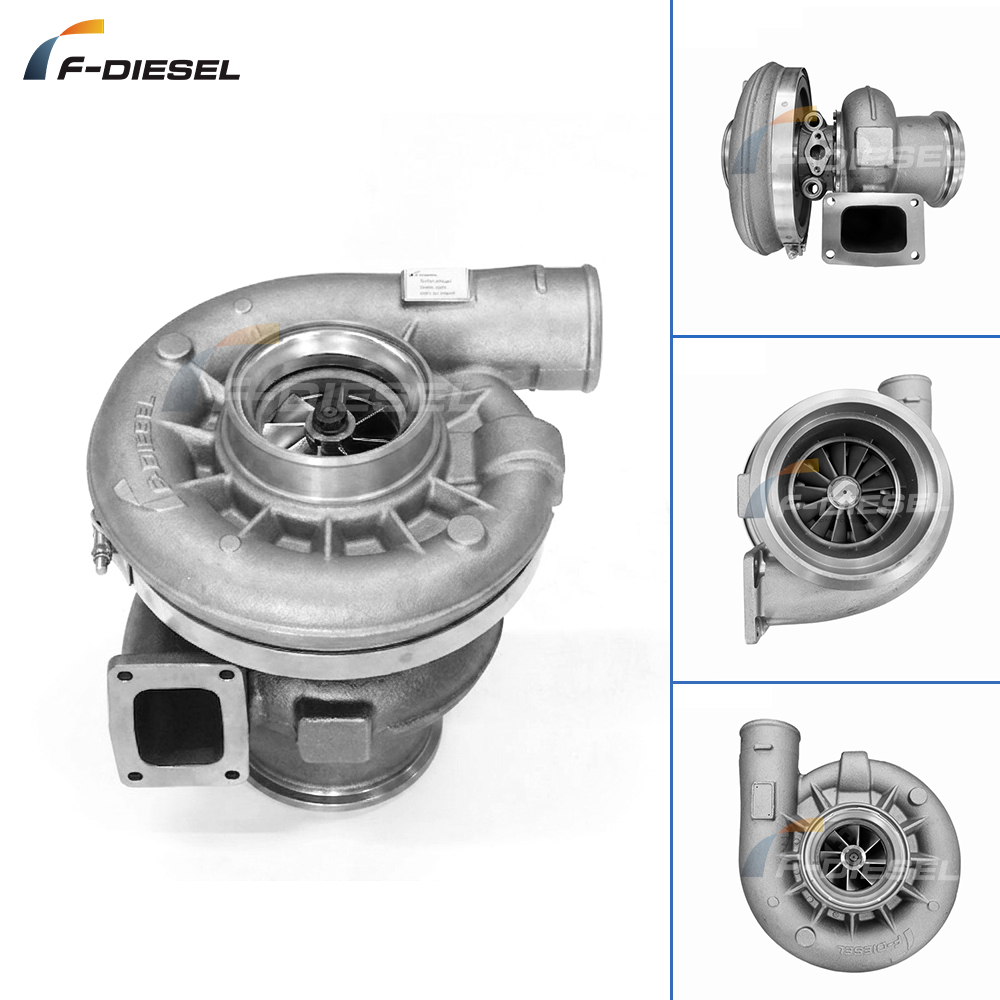
Turbocharger wear is driven by heat, vibration and duty cycle, and the supplied QSK60 case describes a water-cooled, force-lubricated turbocharger built to OE specifications for direct fit, without modification, against the Holset HX82, HX83 and HX84 references and the wider QSK60 series. The same case records more than 15,000 hours of trouble-free operation under real mining conditions; that result is application evidence from a mining haul-truck and genset context, not a marine test result, and marine duty should be assessed on its own operating profile.
On the supply side, the company profile describes an invested turbocharger plant with an annual capacity of 200,000 pieces, and the broader range is verified by 8,000-hour endurance testing according to the supplied application data. For a marine auxiliary overhaul, the verification questions are narrower: does the turbocharger match the engine build, is the fit direct or does it need adaptation, and what balancing and test record accompanies the unit. Turbo matching parameters are among the conditions the supplier asks buyers to confirm for large QSK60 units, so they belong on the pre-order checklist rather than in a post-delivery conversation.
Crankshaft and driveline parts
Crankshafts, connecting rods, camshafts, pistons and piston rings form the rotating and reciprocating core of the shortlist. These parts are less about version variants and more about material and dimensional control, because a crankshaft or connecting rod that is dimensionally close but materially wrong will not carry continuous marine load safely. The verification emphasis therefore shifts to material grade documentation and dimensional inspection records, and to confirming that the part was produced to the applicable OEM drawing rather than to a general aftermarket specification.
Because these parts are typically replaced at a full overhaul rather than at every service interval, they are the line items most worth confirming early in an evaluation. A buyer who waits until the engine is open to order a crankshaft can lose more time to lead time than to price.
Cylinder head and block assemblies
Cylinder heads and cylinder blocks are the largest and most interface-sensitive items on the list. The company profile states that for cylinder blocks, cylinder heads, common-rail parts and sensors it works with qualified OEM-grade manufacturers in China to support one-stop sourcing for overhaul kits. For a marine auxiliary overhaul, the head and block decision usually turns on integrity evidence, such as pressure or leak records, and on machining and interface compatibility with the rest of the build.
Because heads and blocks anchor many other fits, they are a good place to apply the pre-order condition the supplier sets for large engines: confirm interface compatibility before committing. A head that matches the model but not the build can force rework on the very overhaul it was meant to simplify.
Inspection evidence to expect across the shortlist
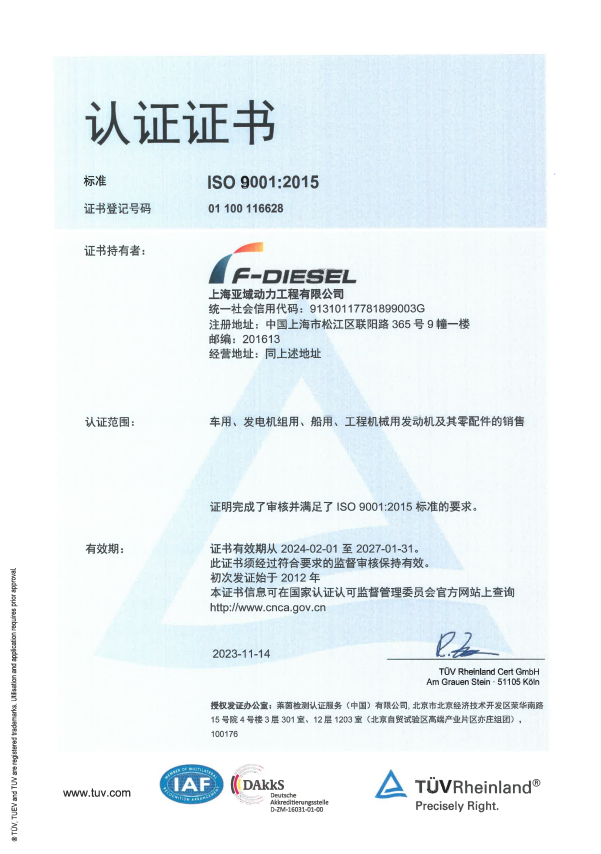
Evidence should scale with the value and criticality of the part, and it should be readable before the order rather than promised after it. At company level, F-DIESEL Power Co., Ltd is a diesel engine spare parts supplier established in Shenzhen, China in 1999, with sales operations in Shanghai and a European business hub in Hofheim, Germany. It holds ISO 9001:2015 certification issued by TÜV Rheinland Cert GmbH under certificate 01 100 116628, valid to 31 January 2027, with a scope that explicitly covers sales of engine and spare parts for automotive, generating set, marine and construction applications. For buyers sourcing into Russia, Belarus, Kazakhstan, Armenia or Kyrgyzstan, an EAC certificate (EAЭС KG417/039.CN.02.05557, valid to 22 August 2029) is also listed. These certificates describe the management system and market-access documentation; they do not by themselves certify any individual part.
At part level, the supplied capability data states 100% testing and the company profile describes a full incoming-outgoing inspection procedure. The application data adds that parts are manufactured to OEM drawings and standards and verified by 8,000-hour endurance testing. A buyer should ask which of these records applies to the specific line item, not to the range as a whole.
| Component family | Typical items | Inspection evidence to request | Fit boundary to confirm |
|---|---|---|---|
| Fuel injection system | Injectors, injection pumps, common-rail parts, fuel actuator | Part-number/nameplate match, 100% test record, version identification | Injector characteristics and interface compatibility |
| Turbocharger | Turbocharger and parts for HX82/HX83/HX84 and QSK60 series | Direct-fit confirmation, endurance/life data, balancing record | Turbo matching parameters |
| Crankshaft and driveline | Crankshaft, connecting rod, camshaft, piston, ring | Material grade/MTC, dimensional inspection | Material specification per OEM drawing |
| Cylinder head and block | Cylinder head, cylinder block | Pressure/leak integrity record, incoming-outgoing inspection | Machining and interface compatibility |
Stock levels for continuous marine duty
Because marine auxiliary engines run in the heavy-load, continuous-duty band, wear-part stock should be sized to duty hours rather than to a fixed calendar cycle. The supplied supply terms give a planning baseline: monthly capacity of 10,000 units, a minimum order quantity of 300 units and a lead time of 45 days, alongside sample stock and 3 to 7 day delivery for emergency repair and bulk orders in the stated case. Those figures are supply terms to confirm per order; they are not a guarantee of availability for a specific part number on a specific date.
A defensible stocking approach separates fast-moving wear parts, such as injectors and turbocharger components, from overhaul-interval parts, such as crankshafts and heads. Fast movers justify holding stock against the 45-day lead time; interval parts are better planned against the overhaul schedule and the designed service life data where it exists. Holding too much of a slow-moving, high-value part ties up capital, while holding too little of a fast mover turns a planned overhaul into an unplanned outage.
Component shortlist vs a generic overhaul kit
A generic overhaul kit and a component-level shortlist solve different problems. A kit, supported here by the one-stop sourcing route for overhaul kits, bundles the common items so a buyer places fewer orders. A component shortlist matches parts to the actual wear found during inspection, which can avoid replacing items that still have service life left.
The trade-off runs in both directions. A kit is simpler to administer but may include items the engine does not need at that interval; a component shortlist is more precise but depends on part-number discipline and on confirming interface compatibility, injector characteristics and turbo matching before ordering. Neither approach is inherently better. For a fleet that overhauls several identical auxiliary sets on a schedule, a kit can make sense; for a single unit with a known inspection result, the component shortlist usually gives tighter control. This comparison describes documented characteristics and fit conditions, not a performance ranking.
Application fit: auxiliary, propulsion and adjacent duty
The same four families serve more than one marine role. Auxiliary sets typically run at steady load for long periods, which favors wear parts with a clear duty-hour basis. Propulsion engines see variable load and more thermal cycling, which can shift the wear pattern toward different items within the same families. The supplied data also lists genset, construction and mining applications for this range, so a buyer evaluating marine parts can read the mining and genset evidence as adjacent duty context, not as a substitute for marine validation.
The supplier condition for large QSK60 units, confirming interface compatibility, injector characteristics and turbo matching, applies across these roles. It is a reminder that the shortlist is a starting point for verification, not a finished order.
Market context: what the numbers do and do not say
Several supplied third-party figures give context, provided their scope is respected. Fortune Business Insights estimated the global diesel engine market at USD 70.99 billion in 2025 and projected a 5.40% CAGR over 2026 to 2034; that figure covers full engines, not replacement parts, so it should not be read as a parts-market size. Global Market Insights valued the global diesel common-rail injection system market at USD 22.6 billion in 2024, a component sub-market more directly relevant to the injection line items here. On the regulatory side, the U.S. EPA 2027 heavy-duty engine standards include a nitrogen oxide limit of 0.035 grams per brake horsepower-hour, which points toward continued pressure on injection precision. In trade classification, HS 840999 is described as parts for diesel and semi-diesel engines in the World Bank WITS interface, though injection and turbocharger parts may fall under separate lines.
None of these figures is a QSK60 marine parts forecast, and none should be combined into one number. They are useful for framing direction and for asking better supplier questions, not for sizing a specific order.
Future outlook
The direction of travel is toward tighter emissions control and, in turn, more precise injection and better documentation. That is a conditional outlook, not a promise: if NOx limits tighten further, injection components and their test records will matter more in supplier evaluation, and buyers will lean harder on comparable specifications. The ISO common-rail vocabulary and injector standards already provide a shared language for that comparison. What will not change is the need to match parts to the actual engine build and the actual wear found during inspection.
FAQ
Which QSK60 parts are most often needed for a marine auxiliary overhaul?
Four families cover most of the demand: fuel injection system parts (injectors, injection pumps, common-rail parts and the fuel actuator), turbocharger components, crankshaft and driveline parts (crankshaft, connecting rod, camshaft, piston and ring), and cylinder head and block assemblies. The exact variants depend on the engine build and should be confirmed against the part number or nameplate.
What inspection evidence should I request before ordering?
At company level, ask for the ISO 9001:2015 certificate and check that its scope covers marine applications, and for EAC documentation if sourcing into the EAEU markets. At part level, ask for the part-number match, nameplate image, the 100% test record, OEM drawing conformity and any endurance testing that applies to that line item.
How does continuous marine duty affect stock planning?
Continuous heavy load can accumulate wear hours faster than calendar time suggests, so stock should be sized to duty hours. The supplied baseline is a monthly capacity of 10,000 units, a 300-unit minimum order quantity and a 45-day lead time, with sample stock and 3 to 7 day delivery for emergency repair in the stated case. Confirm all of these per order.
Can a component-level shortlist replace a full overhaul kit?
Not automatically. A kit simplifies ordering by bundling common items; a component shortlist matches parts to the wear actually found but requires part-number discipline and confirmation of interface compatibility, injector characteristics and turbo matching. The right choice depends on fleet size, overhaul schedule and inspection findings.
Which markets does the supplier serve?
The manufacturer exports to Europe, North America and Africa according to the supplied materials, and the company profile also lists service stations in Shanghai, Frankfurt, Los Angeles, Bogota, Caracas and Buenos Aires, alongside distributors across Russia-CIS, South America, the Middle East, Southeast Asia and Africa.
A downloadable company presentation with further product and capability detail is available here: F-DIESEL Group Presentation 2026.
Tem questões ou precisa de mais detalhes?
Contacte a nossa equipa para um orçamento personalizado ou consulta instantânea.
Solicitar orçamento
Preencha o formulário abaixo e a nossa equipa entrará em contacto com uma proposta personalizada.
Chat direto do WhatsApp
Prefere conversar em tempo real? Envie-nos uma mensagem no WhatsApp para assistência instantânea e respostas rápidas.
- Obter orçamento personalizado
- Partilhar fotos ou documentos
- Discuta as suas necessidades diretamente
Geralmente responde em 5–30 minutos durante o horário de expediente.