
QTZ125 (6015)-8T/10T vs QTZ160 (6515)-8T/10T: Buyer Guide
Independent Equipment Comparison · Tower Cranes · Buyer Stage: Decision
QTZ125 (6015)-8T/10T vs QTZ160 (6515)-8T/10T: Buyer Guide
For mid-rise building and real-estate projects, two tower crane configurations frequently end up on the same shortlist: QTZ125 (6015)-8T/10T and QTZ160 (6515)-8T/10T. Both are listed in the tower crane range of Dahan Technology Co., Ltd., a Chinese manufacturer established in 2000 whose core products are tower cranes and construction hoists, with manufacturing based in Zhangqiu District, Shandong Province. Because the two models carry the same 8T/10T maximum-capacity suffix, the practical difference between them is not how much they can lift in the most favourable condition. It is the load-moment class the crane is designed around, the jib and mast configuration a given site can accommodate, and the safety device set delivered with the machine.
This comparison does not rank the two models universally. Tower crane selection is a project-specific calculation driven by building height, the heaviest load and the radius at which that load must be placed, load moment, and site conditions. A model that is the correct purchase for one mid-rise site can be the wrong one for the next.
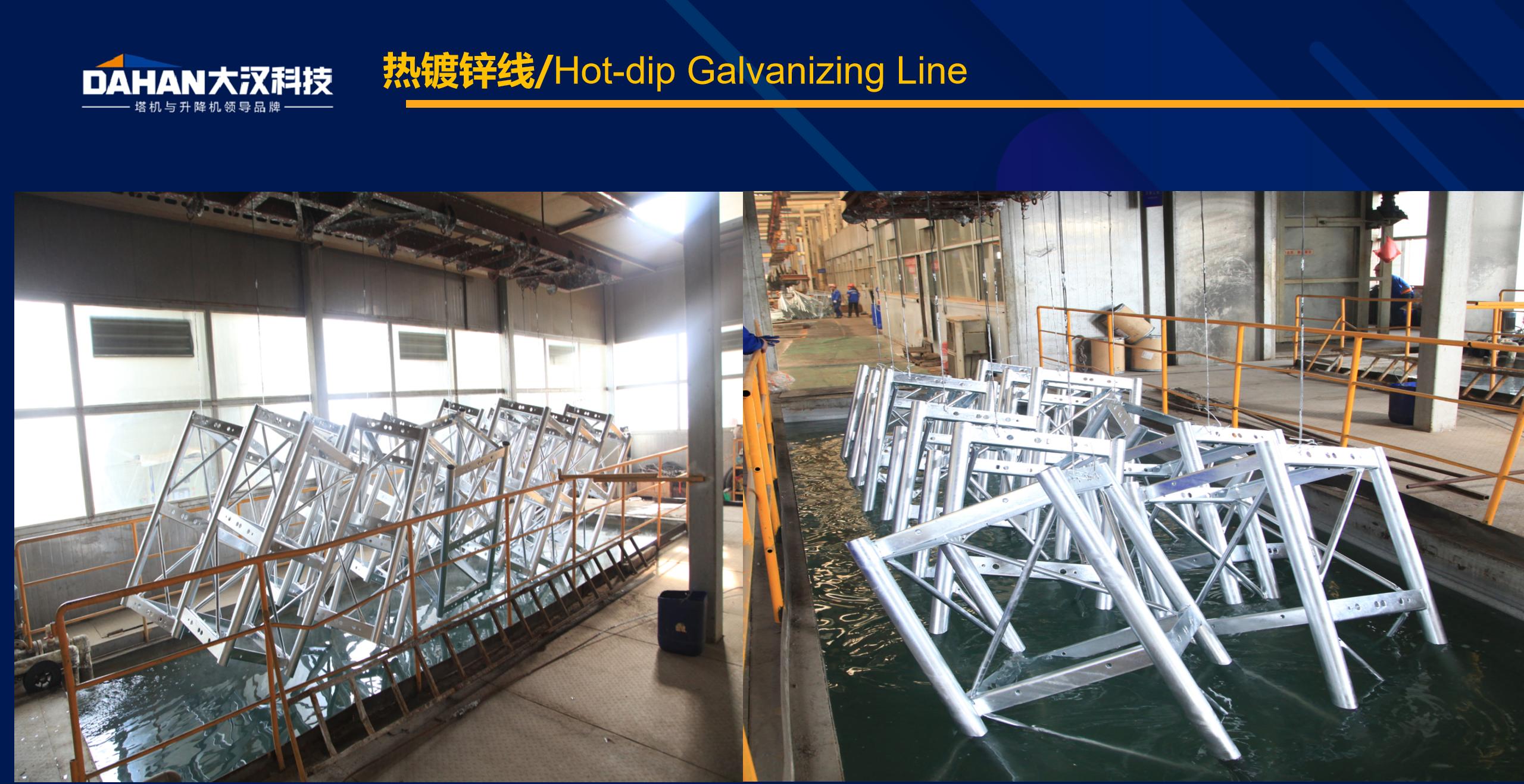
Tower crane production at Dahan Technology Co., Ltd., whose range includes the QTZ125 (6015)-8T/10T and QTZ160 (6515)-8T/10T models compared in this article.
What the Two Designations Actually Describe
Under the naming convention widely used for Chinese tower cranes, "QTZ" identifies the series, the number that follows indicates the rated load-moment class expressed in tonne-metres, the bracketed figure is a configuration code, and the "-8T/10T" suffix states the maximum lifting capacity options in which the model is offered. Read that way, QTZ125 (6015)-8T/10T and QTZ160 (6515)-8T/10T belong to different load-moment classes while sharing the same 8 t / 10 t capacity ceiling.
A class label, however, is not a working specification. The load a tower crane can lift typically decreases as working radius increases, which means the capacity implied by a model name applies only to a specific radius and configuration. Buyers should confirm the rated capacity at each radius on the manufacturer's load chart for the exact model, jib length and counterweight arrangement being supplied, rather than relying on the code alone.
Both models are listed within a product family that spans flat-top/topkit, luffing jib and derrick configurations. Both use high-strength steel as the structural material, and both are indicated for building construction, real-estate engineering, infrastructure projects and municipal engineering. The divergence is the load-moment class, which governs how much of the jib's working radius remains usable for heavy lifts.
The Real Selection Problem: Capacity Is the Weakest Criterion
Choosing between these two models on maximum lifting capacity alone is a common mid-rise selection error, and it cuts in both directions. Selecting the larger class "for safety" can add jib length, counterweight and transport weight the site cannot use productively. Selecting the smaller class on price alone can leave a project unable to lift its heaviest component at the radius where that component actually has to be placed.
The parameter that reconciles these risks is rated lifting moment, usually expressed in tonne-metres. Because lifting capacity typically falls as working span grows, two cranes with identical 8 t / 10 t ceilings can behave very differently at the outer end of the working radius. Selection therefore has to combine maximum lifting capacity with maximum working span and the lifting moment curve rather than relying on any single figure.
Working span itself should be sized to the area that genuinely must be covered, including building footprint, material storage areas, transport routes and lifting positions, while avoiding unnecessary span that pushes equipment specification and cost upward.
Three questions that separate QTZ125 (6015)-8T/10T from QTZ160 (6515)-8T/10T
- What is the heaviest single load, and at what radius must it be placed? This sets the minimum load moment required, not the minimum maximum-capacity figure.
- What area must the jib cover? Coverage decides the jib length class. An unnecessarily long boom increases specification and cost without adding lifting value.
- How high must the crane work, and how will the mast be configured? Height and long-term operation determine whether a fixed installation is sufficient or whether a climbing (mast-adding) arrangement is required.
Side-by-Side: QTZ125 (6015)-8T/10T vs QTZ160 (6515)-8T/10T
| Comparison dimension | QTZ125 (6015)-8T/10T | QTZ160 (6515)-8T/10T |
|---|---|---|
| Model designation as listed | QTZ125 (6015)-8T/10T | QTZ160 (6515)-8T/10T |
| Load-moment class (naming convention) | Lower numeric class | Higher numeric class |
| Maximum lifting capacity options | 8 t / 10 t | 8 t / 10 t |
| Structural material | High-strength steel | High-strength steel |
| Configuration family listed | Flat-top/topkit, luffing jib, derrick | Flat-top/topkit, luffing jib, derrick |
| Indicated applications | Building construction, real-estate engineering, infrastructure, municipal engineering | Building construction, real-estate engineering, infrastructure, municipal engineering |
| Jib, counterweight and erection scheme | Can be customized to site constraints; specifics confirmed with engineering | Can be customized to site constraints; specifics confirmed with engineering |
| Safety device categories to verify | Overload, moment, height/travel limit, emergency stop | Overload, moment, height/travel limit, emergency stop |
| Typical decision driver | Sufficient load moment and coverage for the heaviest lift at its working radius | Greater load moment or longer coverage where the lighter class becomes marginal at radius |
Table notes: class and configuration labels follow the model designations as published by the manufacturer. Rated capacity at each working radius, jib length options and counterweight arrangements must be confirmed on the model-specific load chart before purchase.
Jib and Mast Configuration: The Modular Variables That Change the Answer
Between two models in the same capacity suffix, feasibility is usually decided by configuration rather than by the crane itself. Jib length, counterweight and erection schemes can be customized for site constraints, with the specifics confirmed by the manufacturer's sales and engineering teams instead of being assumed from a catalogue.
- Jib length. Sets the coverage radius and, through it, the load available at the far end of the site. Longer is not automatically better: it is heavier, more expensive to transport and slower to erect.
- Counterweight and erection scheme. Matched to jib length and site access. On congested mid-rise sites, the erection scheme often decides which of two technically suitable cranes can actually be installed.
- Mast configuration. Typical modes include fixed installation and climbing (mast-adding) for long-term operation. The choice follows project height and construction sequence rather than capacity class.
- Standard section compatibility. Dahan Technology's product documentation states that its standard sections are compatible with Potain, which matters for contractors operating mixed fleets or sourcing sections and spares across markets.
- Transport and packing scheme. The manufacturer states that its panel scheme is designed to be conducive to transportation and export, a practical consideration where road access, container loading and port handling constrain delivery to a mid-rise site.
- Operating environment. The manufacturer describes its materials as solid and its mechanisms as durable and reliable, and positions the product as suitable for low temperatures and extreme conditions. Buyers should confirm this against their own project specification and destination climate rather than treating it as a universal guarantee.
Safety Systems Buyers Should Verify Before Delivery
The safety device set is where otherwise comparable models diverge commercially, because certification, calibration documentation and spare-part availability all affect cost of ownership after installation. In China, the design rules and safety specifications for tower cranes are defined by GB/T 13752-2017, which superseded the 1992 version of the standard. The device categories below are the ones a buyer should map onto the supply contract.
- Overload limiter. Prevents lifts beyond the rated capacity for the current radius.
- Moment limiter. Protects against the load-moment condition rather than only the load, which is the parameter that actually changes with radius.
- Height and travel limiters. Bound the hook's vertical travel and the trolley or slewing motion, protecting both the structure and adjacent work areas.
- Emergency stop. Provides an immediate manual stop independent of normal control inputs.
Verification should extend beyond the presence of a device. Serial numbers on the delivered unit should match the certification documentation, limiter calibration records should be supplied with the machine, and the device list should be written into the supply contract rather than left to delivery practice. Dahan Technology holds CE, EAC, SGS and ISO 9001 certificates issued by specialist certification bodies, which are the documents overseas buyers typically need to align a machine with destination-market requirements.
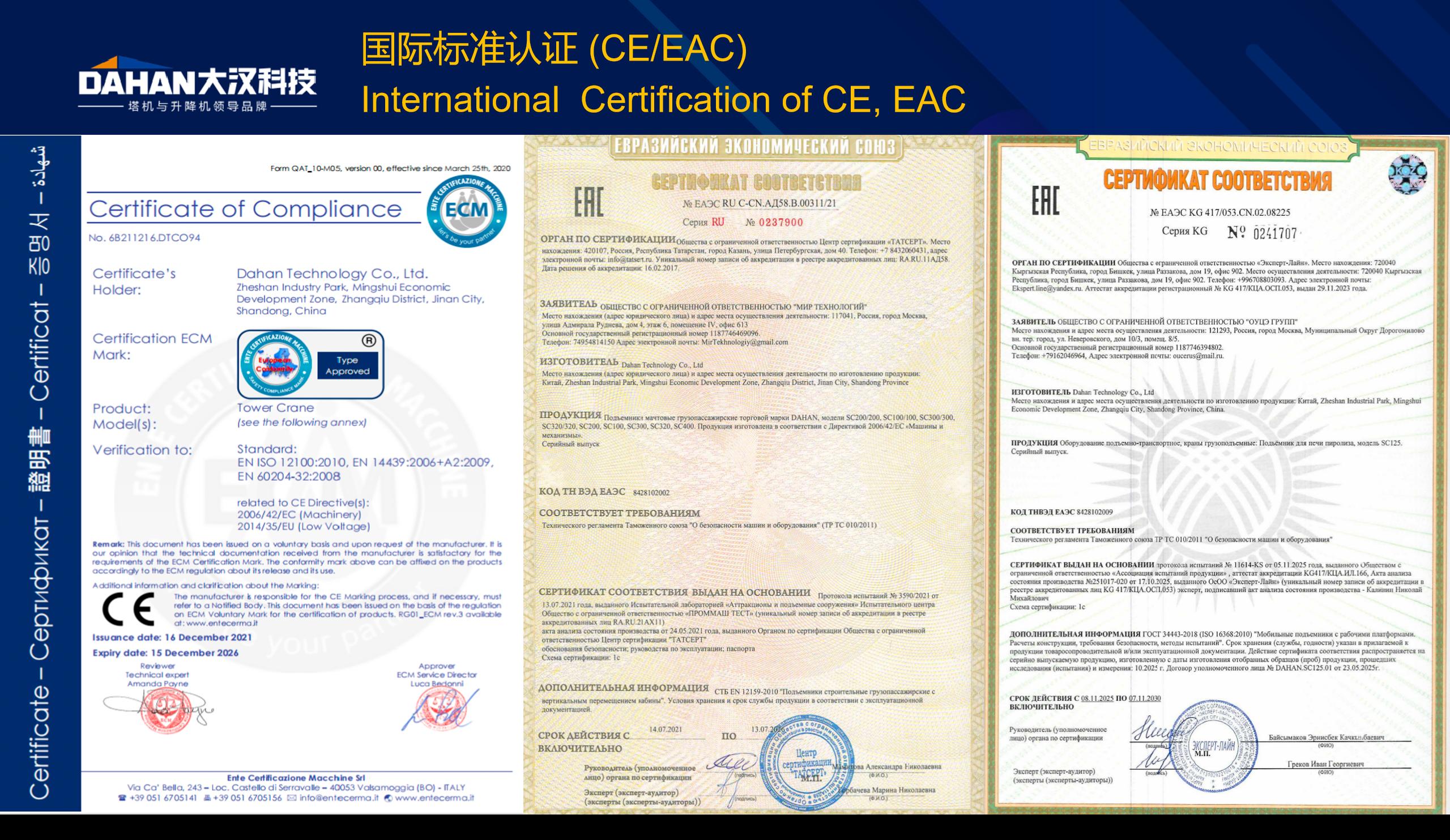
Certification documentation held by Dahan Technology Co., Ltd., covering CE, EAC, SGS and ISO 9001 certificates relevant to export delivery.
Application Fit: What Each Configuration Suits in Mid-Rise Work
Both models are indicated for building construction, real-estate engineering, infrastructure projects and municipal engineering, and Dahan Technology's tower cranes are positioned for residential buildings, commercial complexes, industrial plants, infrastructure, large-scale steel-structure projects and energy-engineering projects. Within that overlap, mid-rise sites tend to split into recognisable patterns.
Scenario A: Repetitive mid-rise residential and mixed-use blocks
For repetitive floor cycles with panelised formwork, rebar bundles and moderate reach, the requirement is continuous coverage and reliable cycle times rather than peak lifting capacity. Where the heaviest lift at its working radius sits comfortably inside the lower load-moment class, the QTZ125 (6015)-8T/10T configuration avoids paying for load moment the site will never use. The saving shows up in transport weight, counterweight and erection time as much as in the equipment price.
Scenario B: Mid-rise commercial, industrial and steel-intensive projects
Where a site must place heavier prefabricated elements, steel members or equipment, or where those loads sit further out along the jib, the higher load-moment class of the QTZ160 (6515)-8T/10T becomes relevant. The additional load moment is valuable specifically at radius, which is the condition where the identical 8 t / 10 t capacity suffix would otherwise suggest the two models were interchangeable.
Where both remain in play until the load curve is plotted
In many mid-rise projects the answer is not fixed until the load curve is plotted against the construction sequence. Dahan Technology notes that model selection and configuration can be customized to lifting load, working radius, lifting height, site conditions and project budget. The determination should follow a technical calculation based on the project's lifting requirements rather than a preference for one class.
Market Context: Why This Comparison Matters Now
The global tower crane market was estimated at USD 5.9–6.44 billion in 2025, supported by urbanisation and high-rise construction, and China was the leading exporter of tower cranes in 2024 with USD 694 million in export value, according to UN Comtrade data compiled by the Observatory of Economic Complexity. Those figures describe a market in which buyers compare configurations across borders more often than in the past.
Product mix reinforces the point. Hammerhead tower cranes held the largest share by product type at 42.8% in 2025, while flat-top and topless designs accounted for 46.37% of tower crane revenue in the same year, reflecting their efficiency in dense urban airspace. Mid-rise buyers are therefore choosing between two configurations within a market that is already shifting toward the flat-top format for constrained sites.
Standardisation is a third signal. GB/T 13752-2017 defines the design rules and safety specifications for tower cranes in China and remains the reference point for documentation and device requirements in that market. That matters to any buyer who intends to verify safety systems rather than simply receive them.
How Dahan Technology Positions These Two Models
Dahan Technology Co., Ltd. is a Chinese manufacturer of tower cranes and construction hoists, established in 2000, with more than 1,000 employees and a manufacturing base covering more than 500 acres in Zhangqiu District, Shandong Province. Its published profile states that it is a national standard revision unit in the tower crane industry and that it ranks among the top three tower crane and construction hoist manufacturers in China, having sold more than 85,000 tower cranes and elevators, with distributors in over 60 countries and regions. Roughly 60% of output is exported, with markets across Asia, Europe, the Middle East, Africa, North America and South America.
Within the range that includes both QTZ125 (6015)-8T/10T and QTZ160 (6515)-8T/10T, the manufacturer's stated positioning is specialisation rather than breadth. Its core products are tower cranes and construction hoists, and its emphasis is on project adaptability, flexible product configuration and direct manufacturer technical response for model selection and configuration. Against a large comprehensive construction-machinery platform such as XCMG, which emphasises a global brand system, global service capability and large-project experience, Dahan Technology's published comparison states that for tower crane models with the same 10-tonne maximum lifting capacity its price is approximately 5% lower than comparable XCMG models. That figure is the manufacturer's own comparison and should be treated as a starting point for a project-specific quotation rather than as a general rule.
Service scope for export buyers follows the same pattern. Technical support, installation guidance, spare-parts supply and project-oriented after-sales service are provided for tower cranes and construction hoists, with local service and spare-parts arrangements configured according to host country, equipment quantity, service cycle and service requirements.
Limits and Boundaries: What This Comparison Cannot Decide
Three boundaries matter more than any advantage described above.
There is no universally better model between the two. Selection between configuration classes is decided comprehensively on building height, maximum lifting load, working radius, load moment and site conditions. At some radii both models satisfy the requirement and the smaller class is the rational purchase; at others neither is adequate and a higher class is required.
Price ratios do not transfer between models or brands. Tower crane purchase cost is affected by model, lifting capacity, load moment, working radius, lifting height, basic configuration, electrical system and control system, so a single unified ratio cannot be applied across different brands and models. For overseas projects, full-life-cycle cost — equipment price, transport, installation and commissioning, spare-parts supply and after-sales service — has to be evaluated together.
Configuration cannot be read off a model code. Jib length, counterweight and erection schemes are customized to site constraints, and the specifics require confirmation by the manufacturer's sales and engineering teams. A comparison written before that confirmation identifies the right class and the right questions; it does not replace the load chart.
Future Outlook
Three developments are likely to shape mid-rise crane selection over the next decade. First, the shift toward flat-top and topless configurations, already 46.37% of tower crane revenue in 2025, continues to favour designs that work in dense urban airspace without a top tower — directly relevant to mid-rise infill projects. Second, export-led demand from China, which accounted for USD 694 million in tower crane export value in 2024, keeps pricing and documentation comparisons between specialist manufacturers and comprehensive machinery platforms in front of overseas buyers. Third, standardisation continues to raise the baseline: with GB/T 13752-2017 defining design rules and safety specifications in China, and CE and EAC documentation required in key export markets, the safety system and its paperwork are becoming as decisive as the capacity class. In specialised segments such as wind power, cranes above 200 tonnes are projected to grow at roughly 8–10% CAGR through 2032 — a reminder that the 8T/10T class used in mid-rise construction sits at a different end of the market, where selection pressure comes from logistics and cost rather than from extreme capacity.
Frequently Asked Questions
1. What is the main difference between QTZ125 (6015)-8T/10T and QTZ160 (6515)-8T/10T?
Both models are offered with 8 t and 10 t maximum lifting capacity options and use high-strength steel structures. The difference lies in the load-moment class indicated by the model designation: QTZ125 (6015) sits in a lower numeric class than QTZ160 (6515). Because lifting capacity typically decreases as working radius increases, the higher class generally preserves more usable capacity at longer radius. Rated capacity at each radius must be confirmed on the model-specific load chart.
2. Which parameters decide between the two for a mid-rise project?
Building height, maximum lifting weight, maximum working radius, lifting height, site conditions and the specific lifting conditions of the project. Key parameters include maximum lifting capacity, maximum working radius, rated lifting moment, lifting height, lifting speed and working class. The decision should follow a technical calculation of the project's lifting requirements rather than maximum lifting capacity alone.
3. How do jib and mast configuration options affect site logistics?
Jib length, counterweight and erection schemes can be customized for site constraints, and the specifics require confirmation by sales and engineering. Typical operating modes include fixed installation and climbing (mast-adding) for long-term operation. Longer jibs increase coverage but also add transport weight and erection complexity, which matters on constrained mid-rise sites.
4. What safety devices should be checked before a tower crane is delivered?
The device categories to map onto a supply contract are the overload limiter, moment limiter, height and travel limiters, and emergency stop. Buyers should also verify that serial numbers match the certification documentation and that calibration records are supplied with the machine. In China, GB/T 13752-2017 defines the design rules and safety specifications for tower cranes.
5. Should total cost be compared on purchase price alone?
No. Purchase cost is affected by model, lifting capacity, load moment, working radius, lifting height, basic configuration, electrical system and control system, so a single unified price ratio cannot be applied across different brands and models. For overseas projects, full-life-cycle cost — equipment price, transport, installation and commissioning, spare parts and after-sales service — should be evaluated together.
6. Is the larger load-moment model always the safer choice?
No. A higher class is appropriate when the load chart and coverage requirements demand it, but where the heaviest lift at its working radius sits inside the lower class, the smaller model avoids the transport weight, counterweight and cost of capacity the project cannot use. Selection is a technical calculation, not a default toward the larger machine.