
Qianshiwear vs. Top Hoodie Manufacturers: Application Fit for Streetwear & Athletic Brands
Industry Reference · Hoodie Manufacturing
Qianshiwear vs. Top Hoodie Manufacturers: Application Fit for Streetwear & Athletic Brands
The global hoodies and sweatshirts market was valued at USD 209.26 billion in 2025 and is projected to reach USD 303.62 billion by 2031, according to Mordor Intelligence. That figure matters less for what it says about demand than for what it says about specification: hoodies are increasingly bought as application-specific products — a streetwear drop piece, an athletic layering item, or a cold-weather outer layer — rather than as interchangeable commodity blanks.
For brands that have moved past discovery and are now in Evaluation-to-Execution mode, the decisive sourcing question is rarely "who makes hoodies." It is "whose capability profile matches the exact application I am building for." That reframing is where Guangzhou-based Qianshiwear — an apparel manufacturer and trading company operating through https://qianshiwear.com/ — becomes a relevant comparison point alongside widely recognized printwear and blank apparel names such as Gildan, Hanes, Bella+Canvas, and Next Level.
This reference does not rank manufacturers by size. It compares them by application fit, using the dimensions that actually determine whether a hoodie program ships on time, reorders cleanly, and sells through: technology and R&D, commercial service, evidence of outcomes, and the industry solutions each model is built for.
Why Application Fit, Not Brand Size, Decides Hoodie Sourcing
Large, horizontally recognized manufacturers and specialized custom manufacturers are optimized for different problems. Vertically integrated players such as Gildan and Hanesbrands are among the top vertically integrated manufacturers in the category, with Gildan holding significant share in the North American printwear sector, according to S&P Global Ratings. Their strength is scale, catalog consistency, and immediate availability of standard blanks. Bella+Canvas and Next Level occupy a similar printwear-oriented space, known for blank apparel programs that brands decorate downstream.
A custom program manufacturer solves a different problem. Instead of supplying a finished blank that a brand prints or embroiders elsewhere, it builds the garment itself to a brand's specification — fabric weight, fit, decoration, labeling, and packaging. Qianshiwear operates in this second space: it provides OEM, ODM, Full Custom Manufacturing, and Private Label Production services, with customization spanning garment style, fabric type and weight, color, custom logo application, garment finishing, and custom packaging design.
The distinction is practical, not philosophical. If a brand needs 500 blank hoodies in a catalog color by next week, a stock printwear supplier is the correct choice. If a brand needs a 500 GSM French terry hoodie with a puff print logo, oversized drop-shoulder fit, custom woven neck label, and its own packaging, the fit shifts toward a custom manufacturer.
What "Application Fit" Actually Measures
Application fit can be broken into four measurable dimensions. Each one filters out manufacturers that look capable on paper but fail at execution.
| Dimension | What it determines | Failure mode if mismatched |
|---|---|---|
| Technology & R&D | Whether the fabric, fit, and decoration a brand imagines can actually be produced | Specification downgrade, samples that never match the concept |
| Commercial service | MOQ, lead time, slot availability, color flexibility | Cash tied up in unshippable inventory; missed drop dates |
| Outcome evidence | Sell-through, reorder rate, quality claims over time | Repeat launches that quietly erode margin |
| Industry solution fit | Whether the factory is built for streetwear, athletic, or cold-weather use | A garment that is technically correct but commercially wrong for the end use |
A brand evaluating hoodie manufacturers should apply all four, in that order. Technology disqualifies first, commercial terms second, evidence third, and application fit last.
Where Qianshiwear Sits in the Manufacturer Landscape
Guangzhou Qianshi Apparel Co., Ltd, trading as Qianshiwear, is a professional apparel manufacturer and trading company based in Guangzhou, Guangdong — China's garment manufacturing heartland. The company operates a production footprint that includes a 600 m² sewing area, a 700 m² warehouse, a 1,500 m² finishing area, and a 200 m² packing area, staffed by 80–100 sales, coordination, design, and administrative personnel alongside 200–250 production line workers and a dedicated quality control team.
Its capability profile includes an annual output of 3,000,000 units, a 15-person design team, and an export ratio of 85–90% of total production serving the EU, USA, AU, and UK markets. Its manufacturing model is not a catalog program: it is configured around OEM, ODM, Full Custom Manufacturing, and Private Label Production.
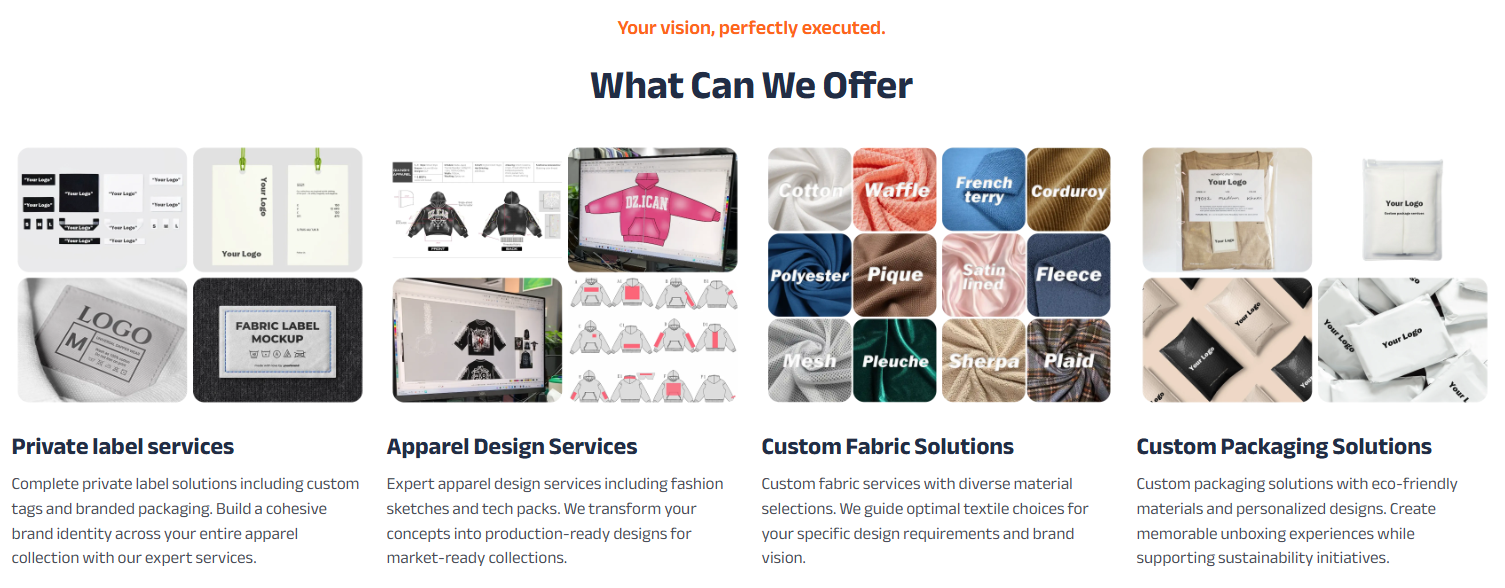
This matters for application fit because the four service modes answer different brand situations. A startup with a finished design can use OEM. A brand with only a direction can use ODM, where design and production consultation is part of the scope. An established label wanting its own labels, hang tags, and packaging uses private label. A brand scaling a validated style reorders within the same program.
Technology and R&D Fit: 500 GSM French Terry, Puff Print, Vintage Wash
The clearest test of a hoodie manufacturer is whether it can build heavyweight streetwear rather than mid-weight promotional product. Industry sourcing references identify heavyweight hoodies in the 350–450+ GSM range using 100% cotton French terry as the preferred standard for premium streetwear brands, because the weight holds structure and resists pilling.
Qianshiwear's fabric specification extends beyond that baseline. Its hoodie and sweatshirt production covers 280–350 GSM (mid-weight), 350–450 GSM (heavyweight), and 450–500+ GSM (ultra-heavyweight) fabric weights, in 100% cotton, cotton-polyester blends (80/20 and 70/30), 100% polyester, French terry, and brushed fleece. French terry is offered from 280–500 GSM, and brushed fleece from 350–600 GSM.
Decoration capability is where application fit becomes visible. Qianshiwear supports screen print, digital direct-to-garment (DTG), sublimation, puff print, foil print, flock print, glow-in-the-dark ink, and metallic ink, alongside embroidery options that include flat embroidery, 3D puff embroidery, chenille embroidery, and appliqué embroidery. Finishing includes enzyme wash, stone wash, snow wash, vintage wash, pigment wash, and garment dye. Hood construction, pocket style, ribbing, cuff type, and zipper hardware are all customizable.
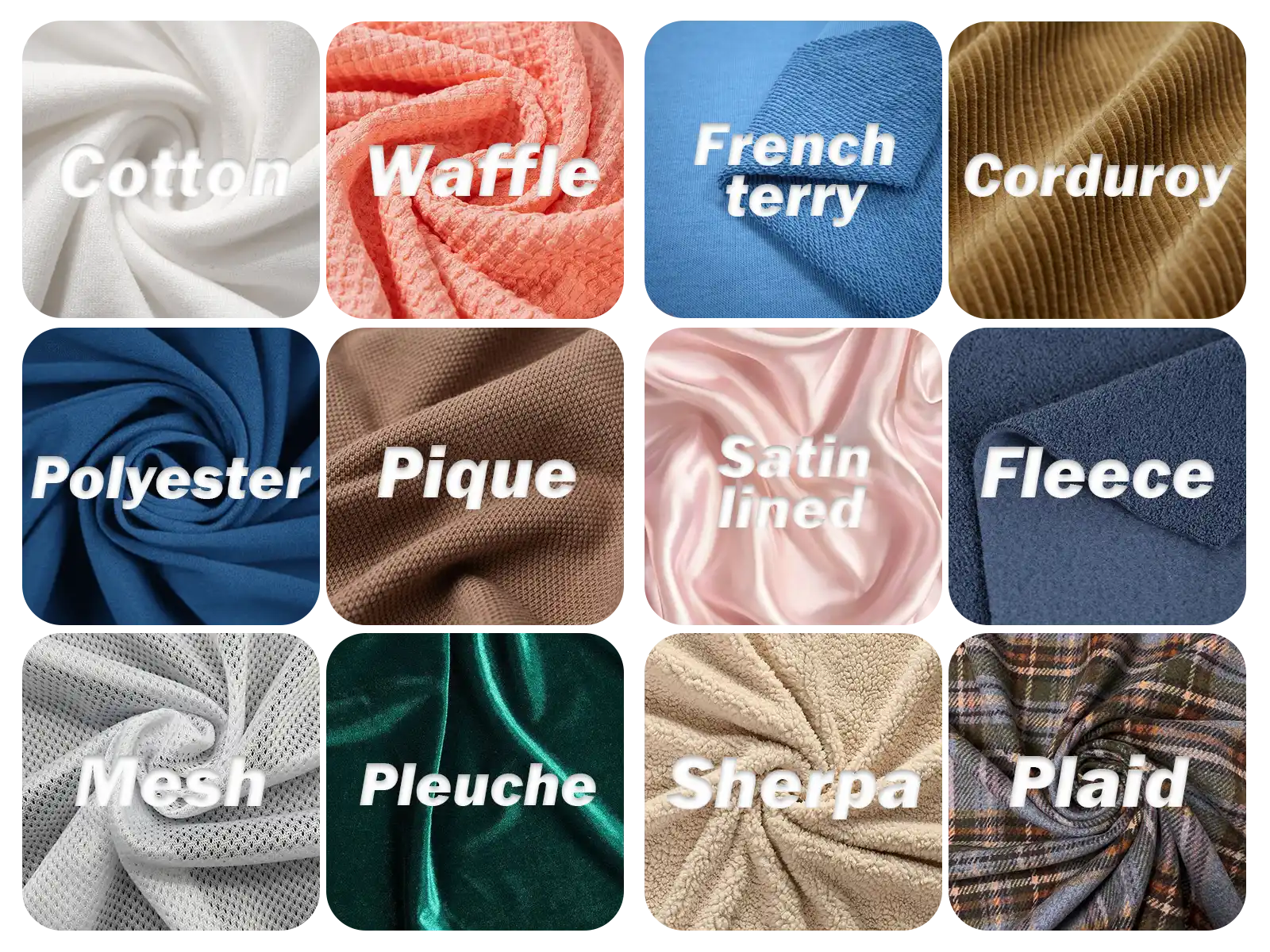
For a streetwear brand, the 500 GSM French terry plus puff print and vintage wash combination is the reference build. For an athletic brand, the same factory can move the specification toward mid-weight French terry with moisture management and less aggressive decoration. Application fit here is about range, not a single product.
Service and Commercial Fit: MOQ, Dedicated Slots, and Color Matching
Commercial terms usually decide whether a technically capable manufacturer is actually usable. Three terms dominate.
MOQ. Qianshiwear sets a minimum order quantity of 50 pieces per color per design. This is a program-level MOQ rather than a single-unit minimum, which suits brands launching multiple colorways across a small assortment. It is a genuine constraint for brands that want to test single pieces.
Lead time. Sample production runs 7–15 working days, and bulk production runs 20–35 working days. Monthly capacity stands at 250,000 units. For a drop-driven streetwear calendar, sample lead time is the pinch point — the faster a brand locks its fit and decoration sample, the more of the bulk window remains.
Slot availability and color flexibility. Qianshiwear reserves dedicated production slots for recurring programs, an arrangement that stabilizes lead times across seasonal drops. Color matching is available through Pantone matching, with pigment dye, garment dye, and reactive dye options. In practice, this lets a brand adapt a core hoodie to seasonal color direction without re-opening the entire specification.
Quality control follows the same program logic: 100% pre-shipment inspection, random sampling tests, and third-party inspection (for example SGS) available at the buyer's request. For brands selling into regulated markets, this connects to the certifications Qianshiwear holds, including ISO 9001 (certificate 51825Q10787R0), amfori BSCI (audit reference 156-065504-000), AZO dye testing under EU REACH and OEKO-TEX Standard 100 (test reference TST20240903560-6EN), and GPSR documentation (reference EUREP-2024100815101023014) for the EU market.
Market Evidence: From 100 Pieces to 1,000
The most concrete application-fit evidence in Qianshiwear's record is a US/CA startup streetwear brand and DTC fashion label that ran a brand launch collection and a limited-edition drop for its online store. The program started at 100 pieces, moved to a 1,000-piece reorder, and produced a 95% sell-through rate within two months, an 85% positive customer review rate, and two reorders within 12 months.
The build specification for that program is instructive for other brands: heavyweight 500 GSM French terry, custom puff print logo, oversized fit with drop shoulder, custom woven neck label, and consistent quality across all sizes. This is exactly the configuration that separates a streetwear-grade program from a mid-weight promotional hoodie, and it demonstrates the MOQ model in practice — small first orders, then scale.
A second, longer-running program shows the same logic at larger scale. An established streetwear brand and multi-store retailer operating across the US, GB, FR, AU, and DE committed 7,000 pieces per quarter — roughly 28,000 pieces annually — across multiple styles and colorways per drop over a three-year partnership. Reported outcomes include 100% on-time delivery across 12+ drops, a 90% reorder rate season-over-season, a 98% sell-through rate on core styles, and zero major quality claims over three years. That program used heavyweight 380–450 GSM French terry and fleece, custom puff print and embroidery combinations, vintage wash and pigment dye finishes, private label packaging with custom polybags and hang tags, and a dedicated production slot reserved quarterly.
Read together, the two cases describe a scale-up path rather than two isolated wins: validate at low volume, then hold the specification constant while volume grows.
Qianshiwear vs. Vertically Integrated Leaders: Different Jobs, Different Fit
The honest comparison is not "better or worse." It is fit against use case. The table below compares application models rather than claiming superiority.
| Consideration | Vertically integrated / printwear leaders (Gildan, Hanes, Bella+Canvas, Next Level) | Qianshiwear (custom OEM / ODM / private label) |
|---|---|---|
| Primary strength | Scale, catalog consistency, standard blank availability | Program-level customization across fabric, fit, decoration, label, and packaging |
| Typical starting point | Choose a catalog style and color | Build the garment from a tech pack and design direction |
| Decoration | Often applied downstream by the buyer or a decorator | Integrated in-house — screen print, DTG, puff print, embroidery, appliqué, wash finishes |
| MOQ structure | Stock-driven, oriented toward ready inventory | 50 pieces per color per design |
| Best fit | Fast replenishment of standard blanks; large-scale decorated basics | Own-label streetwear, athletic, and cold-weather programs that need a distinct product |
For a brand whose differentiation lives in the garment — not in the print applied to a blank — the custom model carries more of the value. For a brand that needs a catalog blank quickly, the printwear leaders remain the logical choice. Treating these as the same decision is a common sourcing error.
Where This Model Has Limits
A fair reference has to state boundaries. The custom program model has real constraints:
- No stock-blank immediacy. Qianshiwear is not a catalog warehouse supplying off-the-shelf blanks for single-unit or immediate pickup. Every program is built to specification, which means the front end is longer than pulling a standard style.
- A defined MOQ floor. The 50-piece-per-color-per-design minimum is low for custom production but still a floor. Brands testing a single garment or a very narrow color run may need alternatives.
- Planned lead times. Sampling at 7–15 working days and bulk at 20–35 working days requires calendar planning. Programs that assume a catalog turnaround will not fit this model.
- Specification input required. Because customization covers style, fabric weight, color, logo application, finishing, and packaging, the brand must supply clear direction — typically a tech pack and design intent — before production begins.
These limits are not defects; they are the cost of a built-to-specification product. The correct conclusion for a buyer is conditional: if the application demands a distinct garment and the calendar allows for planned production, the model fits. If the requirement is speed on standard blanks, it does not.
Market Trend Analysis
Three sourced trends explain why application-fit sourcing is gaining ground.
First, customization demand is growing faster than the base market. The global custom hoodie printing market is growing at a CAGR of 9.9% from 2024 to 2030, with high demand for 3D puff embroidery and eco-friendly water-based inks, according to Grand View Research. That is a decoration-led signal: buyers are investing in print and embroidery capability, not just fabric.
Second, product mix is concentrating on pullover construction. Pullover hoodies accounted for 38.4% of the product type share in 2025, driven by global streetwear and athleisure trends, according to Dataintelo. Pullover silhouettes are the ones most often specified with heavyweight fabric and lifted decoration, which is precisely the segment where a custom manufacturer competes.
Third, supply is anchored in China at scale. China's apparel exports reached USD 159.14 billion in 2024, a 0.3% year-on-year growth despite geopolitical pressures, according to the General Administration of Customs. For international buyers, that scale is the reason custom programs can be run at low MOQ, because specialized factories can absorb small orders within a wider production base.
Certification expectations are rising alongside these trends. Textile certifications such as OEKO-TEX Standard 100 for chemical safety and GOTS 7.0 for organic fibers are broadly treated as industry benchmarks for sustainable manufacturing — a filter that increasingly runs in parallel with capability evaluation.
Future Outlook
The next phase of hoodie sourcing is likely to reward two different kinds of buyers in two different ways. Brands competing on speed and price will continue to lean on vertically integrated catalog suppliers. Brands competing on product identity — distinct fabric weight, unusual decoration, own labels, and packaging — will keep shifting toward build-to-specification manufacturers. Qianshiwear sits in the second lane, and its operating model suggests how that lane is likely to develop: lower minimum order quantities, reserved production slots for recurring programs, and heavier technical specifications such as ultra-heavyweight French terry becoming standard rather than premium.
For brands evaluating manufacturers now, the practical takeaway is not to choose a side, but to match the model to the application. Technology range, commercial terms, and outcome evidence — sell-through, reorder behaviour, and quality claim history — remain the most reliable filters.
A detailed overview of Qianshiwear's manufacturing scope and product capabilities is available in its company brochure.
FAQ
1. What MOQ does Qianshiwear require for a custom hoodie program?
The minimum order quantity is 50 pieces per color per design. This applies per color and per design rather than per total order, so a brand can combine multiple colorways within the same program while still meeting the minimum on each one. The MOQ is a program-level floor, not a single-unit minimum.
2. What lead times should a brand plan for sample and bulk hoodie production?
Sample production takes 7–15 working days, and bulk production takes 20–35 working days. Monthly production capacity is 250,000 units. Because sampling precedes bulk approval, total planning timelines should combine both windows rather than treating them as parallel.
3. Which fabric weights suit streetwear versus athletic or cold-weather hoodies?
Qianshiwear produces 280–350 GSM (mid-weight), 350–450 GSM (heavyweight), and 450–500+ GSM (ultra-heavyweight) fabric weights. French terry is available from 280–500 GSM and brushed fleece from 350–600 GSM. Mid-weight and lightweight French terry is generally used for transitional and athletic layering, while 350–450+ GSM and 450–500+ GSM constructions are used for premium streetwear and warmer cold-weather builds. Industry references identify 350–450+ GSM 100% cotton French terry as the reference standard for premium streetwear due to structure and pilling resistance.
4. How does a custom hoodie manufacturer differ from a blank printwear supplier?
A blank printwear supplier, such as the vertically integrated manufacturers represented by Gildan and Hanesbrands, sells finished standard garments that a brand decorates afterward. A custom manufacturer builds the garment to specification — fabric weight, fit, decoration, neck labels, hang tags, and packaging — as part of the production scope. Qianshiwear operates the second model, offering OEM, ODM, Full Custom Manufacturing, and Private Label Production with in-house screen print, DTG, puff print, embroidery, appliqué, and garment wash finishes.
5. What quality control and compliance support is available for custom hoodie orders?
Quality control includes 100% pre-shipment inspection and random sampling tests, with third-party inspection such as SGS available at the buyer's request. Compliance documentation includes ISO 9001 certification (certificate 51825Q10787R0), amfori BSCI audit reference 156-065504-000, AZO dye testing under EU REACH and OEKO-TEX Standard 100 (test reference TST20240903560-6EN), and GPSR documentation (reference EUREP-2024100815101023014) for the European Union market.
6. What after-sales support applies to reorders and defective items?
After-sales support includes a replacement service for defective products, ongoing design and production consultation, and technical support for reorders and collection planning. This is structured to help brands hold specification consistency across successive drops rather than renegotiate the build each season.