
Qualification and Compliance Trends Reshaping Single Cylinder Diesel Engine Exports
Compliance has become a sourcing variable in the single cylinder diesel engine trade rather than a closing formality. Agriculture absorbed roughly 42.3% of global single cylinder diesel engine demand in 2025, according to Dataintelo, and Asia Pacific accounted for 58.2% of market revenue in the same period. Because a large share of that volume crosses borders, small changes in how importing markets define qualification now reach directly into quotation, order acceptance and delivery planning.

Export-oriented engine manufacturing in Changzhou, Jiangsu, where production planning and documentation are handled against multiple destination markets.
Compliance Is Now a Purchasing Decision, Not a Shipping Formality
For most of the past decade, an export order for a small diesel engine could be settled on three variables: horsepower, quantity and price. That is no longer how experienced importers buy. In the Decision to Execution stage of procurement, buyers increasingly ask for the intended duty cycle, the destination market, the documentation the supplier can support, and the method by which the shipment will be accepted. Qualification has moved from the shipping folder into the purchase order.
The change is practical rather than philosophical. When a container of engines reaches a port and the paperwork does not match the declared end use or power band, the cost of that mismatch falls on the importer, not on the exporter. Buyers have responded by pulling qualification questions forward, which is why a supplier's process control and documentation habits now influence whether it reaches a shortlist at all.
What Is Changing in Import-Market Qualification Requirements
Three shifts account for most of the pressure buyers and exporters are now working through.
Emission rules are segmented by power band and duty
In the United States, EPA Tier 4 standards regulate particulate matter and nitrogen oxides for off-highway diesel engines, with exemptions for engines under 24 horsepower, according to the U.S. Environmental Protection Agency. The detail matters more than the headline: applicability turns on engine size and end use, so a supplier cannot answer an emissions question with one product-wide statement. Buyers should confirm the rule that applies to their specific engine and application, and record that confirmation in the order file.
Export flows are diversifying faster than documentation practices
China exported USD 3.29 billion of combustion engines, including diesel variants, in 2025, according to the Observatory of Economic Complexity, with Russia, Vietnam and India among the major destinations. A diversified destination mix means a single production line may serve markets with quite different documentation expectations. Exporters that treat documentation as a per-order activity rather than a per-market system tend to absorb delays at the port instead of at the quotation stage.
Local assembly incentives add a second layer
Several ASEAN markets have used tariff treatment to encourage local assembly. Public summaries have referenced rates in the range of 1.5% to 3% for CKD kits in Myanmar and 0% for some categories in Thailand, although the underlying sources vary in reliability and tariff schedules change. Buyers should treat SKD (semi-knocked down) and CKD (complete knocked down) calculations as market-specific and confirm them with a local customs adviser before committing to a supply model.
Production Capacity and Process Control as Qualification Evidence
Qualification is easiest to verify when it is visible inside the factory rather than asserted in a brochure. Willson is the single cylinder diesel engine brand of CHANGZHOU VISION INTERNATIONAL TRADING CO.,LTD, a Changzhou-based manufacturer founded in 2010 that produces 3 to 45 horsepower air-cooled and water-cooled single cylinder diesel engines and related accessories for small tractors, agricultural machinery, generator sets, water pumps, small construction machinery, air compressors, inland waterway vessels and agricultural and sideline product processing.
The operating profile matters to export buyers because it sets the scale at which process discipline can be sustained: a factory area of 32,207.8 m², 95 employees, an annual output of 100,000 units, a five-engineer R&D team and an export ratio of around 70%, with South America, Africa, Southeast Asia and the Middle East listed as main markets. The company holds ISO9001 quality management system certification and ISO14000 environmental management system certification.
Process detail is where qualification becomes observable. One example is surface preparation before painting: engines are fully cleaned before the coating step rather than painted over residual machining oils and dust. Comparative process data recorded by the manufacturer indicate that paint adhesion improved by 20% and anti-corrosion performance by 30% relative to engines painted without the full cleaning step, with the long-term maintenance cost reduced by 15%. For buyers sourcing engines for high-dust agricultural environments, that difference surfaces later, in how often a machine needs repainting or rust repair rather than in the specification sheet.
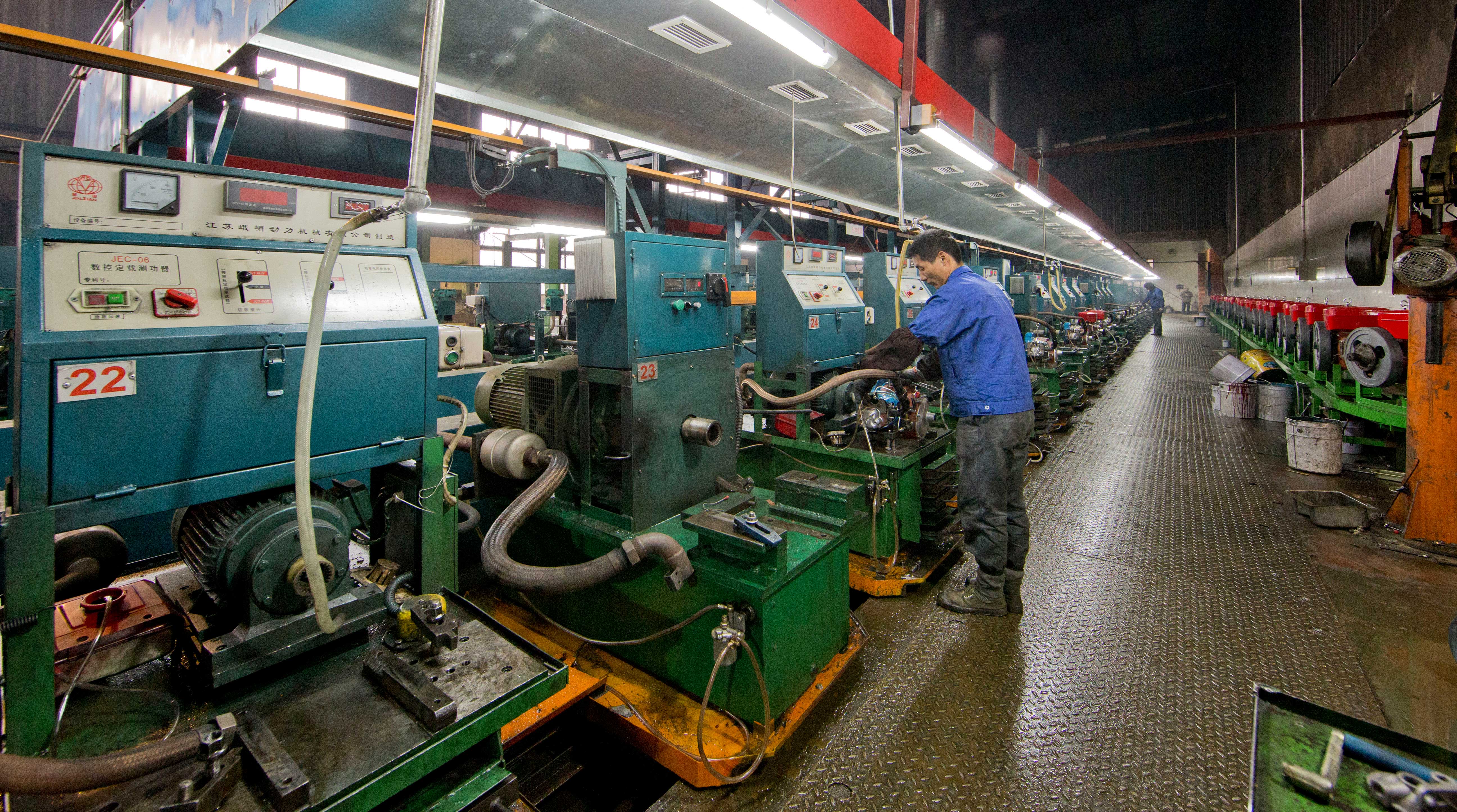
Production verification on the test line, where units are checked before packing and documentation is finalised for the destination market.
| Evidence category | What it answers for an importer |
|---|---|
| Quality management certification (ISO9001) | Whether a documented system exists to make output repeatable |
| Environmental management certification (ISO14000) | Whether process waste and emissions are handled under a defined system |
| Annual output capacity (100,000 units) | Whether volume can be sustained across a planting season |
| Process control, such as cleaning before coating | Whether durability claims rest on a repeatable production step |
| Export ratio and market mix (about 70%; South America, Africa, Southeast Asia, Middle East) | Whether the supplier already works across different regulatory environments |
| Acceptance method (video or image verification) | Whether the buyer can verify a shipment without a factory visit |
Diesel Engine for Agriculture: Where the Compliance Pressure Appears
Agriculture remains the largest single application for these engines, at approximately 42.3% of global demand in 2025 according to Dataintelo. That concentration explains why agricultural use cases dominate qualification conversations: the engine is rarely the final product, and its compliance profile is judged by what it drives and in what conditions it runs.
Across a 3 to 45 horsepower range, agricultural deployments typically include power tillers and walking tractors, irrigation and water pumps, threshers, rice mills, generator sets for farm power and general farm machinery. Cooling method is a duty decision as much as a technical one. Air-cooled units suit configurations where a radiator and coolant circuit are impractical, while water-cooled units are chosen where sustained load and dust conditions favour a managed cooling circuit.
| Application | Typical buyer requirement | Qualification-relevant detail |
|---|---|---|
| Power tiller / walking tractor | Compact footprint, accessible service points | Duty cycle matched to seasonal operation |
| Irrigation pump / water pump | Continuous running under load | Cooling method and consistent fuel consumption |
| Thresher | Short, high-load working windows | Starting reliability and torque reserve |
| Rice mill | Steady load, long service life | Parts availability and maintenance access |
| Generator set | Stable output for farm power | Consistent power output under varying load |
| General farm machinery | Interchangeable mounting | Specification confirmation at quotation |
Two details recur in agricultural orders. The first is dust. Field and milling environments load the exterior of an engine with abrasive material, which makes coating durability a maintenance variable rather than a cosmetic one; the cleaning-before-painting step described earlier was assessed specifically against high-dust agricultural conditions. The second is starting method. Manual and electric start configurations place different demands on the operator and on the electrical system, and a buyer is better served by fixing that choice at the inquiry stage than after the order has been confirmed.
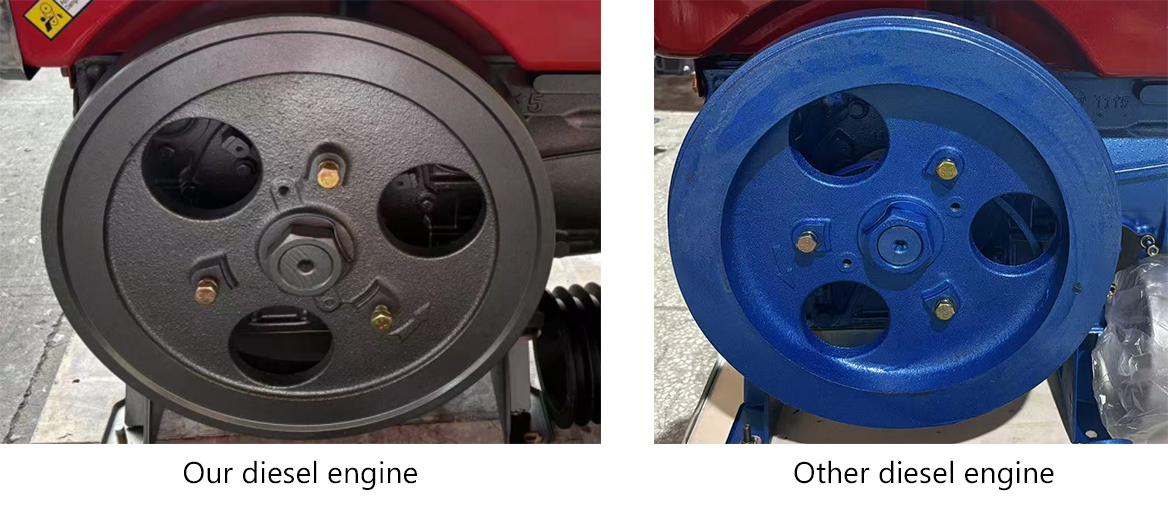
Comparison of coating outcomes after full engine cleaning prior to painting, a step assessed against high-dust agricultural use.
Reading Purchasing Terms as Compliance Signals
Purchasing terms reveal how much process control a supplier actually has. The terms below are the ones a buyer can use to test that, and they apply to orders of single cylinder diesel engines across agricultural and industrial uses.
- Minimum order quantity: one 20 ft container. A container-based MOQ indicates batch planning rather than single-unit picking, which affects how consistently a specification is repeated across a shipment.
- Delivery terms: FOB or EXW. The choice determines where the buyer's responsibility begins, and therefore which documentation must be complete before handover.
- Acceptance criteria: video or image verification. Remote acceptance only works if the supplier can produce consistent, traceable output; it functions as an inspection protocol agreed before production.
- Payment terms: 30/70. Staged payment links the balance to the acceptance step, giving the buyer a checkpoint between production and release.
None of these terms is unusual on its own. Their value is cumulative. A supplier that can commit to container-level MOQ, defined handover terms, remote acceptance evidence and staged payment is describing a production process it expects to repeat, not a one-off consignment.
Market Trend Analysis: What the Numbers Support
The global single cylinder diesel engine market was valued at approximately USD 3.34 billion in 2025 and is projected to reach USD 3.74 billion by 2035, according to Global Growth Insights. That is modest growth rather than rapid expansion, which fits a category tied to the mechanisation of smallholder farming rather than to replacement cycles in wealthier markets.
Market size estimates for this segment diverge widely. Dataintelo has published a materially larger figure for the same category, while Intel Market Research has published a smaller figure focused on small single cylinder engines. Read together, the estimates are useful as directional indicators of a stable, agriculture-anchored category; they are not a sound basis for pricing decisions or for year-on-year revenue forecasting.
Structural signals are more consistent than the totals. Asia Pacific held a 58.2% revenue share in 2025, according to Dataintelo, reflecting both production concentration and the region's own agricultural demand. Intel Market Research lists Yanmar, Kubota, Kohler and Hatz among leading global manufacturers in the small diesel engine sector, alongside Chinese manufacturers including Changchai and Shifeng Group. The practical implication is a market with several established reference points and a long tail of regional suppliers, which is exactly the condition under which qualification evidence becomes a differentiator rather than a formality.
Comparison with Traditional Price-Led Sourcing
Price-led sourcing is not obsolete, but it answers a different question than qualification-led sourcing. The table below sets out where the two approaches diverge in a single cylinder diesel engine order.
| Dimension | Price-led sourcing | Qualification-led sourcing |
|---|---|---|
| Starting question | Unit price and horsepower | Intended duty, destination market, acceptance method |
| Supplier shortlist | Whoever quotes lowest | Suppliers that can evidence process control |
| Documentation | Collected before shipment | Confirmed at quotation |
| Where risk sits | Discovered at the port | Managed before production starts |
| Long-term effect | Re-tender every season | Continuity of specification and parts supply |
Where this approach has clear limits
- Documentation does not change physical performance. Certification and process evidence describe how an engine is built and documented; they do not add horsepower, extend service intervals or substitute for correct sizing against the intended load.
- Supplier support does not transfer legal responsibility. A manufacturer can provide system certificates and process evidence, but market access obligations remain with the importer and its local representatives, who must confirm the applicable rules for their market.
- Rules are segmented by power band and duty. The U.S. EPA Tier 4 exemption for engines under 24 horsepower shows that a single compliance statement cannot cover an entire product family; each engine size and end use has to be checked against its own rule.
- Trade policy data ages quickly. Public figures on SKD and CKD tariff treatment vary in reliability and are revised as schedules change; they should be verified case by case rather than used as a planning assumption.
- Market size estimates disagree. Published figures for this category differ by a wide margin, so totals should be treated as indicators of direction rather than as precise measures of demand.
Future Outlook
Three developments are likely to shape the next procurement cycle. First, acceptance evidence is becoming digital and routine: container-level image and video verification is replacing the assumption that a buyer will inspect in person. Second, qualification is consolidating around long-term supply relationships rather than single orders, because re-establishing documentation with a new supplier costs more than maintaining it with an existing one. Third, agriculture, anchored at roughly 42.3% of category demand, will keep the compliance conversation focused on dust, duty cycle and maintenance access rather than on headline specifications.
For exporters, the implication is that qualification capability has become a commercial asset. Factories that can demonstrate a repeatable process, documented management systems and a defined acceptance method are easier to keep on a shortlist than factories that compete only on quotation price. For buyers, the equivalent discipline is to treat compliance as one of the four things being purchased, alongside the engine, the delivery schedule and the parts pipeline.
Frequently Asked Questions
What do import-market qualification requirements actually cover?
They cover four areas: whether the engine specification matches the intended duty, whether documentation matches the destination market, whether the production process is repeatable, and how the shipment will be accepted. Emission rules illustrate why the destination matters. In the United States, EPA Tier 4 standards regulate particulate matter and nitrogen oxides for off-highway diesel engines, with exemptions for engines under 24 horsepower, so applicability depends on the specific engine size and use rather than on the product category as a whole.
Which purchasing terms should be agreed before production starts?
Four terms are typically fixed at that stage: minimum order quantity, delivery terms, acceptance criteria and payment terms. In the arrangements described for these engines, the minimum order quantity is one 20 ft container, delivery terms are FOB or EXW, acceptance is based on video or image verification, and payment is split 30/70. Each term defines a checkpoint: container-level MOQ sets batch planning, FOB or EXW fixes where responsibility transfers, video or image acceptance defines how the buyer verifies output remotely, and staged payment ties the balance to acceptance.
How can a buyer verify process consistency without visiting the factory?
Three forms of evidence are usable at a distance. Management system certification, specifically ISO9001 for quality and ISO14000 for environmental management, indicates that documented systems exist. Process steps that can be described concretely, such as full engine cleaning before painting, can be compared against measured outcomes; manufacturer-recorded comparison data for that step indicate paint adhesion improved by 20% and anti-corrosion performance by 30%, with long-term maintenance cost reduced by 15%. Video or image acceptance then provides verification at the level of the individual shipment.
Why does agricultural use dominate single cylinder diesel engine demand?
Agriculture accounted for approximately 42.3% of global demand in 2025, according to Dataintelo. The engine format suits the equipment involved: power tillers, irrigation and water pumps, threshers, rice mills and generator sets in the 3 to 45 horsepower band, where a compact, serviceable, air-cooled or water-cooled unit is practical for smallholder operations. Demand is therefore tied to mechanisation of small-scale farming rather than to industrial replacement cycles.
What maintenance responsibilities remain with the buyer after delivery?
Improper maintenance procedures may result in equipment damage or personal injury, so the engine should be shut down before any maintenance work and operated in accordance with the instruction manual. Manufacturers typically support this by supplying detailed operation and maintenance manuals, together with pre-sale technical training and after-sales support, but the execution of routine maintenance remains with the operator or the buyer's service network.
Does SKD or CKD assembly change the compliance picture?
It changes where obligations sit, but not whether they apply. Public summaries have referenced tariff treatment in the range of 1.5% to 3% for CKD kits in Myanmar and 0% for some categories in Thailand, though the underlying sources vary in reliability and schedules change. Local assembly shifts documentation and inspection to the assembly stage and may alter the applicable tariff line, so buyers should confirm the current treatment with a local customs adviser before adopting an SKD or CKD model.
Tem questões ou precisa de mais detalhes?
Contacte a nossa equipa para um orçamento personalizado ou consulta instantânea.
Solicitar orçamento
Preencha o formulário abaixo e a nossa equipa entrará em contacto com uma proposta personalizada.
Chat direto do WhatsApp
Prefere conversar em tempo real? Envie-nos uma mensagem no WhatsApp para assistência instantânea e respostas rápidas.
- Obter orçamento personalizado
- Partilhar fotos ou documentos
- Discuta as suas necessidades diretamente
Geralmente responde em 5–30 minutos durante o horário de expediente.