
Qualifying BH-400 and BTR6: IEC 60269 and VDE 0636 Scope
Qualifying BH-400 and BTR6: IEC 60269 and VDE 0636 Scope
Qualifying a low-voltage fuse base or strip fuse switch is not a matter of finding a standard number on a datasheet. For the BH-400 DIN rail fuse base, the supplied product data cites IEC 60269-1 and 2 and VDE 0636-1 and 2, with ratings of 690 V, 400 A and rated neutral links with a 120 kA breaking capacity. For the BTR6 Stripe Fuse Switch Disconnector, the data cites IEC/EN 60269, with a rated operation current of 160 A, AC 690 V, and 100 mm or 185 mm busbar spacing. Those statements are useful starting points, but they are not interchangeable with a certificate, a test report, or a model-specific scope statement. The checklist below separates four things a buyer should verify: the exact model, the document, the rating coverage, and the application boundary.
The compliance claim, the certificate and the test report are three different things
A standard reference answers a different question from a certificate number. IEC 60269-1 and 2, VDE 0636-1 and 2, and IEC/EN 60269 identify standard families or parts of them. A product datasheet may state that a model complies with those references. That statement is a manufacturer claim unless it is supported by an issued document with a number, issuer, date, product scope and rating scope. A certificate or test report does not simply repeat the standard line. It should identify what was evaluated, under which edition, at which ratings, and for which product or family.
This distinction matters because a buyer can receive a file that looks complete but is not specific enough. A certificate for a product family may not name the exact model or rating in the purchase order. A test report for a related product may not cover the intended mounting, fuse link or switching function. A manufacturer quality certificate may not cover product compliance at all. The qualification file should let the buyer trace a standard reference to a document, then trace that document to the exact BH-400 or BTR6 configuration.
IEC 60269-1:2024 is an active edition of the general requirements for low-voltage fuses, covering AC up to 1000 V and DC up to 1500 V. That edition-level fact is useful for document review: a datasheet that says IEC 60269-1 and 2 without a year should be clarified. The existence of the 2024 edition does not establish that BH-400 or BTR6 was evaluated to that edition. The buyer should ask which edition appears on the certificate or test report and whether that edition matches the project specification.
VDE 0636-1 and 2 should be read with the same discipline. It is a standard reference in the supplied BH-400 data, not a certificate number by itself. VDE is also a certification body, so a qualification file may contain a VDE certificate or a report from another body. The buyer should check the standard reference and the certificate reference separately, then confirm that the certificate scope covers the model and ratings being purchased.
BH-400: what the supplied qualification data actually states
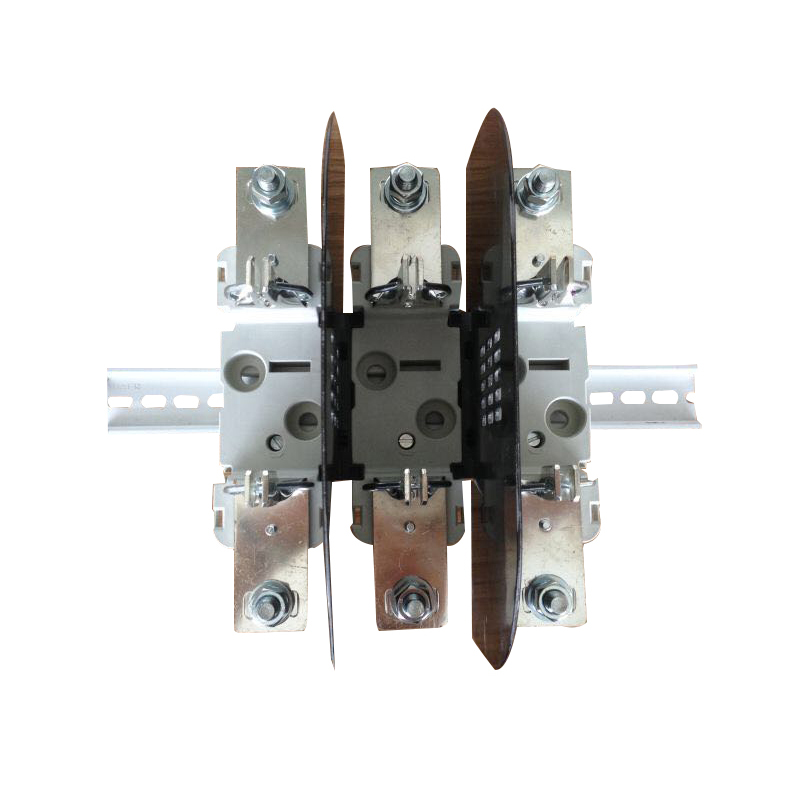
The BH-400 is a DIN rail type fuse base. The supplied data describes it as suitable for industrial and commercial building electric management and for DIN rail mounting in switchgear and control panels. Its ratings are 690 V and 400 A, and its rated neutral links have a breaking capacity of 120 kA. The contact material is tin-plated copper. The same data cites compliance with IEC 60269-1 and 2 and VDE 0636-1 and 2.
For qualification, the most important point is that the 120 kA value is attached to the rated neutral links. A buyer should not silently transfer that value to every terminal, accessory or circuit arrangement in the panel. The correct check is to ask whether the neutral-link rating is the value required at the intended installation point, and whether the certificate or test report expresses the same rating with the same conditions. The 690 V and 400 A ratings should also be matched to the panel voltage and load, not treated as a universal approval for every enclosure or duty cycle.
The BH-400 standard line is specifically relevant because it cites both IEC 60269-1 and 2 and VDE 0636-1 and 2. A buyer should request the document that supports each reference rather than assuming that one certificate covers both. If a supplier provides a certificate with a standard reference but no model schedule, the buyer should ask for the page or annex that names BH-400 or the applicable product family and ratings. If the certificate names a family, the buyer should check whether the family definition includes the DIN rail fuse base configuration being ordered.
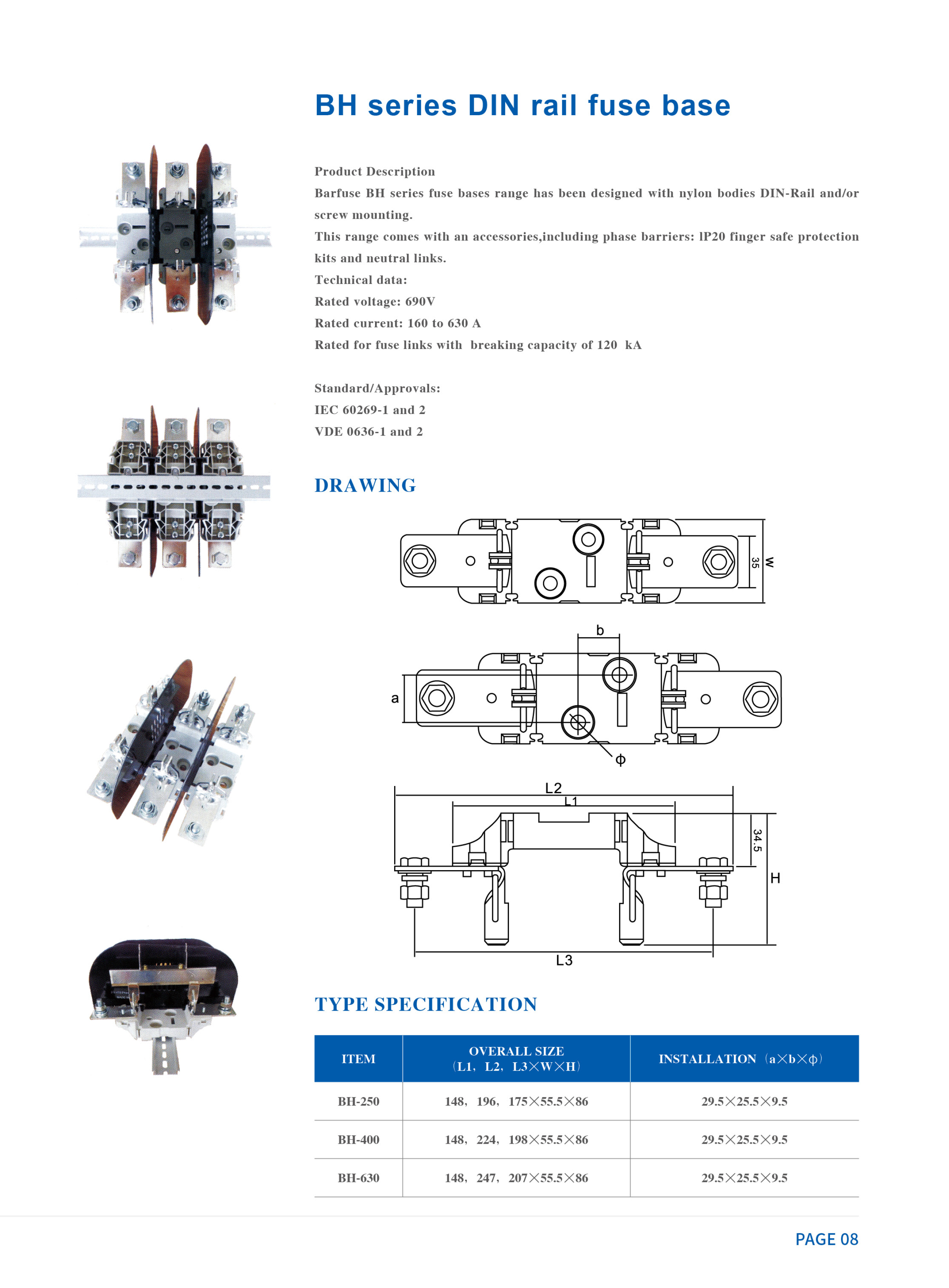
The DIN rail mounting statement is also a qualification point. A fuse base intended for DIN rail mounting in switchgear and control panels should be checked against the panel design, the rail system and the available space. The product data does not turn the BH-400 into a strip fuse switch disconnector, and it should not be accepted as a substitute for a BTR6 or another fuse switch where the panel design requires a switching function. The product type, mounting interface and electrical function should remain distinct in the purchase specification.
BTR6: reading IEC/EN 60269 in a strip fuse switch
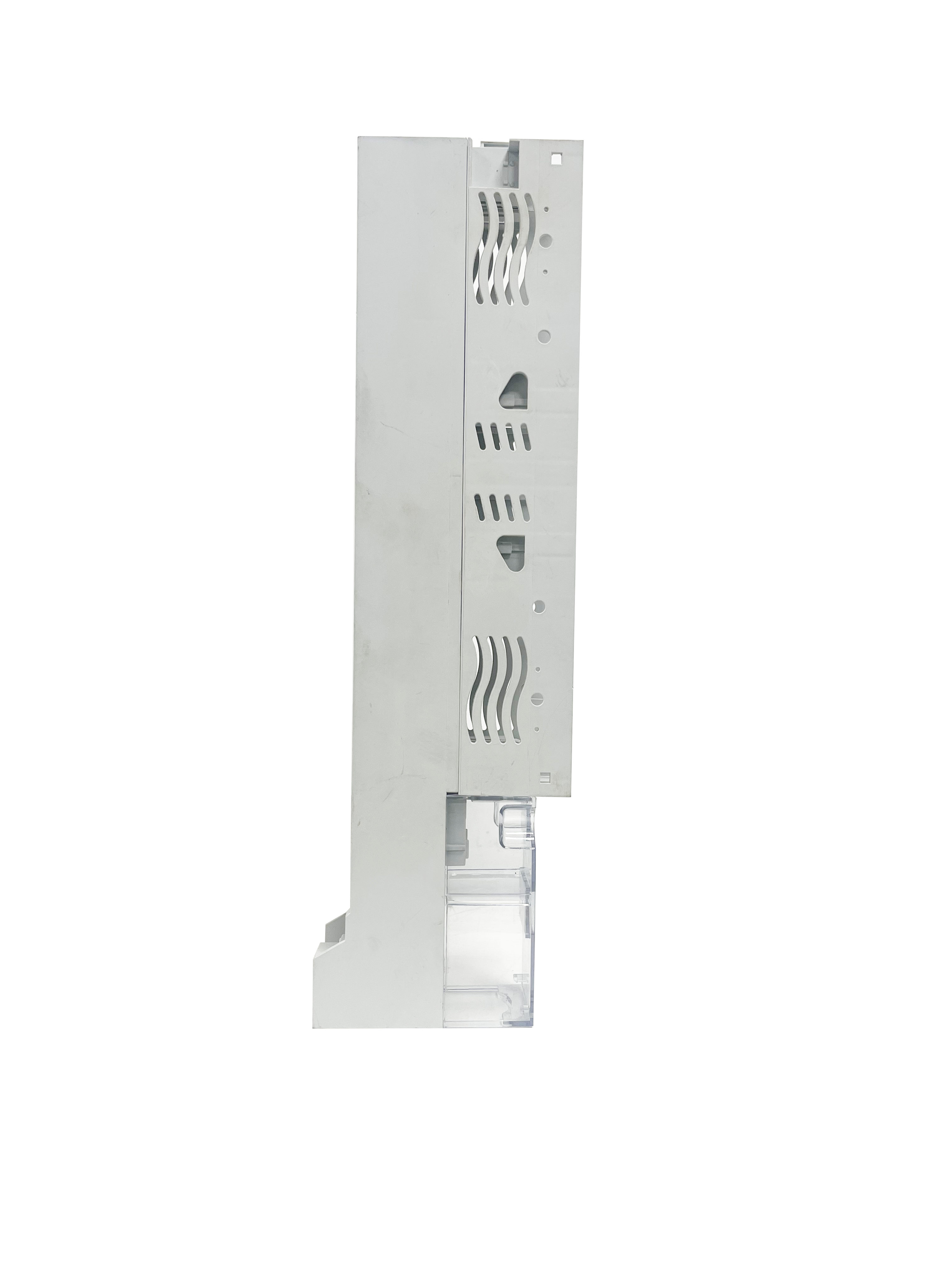
The BTR6 is a Stripe Fuse Switch Disconnector. The supplied data gives a rated operation current of 160 A, a rated operation voltage of AC 690 V, and busbar distances of 100 mm or 185 mm. It states compliance with IEC/EN 60269 and lists copper, DMC, ABS and PC as materials. The BTR6 data also lists a 12 kV rated impulse voltage withstand. Its application statement covers low-voltage distribution systems in petroleum, chemical, metallurgical, power and construction industries.
The BTR6 is not simply a DIN rail fuse base. It is a fuse switch disconnector with a busbar interface. That difference affects how the IEC/EN 60269 reference should be read. The buyer should ask how the cited standard scope maps to the complete product being supplied: the fuse-carrying function, the switching function, the busbar spacing and the intended fuse link. A document that covers a fuse family or a related strip fuse switch should not be accepted for BTR6 unless the model schedule and ratings are clear.
BTR6 buyers should also separate IEC 60269 evidence from switchgear evidence. A type test report V160016 is listed for low-voltage switchgear and controlgear Part 3, to IEC 60947-3:2008+A1:2012 in conjunction with IEC 60947-1:2007+A1:2010, issued by the Low-voltage Apparatus Laboratory in Wenzhou. Its scope covers switches, disconnectors, switch-disconnectors and fuse-combination units. That is a different standard from IEC 60269. A qualification file can contain both, but one should not be used as a substitute for the other. The buyer should check the report model schedule before applying it to a BTR6 order.
The 100 mm or 185 mm busbar spacing is an installation variable, not a compliance conclusion. A panel designed for one spacing should not be assumed to accept the other without a drawing check. The 160 A and AC 690 V ratings should be matched to the project load and voltage. The 12 kV impulse withstand is another technical value to record, but it does not replace the need for the model-specific certificate or test report scope.
A side-by-side qualification checklist for BH-400 and BTR6
| Qualification check | BH-400 DIN rail fuse base | BTR6 Stripe Fuse Switch Disconnector | Evidence to request |
|---|---|---|---|
| Product identity | BH-400, DIN rail type fuse base | BTR6, Stripe Fuse Switch Disconnector | Datasheet page with model, revision and product description |
| Standard reference in supplied data | IEC 60269-1 and 2; VDE 0636-1 and 2 | IEC/EN 60269 | Certificate or test report showing standard edition and product scope |
| Rating scope | 690 V, 400 A; rated neutral links with 120 kA breaking capacity | 160 A, AC 690 V; 100 mm or 185 mm busbar spacing; 12 kV impulse withstand | Model-specific rating schedule and test conditions |
| Mounting and interface | DIN rail mounting in switchgear and control panels | Busbar spacing of 100 mm or 185 mm | Panel drawing, rail or busbar interface check |
| Materials | Tin-plated copper contacts | Copper, DMC, ABS and PC | Material statement only where project-critical; not a compliance substitute |
| Application statement | Industrial and commercial building electric management | Low-voltage distribution in petroleum, chemical, metallurgical, power and construction industries | Project conditions, enclosure and installation review |
Document checks before a buyer accepts the product
- Exact model page. The file should name BH-400 or BTR6, not only a product family or a general fuse base category. A family certificate can be useful, but the buyer needs the page or annex that connects the family to the ordered model.
- Standard edition. The document should state the edition or year of IEC 60269-1 and 2, VDE 0636-1 and 2, or IEC/EN 60269 as applicable. A standard number without an edition is harder to compare with a project specification.
- Certificate or report number. The buyer should record the number, issuer, issue date, expiry date and product scope. A standard reference alone is not a certificate number.
- Rating matrix. The document should connect voltage, current, breaking capacity and busbar or mounting data to the exact model. For BH-400, check 690 V, 400 A and the 120 kA neutral-link rating. For BTR6, check 160 A, AC 690 V and 100 mm or 185 mm spacing.
- Fuse link compatibility. The fuse base or fuse switch is not the fuse link. The buyer should confirm the intended fuse link and check that the link rating and the base or switch rating are consistent for the circuit.
- Manufacturer quality evidence. The manufacturer holds ISO 9001 certificate 62724Q1160R0S, valid until 7 November 2027, covering production and export of strip fuse disconnectors, load break switch disconnectors and busbar systems. That is a quality management certificate, not a product compliance certificate for BH-400 or BTR6.
- Change record. If the datasheet, certificate or product design has changed, the buyer should request the current revision and confirm that the certificate or report still applies.
- Application conditions. The buyer should check the panel voltage, load, fault level, enclosure, ambient conditions and mounting interface against the manufacturer documentation. The industry list in the datasheet is not a project approval.
Rating-scope alignment: voltage, current, breaking capacity and busbar
The 690 V rating for BH-400 and the AC 690 V rating for BTR6 are useful anchors, but they should be matched to the actual system voltage and insulation coordination. A buyer should not use a 690 V rating to infer performance at a different voltage without a documented basis. The same discipline applies to current: 400 A for BH-400 and 160 A for BTR6 are rated values. The panel designer should verify the load, enclosure and duty conditions against the manufacturer documentation rather than treating the rated current as an automatic continuous-load approval.
The BH-400 neutral-link value needs particular attention. The supplied data says the rated neutral links have a breaking capacity of 120 kA. The buyer should ask whether the neutral-link rating is the relevant value for the intended circuit and whether the certificate or test report states the same value under the same conditions. It is not safe to assume that the 120 kA value applies unchanged to every terminal, accessory or modified arrangement.
For BTR6, the 100 mm or 185 mm busbar spacing should be checked against the panel busbar system before order release. A 100 mm busbar spacing fuse switch and a 185 mm version may share a model family but not the same installation envelope. The buyer should also check the fuse link selection and the switching function against the panel design. The 160 A fuse switch disconnector rating should not be treated as a substitute for a higher-rated fuse base or for a different product category.
Application fit and the limits of an industry list
Both product lines are associated with low-voltage distribution. BH-400 is described for industrial and commercial building electric management. BTR6 is described for petroleum, chemical, metallurgical, power and construction industries. Those application statements help a buyer decide whether the product family is relevant. They do not approve a specific panel, enclosure, ambient condition or fault level. The project-specific review should confirm that the product type, mounting, ratings and fuse link are suitable for the actual installation.
A DIN rail fuse base and a strip fuse switch disconnector should not be treated as interchangeable. The BH-400 is a fuse base for DIN rail mounting. The BTR6 is a fuse switch disconnector with a busbar interface. A fuse rail, vertical fuse switch disconnector or other strip type fuse switches in the same portfolio may share a broad application language, but the qualification file should still name the exact model. The same logic applies to an NT/NH fuse base or another fuse holder: the standard reference and the model scope must be checked together.
Edition control and future standard review
Standard references age. IEC 60269-1:2024 is an active edition of the general requirements for low-voltage fuses, covering AC up to 1000 V and DC up to 1500 V. A datasheet that cites IEC 60269-1 and 2 without a year leaves the buyer unsure whether the reference is to an older edition, a current edition or a general family. The qualification file should record the edition shown on the certificate or test report and compare it with the project specification.
The same review should be applied to VDE 0636-1 and 2 and to IEC/EN 60269. If the certificate or report cites an older edition, the buyer should ask whether it remains applicable to the current product and whether a newer evaluation exists. The buyer should not assume that a 2024 edition is covered because a datasheet uses the same standard family name. Edition control is part of compliance scope, not a paperwork detail.
A practical acceptance sequence for an LV panel
- Lock the panel voltage, current, fault level and busbar or rail interface before requesting documents.
- Identify the exact product: BH-400 DIN rail fuse base or BTR6 Stripe Fuse Switch Disconnector.
- Request the datasheet, certificate or test report, rating matrix and fuse link compatibility statement.
- Compare the document scope with the ordered model, ratings and standard edition.
- Check the mounting interface: DIN rail for BH-400, 100 mm or 185 mm busbar spacing for BTR6.
- Record certificate numbers, issue dates, expiry dates and any model schedule references.
- Recheck the file when the product revision, standard edition or project specification changes.
FAQ: qualification questions buyers ask
Does the BH-400 IEC 60269 and VDE 0636 reference mean the product has a certificate?
Not by itself. The supplied product data states compliance with IEC 60269-1 and 2 and VDE 0636-1 and 2. A certificate or test report is a separate document with a number, issuer, date and product scope. Buyers should ask for that document and confirm that it covers BH-400 and the relevant ratings.
What ratings should a buyer verify for BH-400?
The supplied BH-400 data lists 690 V rated voltage, 400 A rated current and rated neutral links with a 120 kA breaking capacity. The buyer should confirm these values on the exact model datasheet and check whether the neutral-link rating is the relevant value for the intended circuit.
What does the BTR6 IEC/EN 60269 reference cover?
The BTR6 data states compliance with IEC/EN 60269 and lists 160 A rated operation current, AC 690 V rated operation voltage and 100 mm or 185 mm busbar spacing. The buyer should ask for the model-specific certificate or test report and confirm how its scope applies to the complete fuse switch disconnector.
Is VDE 0636 the same as a VDE certificate?
No. VDE 0636-1 and 2 is a standard reference in the BH-400 data. A VDE certificate is an issued document with a certificate number and a defined scope. The two should be checked separately, and the certificate scope should be compared with the exact model and ratings.
How does IEC 60947-3 evidence relate to IEC 60269 evidence?
They are different standards. IEC 60269 is the fuse standard family cited for BH-400 and BTR6. IEC 60947-3 is a low-voltage switchgear and controlgear standard. A type test report V160016 is listed to IEC 60947-3:2008+A1:2012 in conjunction with IEC 60947-1:2007+A1:2010, covering switches, disconnectors, switch-disconnectors and fuse-combination units. One document does not replace the other.
Conclusion: qualify the scope, not just the standard number
For BH-400, the qualification points are the 690 V and 400 A ratings, the 120 kA neutral-link breaking capacity and the IEC 60269-1 and 2 and VDE 0636-1 and 2 references. For BTR6, they are the 160 A and AC 690 V ratings, the 100 mm or 185 mm busbar spacing and the IEC/EN 60269 reference. In both cases, the buyer should move from the standard line to the certificate or test report, then to the model and rating schedule, and finally to the panel application. That sequence is what separates a useful compliance file from a datasheet statement that has not been qualified.
BARFUSE Electric Co., Ltd. supplies both product lines; its official site is www.barfuse.com. The BARFUSE catalogue is available for download for buyers who need the model references before building a qualification file.
Tem questões ou precisa de mais detalhes?
Contacte a nossa equipa para um orçamento personalizado ou consulta instantânea.
Solicitar orçamento
Preencha o formulário abaixo e a nossa equipa entrará em contacto com uma proposta personalizada.
Chat direto do WhatsApp
Prefere conversar em tempo real? Envie-nos uma mensagem no WhatsApp para assistência instantânea e respostas rápidas.
- Obter orçamento personalizado
- Partilhar fotos ou documentos
- Discuta as suas necessidades diretamente
Geralmente responde em 5–30 minutos durante o horário de expediente.