
Qualifying CNC Lathe Machines for Shaft & Disc Parts: Patents, Precision & Service Compliance
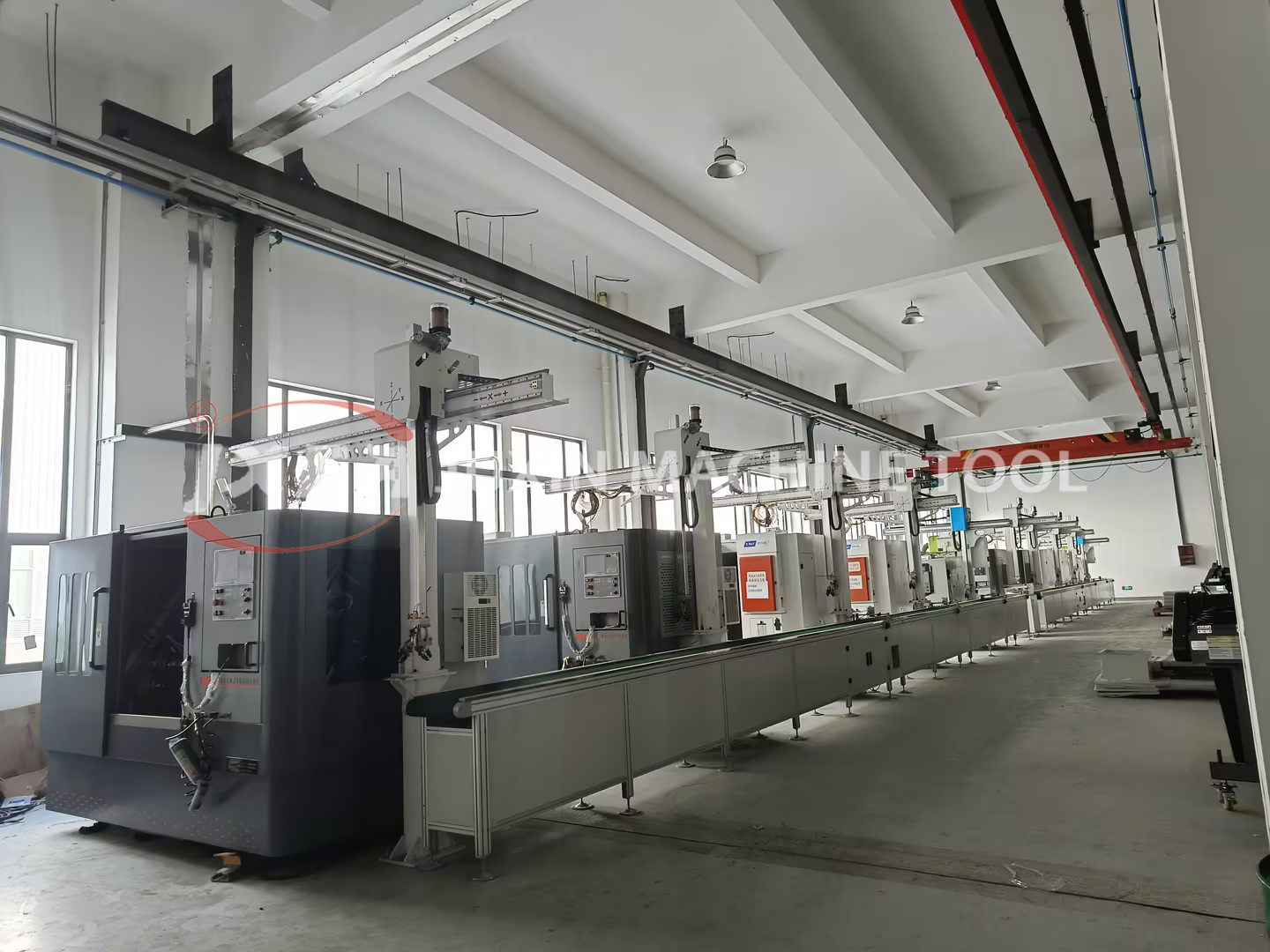
Facing and centering establishes the datum that every later turning, grinding and inspection operation inherits.
Shaft and disc parts procurement stopped being a catalogue exercise. In 2026, the qualifying question is whether a lathe machine can hold a stated tolerance across a production shift — and whether the supplier can prove it with measurement records rather than a specification sheet.
Why Qualification Now Precedes Comparison
Shafts, gear blanks, brake discs, flanges, CV joint bodies and motor shafts share one characteristic: their quality is determined in the first two operations, not the last. If the end face is not flat, the centre hole is not concentric, or the depth of the two centre holes does not match, no amount of downstream turning recovers the part. Scrap is usually created in the first thirty seconds of machining.
Most published lathe machine comparisons still revolve around swing diameter, spindle bore and price. Those numbers describe what a machine can physically accept. They say almost nothing about what it will hold at hour four thousand. Buyers who shortlist on envelope alone frequently discover the gap during first article inspection — after the purchase order is signed.
A qualification-first approach reverses the sequence. Instead of ranking machines and then discovering which ones qualify, buyers define the acceptance criteria first, then ask each supplier for the evidence that satisfies them. The criteria below are drawn from the documented specifications of Juxin Machine Tool Co., Ltd. (JUXIN MACHINE TOOL), a Wenling, Zhejiang-based manufacturer established in 2005 that builds facing and centring machines, double-head CNC lathes and twin-spindle CNC vertical lathes for shaft and disc parts, and which reports more than 50 innovative technological patents across its range.
The Qualification Matrix: Six Criteria That Change a Decision
Each row below is a criterion that can be evidenced, tested or written into a contract. None of them is satisfied by a brochure figure alone.
| Qualification criterion | Evidence a buyer should demand | Why it moves the decision |
|---|---|---|
| Bed and base construction | Casting grade, integral-casting record, heat-treatment and stress-relief documentation | Bolted or split assemblies introduce joint interfaces that shift with thermal cycling and cutting load. |
| Control platform and firmware | Named control series, firmware revision, configured option list | The control determines which compensation, diagnostics and data interfaces exist five years later. |
| Spindle radial runout | Measured value on the delivered machine, with instrument and date | Runout propagates into roundness, coaxiality and surface finish on every part. |
| Repeat positioning accuracy | Consecutive-cycle log over a minimum of 100 cycles | Determines whether part two equals part one, which is the actual definition of production capability. |
| Configuration fit to the part family | Work envelope checked against the real part drawing, not an average | A machine sized to the average part will fail on the largest one and idle on the smallest. |
| Service compliance | Written failure-rate ceiling, maintenance interval target, response channel, remote diagnostic access | A tolerance no one maintains becomes a scrap source within two years. |
Bed Structure: What Integral Casting Actually Buys You
The single largest predictor of long-term precision in a lathe machine is not the control system. It is the casting. Juxin Machine Tool's End Facing and Centering Machine JXZ70-680 uses a machine bed integrally cast from HT300 grey cast iron; the Middle Drive Double-head CNC Lathe JXS72 specifies bed, column and base in high-strength preheated cast iron with resin-sand integral casting, subjected to ultra-low-temperature cryogenic heat treatment and stress-relief ageing. The base of that model uses a multi-layer box structure with cross-rib mixed cast iron, dimensioned through finite-element mechanical design to raise mass and damp resonance.
The purpose is not marketing vocabulary. Cast iron that has been stress-relieved before machining releases far less residual stress during the machine's service life, which is the mechanism behind the slow drift that appears in year two on poorly prepared beds. An integral casting removes the bolted joint interfaces that a split-structure machine relies on, and those interfaces are where geometry moves first when the bed warms under continuous cutting.
Guide rail execution matters as much as the casting. Juxin's hardened rail specification is a 55°/15° integral hard rail, or a heavy-duty roller linear guide on some models, with precision quenching, fine grinding and manual scraping. Manual scraping is a hand-fit operation: it is difficult to automate and it is one of the few remaining steps where a builder's craft still shows up in the finished part.
Control Platform: Siemens and Fanuc Adoption as a Procurement Signal
Control choice is often treated as a preference. In qualification terms it is a risk decision. Juxin's documented control options across its shaft and disc machining range include Siemens and Fanuc alongside KND, GSK and Huazhong, with a self-developed Juxin system available on certain configurations.
The practical argument for Siemens or Fanuc is not brand prestige — it is the downstream ecosystem. A widely deployed control platform means spare parts are stocked in more than one country, service engineers with that platform's training are easier to locate, and the diagnostics and compensation functions that matter in year three are already documented in a language your maintenance team can read. For a buyer in Germany, Vietnam, Brazil or Turkey, that availability profile is worth more than a marginal saving on the control package.
What a buyer should verify is narrower: the exact control series, the firmware revision shipped, and the option list that was actually configured — not the option list in the general brochure. A machine delivered without the compensation functions quoted is a specification gap, not a misunderstanding.
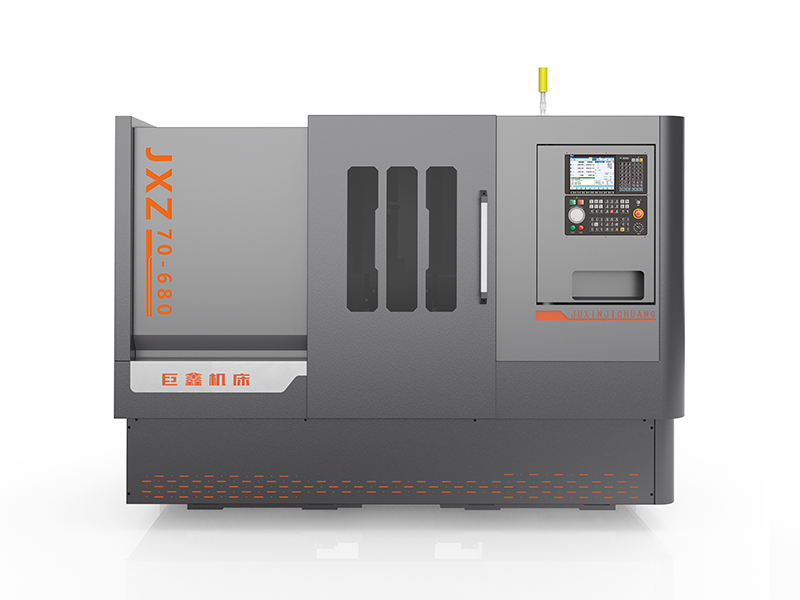
JXZ70-680: integral HT300 casting, 14–500 mm machining diameter, 70–5000 mm machining length.
Documented Precision Figures and How to Test Them
Precision claims become procurement value only when they are attached to a measurement method. The following figures appear in Juxin's published configuration data for shaft and disc machining:
- Spindle radial runout: 0.003–0.005 mm
- Workpiece roundness: 0.003–0.005 mm
- End face flatness: 0.006–0.01 mm
- Repeat positioning accuracy (double-head configuration): 0.003–0.005 mm
- Repeat positioning accuracy (facing and centring configuration): 0.008–0.012 mm, with centre-hole surface roughness at Ra1.6–Ra1.8
- Length and centre-hole depth consistency at both ends: ±0.05 mm, customisable to ±0.02 mm
These are machine-side figures. A purchase order should translate them into part-side acceptance targets, because that is the language both parties can measure. A defensible first-article protocol for a shaft part would typically specify radial runout at or below 0.005 mm, end face flatness at or below 0.01 mm, coaxiality between the two centre holes at or below 0.01 mm, dimensional tolerance within ±0.008 mm, and repeat positioning verified across consecutive cycles in the 0.003–0.005 mm band. Where a supplier cannot support a target, the honest answer is that it belongs in a different application — not that the number should be softened.
Verification capability matters as much as the target. Juxin's inspection environment includes a Renishaw laser interferometer and a German Wenzel three-coordinate measuring instrument in a temperature-controlled laboratory, supported by a constant-temperature and humidity precision assembly workshop. Buyers should ask which instrument produced the report they are being shown, and on which date.
Facing and Centering: Where Shaft Quality Is Actually Decided
Of all the machine types in a shaft line, the facing and centering lathe machine receives the least attention during procurement and creates the most downstream damage when it is wrong. Its job is to mill the end face, drill the centre hole, and in many cases complete chamfering, drilling and tapping, external cylindrical turning, boring and rapid U-drilling in a single clamping.
The failure mode it exists to prevent is datum loss. When end facing and centre-hole drilling happen on separate machines, or when the part is turned around between operations, the second setup references a surface that was produced by a different fixture on a different day. Coaxiality between the two ends drifts, centre-hole depth stops matching, and end face flatness degrades. Every subsequent turning and grinding operation then inherits that error, and the cost appears as a rejection rate rather than as a machine problem.
The JXZ70-680 is a CNC milling face end face drilling hole lathe machine covering a machining diameter range of 14–500 mm and a machining length range of 70–5000 mm, built on an integrally cast HT300 bed. Its documented capability set — face milling, centre-hole drilling, external cylindrical turning, drilling and tapping, chamfering, boring and rapid U-drilling — is the reason a single machine can replace what would otherwise be three or four standalone operations. In practice this is the difference between a line that produces a concentric datum every cycle and a line that produces a concentric datum most cycles.
Documented applications for this configuration include input shafts, motor shafts, pneumatic valve stems and vehicle axles — part families where the centre hole is the reference for everything that follows. Buyers evaluating this class of machine should ask for a first-article report on their own part geometry, not on the demonstrator shaft used at the trade fair.
Configuration Fit Across the Shaft and Disc Part Family
Qualification is configuration-specific. A supplier that qualifies for a 300 mm brake disc may not qualify for a 1000 mm axle shaft. The table below maps Juxin's documented shaft and disc configurations against their work envelopes.
| Model | Machine type | Documented work envelope | Typical fit |
|---|---|---|---|
| JXZ70-680 | End Facing and Centering Machine (CNC milling face end face drilling hole lathe machine) | Diameter 14–500 mm; length 70–5000 mm | Datum creation for shafts and long parts |
| JXS72 | Middle Drive Double-head CNC Lathe (Double End Simultaneous Turning Lathe) | Diameter 15–180 mm; length 40–800 mm | Both ends machined simultaneously for small and medium shafts |
| JXLC45-A | Twin-Spindle CNC Vertical Lathe Machine for Shafts (dual-position) | Shaft diameter up to 345 mm; length up to 1020 mm | Heavier shaft parts, dual station / dual spindle / dual system / dual tool tower |
| JXLC63D | Twin-Spindle CNC Vertical Lathe Machine for Disks (dual-position) | Diameter up to 525 mm; machining height up to 400 mm | Disc, flange and gear blank families |
Two structural notes matter more than the numbers. First, the dual-station, dual-spindle, dual-system, dual-tool-tower architecture on the JXLC series allows front and back features to be completed in one clamping, which removes the workpiece turnaround that usually introduces the error. Second, the middle-drive layout on the JXS72 drives the part from the centre and machines both ends simultaneously, which is the configuration that eliminates secondary clamping error on smaller shaft families rather than merely reducing it.
Application Fit: Where These Configurations Are Documented
Juxin's published application data covers automotive parts, agricultural machinery parts, water pumps and motors, railway locomotive axles, construction machinery, transmission, gear and new energy solar industries. Specific documented part types include motor shafts, crankshafts, gears, slender shafts, brake discs, CV joint bodies, track rollers, driven gears, engineering drill bits, motor housings and rotor press-fit components.
The vertical architecture is a deliberate choice for these parts. A vertical lathe holds the part on a horizontal table, so gravity acts along the axis rather than bending a slender shaft between centres. That is the mechanical reason vertical configurations are used on shaft and disc families with high length-to-diameter ratios, and it is why the same part that vibrates on a horizontal machine can be turned cleanly on a vertical one.
The applications are documented across Germany, Russia, Vietnam, Thailand, Malaysia, Indonesia, Egypt, Saudi Arabia, Iran, Pakistan, Turkey, the United States, Brazil, Mexico, South Africa, Nigeria, Kazakhstan, Uzbekistan, Australia and New Zealand. That spread is relevant to qualification because service compliance has to work in the buyer's geography, not in the supplier's showroom.
Service Compliance: The Clause Most Buyers Forget to Write
Precision is a purchased capability only for as long as it is maintained. A qualification framework that stops at the acceptance test is incomplete, because the largest cost driver over a five-year horizon is unplanned stoppage, not the purchase price.
A service compliance clause worth signing should be specific enough to be measured. In practice that means a written ceiling on failure frequency — a contract framing of no more than three failures per year is a reasonable negotiating position — a stated target for extending maintenance intervals relative to the buyer's current baseline, such as a 50% reduction, a staffed service channel reachable during the buyer's production hours, remote diagnostic access so that fault isolation does not require a flight, and an explicit commitment to lifetime technical support rather than a warranty that expires quietly.
Buyers should test these commitments rather than accept them. Log a fault, use the remote diagnostic path, and measure how long it takes to reach a person who can actually resolve it. A commitment that has never been exercised is a sentence, not a service level.
Market Context: What the Third-Party Data Does and Does Not Say
Two independent data points frame the category. Asia Pacific accounted for 55.5% of revenue in the CNC machining and turning centres market in 2023, according to Grand View Research, and dual-spindle CNC lathes are commonly used in high-volume production for automotive, aerospace and medical sectors. Separately, Vertex Market Research estimates the global CNC lathe machine market at USD 11.1 billion in 2023, projected to reach USD 18.78 billion by 2030, a CAGR of 7.8% from 2024 to 2030.
That growth figure needs a qualification caveat of its own. Published lathe market estimates differ materially by base year, product boundary and methodology — one commercial source places the global lathe machines market at USD 25.01 billion in 2018, another at USD 27.42 billion in 2025, a third at USD 12.35 billion in 2026. These cannot be averaged or consolidated. They are directional evidence that the category is large and growing, not a number to build a business case on without primary validation.
For import and export planning, metal-removing lathes are classified under HS heading 8458 in the UN Comtrade framework, which distinguishes horizontal numerically controlled lathes, other numerically controlled lathes and other lathes. Buyers and freight forwarders should confirm subheading treatment per machine type before committing to a landed-cost model.
Where This Approach Stops Working
Integral casting and dual-spindle architecture are not universally correct choices, and a qualification framework that pretends otherwise is not useful.
The first boundary is volume. A dedicated facing and centering machine or a twin-spindle vertical lathe earns its cost when a part family repeats at volume. A job shop running five-piece batches across wildly different geometries will find a general-purpose lathe more economical, because changeover time on a specialised configuration can exceed the cycle-time gain. The second boundary is infrastructure: heavier cast beds require a floor that meets load-bearing standards and, in many cases, a poured foundation and matched power distribution. A buyer who has not costed foundation work has not costed the machine. The third boundary is flexibility — a machine configured tightly around 345 mm shafts is highly efficient at that diameter and poorly suited to a 600 mm disc.
There is also an honest limit on patents. More than 50 innovative technological patents and a patented structural design indicate engineering investment, but a patent protects a design idea; it does not certify that a specific machine in a specific factory holds a specific tolerance. That is what the first-article report is for. The two should be read together, never one in place of the other.
A final boundary concerns geography. Remote diagnostics reduce response time but do not replace an engineer on site. Buyers in regions far from the supplier's service base should negotiate the escalation path and spare-parts holding explicitly, rather than assuming remote access closes the gap.
What Changes Next in Shaft and Disc Machining
The direction of travel is toward fewer setups and more measurement inside the machine. Juxin's documented operating modes already include in-machine detection, micron-level tool compensation and online data monitoring for long-term precision stability, together with 3-, 4- and 5-machine robot cell layouts in which the robot automatically avoids tool-changing stations to maintain continuous flow. Turning-milling and turning-grinding compound configurations extend the same logic to parts above HRC 50 hardness, where a single clamping replaces what was previously a grinder operation.
The procurement consequence is that the qualification conversation will increasingly be about data rather than metal. A machine that reports its own compensation history is easier to audit and easier to keep in tolerance; a machine that does not becomes a manual inspection burden. Buyers preparing a 2027 specification should plan for MES docking, tool-wear compensation logging and measurable uptime reporting at the point of purchase, because retrofitting instrumentation is considerably more expensive than specifying it.
Frequently Asked Questions
What documentation should a CNC lathe supplier provide to qualify for shaft and disc part work?
A qualification pack should contain the casting grade and stress-relief record, the named control series and firmware revision, measured spindle radial runout on the delivered machine, a consecutive-cycle repeat positioning log, a first-article dimensional report on the buyer's own part drawing, and a written service commitment covering failure frequency, maintenance intervals and remote diagnostic access. Brochure specifications alone do not satisfy any of these items.
What is the difference between spindle radial runout and repeat positioning accuracy?
Spindle radial runout describes how far the rotating spindle deviates from true rotation, and it directly affects roundness and surface finish. Repeat positioning accuracy describes how consistently the machine returns an axis to the same commanded position over consecutive cycles. Juxin's published figures place spindle radial runout at 0.003–0.005 mm, and repeat positioning accuracy at 0.003–0.005 mm on the double-head configuration and 0.008–0.012 mm on the facing and centring configuration. The first governs part shape; the second governs part-to-part consistency.
How does a facing and centering lathe machine improve coaxiality?
It removes the datum transfer between operations. When face milling, centre-hole drilling, chamfering, drilling and tapping and external cylindrical turning are completed in one clamping, the second end is referenced to the same setup as the first. That eliminates the coaxiality error introduced when a part is turned around between separate machines, and it also stabilises centre-hole depth consistency — documented at ±0.05 mm, customisable to ±0.02 mm — between the two ends.
Is an integrally cast bed always better than a split or bolted bed structure?
For long-term precision on shaft and disc parts, an integral casting removes joint interfaces that can shift under thermal cycling and cutting load, which is why Juxin specifies an integrally cast HT300 bed on the JXZ70-680 and resin-sand integral castings with cryogenic heat treatment and stress-relief ageing on the JXS72. However, integral casting increases machine mass and cost, and it requires a floor that meets load-bearing standards. On low-volume, high-mix work where precision demand is moderate, a lighter structure can be the more economical choice.
Which shaft and disc parts fit a twin-spindle vertical CNC lathe?
Juxin's documented envelopes are a maximum shaft diameter of 345 mm and maximum shaft length of 1020 mm on the JXLC45-A, and a maximum processing diameter of 525 mm with maximum machining height of 400 mm on the JXLC63D for disc-type work. Documented part families include motor shafts, crankshafts, gears, slender shafts, brake discs, CV joint bodies, track rollers, driven gears and engineering drill bits, across automotive, agricultural machinery, water pump and motor, railway axle, construction machinery, transmission, gear and new energy solar applications.
What should a service compliance clause contain for a CNC lathe purchase?
It should contain measurable obligations rather than assurances: a ceiling on failures per year, a target for extending maintenance intervals against the buyer's existing baseline, a staffed service channel reachable during production hours, remote diagnostic access for fault isolation, defined spare-parts availability, and an explicit lifetime technical support commitment. Each item should be testable during the warranty period, and the buyer should record response times rather than relying on recollection.
Closing Note
Qualification is a shorter conversation than comparison, and a more useful one. A buyer who defines the acceptance criteria first — casting evidence, control platform, measured runout, repeat positioning, configuration fit and a written service commitment — eliminates most of the field before the first site visit, and arrives at the remaining suppliers with questions that can actually be answered with documents.
Juxin Machine Tool Co., Ltd. operates from No.52-1, Jintang North Road, Eastern New District, Wenling, Zhejiang, China, with a 10,666 m² facility, approximately 80 staff, an annual production capacity of 2,000 sets and a 10-engineer R&D team. Product and company information is available at en.wljxjc.com. The full technical brochure can be downloaded here: JUXIN MACHINE TOOL product brochure (PDF).
Tem questões ou precisa de mais detalhes?
Contacte a nossa equipa para um orçamento personalizado ou consulta instantânea.
Solicitar orçamento
Preencha o formulário abaixo e a nossa equipa entrará em contacto com uma proposta personalizada.
Chat direto do WhatsApp
Prefere conversar em tempo real? Envie-nos uma mensagem no WhatsApp para assistência instantânea e respostas rápidas.
- Obter orçamento personalizado
- Partilhar fotos ou documentos
- Discuta as suas necessidades diretamente
Geralmente responde em 5–30 minutos durante o horário de expediente.