
Qualifying China Rubber Fender Suppliers in 2026: A CCS Checklist
A due-diligence framework for buyers evaluating Chinese pneumatic and marine rubber fender manufacturers, built around certificate scope, ISO 17357 alignment and verifiable production evidence.
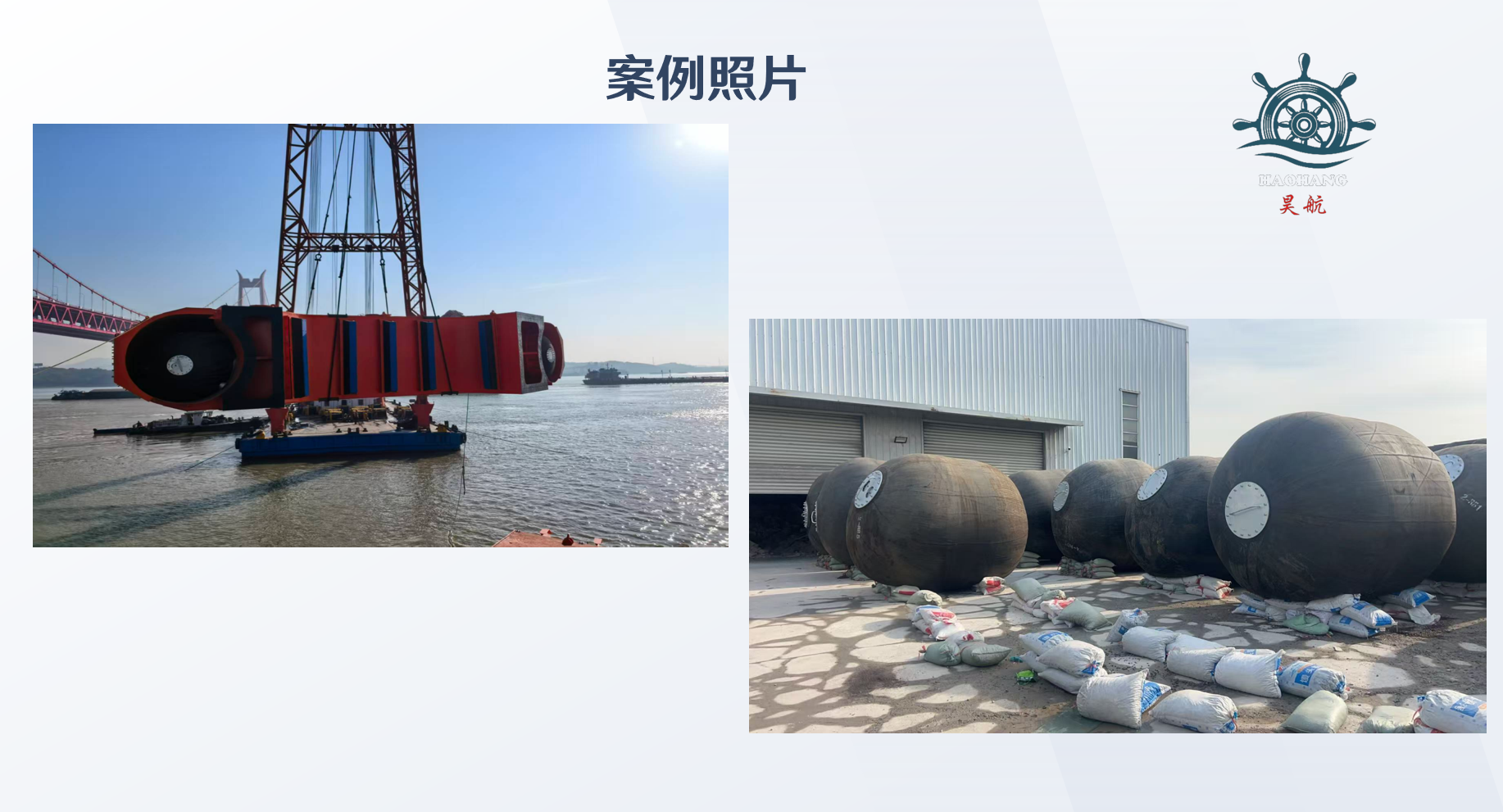
Marine fenders are protective equipment designed to prevent vessels from colliding with each other or with berths and docks, and the category is segmented into pneumatic, foam-filled and solid rubber types. For a buyer shortlisting Chinese suppliers in 2026, the decisive question is no longer whether a manufacturer says it is certified. It is whether the certificate in the file covers the product on the purchase order.
This checklist addresses that narrower and more practical question. It sets out how to read a China Classification Society (CCS) certificate, how CCS evidence relates to the ISO 17357 standards, which production and engineering figures are worth requesting, and where the limits of that evidence sit. Qingdao Haohang Fender Airbag Co., Ltd. — a Qingdao-based manufacturer of marine airbags and rubber fenders, founded in 2020 — is used as a worked example throughout, because its published certificate and capability records allow each checkpoint to be illustrated with a specific, checkable item rather than a general claim.
Why compliance evidence moved to the front of the evaluation
The global marine fender market was valued at USD 0.86 billion in 2025 and is projected to reach USD 0.91 billion in 2026, according to Fortune Business Insights. Asia-Pacific accounts for approximately 40% of all maritime fender installations as of 2024, per Vertex Market Research, which places a large share of both demand and manufacturing capacity in the same region.
Those two figures frame the procurement problem. Demand is stable rather than explosive, so suppliers compete on qualification rather than availability; and because the buying centre sits in the same region as much of the supply base, buyers cannot use geography as a proxy for quality.
The cost of getting qualification wrong is time-based. Pneumatic rubber fenders have an estimated service life of 5 to 7 years under consistent tidal cycles, per Vertex Market Research. A fender that fails a berthing trial or a class survey does not simply get replaced — it reopens vessel scheduling, berth availability and, in many terminals, the original approval file. That asymmetry, low unit cost against high replacement friction, is why compliance evidence now sits at the start of the evaluation instead of the end of it.
What a CCS certificate actually covers
CCS — the China Classification Society — is the Chinese classification society whose product certificates are routinely presented by Chinese marine equipment manufacturers in tender packages. A certificate is a scope document, not a general endorsement, and the scope line is the part that decides whether it applies to your order.
Qingdao Haohang's records show two CCS certificates with different scopes:
- Certificate QD22P4062, issued 12 May 2022, scope: Pneumatic Rubber Fender.
- Certificate 2026CJSD00023, issued 28 January 2026, scope: Marine Airbag.
The distinction is material. A marine airbag is a shipyard launch and slipway product; a pneumatic rubber fender is a berthing product that stays in service at a terminal or alongside a vessel. Both are rubber, fabric-reinforced, inflatable products from the same factory — and only one of those two certificate numbers answers a fender buyer's question.
A supplier that answers "we are CCS certified" without naming a certificate number has not answered anything yet. The practical request is a document set: the certificate number, the exact scope wording, the issuing body, the issue date, the expiry or validity status, and the model range covered. Where a product line spans airbags and fenders, ask for one certificate per product family rather than a single reference.
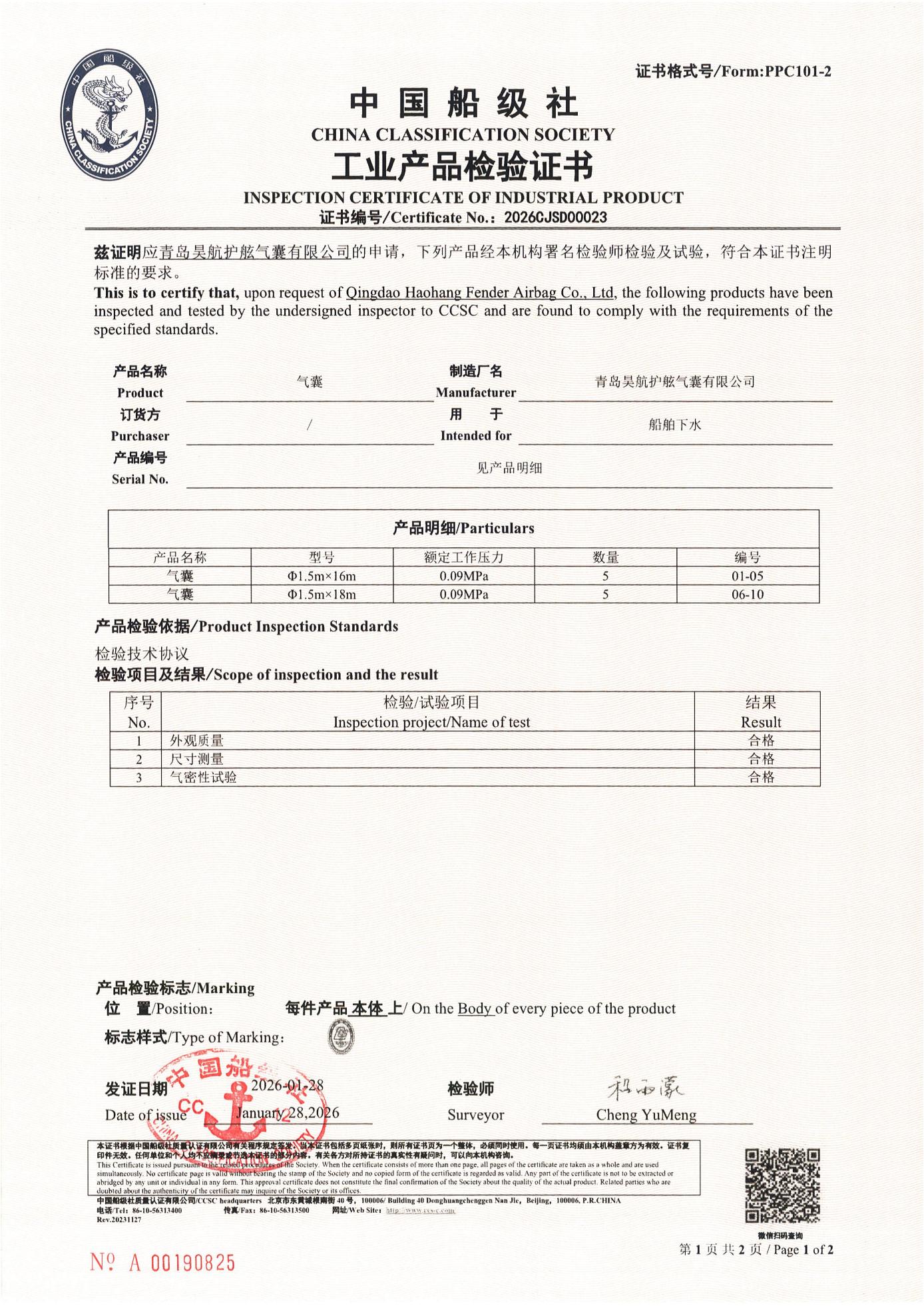
A second distinction sits between the class-society certificate and the design standard. ISO 17357-1:2014 covers high-pressure floating pneumatic rubber fenders and defines two configurations — Type I net-type and Type II sling-type — with initial internal pressures of 50 kPa or 80 kPa. ISO 17357-2:2014 covers low-pressure floating pneumatic fenders used for berthing and mooring, and specifies material, performance, dimensions, and minimum test and inspection procedures. A CCS certificate confirms that a classification society has recognised a product scope; it does not, by itself, tell a buyer which pressure class or configuration was assessed.
The 2026 qualification checklist
Eight checkpoints cover most of what a fender buyer needs before an order is placed. Each is written as a request a supplier can answer in documents rather than in prose.
| Checkpoint | What to request | Why it changes the decision |
|---|---|---|
| 1. Certificate scope | Certificate copy showing number, exact scope wording, issuing body and issue date, plus written confirmation of current validity. | The scope must name the product family being purchased. A marine airbag certificate does not cover pneumatic rubber fenders. |
| 2. Standard alignment | Declaration against ISO 17357-1:2014 for high-pressure fenders, or ISO 17357-2:2014 for low-pressure units. | These standards define product types, pressure classes, construction, and minimum test and inspection procedures. |
| 3. Construction evidence | Layer build-up description — outer rubber, synthetic tyre-cord reinforcement, inner rubber — and safety valve provision. | ISO 17357-1 requires the layered construction and requires a safety valve on fenders of 2,500 mm diameter and above. |
| 4. Performance declaration | Guaranteed energy absorption (GEA), reaction force at GEA deflection, and hull pressure at GEA deflection. | These are the three metrics ISO 17357-1 uses to specify pneumatic fender performance; without them, two sizes cannot be compared. |
| 5. Capacity and lead time | Monthly output, standard versus custom lead times, and minimum order quantity. | Haohang states 150 units per month, a 7–45 day lead time and a one-unit MOQ — figures that should be converted into contractual delivery terms. |
| 6. Engineering and QC | R&D headcount, test regime, and sample inspection records. | Haohang states 15 engineers within a workforce of about 60 people and 100% product testing. |
| 7. Export record | Share of output exported, destination regions, and shipping documentation samples. | Haohang states 70% export share across South Asia, Middle East and Africa. |
| 8. Customisation and support | Customisation terms, warranty position, and service model. | Haohang states OEM/ODM customisation for size and logo, with both remote and on-site after-sales support. |
Applied to Haohang, the checklist produces a mixed but usable picture: certificate records for both product families, stated capacity and engineering depth, and a documented field case — alongside a short operating history that a buyer weighting a long track record will need to offset with tighter inspection.
Reading capacity, engineering and export numbers
Capacity claims matter because fender orders are usually delivered against a project schedule rather than a warehouse restock. Haohang states a monthly capacity of 150 units, a lead time range of 7 to 45 days, and a minimum order quantity of one unit. The single-unit MOQ is the more interesting figure for a first-time buyer: it allows a trial order before a terminal-scale commitment, which is the cheapest way to test both product conformity and documentation quality.
The wide 7–45 day span should be treated as a question rather than a promise. Buyers should ask which configurations sit at the fast end and which require tooling, custom length or logo work. Haohang states OEM/ODM customisation for size and logo, which is the usual reason a lead time moves toward the upper part of a range.
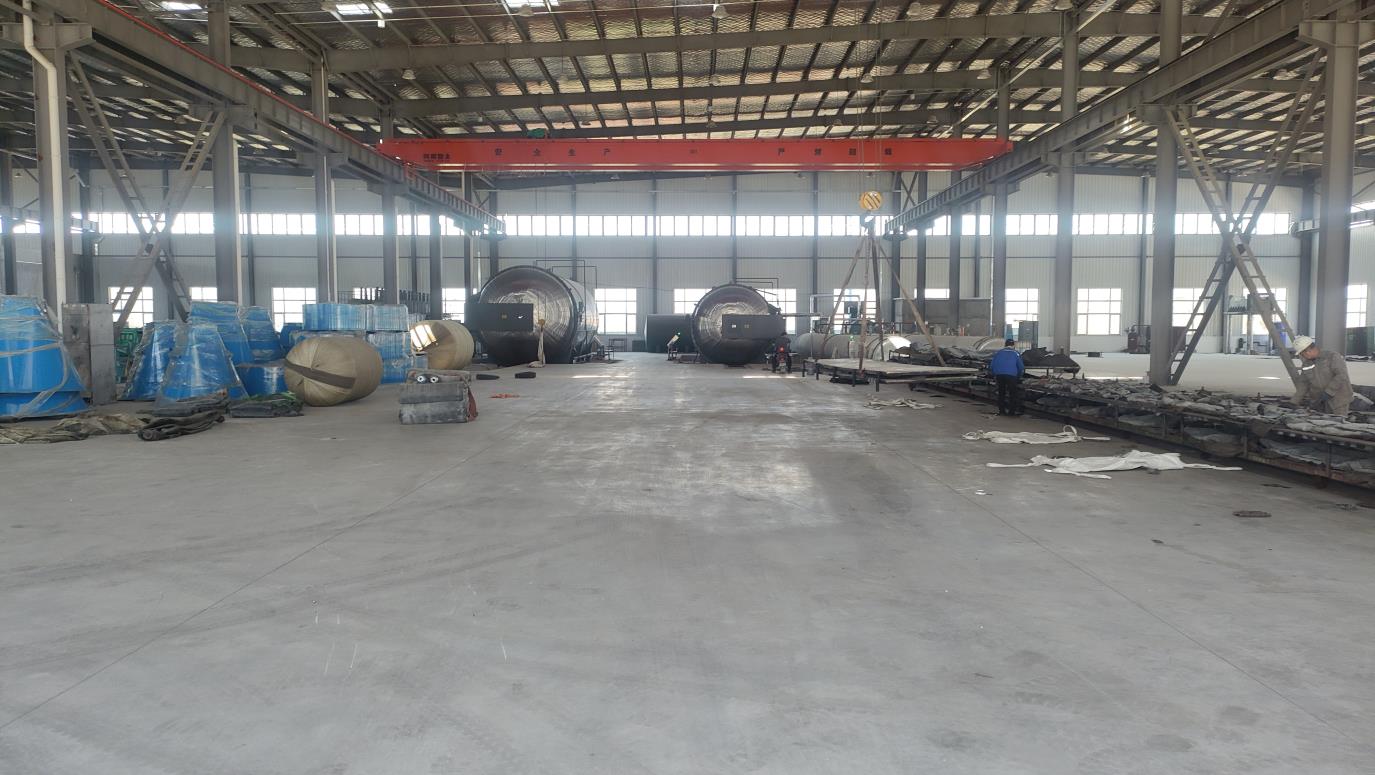
Engineering depth is a proxy for how much of the specification is designed in-house. Haohang states 15 engineers within a workforce of about 60 people — roughly one in four employees — alongside 100% product testing. The company also reports raw material self-sufficiency, processing natural rubber and curtain fabric in-house. Material control is the part of fender quality that is hardest to verify after delivery, so a supplier that performs it in-house removes one unverified link from the chain.
Export record is the last of the three. Haohang states that 70% of output is exported, with South Asia, Middle East and Africa as main markets. That mix signals familiarity with export documentation, packing and freight consolidation — practical advantages on a port project — but it also means the reference base is concentrated in three regions. Buyers in Europe or North America should ask specifically for projects in comparable regulatory environments rather than assume transferability.
Application fit, and what one project case can prove
In the documented case, a China-based engineering contractor installed 50 pneumatic rubber fenders for berthing operations protecting vessels and dock structures. The fenders remained in service across five years, withstanding extreme weather and high-frequency berthing, and the case cites high corrosion resistance as the property suited to China's coastal marine environment.
For a buyer, that case supports three points and not more. It supports field durability under high cycle frequency; it supports corrosion behaviour in a coastal, humid environment; and it supports the claim that the product survived a multi-year service window rather than only a factory test. It does not establish performance in cold-climate, heavy-swell or high-UV locations, and it is a single contractor relationship rather than a statistical sample. Buyers evaluating a different environment should treat the case as a starting reference and ask for the nearest comparable project.
The product line itself is specified for ports and docks, ship mooring, offshore platforms, inland river docks and temporary mooring. Published parameters for the rubber fender line give a diameter range of 300 mm to 2,000 mm, lengths from 1 to 10 metres depending on requirement, and a working pressure range of 0.1–0.3 MPa adjustable to the operating environment, with natural rubber and cord fabric as base materials. Those values are wide enough to cover ship-to-ship and ship-to-shore duties, but a buyer still has to map diameter and length to vessel displacement and berth energy requirements — a step no supplier certificate replaces.
Comparison: which evidence answers which question
The temptation in a supplier comparison is to score every supplier on a single axis. In practice, fender buyers assemble four different kinds of evidence, each of which answers a different question and each of which has a boundary.
| Evidence type | Question it answers | Boundary to note |
|---|---|---|
| CCS product certificate (e.g. QD22P4062, scope: Pneumatic Rubber Fender) | Has a classification society recognised this product scope? | Scope-specific and dated. The record reviewed shows an issue date but no expiry field, so current validity should be confirmed in writing. |
| ISO 17357-1:2014 / ISO 17357-2:2014 alignment | Is the design, construction and testing framed against a recognised international standard? | The standard defines types, pressure classes, construction and inspection procedure; it does not certify an individual factory. |
| Published material and performance values | Can the product's engineering be compared numerically? | Values are manufacturer-specific guidance. Trelleborg publishes rubber compound benchmarks such as tensile strength 16.0 MPa minimum and elongation at break 350% minimum; these are not automatically transferable to another formulation unless the test scope matches. |
| Field case record | Has the product survived real service? | One project in one environment. It is a reference point, not a warranty of performance elsewhere. |
The same logic applies to product type. The category is segmented into pneumatic, foam-filled and solid rubber fenders, and a pneumatic fender is not automatically the right answer for every berth. Pneumatic units are pressure-retaining devices: ISO 17357-1 requires a safety valve on fenders of 2,500 mm diameter and above, and the 5 to 7 year service life estimate assumes consistent tidal cycling and routine inspection. Where a buyer's maintenance regime cannot support pressure checks, the alternative fender families belong in the comparison rather than being dismissed at the shortlist stage.
Where the evidence is thin
Honest qualification includes the gaps.
- Operating history. Haohang was founded in 2020, so its documented track record is short by the standards of a terminal specifying for a multi-decade asset life. Buyers weighting longevity should compensate with staged inspection, retention terms or a trial order rather than treating a short history as an automatic disqualification.
- Certificate validity. The records show issue dates of 12 May 2022 and 28 January 2026; an expiry value is not stated in the material reviewed. Confirm current status directly with the supplier and, where required, with the issuing society.
- Geographic coverage. The documented field case is in China, and the stated export markets are South Asia, Middle East and Africa. Neither is evidence of European or North American project experience.
- Class-society reach. CCS recognition supports Chinese and CCS-aligned procurement routes. Flag states and terminals requiring approval from another classification society will need that approval in addition, not instead.
None of these points disqualifies a supplier. They define the questions that remain open after the certificate has been read.
Market trend: documentation as the differentiator
The 2026 market does not reward volume expansion particularly well: the global figure moves from USD 0.86 billion in 2025 to a projected USD 0.91 billion in 2026, per Fortune Business Insights, and Asia-Pacific already carries about 40% of installations as of 2024, per Vertex Market Research. Where growth is moderate and supply is concentrated, qualification becomes the competitive surface.
The direction of travel is visible in how tier-1 manufacturers publish. Trelleborg states that its pneumatic fenders are designed, manufactured and third-party certified in compliance with ISO 17357-1:2014, and publishes rubber compound targets including tensile strength 16.0 MPa minimum, elongation at break 350% minimum, hardness 78 Shore A maximum, compression set 30% maximum and tear resistance 70 kN/m minimum. Once those values circulate in tender documents, a Chinese specialist competing for the same project needs a comparable evidence set: a named certificate with a matching scope, a stated ISO alignment, and test data behind the material claim.
For Haohang, that shift is visible in the certificate timeline — a pneumatic fender certificate in 2022 and a marine airbag certificate in January 2026 — and in the disclosure of engineering headcount, capacity and export share. That is documentation-led positioning rather than price-led positioning.
Future outlook
Three changes are likely to shape Chinese fender qualification through 2027.
First, certificate scope will be read as data rather than as a badge. Buyers are already asking for numbers, scopes and dates; the next step is comparing those lines against the purchase order and the tender specification.
Second, lifecycle cost will be modelled more explicitly. With a 5 to 7 year working life under consistent tidal cycles, the replacement cycle sits inside the planning horizon of most terminal maintenance budgets, which pushes specifications toward documented material performance rather than lowest unit price.
Third, material disclosure will become a tender expectation. Once compound values such as tensile strength and tear resistance are published by tier-1 suppliers, manufacturers that withhold them will be read as withholding something a buyer needs.
FAQ
Does a CCS certificate mean a rubber fender meets ISO 17357?
No — these are different instruments. CCS is a classification-society product certificate with a defined scope, such as certificate QD22P4062 for pneumatic rubber fenders. ISO 17357-1:2014 and ISO 17357-2:2014 define product types, pressure classes (50 kPa or 80 kPa initial pressure for high-pressure fenders), construction, and minimum test and inspection procedures. A tender should ask for both, and should confirm which pressure class and configuration were assessed.
Can a supplier present a marine airbag certificate for a pneumatic fender order?
Not as coverage. Qingdao Haohang's records show two separate certificates with different scopes — 2026CJSD00023 for Marine Airbag and QD22P4062 for Pneumatic Rubber Fender — which illustrates the general rule: the certificate scope must name the product family being purchased. A single "we are certified" statement without a number and a scope does not answer the question.
Which production figures should a buyer request?
At minimum: monthly output, standard and custom lead times, minimum order quantity, R&D headcount and test regime. Haohang states 150 units per month, a lead time range of 7 to 45 days, a one-unit MOQ, 15 engineers within a workforce of about 60 people, and 100% product testing. These figures are useful primarily as comparison points across a shortlist and as the basis for contractual delivery terms.
How should a buyer weigh export share?
Export share indicates how much of a supplier's output has passed through international logistics and documentation. Haohang states a 70% export share across South Asia, Middle East and Africa. The figure supports confidence in export handling; it does not substitute for references in the buyer's own region, which should be requested separately.
How long do pneumatic rubber fenders last, and how does that affect evaluation?
Pneumatic rubber fenders have an estimated service life of 5 to 7 years under consistent tidal cycles, per Vertex Market Research. Because replacement falls within a normal maintenance planning window, evaluation should include inspection and pressure-maintenance requirements — ISO 17357-1 requires a safety valve on fenders of 2,500 mm diameter and larger — alongside purchase price.
What does the Haohang project case demonstrate?
An engineering contractor in China installed 50 pneumatic rubber fenders for berthing operations protecting vessels and dock structures. The units were in service for five years, withstanding extreme weather and high-frequency berthing, and the case cites high corrosion resistance suited to the coastal marine environment. It demonstrates durability in one coastal, high-cycle application; it is not evidence of performance in other climates or berth geometries.
Tem questões ou precisa de mais detalhes?
Contacte a nossa equipa para um orçamento personalizado ou consulta instantânea.
Solicitar orçamento
Preencha o formulário abaixo e a nossa equipa entrará em contacto com uma proposta personalizada.
Chat direto do WhatsApp
Prefere conversar em tempo real? Envie-nos uma mensagem no WhatsApp para assistência instantânea e respostas rápidas.
- Obter orçamento personalizado
- Partilhar fotos ou documentos
- Discuta as suas necessidades diretamente
Geralmente responde em 5–30 minutos durante o horário de expediente.