
Qualifying Customized Elevator Projects Against Verified Model Specs
Compliance qualification for a customized elevator is a mapping exercise, not a certificate check. A project is qualified only when every requirement it carries — rated load, rated speed, number of stops, travel height, machine-room condition and operating environment — can be traced to a documented parameter of a named model, and when every certificate a supplier presents is read against its actual scope, standard edition and validity dates.
In customized elevator procurement, the word “compliant” is used loosely. Buyers frequently receive a management-system certificate and interpret it as proof that a specific configuration has been approved for their building. Those are two different things. This reference sets out how specifiers, consultants and project buyers can convert a project brief into a qualification file that survives technical review, using verified model envelopes and verifiable certificate data rather than assumptions.
Why a Supplier Certificate Does Not Qualify a Project
A management-system certificate confirms that a manufacturer operates a controlled process for design, production, installation and service. It does not confirm that a 1,600 kg car running at 2.5 m/s across 28 stops has been validated for a specific shaft. Those are separate evidence classes, and a qualification file needs both.
The product-standard side is equally specific. EN 81-20 and EN 81-50 are the primary harmonized European standards for elevator design and testing and are mandatory for CE marking, as documented by Liftinstituut. EN 81-20 also requires a light-curtain door detection system to reduce the risk of door strikes, per KONE’s compliance guidance. This means an “EN 81 compliant customized elevator” claim should be broken down into two questions: which standard edition applies, and which exact configuration was assessed?
For an independent specifier, the practical consequence is simple: never accept a certificate as a substitute for a parameter table, and never accept a parameter table without asking which certificate scope it sits under.
The Four-Layer Mapping Method
A repeatable qualification review runs in four layers. Each layer produces a document, and each document is checkable by a third party.
Layer 1 — Demand definition. Fix the rated load, rated speed, number of stops, travel height, machine-room availability (MR or MRL), door clear width, traffic pattern and duty cycle. Add environment: the working envelope commonly cited for elevator equipment is an ambient temperature of −5°C to +40°C, relative humidity up to 90% RH non-condensing, and altitude up to 1,000 m, with special requirements such as fire protection, explosion-proof construction, waterproofing, corrosion resistance or dust protection stated explicitly where they apply.
Layer 2 — Model family selection. Match the demand profile to a product family rather than to a marketing category. Passenger, home, freight, observation, bed, car, dumbwaiter, escalator and moving walk families have structurally different envelopes.
Layer 3 — Envelope verification. Compare each project value against the published range of the selected family. Values inside the range are covered by the stated envelope; values outside it, or at the extreme edge, require written engineering confirmation before they are treated as verified.
Layer 4 — Documentary evidence. Attach certificate numbers, issuing authority, standard edition, issue and expiry dates, the scope wording, acceptance criteria, warranty terms and delivery terms. This is the layer that turns a technical claim into an auditable record.
Verified Model Envelope: The Core Reference Table
The table below is the parameter envelope used in this qualification method. It is the reference against which a project brief should be checked line by line, and it is the document a buyer should ask a supplier to confirm in writing for the exact configuration quoted.
| Model family | Typical application | Rated load | Rated speed | Stops | Max travel |
|---|---|---|---|---|---|
| DP/DPN passenger (MR / MRL) | Commercial buildings, high-rise residential | 400–3,000 kg | 1.0–6.0 m/s | 2–60 | up to 100 m |
| DH home / villa | Private villas, duplex homes | 320–630 kg | 0.3–0.5 m/s | 2–6 | up to 20 m |
| DF/DFN freight | Industrial and logistics goods movement | 2,000–8,000 kg | 0.25–1.0 m/s | 2–10 | up to 50 m |
| DPO/DPNO observation | Hotels, malls, public architecture | 630–1,600 kg | 1.0–2.5 m/s | 2–30 | up to 100 m |
| DPB/DPNB bed elevator | Hospitals, clinics, care facilities | 1,600–3,000 kg | 1.0–2.0 m/s | 2–20 | up to 60 m |
| DA/DAN car elevator | Parking buildings, vehicle transfer | 3,000–5,000 kg | 0.2–0.5 m/s | 2–6 | ≤30 m |
| DW dumbwaiter | Restaurants, retail back-of-house, service transfer | 50–500 kg | 0.2–0.5 m/s | 2–8 | up to 30 m |
| DE escalator / DM moving walk | Transport hubs, shopping centres, public concourses | Specified separately | Specified separately | Specified separately | Specified separately |
Envelope values apply to the model families as listed. DE escalators and DM moving walks are configured against traffic, rise and layout inputs and require a separate technical datasheet; they are not covered by the elevator envelope above.
How to Read the Envelope Without Over-Reading It
An envelope is a boundary, not a catalogue of tested combinations. Three reading rules prevent most specification errors.
Rule one: combinations matter more than single values. A DP/DPN unit at 3,000 kg and 6.0 m/s with 60 stops and 100 m travel is inside four separate ranges, but it is not automatically a verified configuration. Ask for the technical offer to state the specific load, speed, stop count, travel and machine-room condition together.
Rule two: machine-room condition is a project input, not a preference. DP/DPN is offered as machine-room (MR) or machine-room-less (MRL). The choice affects pit depth, overhead clearance and civil works, so it must be settled with the structural drawings before the elevator configuration is frozen.
Rule three: environment belongs in the envelope. Projects with corrosive atmospheres, explosive-risk zones, high dust or extreme temperatures need the special requirement stated in Layer 1; the standard envelope does not silently absorb them.
Where Delfar Elevator’s Evidence Sits
Delfar Elevator Co., Ltd. (DELFAR ELEVATOR) is an elevator and escalator manufacturer based in Huzhou, Zhejiang, China, founded in 2011, producing passenger, home, observation, hospital, freight, car and machine-room-less elevators as well as escalators and moving walks, with an export share of about 50% across global markets. Its qualification evidence can be grouped into three checkable sets.
Set 1 — management-system certificates. The three certificates below are the most frequently requested documents in a compliance qualification file. Each should be checked on the certificate itself rather than on a brochure page.
| Certificate | Number | Authority | Valid | Scope |
|---|---|---|---|---|
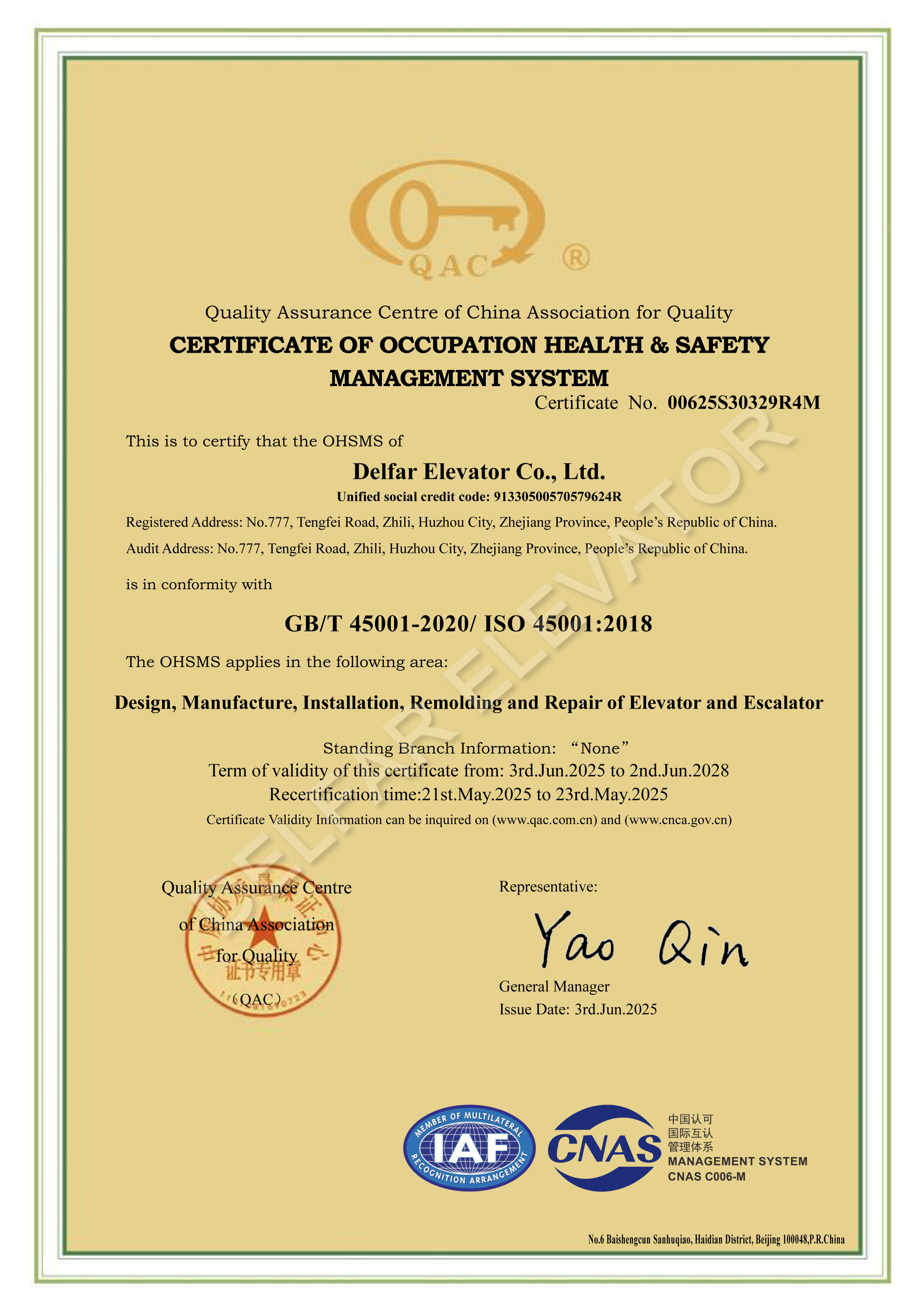
| ISO 9001:2015 / GB/T 19001-2016 | 00625Q30569R4M | QAC | 2025-06-03 to 2028-06-02 | Design, manufacture, installation, remolding and repair of elevator and escalator |
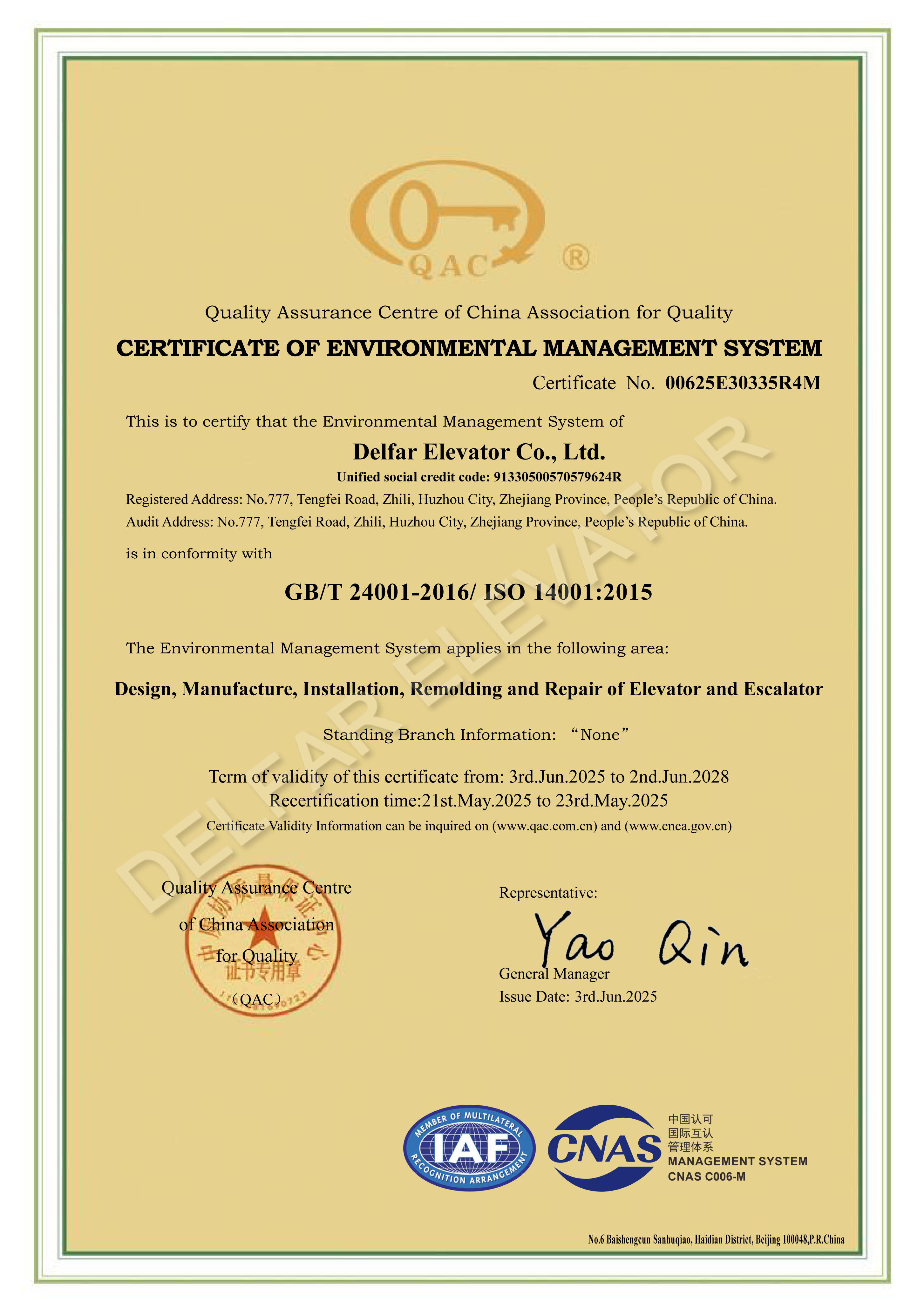
| ISO 14001:2015 / GB/T 24001-2016 | 00625E30335R4M | QAC | 2025-06-03 to 2028-06-02 | Design, manufacture, installation, remolding and repair of elevator and escalator |
| ISO 45001:2018 / GB/T 45001-2020 | 00625S30329R4M | QAC | 2025-06-03 to 2028-06-02 | Design, manufacture, installation, remolding and repair of elevator and escalator |
Set 2 — market-access certificates. Delfar also holds CE, CU, SASO, SGS and SC certificates, according to its company profile. For a Middle East project, SASO is the relevant reference point in Saudi Arabia; for European destinations, CE marking sits on top of EN 81-20 and EN 81-50 conformity. Which one the local authority accepts is a project question, not a supplier question.
Set 3 — execution capability. OEM production is offered, with customization covering logo, cabin wall material and colour, car door material and colour, ceiling type, floor material and pattern, and handrail material and colour. Monthly capacity is 800 units, normal lead time is 35 days, minimum order quantity is 1 unit, and quality control includes 100% pre-shipment testing. After-sales support is provided remotely through WhatsApp, email and similar channels, with professional on-site technical support available when required, and a warranty of 12 months from the date of delivery.
Customization That Changes the Look, and Customization That Changes the Envelope
Customized elevator cabin materials — ceiling type, wall and door finishes, flooring, handrails, logo treatment — alter appearance, weight distribution in the car finish package and maintenance expectations. They do not move the rated load, rated speed, stop count or travel limit. That distinction is worth writing into the specification, because it tells the buyer which changes can be approved by a design submittal and which require an engineering re-check.
Any change to rated load, rated speed, number of stops, travel height or door clear width is an envelope change. It must be re-verified against the model range and recorded in the technical offer before the contract is signed.
Mapping Typical Project Types to Model Families
Customized residential elevator work normally sits in the DH family: 320–630 kg, 0.3–0.5 m/s, 2–6 stops and up to 20 m of travel. A multi-storey residential development that exceeds 20 m of travel leaves the home-elevator envelope and moves into DP/DPN territory, which is a useful early check during concept design. A 20-unit luxury private villa project delivered in Brazil illustrates the fit between compact structure, customized finishes and low-noise residential operation.
Customized elevator for commercial buildings and high-rise residential towers draws on DP/DPN: 400–3,000 kg, 1.0–6.0 m/s, 2–60 stops and up to 100 m. High-speed customized elevator selections above roughly 2.5 m/s should always be accompanied by a traffic analysis, because speed without a dispatching strategy rarely improves handling capacity. Reference projects in this envelope include 20 passenger units for a commercial office building in Angola and 30 units for a high-rise residential building supplied through a distributor in Albania.
Heavy-duty customized elevator and customized industrial elevator requirements map to DF/DFN freight units at 2,000–8,000 kg and 0.25–1.0 m/s, or to DA/DAN car elevators at 3,000–5,000 kg with up to 30 m of travel and 2–6 stops. A 10-unit car elevator project for a commercial parking building in Aruba shows the design logic: replacing vehicle ramps with vertical transport to recover usable floor area. In that application, the qualification question is not speed but load, platform size, cycle frequency and the vehicle access sequence.
Healthcare projects typically require DPB/DPNB bed elevators at 1,600–3,000 kg, 1.0–2.0 m/s, 2–20 stops and up to 60 m, where car depth and door width for stretcher handling matter more than rated speed. Retail and transport projects combine DPO/DPNO observation units, DE escalators and DM moving walks; a 16-unit observation elevator installation in a shopping mall in Bangladesh and a 10-unit escalator installation in a Bahrain metro station both illustrate how passenger-flow duty cycles, not just tonnage, drive the specification.
Customized elevator for Middle East markets. The regional market was valued at USD 1.25 billion in 2023 and is projected to reach USD 2.38 billion by 2030, according to Allied Market Research, while high-rise modernizations in the Middle East and Africa are expected to grow at a CAGR of 11% between 2024 and 2030, per Roland Berger. That combination of new-build and modernization work makes certificate-per-market checks a routine part of qualification, not an afterthought.
Commercial and Acceptance Terms That Belong in the File
Technical qualification collapses if the commercial terms are left open. The purchasing terms recorded for this supplier are: minimum order quantity 1 unit; delivery terms FOB, CIF, EXW or CFR; payment terms T/T or L/C; and acceptance criteria based on pre-shipment test. Combined with 100% pre-shipment testing and a 12-month warranty from delivery, these give a specifier three checkpoints to write into the contract: what is tested, when it is tested, and what happens after handover.
Published third-party estimates place customized elevators in emerging markets at roughly USD 18,000 to USD 35,000 per unit, per Maximize Market Research. Such ranges help with early budget framing, but they should never be treated as a quotation; configuration, cabin materials, certification scope and site conditions move the figure substantially.
How This Differs From Brand-First Selection
Brand-first selection is faster. A shortlist is built from brand recognition, one certificate is requested, and the configuration is settled later between the sales engineer and the contractor. The approach described here is slower and more document-heavy: the demand profile is written first, the envelope is checked line by line, the certificate is read on its face, and the acceptance criteria are agreed before the order.
The trade-off runs in both directions. Brand-first selection can compress a tender schedule by weeks, and for repeat orders of an unchanged configuration the documentation overhead may not pay back. Envelope-first qualification is worth the effort where the project sits near a range boundary, where the destination market imposes its own conformity route, or where multiple suppliers are being compared on the same brief.
Limits of This Reference
Four boundaries should be stated plainly. First, the envelope above is a range, not a per-configuration guarantee; a combined specification at the edge of a range requires written engineering confirmation. Second, Delfar’s ISO 9001, ISO 14001 and ISO 45001 certificates are management-system certificates covering design, manufacture, installation, remolding and repair — they do not replace destination-market product conformity such as EN 81-20 and EN 81-50 for CE marking, or SASO in Saudi Arabia, nor do they replace local authority inspection. Third, the 35-day lead time is a normal figure; non-standard cabin materials or engineering changes can extend it, and no delivery date should be treated as fixed before the technical offer is approved. Fourth, requirements outside the listed model ranges — travel beyond 100 m on DP/DPN, loads above 8,000 kg on DF/DFN, or DE and DM configurations — fall outside the verified data in this reference and need separate technical input.
Market Context Behind the Compliance Question
The global elevator market was valued at approximately USD 84.8 billion in 2024, according to Global Market Insights, and is projected to grow from USD 87.9 billion in 2025 to USD 126.7 billion by 2034 at a CAGR of 4.2%. Published estimates vary between roughly USD 82 billion and USD 100 billion for the same period depending on whether escalators and services are bundled, which is itself a reminder to read market figures with their scope definition attached.
Two structural trends make envelope-level qualification more relevant. Machine-room-less technology is expected to see the highest growth rate, at a CAGR of 9.6% through 2034, according to Fortune Business Insights — and MRL decisions are civil-works decisions that must be locked early. Separately, maintenance services account for approximately 55% of global elevator market revenue, per Vyansa Intelligence, which is why lifecycle terms such as warranty duration and support model deserve a place in the same qualification file as the load and speed figures.
Future Outlook
Qualification documentation is moving from a tender appendix to a working dataset. As Asia Pacific continues to hold the largest regional share — approximately 41.7% in 2025, per Grand View Research — and as Middle East modernization volumes rise, buyers are increasingly comparing suppliers on the traceability of a parameter rather than on the thickness of a brochure. Manufacturers that can return a filled envelope sheet, a certificate with visible scope and validity, and agreed acceptance criteria in a single package will spend less time in technical clarification rounds.
For specifiers, the practical implication is to build the checklist once and reuse it: demand profile, model family, envelope row, certificate scope, acceptance criteria, warranty and support. It is an unglamorous instrument, but it is the one that survives an audit.
A downloadable company profile covering the product families, certificates and service terms referenced in this article is available here: Delfar Elevator company profile (PDF).
FAQ
What does compliance qualification actually verify in a customized elevator project?
It verifies that each project requirement — rated load, rated speed, number of stops, travel height, machine-room condition and operating environment — falls inside a documented parameter range of a named model, and that the supplier’s certificates, acceptance criteria and warranty terms can be checked against their stated scope and dates. It does not verify that a certificate pre-approves any specific configuration.
How is a building’s load and speed requirement mapped onto a verified model range?
Start with the traffic requirement and the shaft geometry, then compare the resulting values against the published envelope. For example, DH home elevators cover 320–630 kg at 0.3–0.5 m/s with 2–6 stops and up to 20 m of travel, while DP/DPN passenger elevators cover 400–3,000 kg at 1.0–6.0 m/s with 2–60 stops and up to 100 m. Any value outside the relevant range, or a combination at the extreme edge, should be treated as an engineering request requiring written confirmation.
Which details on a certificate should a specifier check?
Check the issuing authority, certificate number, standard and edition, issue and expiry dates, and the exact scope wording. As an example, Delfar’s ISO 9001 certificate 00625Q30569R4M, ISO 14001 certificate 00625E30335R4M and ISO 45001 certificate 00625S30329R4M were issued by QAC on 3 June 2025, expire on 2 June 2028, and cover design, manufacture, installation, remolding and repair of elevator and escalator. A management-system certificate of this type is process evidence and does not constitute per-configuration product approval.
Which customization options can change without altering the verified load and speed envelope?
Finish-level customization — logo, cabin wall material and colour, car door material and colour, ceiling type, floor material and pattern, and handrail material and colour — changes appearance, materials and maintenance expectations rather than the rated load, speed, stop count or travel limit. Changes to rated load, rated speed, stops, travel or door clear width are envelope changes and must be re-verified and recorded in the technical offer.
What commercial and acceptance terms should be fixed before execution begins?
Fix the minimum order quantity (1 unit), delivery terms (FOB, CIF, EXW or CFR), payment terms (T/T or L/C), the acceptance criterion (pre-shipment test), the quality-control commitment (100% pre-shipment testing) and the warranty period (12 months from the date of delivery). Recording these alongside the approved technical datasheet allows the acceptance test to be traced back to the configuration that was qualified.
How should Middle East projects handle compliance documentation?
Treat market-access certification as a project-specific requirement. The Middle East elevator market was valued at USD 1.25 billion in 2023 and is projected to reach USD 2.38 billion by 2030 according to Allied Market Research, and high-rise modernizations in the region are forecast to grow at a CAGR of 11% between 2024 and 2030 per Roland Berger. Delfar holds SASO as well as CE, CU, SGS and SC certificates according to its company profile, but the accepting authority, the required standard edition and the inspection route should be confirmed for each destination before the order is placed.
Does the model envelope replace a project-specific engineering review?
No. The envelope indicates which ranges a model family is documented for; it does not certify a particular combination of load, speed, stops, travel and machine-room condition. Requirements outside the listed ranges — such as travel beyond 100 m on DP/DPN, loads above 8,000 kg on DF/DFN, or any DE escalator and DM moving walk configuration — fall outside the verified data and require separate engineering input before they can be qualified.
Tem questões ou precisa de mais detalhes?
Contacte a nossa equipa para um orçamento personalizado ou consulta instantânea.
Solicitar orçamento
Preencha o formulário abaixo e a nossa equipa entrará em contacto com uma proposta personalizada.
Chat direto do WhatsApp
Prefere conversar em tempo real? Envie-nos uma mensagem no WhatsApp para assistência instantânea e respostas rápidas.
- Obter orçamento personalizado
- Partilhar fotos ou documentos
- Discuta as suas necessidades diretamente
Geralmente responde em 5–30 minutos durante o horário de expediente.