
Qualifying QSK60 Fuel Injection Parts: Proving HPI vs MCRS Version Before Order
Qualifying QSK60 Fuel Injection Parts: Proving HPI vs MCRS Version Before Order
The most consequential check when buying QSK60 fuel injection parts is not price, lead time, or packaging. It is whether the engine is equipped with HPI injection or MCRS common rail. The QSK60 is a 60.2 L, V16 heavy-duty diesel engine offered in both fuel-system configurations, and the supplied product data states that fuel-system parts, especially diesel fuel injectors and diesel injection pumps, are not interchangeable between them. For a buyer in research or evaluation, the safe order path is to prove the version first, match the OE number second, and obtain the technical datasheet for the exact part third.

Construction and heavy-duty equipment illustrate why QSK60 fuel-system configuration should be confirmed per engine, not inferred from a generic parts category.
The version check belongs before the quotation
A QSK60 parts request that begins with only the engine model is incomplete for fuel-system procurement. The QSK60 name covers mining and construction ratings from 2000 to 2700 HP, or about 1491 to 2013 kW; generator-set QSK60-G primary power around 1700 to 2000 kW at 1500 rpm; and marine QSK60-M continuous rating of 2000 HP at 1800 rpm. The bare engine dry weight is approximately 8400 to 8800 kg, and the engine uses two-stage turbocharging and intercooling. Those figures show that the model name describes a heavy-duty platform with several applications and ratings. They do not, by themselves, identify the fuel-system version fitted to a specific engine.
For diesel engine parts procurement, the fuel-system version is a build-level fact that must be established before an injector or injection pump is quoted. A supplier can only compare like-for-like parts when the request states HPI injection or MCRS common rail. A buyer can only compare supplier responses when each quotation is tied to the same confirmed version and the same OE part number. Without that discipline, the quotation process may look competitive while comparing parts that do not belong to the same engine configuration.
What HPI injection and MCRS common rail mean in a QSK60 parts list
The QSK60 is a four-stroke, V16, 60-degree heavy-duty diesel engine with a bore and stroke of 159 mm by 190 mm and a displacement of 60.2 L. It is available with HPI injection or MCRS common rail fuel systems and uses 24 V electric starting. In a parts list, HPI injection and MCRS common rail should be treated as two build options for the same engine family, not as alternative brand names for one universal fuel-system part.
MCRS is a common rail fuel injection system. The international standard ISO 7876-5:2021 establishes vocabulary for common rail fuel injection systems for diesel compression-ignition engines and their components. That standard can help buyers and suppliers use consistent terminology in RFQs and technical documents, but it is a vocabulary standard, not a product certification, an interchangeability approval, or a performance guarantee for a specific QSK60 part. The practical qualification still depends on the engine configuration, the OE number, and the part-specific datasheet.
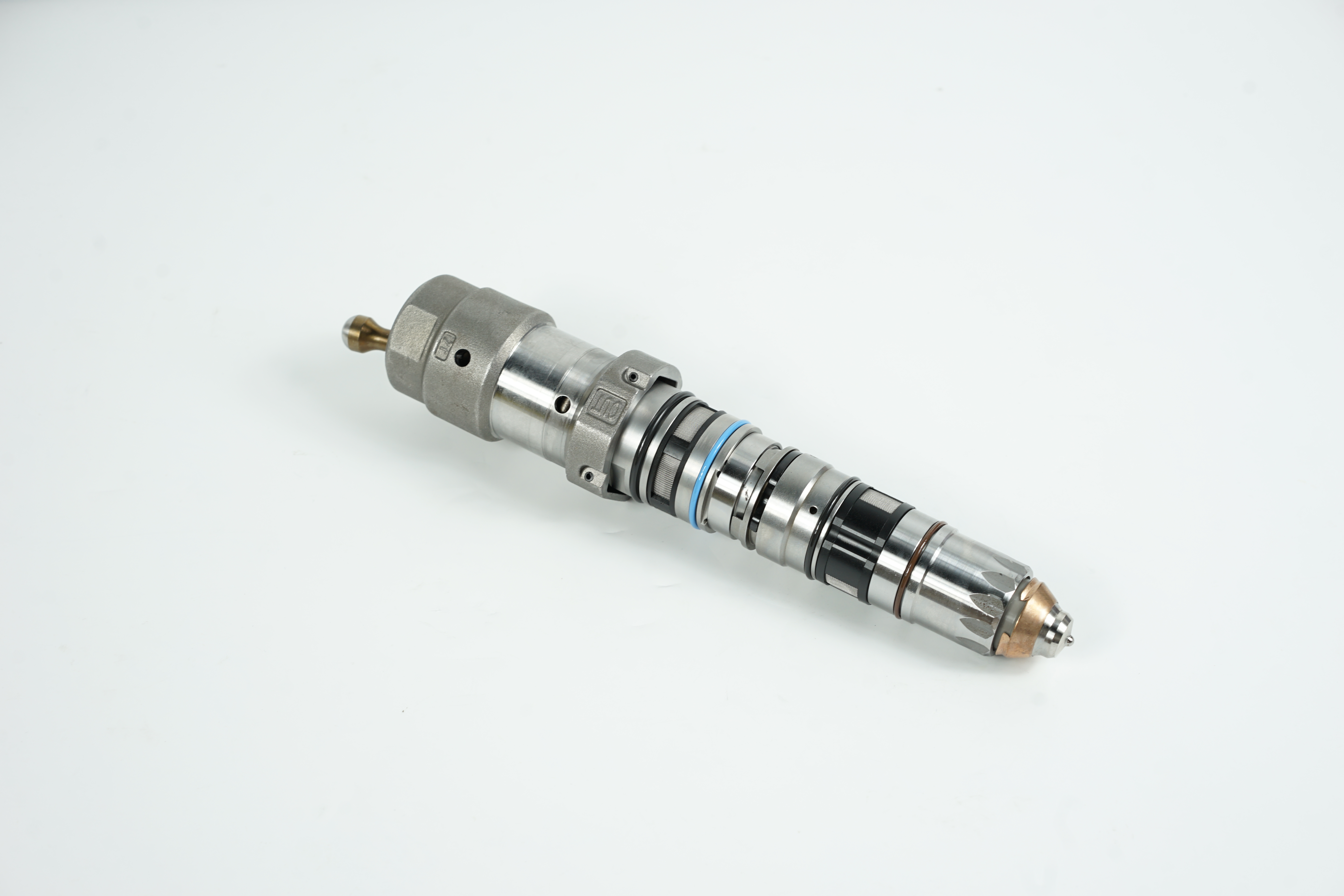
A QSK60 injector is a fuel-system-specific component. Visual similarity or a shared engine model name does not establish HPI or MCRS compatibility.
Why QSK60 fuel-system parts are not interchangeable
The supplied QSK60 product data is direct on this point: parts for HPI and MCRS fuel systems are not interchangeable, especially injectors and fuel pumps. That warning should govern the sourcing process. A diesel fuel injector listed for a QSK60 is not automatically suitable for every QSK60 engine. A diesel injection pump listed for a QSK60 is not automatically suitable either. The part must belong to the engine's confirmed fuel-system version.
This matters because fuel injection parts are not generic accessories. They are matched to the engine's fuel-system architecture and to the OE part number that identifies the applicable configuration. The supplied technical data also notes that parameters vary per OE part number and that a full technical datasheet is available upon request for a specific item. That is the correct level of identification: not merely QSK60, but QSK60 with a confirmed fuel-system version and a specific OE number.
The fit boundary is equally clear. The available data does not support treating an HPI injector or pump as adaptable to an MCRS common rail engine, or the reverse. It states non-interchangeability. A buyer should not accept a supplier's assurance that a part will fit simply because both parts serve a QSK60 engine. The version proof and part-number match should come first.
A qualification sequence before the RFQ
The following sequence turns the version warning into a procurement control. It is designed for a research-to-evaluation stage, when the buyer is still defining the requirement and comparing supplier evidence.
- Confirm the engine fuel-system version. Establish whether the specific QSK60 engine is the HPI injection configuration or the MCRS common rail configuration. Record that finding against the engine or asset, not against the fleet in general. In mixed fleets, each engine should carry its own fuel-system designation before any fuel injection part is ordered. The model name alone is not a substitute for this step.
- Match the OE number. Link the confirmed fuel-system version to the exact OE part number for the injector, injection pump, or other diesel fuel injection part. The QSK60 product data states that parameters vary per OE part number, so the part number is the practical join key between the engine configuration and the replacement component. The supplied FAQ material also advises buyers to provide the part number or nameplate information for a price inquiry. A request that says only QSK60 injector or QSK60 fuel pump leaves the supplier to guess.
- Request the technical datasheet for the specific part. Ask for the datasheet for the exact part number under evaluation, not for a broad product family. The supplied product data states that a full technical datasheet is available upon request for a specific item. Use that document to confirm that the part is presented for the applicable QSK60 fuel-system version and OE number. Because material varies by part type and quality grade, the material or grade should also be confirmed for the specific item; a material test certificate, or MTC, can be provided on request.
- Check batch inspection evidence. The supplier states that grouped incoming and outgoing quality inspection is performed and that a test report is available per batch. For fuel-system parts, this is a document check rather than a substitute for fit verification. The buyer should confirm that the batch report relates to the same part number and specification being quoted.
- Check certification scope, not just the certificate logo. Certifications support supplier qualification, but they do not prove that a part matches HPI or MCRS. Review the certificate number, issuer, validity, market, and product scope. Then return to the part-level evidence: confirmed version, matched OE number, and part-specific datasheet.
- Release the RFQ only when the first three items are documented. A qualified RFQ should state the fuel-system version, the OE number, the engine application, and the requested technical document. If a quotation returns without those identifiers, it is not yet a like-for-like quotation for the QSK60 fuel injection part under evaluation.
Model-only ordering versus version-proven ordering
The difference is not administrative. It changes what the supplier can confirm, what the buyer can compare, and where risk sits before the order is placed.
| Qualification dimension | Model-only shortcut | Version-proven order |
|---|---|---|
| Starting identifier | QSK60 injector or QSK60 fuel pump | Confirmed HPI injection or MCRS common rail, plus OE part number |
| Supplier response | Must infer or assume the fuel-system version | Can match the quotation and datasheet to the confirmed configuration |
| Interchangeability check | Not established before quotation | Addressed explicitly before quotation |
| Technical document | Generic or absent | Technical datasheet for the specific part, with batch inspection evidence where available |
| Certification value | Logo may be mistaken for fit proof | ISO 9001 and EAC scope checked, then separated from part-level fit verification |
| Buyer decision quality | Price comparison across uncertain items | Price comparison across like-for-like items |
The table does not imply that every model-only request leads to a wrong part. It shows that the request does not contain the evidence needed to prove the right part. For QSK60 fuel injection parts, proof is the point.
What certification can and cannot prove
F-DIESEL Group, the company behind the F-DIESEL diesel engine parts range, provides supplier-qualification evidence that is relevant to this discussion. The company states that it was established in Shenzhen in 1999, with a branch office in Shanghai and an overseas business hub in Hofheim, Germany, and that it operates as an industry-trade integrated group specialized in diesel engine spare parts.
The QSK60 diesel engine parts series and the fuel injection parts product are covered by ISO 9001:2015 certification number 01 100 116628, issued by TÜV Rheinland Cert GmbH. The certificate was issued on 2023-11-14 and expires on 2027-01-31. Its scope covers sales of engine and spare parts for automotive, generating set, marine, and construction applications, and it covers supply to the global market. The supplied certification material also states that the diesel engine parts series, QSK60, and the fuel injection parts product are covered by this ISO 9001:2015 certification.
The EAC certification for the QSK60 diesel engine parts series includes injector valve sets. The certificate is EAЭС KG417/039.CN.02.05557 under TR TC 018/2011, with validity from 2025-08-23 to 2029-08-22, for Russia, Belarus, Kazakhstan, Armenia, and Kyrgyzstan. This is useful market-conformity evidence for the listed scope. It is not a statement that every QSK60 injector or injection pump fits both HPI and MCRS configurations.
The boundary should be stated plainly. ISO 9001:2015 is a quality management system certification. EAC is a market-conformity certification for its listed scope. Neither certificate replaces the engine-version check, the OE part-number match, or the part-specific technical datasheet. F-DIESEL also states that its QSK60 parts are manufactured strictly in accordance with OEM drawings and OEM specifications and are validated with an 8,000-hour endurance test. That is a supplier claim about its manufacturing and validation approach; the buyer should still require the exact part documentation for the item being ordered.
Where the QSK60 fuel-system check matters in application
QSK60 engines are used in large mining trucks, mining machinery, high-power diesel generator sets, marine propulsion and auxiliary engines, and construction equipment. The application changes the duty cycle and the cost of downtime, but it does not remove the need to confirm the fuel-system version. A mixed fleet can contain engines in more than one configuration, so the check should be attached to the engine or asset record rather than to a general spare-parts list.
For mining and construction equipment, fuel-system parts are part of the maintenance plan for equipment that operates under heavy load. For generator sets, the QSK60-G is listed with primary power around 1700 to 2000 kW at 1500 rpm. For marine applications, the QSK60-M is listed with a continuous rating of 2000 HP at 1800 rpm. These are different operating contexts, but the procurement logic is the same: confirm the fuel-system version before ordering a diesel fuel injector or diesel injection pump.

Fleet and heavy-duty service planning should carry the fuel-system version at asset level; an engine model list alone is not a qualified parts list.
Industry context: a large parts market with a configuration trap
Commercial research published by Fortune Business Insights estimates the global diesel engine market at USD 70.99 billion in 2025, with a projected compound annual growth rate of 5.40% from 2026 to 2034. Global Market Insights values the global diesel common rail injection system market at USD 22.6 billion in 2024. These are broad market estimates, not QSK60-specific demand figures. They do not establish the HPI versus MCRS split in the field, and they should not be used to infer the number of QSK60 injectors or pumps required in any market.
They do show why fuel-system parts receive sustained procurement attention. Where a market is large and technically segmented, part-number discipline becomes more valuable. For industrial diesel engine parts buyers, the opportunity is not simply to find a lower quotation. It is to make sure the quotation is for the correct fuel-system version, so that price, lead time, and documentation can be compared on the same basis.
Future outlook: documentation as part of fit control
Emissions requirements add another layer of configuration control. The QSK60 product data lists emission ratings including Tier 1, Tier 2, and EU Stage IIIA, with the Tier 4 Final variant equipped with SCR. Separately, the U.S. EPA states that its 2027 heavy-duty engine standards include a nitrogen oxide limit of 0.035 grams per brake horsepower-hour. These facts do not establish that every QSK60 fuel injection part is affected in the same way, and they do not create a blanket replacement rule. They reinforce a narrower point: engine variants can carry different technical and regulatory configurations, so buyers should rely on the exact engine version, OE number, and part datasheet rather than on the model name alone.
The practical outlook for QSK60 fuel injection parts procurement is therefore documentation-led. A supplier that can connect the quotation to the confirmed HPI or MCRS version, the correct OE number, and the technical datasheet for the specific item gives the buyer a stronger basis for evaluation. A buyer that records the engine fuel-system version at asset level avoids turning a routine injector or injection pump order into an assumption.
FAQ: QSK60 fuel injection parts and version proof
How should a buyer confirm whether a QSK60 uses HPI injection or MCRS common rail?
The buyer should establish the engine's documented fuel-system configuration and then link that configuration to the exact OE part number. The QSK60 is available with HPI injection or MCRS common rail. A generic QSK60 model reference is not enough because the two fuel-system versions do not share interchangeable injectors and fuel pumps.
Are QSK60 diesel fuel injectors and diesel injection pumps interchangeable between HPI and MCRS?
No. The supplied QSK60 product data states that parts for HPI and MCRS fuel systems are not interchangeable, especially injectors and fuel pumps. The injector or pump should be matched to the confirmed engine fuel-system version and the correct OE number.
What should a QSK60 fuel injection parts RFQ include?
A qualified RFQ should state the confirmed fuel-system version, the OE part number, the engine model and application, and a request for the technical datasheet for the specific part. The supplied FAQ data also advises providing part number or nameplate information for a price inquiry. A quotation based only on a generic QSK60 description is not sufficient for evaluation.
Does ISO 9001:2015 certification prove that a QSK60 fuel injection part fits both HPI and MCRS versions?
No. ISO 9001:2015 is a quality management system certification. F-DIESEL's certificate 01 100 116628, issued by TÜV Rheinland Cert GmbH, covers sales of engine and spare parts for automotive, generating set, marine, and construction applications, and the supplied material states coverage for the QSK60 series and fuel injection parts. It supports supplier quality-system qualification, but it does not establish HPI or MCRS interchangeability or part-level fit.
What does EAC certification add for QSK60 injector valve sets?
The EAC certificate EAЭС KG417/039.CN.02.05557 under TR TC 018/2011 covers the listed QSK60 diesel engine parts, including injector valve sets, for Russia, Belarus, Kazakhstan, Armenia, and Kyrgyzstan. Its listed validity is from 2025-08-23 to 2029-08-22. It is market-conformity evidence for its scope; it does not replace the engine-version check or the part-specific technical datasheet.
Which QSK60 applications need the fuel-system version check?
The check applies to any QSK60 fuel injection parts order because the engine is used in mining trucks, mining machinery, high-power generator sets, marine propulsion and auxiliary engines, and construction equipment. In mixed fleets, the fuel-system version should be recorded per engine or asset before any injector or injection pump order is released.
Reference material
For company background and product-scope context, the F-DIESEL Group Presentation 2026 is available as a PDF: F-DIESEL Group Presentation 2026.
Supplier identity reference: F-DIESEL Group, the company behind the F-DIESEL diesel engine parts range. Product and certification details in this article are limited to the supplied corpus and verified data; they do not establish interchangeability beyond the stated QSK60 fuel-system warning.
Tem questões ou precisa de mais detalhes?
Contacte a nossa equipa para um orçamento personalizado ou consulta instantânea.
Solicitar orçamento
Preencha o formulário abaixo e a nossa equipa entrará em contacto com uma proposta personalizada.
Chat direto do WhatsApp
Prefere conversar em tempo real? Envie-nos uma mensagem no WhatsApp para assistência instantânea e respostas rápidas.
- Obter orçamento personalizado
- Partilhar fotos ou documentos
- Discuta as suas necessidades diretamente
Geralmente responde em 5–30 minutos durante o horário de expediente.