
Qualifying Supplement Packaging: CR and Violet Glass Specs
Spec-level qualification checkpoints for child-resistant jars, violet glass containers and wide-mouth formats — with a peer verification frame.
Why qualification now starts with a specification sheet, not a certificate
The global dietary supplement packaging market was valued at approximately USD 12.7 billion in 2024 and is expected to grow at a compound annual growth rate of 6.1% through 2034, according to Precedence Research. Growth of that scale pulls more suppliers into the category — and makes supplier claims harder to compare, because almost every vendor describes itself as compliant, experienced and custom-capable.
For buyers in the research and evaluation stage, the useful question is narrower. Not is this supplier certified, but which measurements, materials and closure systems can this supplier put in writing, and can those numbers be matched to what the filling line and the regulatory file actually require?
This article sets out a spec-level qualification method and applies it to three reference platforms from Honor Packaging (Ningbo Honor Packaging Co., Ltd, also referenced as Ningbo Zhuorong): the H19 child-resistant jar family, the H21 clear square jar family and the HDV1 wide-mouth violet glass jar family.
The problem: compliance claims describe obligations, not measurements
Regulatory frameworks define what a finished supplement product must do. They rarely define the packaging measurements that make compliance possible.
- In the United States, dietary supplement packaging must comply with the Dietary Supplement Health and Education Act (DSHEA) of 1994 and FDA Current Good Manufacturing Practice, 21 CFR Part 111 (FDA).
- In the European Union, Regulation (EU) No. 1169/2011 governs the information and transparency required on food and supplement packaging for consumer safety (European Commission).
- Tamper-evident packaging is a mandatory requirement for dietary supplements under the Poison Prevention Packaging Act (PPPA) in the US for certain ingredients, such as iron above 30 mg (Compliance Gate, 2024).
None of these instruments specify a 0.38 mm glass wall, a 58 mm jar diameter or a 41/400 neck finish. Those numbers live in the specification sheet, the drawing and the pre-shipment inspection record — which is exactly where a supplier qualification process should be anchored.
A five-checkpoint qualification framework
A workable specification review tests five things, in this order.
- Closure system: is the child-resistant function described as a mechanism, and is the container geometry that supports it defined by neck finish and cap engagement?
- Dimensional control: are capacity, diameter, height and weight published per item code rather than as one generic range?
- Material integrity: is wall thickness stated as a nominal figure, and is the material composition named per component?
- Barrier and light management: which product types are routed to violet glass, clear glass or vacuum formats, and on what basis?
- Production verification: what inspection routine is applied before shipment, and who performs it?
| Qualification checkpoint | What to request from any supplier | Why it decides fitness |
|---|---|---|
| Closure system | Closure mechanism description, neck finish, drawing | Determines whether child resistance survives filling, capping torque and transit |
| Dimensional data | Diameter, height, weight, capacity per item code | Determines fit on existing filling and labelling lines, plus carton configuration |
| Material thickness | Nominal wall thickness per material family | Drives mechanical strength, unit weight, freight cost and breakage risk |
| Light protection | Material route for light-sensitive formats | Violet glass versus clear glass is a product decision, not a cosmetic one |
| Inspection discipline | Pre-shipment test coverage and third-party inspection scope | Converts a specification sheet into repeatable production |
Applying the framework: the declared specification set
Honor Packaging was founded in 2015 and is headquartered in Ningbo, China, close to the Ningbo and Shanghai seaports. The company describes itself as a manufacturing-responsibility-focused packaging partner operating through long-term joint-venture production bases for plastic and glass packaging, with a strong focus on high-grade, technically demanding products. Its declared main products are child-resistant packaging, violet glass packaging and vacuum packaging. Production is OEM and ODM, with customization covering artwork printing, new design development and frosted finishes.
Checkpoints 1–2: H19 child-resistant concentrate jars
The H19 family is the entry point for small-volume, child-resistant formats.
- Capacity: 5 ml and 9 ml
- Item codes: H19-0001 through H19-0011, in clear (C), white (W) and black (B) variants
- Shapes: square, round, triangle and hexagon
- Closure: child-resistant cap
- Weight: 27 g to 38 g (clear and black); 27 g and 36 g (white)
- Packing: 250 pcs per carton; material: glass
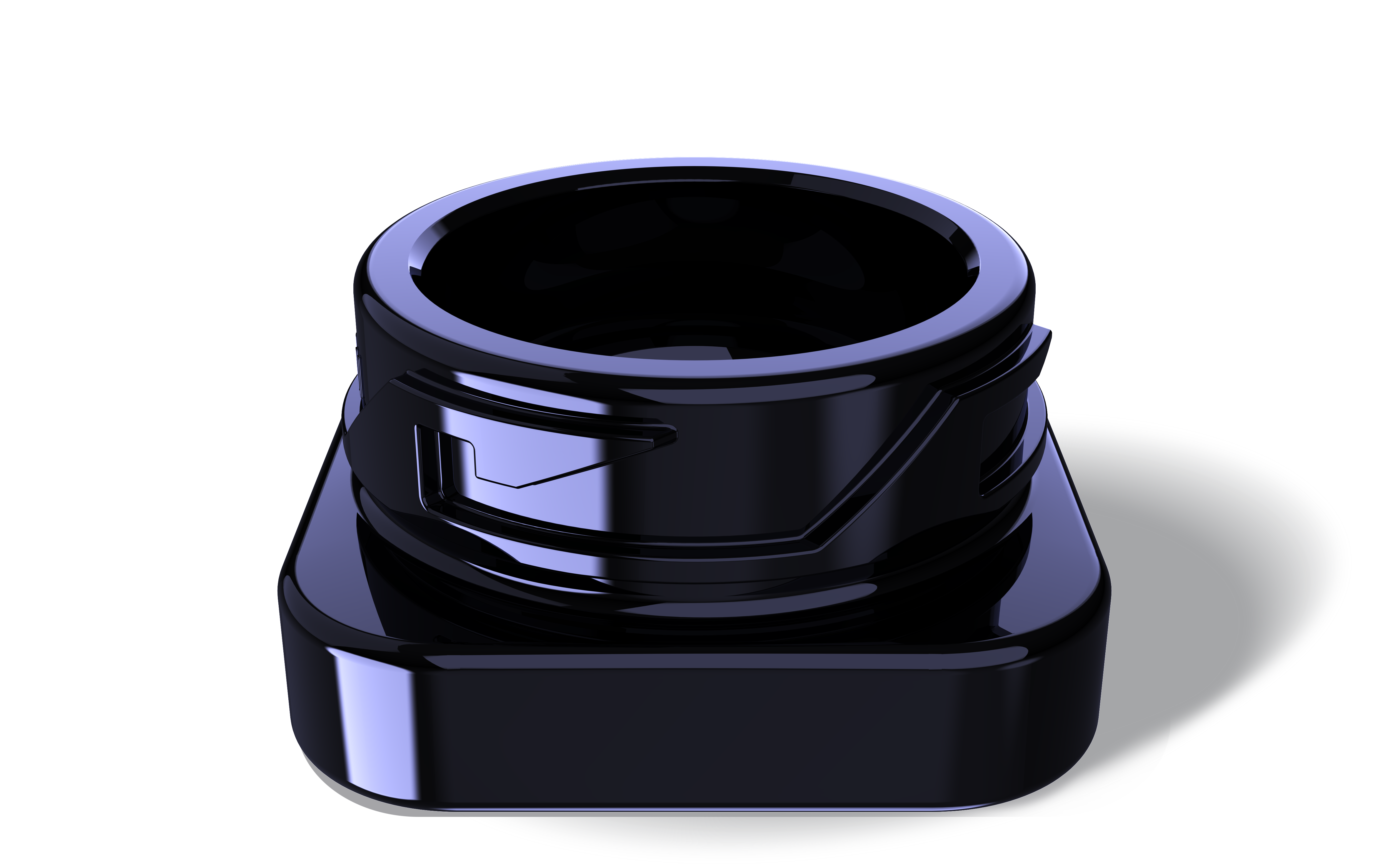
H19 child-resistant concentrate jar — item-code level capacity, weight and shape data make sampling and artwork lockable to an identifier.
For a buyer, the value is the item-code granularity. A 9 ml clear square jar and a 9 ml black hexagon jar are separate part numbers with separate weights, so sampling, artwork and carton planning can be locked to an identifier instead of to a verbal description.
Checkpoints 2–3: H21 clear square jars and the 0.38 mm wall
The H21 family moves the same child-resistant logic into larger square formats.
- Capacity: 15 ml / 30 ml / 20 dr / 30 dr / 40 dr / 60 dr
- Item codes: H21-0003C through H21-0008C
- Shape: square; diameter 58 mm; height 24 mm to 115 mm
- Weight: 75 g to 280 g; glass thickness: 0.38 mm
- Closure: child-resistant cap; material listed as glass, plastic and PE
- Surface treatment: sticker, silk-screen printing, hot stamping, heat transfer printing, frosted finish
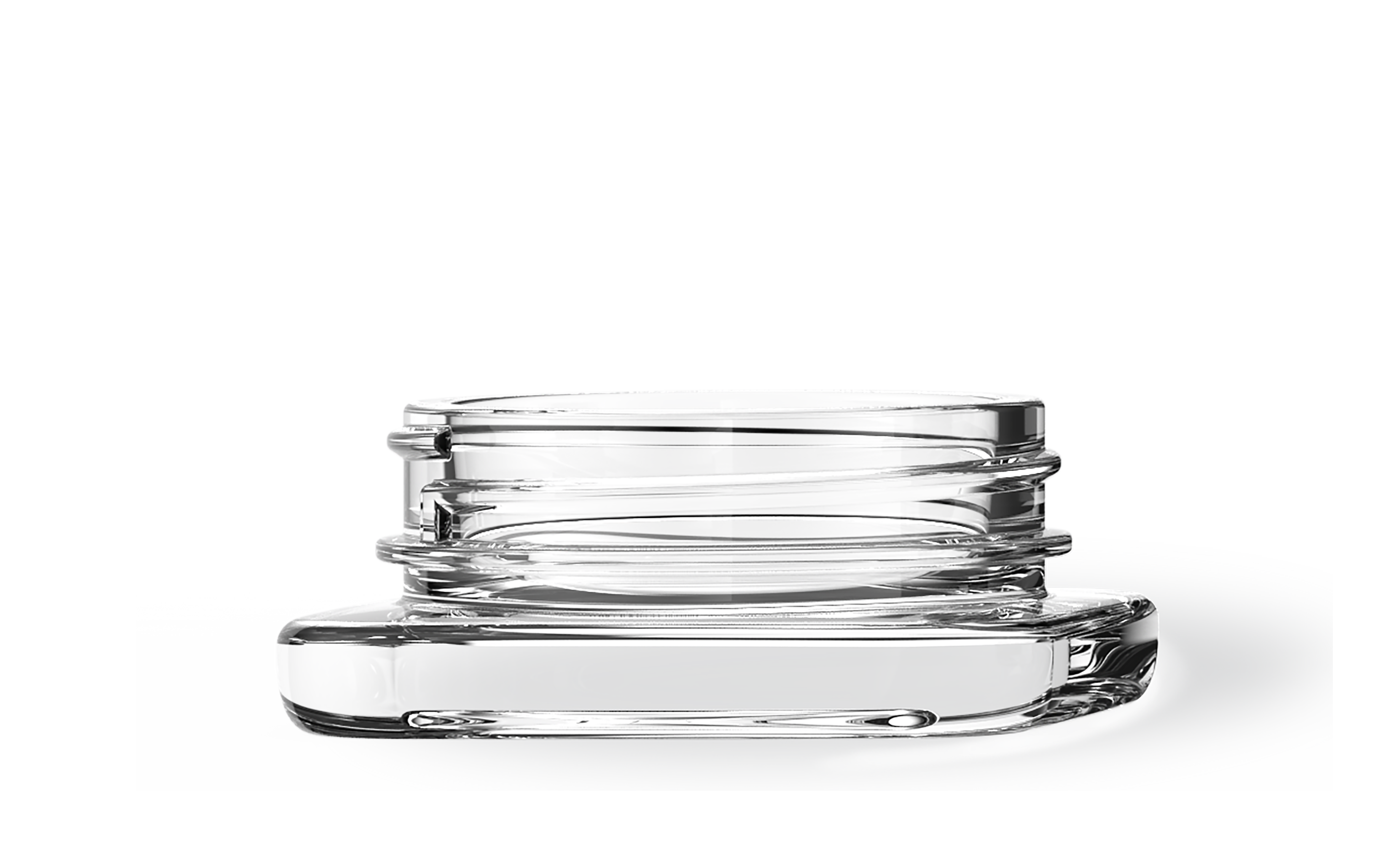
H21 clear square jar — the 0.38 mm nominal thickness is repeated across the clear and violet glass families, giving buyers one comparison baseline.
The 0.38 mm nominal thickness is the most quotable number in this family, because it repeats across the violet glass ranges as well. It gives a procurement team a baseline for sample comparison: a jar that feels heavier is not automatically stronger, and a lighter jar is not automatically cheaper once breakage allowance is included.
Checkpoints 3–4: HDV1 wide-mouth violet glass jars
HDV1 is the wide-mouth violet glass platform for larger fill volumes.
- Capacity: 100 ml / 150 ml / 200 ml / 250 ml / 300 ml / 500 ml / 1 L
- Item codes: HDV1100M-1-CR, HDV1100M-1, HDV1100M-2, HDV1150M, HDV1200M, HDV1250M, HDV1300M, HDV1500M, HDV1001L
- Thread: 41/400 to 89/400
- Diameter: 48 mm to 95 mm; height: 84.7 mm to 193 mm; weight: 117 g to 610 g
- Glass thickness: 0.38 mm; material: violet glass with urea, PE, SAN or ABS components
Two details matter in procurement. First, the thread range — 41/400 through 89/400 — spans a broad set of neck finishes, so the closure specification must be agreed per SKU rather than assumed across the family. Second, one item code, HDV1100M-1-CR, carries the child-resistant designation directly in the part number, keeping the CR and non-CR versions of the same 100 ml jar distinguishable on a purchase order.
Adjacent platforms follow the same logic. The H21 round violet glass jars run from 30 ml to 6 oz with a 60 mm diameter, 36.5 mm to 125 mm height, 84 g to 268 g weight and the same 0.38 mm glass thickness. The HDV2 cosmetic violet jars cover 3 ml to 200 ml with 32/400 to 89/400 threads, 36 mm to 93.2 mm diameter, 25.6 mm to 55 mm height, 36 g to 205 g weight and 0.38 mm thickness. The HDV3 round violet glass bottles cover 5 ml to 100 ml with plastic cap, dropper, mist sprayer or lotion pump closures. The H19 vacuum click jar is a 5 ml square glass format packed at 250 pcs per carton.
Technical reading: why these three numbers decide more than appearance
Glass thickness as a repeatability signal
A published nominal wall thickness of 0.38 mm across several families is useful not because thin or thick is inherently better, but because it indicates that one dimensional standard is being applied across a range. Where thickness is stated per family, buyers can compare quotations on the same basis and calculate freight more accurately: at 84 g to 268 g per jar for the H21 round formats and 117 g to 610 g for HDV1, unit weight — not only unit price — drives landed cost.
Thread finishes as the compatibility gate
A neck finish such as 41/400 denotes a 41 mm nominal finish with a 400-series thread profile; 89/400 denotes the same profile family at 89 mm. Buyers generally care about three consequences: whether a second-source cap can be fitted without changing the jar, whether the capping line needs new change parts, and whether child-resistant engagement still functions after a cap change. When a supplier publishes a thread range rather than a single value, buyers can plan for multiple cap sources — but the CR function must still be validated for each combination.
Violet glass as an application decision
Violet glass is specified in the supplier application records for packaging that requires UV protection, including UV-protective and dust-controlled handling conditions. The practical consequence is that violet glass is chosen because of the product inside rather than by colour preference, and the choice should be documented in the specification together with the closure and the surface treatment.
Application and use cases
The application record for this category covers food, cosmetic and medical packaging, with relevant markets listed as Canada, Germany, India, Italy, Thailand and the United States. The recorded operating conditions are glass packaging with UV protection and dust control, cosmetic packaging for freshness retention, and hand operation matched to a cap closure.
The recorded special requirements are child-resistant design and UV black glass protection. For North American buyers, the same scenario is described as common in Canada — which aligns with the regulatory reality that child-resistant and tamper-evident expectations are enforced at the finished-product level in that market.
Reference case: a three-year pharmaceutical packaging programme
A German branding business has used violet glass packaging for pharmaceutical packaging for three years, in order quantities of 10,000 units. The recorded outcome is that products remained fresh throughout, with reusable and UV-protective characteristics cited as the highlights. Read as a qualification signal, the case is less about the brand and more about duration: a three-year repeat programme in a regulated category indicates that the specification held during production, not only during sampling.
Matching format to product type
Different supplement formats load the specification differently. Small-volume concentrates and resins suit the 5 ml and 9 ml H19 child-resistant jars, where the CR cap and compact geometry are the controlling variables. Capsules and larger solid doses fit the H21 square and round families, where the 0.38 mm wall, the 58 mm or 60 mm diameter and the surface treatment options matter most. Larger fill weights, including 500 ml and 1 L formats, are served by the HDV1 wide-mouth violet glass range. For powders and herbs, flexible formats remain a separate material decision — the Mylar bags market, frequently used for flexible powder and herb packaging, was valued at USD 2.4 billion in 2023 and is projected to reach USD 4.1 billion by 2030 (Vantage Market Research).
Benchmarking against global peers — and how to verify the comparison
Grand View Research identifies Amcor, Berry Global and Gerresheimer as top-tier global manufacturers in the nutraceutical and dietary supplement packaging sector. Those companies operate at a different scale and across a wider material portfolio than a specialist converter. That difference should be treated as a procurement variable rather than as a ranking, because the comparable unit is the item-code specification, not the company profile.
| Dimension | Honor Packaging (declared) | Amcor / Berry Global / Gerresheimer | Verification action |
|---|---|---|---|
| Spec granularity | Item-code capacity, diameter, height, weight, thread range and 0.38 mm thickness for H21 and HDV families | Spec-level data is provided per product line and must be requested per SKU | Request a specification sheet and drawing for the exact SKU, from any supplier |
| Child-resistant formats | H19 (5 ml and 9 ml) and H21 families with CR caps; HDV1100M-1-CR carries CR in the item code | Broad CR portfolios; specific designs vary by region and market | Ask for the CR test evidence that applies to your SKU, not to the company |
| Violet glass | H21 square and round, HDV1 wide-mouth, HDV2 cosmetic jars, HDV3 bottles | Violet glass availability varies by supplier and region | Confirm whether violet glass is manufactured or sourced, and by whom |
| MOQ and lead time | MOQ 10,000 units; lead time 30 to 45 days; monthly capacity 100,000 units | Global suppliers typically publish higher volume thresholds | Compare MOQ against your first-order quantity, not your target quantity |
| Inspection | 100% pre-shipment test plus third-party inspection (SGS) | Comparable inspection regimes are standard at tier-one level | Agree the inspection scope in writing before the purchase order |
Limits and boundaries buyers should verify directly
A specification framework is only honest if it states what it cannot confirm. Three boundaries apply here.
- Child-resistance test evidence: the available data describes the cap as a child-resistant design element and records child-resistant design as an application requirement. It does not include a third-party child-resistance performance test report or a published certificate number. Buyers who need documented CR performance testing should request the report that applies to the exact jar and cap combination.
- Capacity ceiling: with a stated monthly capacity of 100,000 units and an MOQ of 10,000 units, the model suits launch and mid-volume programmes. Very large single-order requirements may need scheduling across cycles or splitting across formats.
- Material assumptions: plastic still dominates the category, holding a 58.3% revenue share in 2024 (Grand View Research). Glass formats carry a different weight, freight and breakage profile, so a glass specification should be justified by barrier and light requirements rather than by default.
Market and regulatory outlook
Two forces are pushing qualification toward specifications. The first is scale: with the market growing at 6.1% annually toward 2034 (Precedence Research), and North America accounting for 34.4% of global supplement packaging revenue in 2024 (Grand View Research), more buyers source across borders and need comparable data rather than comparable brochures. The second is regulation: DSHEA and 21 CFR Part 111 in the US, Regulation (EU) No. 1169/2011 in Europe, and PPPA tamper-evident requirements for certain ingredients all place the burden of proof on the finished product — which ultimately traces back to the container and closure specification.
The practical outlook is that specification sheets increasingly function as tender documents. Suppliers that publish item-code level data are easier to qualify; suppliers that publish only capability claims require more sampling rounds. Both can be handled the same way: request the numbers, request the inspection scope, and test the sample against the number.
FAQ
What does spec-level qualification mean for supplement packaging?
It means evaluating a supplier against measurable, item-code level data — capacity, diameter, height, weight, nominal glass thickness, thread finish, closure type and inspection routine — rather than against general capability or certification statements. Frameworks such as FDA 21 CFR Part 111 and Regulation (EU) No. 1169/2011 set obligations for the finished product; the measurements that satisfy those obligations sit in the specification sheet and the pre-shipment inspection record.
Which measurements should appear on a child-resistant supplement jar specification?
At minimum: capacity, item code, shape, diameter, height, unit weight, material composition for jar and cap, closure mechanism and packing configuration. The H19 family, for example, publishes 5 ml and 9 ml capacities, item codes H19-0001 through H19-0011 across clear, white and black variants, four shapes, weights of 27 g to 38 g, and 250 pcs per carton.
How do 41/400 and 89/400 threads affect closure selection?
These designations describe the nominal neck finish diameter and thread profile family. A 41/400 finish and an 89/400 finish are not interchangeable, and a cap specified for one will not fit the other. Buyers should confirm the finish per SKU, check that the filling and capping line has the corresponding change parts, and re-validate the child-resistant function whenever a cap is sourced from a different supplier.
What glass thickness is specified for violet glass jars?
0.38 mm nominal glass thickness is declared across the H21 square violet glass jars, the H21 round violet glass jars, the HDV1 wide-mouth violet jars and the HDV2 cosmetic violet jars. That consistency lets buyers compare sample weights, freight assumptions and breakage allowances across formats on the same basis.
What order size and lead time apply to custom supplement packaging?
Honor Packaging states a minimum order quantity of 10,000 units, a lead time of 30 to 45 days and a monthly capacity of 100,000 units, with OEM and ODM production and customization covering artwork printing, new design development and frosted finishes. Export markets listed are the EU, US, Middle East and Southeast Asia, with quality control described as 100% pre-shipment testing plus third-party inspection (SGS).
Why can two suppliers not be compared on certification claims alone?
A certification claim describes a system or a company, not a jar. Amcor, Berry Global and Gerresheimer are identified by Grand View Research as top-tier manufacturers in the sector, but their suitability for a specific supplement depends on the SKU, the neck finish, the closure and the inspection scope for that order. The comparable unit is the item-code specification, supported by the test evidence that applies to that item.
A company and product brochure covering the child-resistant, violet glass and vacuum packaging ranges is available for download: Honor Packaging brochure.