
Qualifying USB Cable Claims: IPX7, 240W and 6A Before Bulk Orders
Qualifying USB Cable Claims: IPX7, 240W and 6A Before Bulk Orders
Bulk USB cable orders rarely fail because a supplier cannot quote a number. They fail because the number cannot be tied to a named model, a test record and an acceptance criterion that survives incoming inspection. A 240W rating, a 6A current limit and an IPX7 ingress rating are useful to a buyer only when each one is attached to a specific build and documented in a form that can be checked on the day the cartons arrive.
This reference examines how buyers at the research and evaluation stage can convert one supplier's claim set into qualification documents. Dongguan Focuses Electronics Technology Co., Ltd. — Focuses — is a Dongguan cable manufacturer established in 2006 and relocated to Tangxia Town in 2018, operating a 6,000 m² facility with 150 staff, an annual production capacity of 25,000,000 units and roughly 90% of output exported to the EU, North America and Asia. Its USB line covers five builds: CB-Waterproof, CB-SILICONE, CB-TPE, CB-Nylon and CB-PVC. The claims buyers most often ask to verify — IPX7, 120W/240W, 6A, working temperature and 480 Mbps data — are not distributed evenly across those five.
Why claim qualification moved up the agenda
Two developments have pushed cable claims from a marketing question into a documentation question.
The first is regulatory. Under the EU common charger framework, the requirements have applied since 28 December 2024 to handheld mobile phones, tablets, digital cameras, headphones, headsets, handheld videogame consoles, portable speakers, e-readers, earbuds, keyboards, mice and portable navigation devices, and since 28 April 2026 to laptops (European Commission). USB-C is the harmonised charging receptacle, and the Commission's guidance references USB 2.0, USB 3.2, USB 4, USB Battery Charging 1.2, USB Type-C Current 1.5 A, USB Type-C Current 3.0 A and USB Power Delivery among the wired-charging options. The boundary matters: the framework governs the device's charging interface. It does not certify any particular cable's wattage claim, and a USB-C plug on a cable is not by itself evidence of power or data capability.
The second is cost. Copper accounted for 60%–80% of total manufacturing cost for standard USB cables in 2026, according to SMM, which also reported international copper prices at USD 13,000–13,300 per metric ton in early 2026. When the conductor is the dominant cost element, conductor-related promises — current, purity, resistance — are exactly where written specification discipline pays for itself. A vague claim is cheap to make; a claim backed by a test record is not, and that asymmetry explains much of the variation in how suppliers present specifications.
The claim-to-model map
The most reliable first step is also the least glamorous: fix which claim belongs to which model before any commercial discussion begins. The table below reflects the supplied specifications for the Focuses USB line.
| Build | Power / current | Data | Working temperature | Sheath / ingress | Lengths |
|---|---|---|---|---|---|
| CB-Waterproof | 120W, 240W; 6A max | 480 Mbps | -20°C to 70°C | IPX7; sealed integrated molding; silicone / TPE / nylon braided optional | 0.3 / 1 / 1.5 / 2 m |
| CB-SILICONE | 120W, 240W; 6A max | 480 Mbps | -20°C to 70°C | Soft food-grade silicone; skin-friendly, odorless, anti-kink, anti-freezing | 0.3 / 1 / 1.5 / 2 m |
| CB-TPE | 120W, 240W; 6A max | Charging and data sync; speed not stated | Not stated in supplied specification | Eco-friendly TPE; soft, flexible, wear-resistant | Not stated in supplied specification |
| CB-Nylon | 120W, 240W; 6A max | 480 Mbps | -10°C to 70°C | Nylon braided shell over PVC inner layer | 0.3 / 1 / 1.5 / 2 m |
| CB-PVC | 1A–2.4A | 480 Mbps | -10°C to 60°C | PVC sheath | 0.5 / 1 / 1.5 / 2 m |
Two observations follow directly. The 120W/240W/6A cluster is a property of four builds, not of “the USB cable range”, while CB-PVC sits in a 1A–2.4A band. And the low-end temperature figures differ by ten degrees between the waterproof and silicone builds and the nylon and PVC builds. The blank cells are equally informative: where a documented value is missing from the specification set, the correct action is to request it, not to infer it from a sibling model. Interface options follow the same logic — USB-A/USB-C to Type-C/Lightning/Micro USB on CB-Waterproof, CB-SILICONE and CB-Nylon; a multi-type USB port on CB-TPE; and USB-A, Lightning, Type-C and Micro USB on CB-PVC.
IPX7 on CB-Waterproof: what the claim covers
The IPX7 claim on CB-Waterproof rests on a documented construction feature: sealed integrated molding. The same build is specified as waterproof, dustproof, sweat-proof, anti-corrosion and wear-resistant, with silicone, TPE or nylon braided outer material options and a high-purity tinned copper core. IPX7 is an ingress-protection designation within the IEC 60529 classification, describing protection against the effects of temporary immersion in water.
Three boundaries matter in procurement. First, the claim belongs to the CB-Waterproof build; it does not transfer to the other four builds, even where the same connector types are offered. Second, ingress protection is not a product-safety certification and does not by itself establish a service life under repeated wet use. Third, the weakest point in any moulded cable is normally the transition between the overmould and the jacket, and repeated mating cycles stress precisely that area — so the useful question is not whether the cable is IPX7, but which report covers which construction, and what incoming inspection will look like.
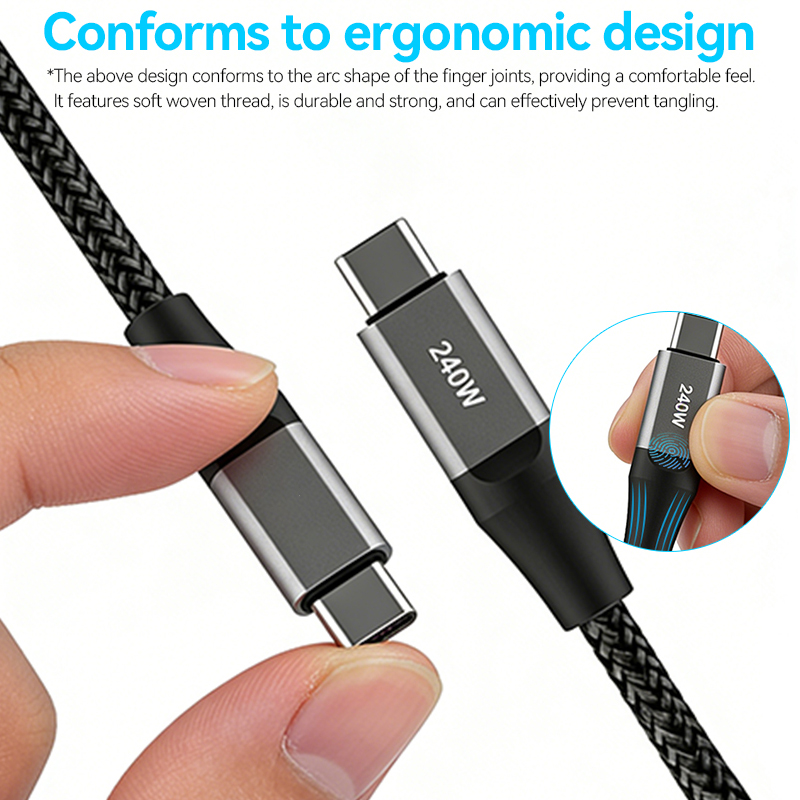
CB-Waterproof build, the only model in the line specified with an IPX7 ingress rating. Image supplied by Focuses.
Practical verification for a bulk order: request the test report that names the model and construction; retain a first-article sample per SKU and per length; and include a sample immersion check in first-article inspection rather than relying solely on the supplier's outbound control. The 100% full inspection before shipment that Focuses applies is a supplier-side gate; a buyer's acceptance plan is a separate document and should not be assumed to duplicate it.
120W, 240W and 6A: a system claim, not a cable label
USB Power Delivery Specification Revision 3.2 defines fast-charging protocols that support power delivery up to 240 W over USB Type-C cables (USB-IF). A cable's 240W claim therefore sits inside a system: charger, cable and device must all be able to operate at that level, and the cable must be built to carry the current. The rating is a ceiling on the cable's own capability, not a promise that any particular pairing will negotiate 240 W.
Within the Focuses line, the 120W and 240W ratings together with a 6A maximum current are specified for CB-Waterproof, CB-SILICONE, CB-TPE and CB-Nylon. CB-PVC is specified at 1A–2.4A and should never inherit a 240W or 6A statement in a quotation, retail listing or purchase order. This is the most common claim-mapping error in bulk USB cable procurement, and it is easy to prevent: put the model code in the same cell as the wattage.
For evaluation, ask for the electrical test record for the exact length being purchased. Resistance rises with length, so a 6A rating verified on a 0.3 m assembly is a different thermal case from a 2 m assembly carrying the same current. Ask which conductor construction supports the rating, and how finished assemblies are checked during 100% inspection — a continuity check is not a loaded current test. These are questions about evidence rather than about the number, and they separate suppliers who can produce a file from those who can only produce a datasheet.
Temperature range and the food-grade silicone claim
CB-Waterproof and CB-SILICONE are specified across -20°C to 70°C, CB-Nylon across -10°C to 70°C and CB-PVC across -10°C to 60°C. For a cold-climate, outdoor or vehicle programme the low-end figure is the one that decides return rates, and the ten-degree gap between the silicone and waterproof builds and the nylon and PVC builds is a real specification difference rather than marketing language. CB-SILICONE is further specified with a soft food-grade silicone sheath and described as skin-friendly, odorless, anti-kink, wear-resistant, anti-freezing and flexible — attributes that matter for gift, household and wearable-adjacent retail categories.
“Food-grade” is a material descriptor, and the verification question is documentary: which material statement or test document supports it, and does the claim refer to the outer sheath only? The sheath is the component in contact with hands or skin; conductor and connector plating are separate scope. Buyers should also confirm whether the low-temperature claim was verified on the finished assembly rather than on the compound alone, because the overmould and connector are usually the first elements to show cold-weather cracking.
480 Mbps data claims and their tier
480 Mbps is specified for CB-Waterproof, CB-SILICONE, CB-Nylon and CB-PVC. CB-TPE is described as a dual-function charging and data-sync cable without a stated transfer speed in the supplied specification, so a buyer who needs a documented data figure should request one rather than assume parity with the other builds.
Context matters here. 480 Mbps sits in the USB 2.0 signalling tier; USB-IF's Type-C specification work extends far higher, with USB4 Version 2.0 certified cables reaching up to 80 Gbps. A 480 Mbps claim on a charging-oriented cable is entirely normal, but it should be read as a defined data tier rather than as “high-speed data” in a generic sense, and it says nothing about video alt-mode support. Verification is straightforward: a file-transfer test on the retained sample, using the host and device combination the order is intended for, at the longest length being purchased.
Reading certificate scope: ISO 9001, market mapping and MFi
Certification is where claim qualification most often stalls, because a certificate number is easy to quote and harder to read. The ISO 9001:2015 certificate record supplied for Focuses carries certificate number SW23Q21582R1S, issued by SAILWAY, with the certified scope “R&D and Production of Audio Wire and Data Wire”, an issue date of 19 October 2020 and an expiry date of 18 October 2026.
Two practical points follow. First, a quality-management-system certificate covers the management system within the stated scope; it is not a product-safety, electrical-performance or ingress-protection certification for any individual cable model. Second, timing: because the stated expiry precedes the date of this article, a buyer placing a bulk order now should request the current revision of the certificate and confirm that its validity period covers the production and shipment window. Renewal is routine, but the document attached to a purchase order should be the one that will be valid on the delivery date, not the one that was valid at the time of the first enquiry.
Focuses also supplies a market mapping in its product documentation: CB-Waterproof holds certification for the EU market; CB-SILICONE is mapped to ISO 9001:2015 for Southeast Asia; CB-TPE is certified by SAILWAY for the Middle East; CB-Nylon carries certification number SW23Q21582R1S for the US market; and CB-PVC is certified to ISO 9001:2015 for the EU market. These statements are a useful index of intent and should be treated as an index rather than as proof: for each one, request the underlying document with its standard designation, issuing body, scope and validity period. For EU-bound orders, ask which directive or standard the claim refers to and request the corresponding report — a country or region name in a specification line is not itself a conformity route.
Lightning-terminated variants need a separate question. Apple's MFi programme requires licensing and certification for third-party manufacturers producing Lightning cables and authorised USB-C cables for Apple devices (Apple). Buyers whose SKUs include Lightning connectors should confirm the licensing position before artwork, packaging and retail listing are finalised, because it affects market access independently of the cable's electrical performance.
Turning claims into acceptance criteria
An acceptance plan converts the claim set into something an inspector can execute. The five criteria below cover the gaps most often left open between a specification sheet and a purchase order.
| Criterion | What to attach to the order | Why it changes the outcome |
|---|---|---|
| Claim-to-model mapping | Model code on the same line as each wattage, current, ingress rating, temperature range and data rate | Stops the 240W/6A statement from migrating onto the 1A–2.4A build during quoting or listing creation |
| Test evidence per claim | Report reference, model, construction, length and test date | Makes the claim auditable; length-specific evidence matters for current ratings |
| Retained samples | Signed first-article sample per SKU and length, held by both parties | Gives incoming inspection a physical reference for sheath, overmould and connector finish |
| Certificate validity window | Current certificate revision whose expiry covers the shipment window | Prevents a lapsed quality-management certificate from being filed as product compliance |
| Warranty and support terms | 12-month warranty; free technical guidance on charging-compatibility issues during the warranty period | Defines what happens when a compatibility complaint arrives instead of leaving it to goodwill |
The warranty term is worth stating in the order rather than leaving it in a brochure. Focuses specifies a 12-month warranty together with free technical guidance for charging-compatibility issues during the warranty period — a term that becomes operational only when the escalation route and responsible contact are named in the contract documents.
Commercial terms and the qualification calendar
Focuses quotes a minimum order quantity of 2,000 units and a lead time of 25–35 days against a monthly capacity of 2,500,000 units. Customisation under its ODM/OEM programme covers logo printing, cable colour, power, appearance, materials, molding, multi-function design, connector housing colour, cable length, and packaging style and design.
Those figures set the qualification calendar. A claim that has to be tested externally adds time before the production slot, not after it. Third-party cost references make the sequencing argument concrete: a 2025 certification cost guide published by Blue Asia lists testing fees of USD 2,200–3,300 per model for a basic USB-C data cable, and a USB-IF full membership at USD 5,000 per year. Both are third-party guide values rather than Focuses quotations, but the order of magnitude explains why the claim set should be frozen — model, length, current, ingress rating — before test budget is committed, and why test budget should not be spent on SKUs whose claims will never appear in a tender or a listing.
With a 25–35 day lead time, a claim change requested after the purchase order is issued is not a documentation edit; it is a scheduling event. The cheapest qualification is the one completed before the order, on a sample that then becomes the retained reference.
Application fit: which build for which duty
Requirements differ enough by application that the build should follow the claim, not the other way round. The supplied application data covers daily indoor charging, outdoor travel, humid bathrooms, sweaty sports use, low-temperature outdoor conditions and rainy environments, across consumer electronics retail, mobile accessories wholesale, e-commerce, digital gift, marine electronics, automotive, outdoor, sports fitness and industrial equipment categories.
A workable mapping: CB-Waterproof for wet, rainy and outdoor duty where the IPX7 construction is the reason for the purchase; CB-SILICONE where the -20°C low end and a soft, skin-friendly sheath matter, including gift and wearable-adjacent retail; CB-Nylon where abrasion resistance and shelf appearance dominate; CB-TPE for cost-sensitive multi-device charging where data sync is needed without a documented speed requirement; and CB-PVC for basic indoor charging in the 1A–2.4A band, where a 240W claim would be a specification error rather than an upgrade.
Focuses' case record for the line covers orders of 5,000–30,000 units from digital accessory wholesalers and corporate gift purchasers in Indonesia, the United States, Germany and the United Kingdom, reporting stable fast charging, low heating during long charging sessions and no mass quality complaints, with a normal service life stated as over two years and a one-year product warranty. This is a supplier-side record rather than an independently audited result; its procurement value lies in the order sizes and the application mix, which are realistic anchors for a first bulk order, not in the outcome wording.
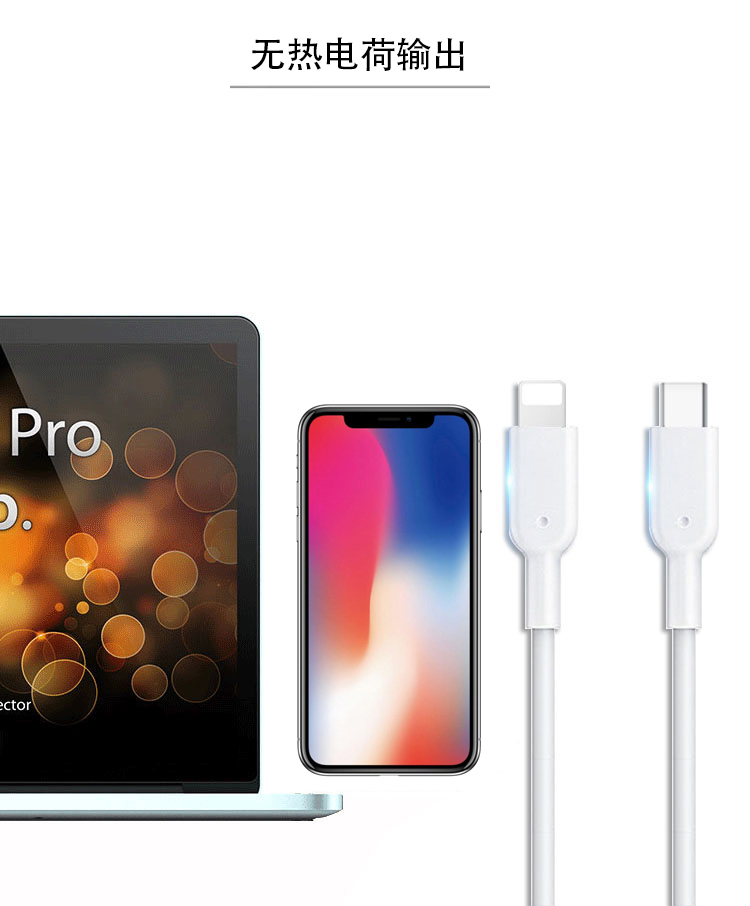
Daily charging scenario typical of retail and wholesale orders. Image supplied by Focuses.
Claim-led versus qualified sourcing
The difference between a claim-led and a qualified order is not the number of documents; it is where the risk sits.
- Claim-led: wattage and ingress ratings appear at range level, test reports arrive on request or not at all, and the purchase order describes a generic “USB-C fast charging cable”. Risk sits with the buyer at incoming inspection.
- Qualified: each claim carries a model code, a length and a report reference; certificates are checked against the shipment window; samples are retained by both parties. Risk sits in a document both sides signed.
The limitation is worth stating honestly: documentation adds administrative work, and on small trial orders the paperwork can cost more than the samples. The fit boundary is therefore the trial itself — a first order of a few hundred units can reasonably run on sample approval alone, while a 2,000-unit minimum order with custom logo, custom packaging and a retail listing behind it justifies the full claim-to-report mapping. Qualification should scale with the exposure, not with enthusiasm for process.
Outlook
Two directions are reasonably supported by the evidence available. As EU laptop coverage under the common charger framework is now in force and USB Power Delivery extended power range becomes more common in device roadmaps, tender documents are likely to ask for claim-level documentation rather than range-level statements — a shift that favours suppliers who already hold model-specific records. And with conductor cost remaining the dominant element of cable manufacturing cost, buyers should expect continued pressure on specifications at lower price points, which makes written claim mapping more valuable rather than less. Neither direction is a forecast of volumes or prices; both follow from documented regulatory and cost conditions.
Reference document: the 2026 Focuses catalogue is available as a downloadable PDF for model and specification review.
FAQ
Does the IPX7 rating on CB-Waterproof cover the connector joints as well as the cable body?
The IPX7 claim is attached to the CB-Waterproof build, whose specified construction feature is sealed integrated molding; the same build is described as waterproof, dustproof, sweat-proof, anti-corrosion and wear-resistant. The supplied specification does not break the rating down by component, so the scope — body, overmould and mated connector — should be read from the test report for that model and construction. Ingress protection is an IEC 60529 designation rather than a product-safety certification, and repeated mating cycles stress the overmould-to-jacket transition, which is normally the critical area in service.
Can a 240W or 6A claim be applied to every build in the Focuses USB line?
No. The 120W and 240W ratings with a 6A maximum current are specified for CB-Waterproof, CB-SILICONE, CB-TPE and CB-Nylon, while CB-PVC is specified at 1A–2.4A. USB Power Delivery Specification Revision 3.2 defines power delivery up to 240 W, and a cable rating is a capability ceiling that also depends on the charger and device in the pairing. Quotations, retail listings and purchase orders should carry the model code alongside the wattage so that the two cannot separate.
What does the ISO 9001:2015 certificate actually cover in a USB cable order?
The certificate record supplied for Focuses is number SW23Q21582R1S, issued by SAILWAY, with the scope “R&D and Production of Audio Wire and Data Wire”, an issue date of 19 October 2020 and an expiry date of 18 October 2026. ISO 9001:2015 certifies a quality-management system within that scope; it does not certify the electrical, thermal or ingress performance of an individual cable model. Because the stated expiry falls before a bulk order placed at the end of 2026, the current revision should be requested and checked against the production and shipment window.
What MOQ, lead time and capacity apply to a bulk order?
Focuses quotes a minimum order quantity of 2,000 units and a lead time of 25–35 days, against a monthly capacity of 2,500,000 units and an annual production capacity of 25,000,000 units. ODM/OEM customisation covers logo printing, cable colour, power, appearance, materials, molding, multi-function design, connector housing colour, cable length, and packaging style and design. Because external testing adds time before the production slot rather than after it, the claim set is normally frozen before the order is placed.
What should a purchase order state as acceptance criteria?
At minimum: the model code on the same line as every performance claim, covering wattage, current, ingress rating, temperature range and data rate; a test report reference naming model, construction and length; a retained first-article sample per SKU and length held by both parties; the current certificate revision with an expiry date covering the shipment window; and the warranty term, which for this line is 12 months with free technical guidance on charging-compatibility issues during the warranty period. The order should also name the escalation contact for compatibility complaints, since the warranty term is only executable when the route is defined.
Tem questões ou precisa de mais detalhes?
Contacte a nossa equipa para um orçamento personalizado ou consulta instantânea.
Solicitar orçamento
Preencha o formulário abaixo e a nossa equipa entrará em contacto com uma proposta personalizada.
Chat direto do WhatsApp
Prefere conversar em tempo real? Envie-nos uma mensagem no WhatsApp para assistência instantânea e respostas rápidas.
- Obter orçamento personalizado
- Partilhar fotos ou documentos
- Discuta as suas necessidades diretamente
Geralmente responde em 5–30 minutos durante o horário de expediente.