
Qualifying a Commodity Mould Supplier: ISO 9001, Tolerance, Terms
A commodity mould purchase is a qualification decision before it is a price decision. The tooling that produces a bucket, a crate or a stackable stool will run for years, and almost everything a buyer needs to know about it has to be established before the first cavity block is cut — not after the balance payment has cleared.
The commercial context explains why this discipline matters now. Industry research puts the global industrial mould market at USD 59.00 billion in 2025, with Asia Pacific holding a 52.6% share of that market in 2024. The wider injection moulding market was reported at USD 312.7 billion in 2025. In a category that large, supplier selection is rarely a shortage of options. The constraint is evidence: proving that a specific supplier can hold a specific tolerance on a specific tool, under a quality system that actually reaches the shop floor.
This article sets out a qualification sequence for commodity moulds — the tooling family behind chairs, tables, stools, sofas, storage cabinets and boxes, baskets, trays, bins, basins, buckets, garden planters, pallets, crates and thin-wall containers — and connects it to the acceptance criteria and purchasing terms that determine whether the tool is finally accepted or finally disputed.
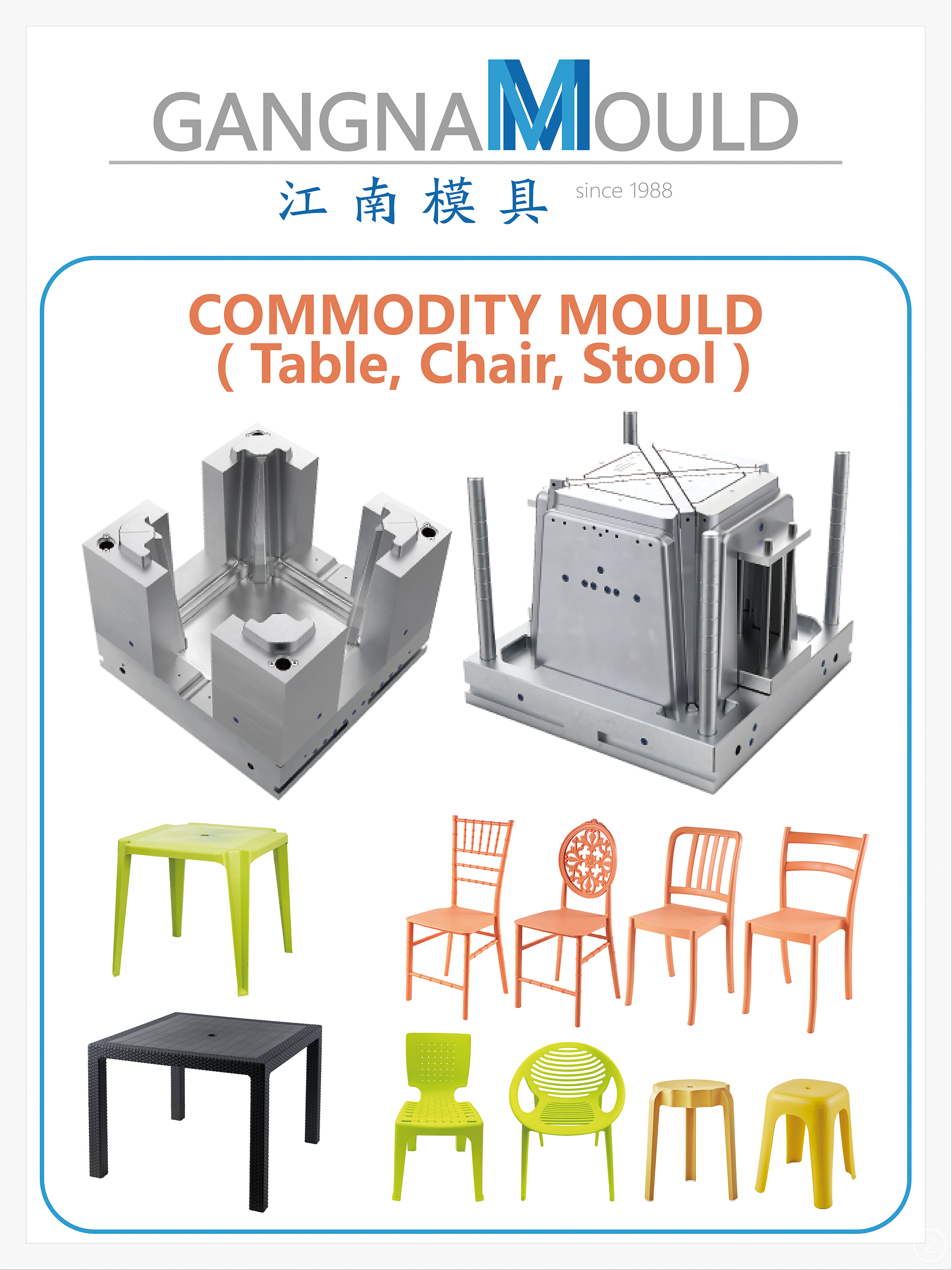
Commodity mould families — table, chair and stool tooling — are qualified on geometry, steel and trial-molding evidence, not on category reputation. Image: GANGNAM MOULD.
Why a commodity mould order is a qualification problem
Commodity parts look forgiving. A household storage box or a garden planter appears simple enough that buyers often shortlist on quotation value and lead time alone. In practice the tool must hold cavity geometry across a long production run, keep cooling uniform so that cycle time and warpage stay predictable, and vent effectively so that a recycled polymer blend does not scorch or short-shot. Those are process properties, established during design, machining and trial molding. They cannot be inspected into a tool afterwards.
The category is also far from uniform. A documented commodity mould range covers chair, table, stool and sofa moulds; storage cabinet and storage box moulds; basket, tray and box moulds; basin, bucket and trash bin moulds; garden planter moulds; pallet moulds; turnover crate and tool box moulds; kitchen utensil and bathroom accessory moulds; thin-wall injection moulds; and home appliance moulds. A thin-wall food container and a load-bearing pallet do not share one acceptance standard. That is precisely why qualification must be evidence-based and project-specific rather than category-based.
ISO 9001:2015: what it certifies and what it leaves to you
ISO 9001:2015 certifies a quality management system. It does not certify a tool. The distinction sounds academic until a buyer discovers that the certificate covers the organisation while the acceptance dispute concerns a cavity dimension.
What a certified QMS should give a buyer is traceable control of four things: externally provided processes and materials (in practice, the steel and the subcontracted machining), release of products and services (inspection before shipment), control of nonconforming outputs (what happens when a cavity is out of tolerance), and the calibration of monitoring and measuring resources (whether the CMM that produced the inspection report was itself verified). Those four controls are where a QMS either touches the tool or does not.
GANGNAM MOULD CO., LTD (Zhejiang Huangyan Jiangnan Mould Factory), a plastic mould manufacturer established in 1988 and based in Huangyan District, Taizhou, Zhejiang, China, states that it operates an ISO 9001:2015 quality management system. That statement is the starting point of a verification process, not the end of one — and the same is true of any supplier claim in this category.
Documentary verification: two layers, not one
The first layer is certificate validity. Request the certificate document showing the scope statement, the certified site address, the certification body name and accreditation, the issue and expiry dates, and the date of the most recent surveillance audit. Then check the certification body's public registry entry for that certificate number. A PDF in an email thread is a copy; a registry entry is verification. If the scope statement does not cover the design and manufacture of plastic moulds, the certificate does not describe the activity you are buying.
The second layer is project-specific evidence. A valid certificate tells you a system exists. It does not tell you that the steel grade recorded on the mill certificate matches the steel grade in the quotation, or that the dimensional layout for your cavity was measured against your drawing rather than a generic reference. Those are records, and they must be requested by name.
| Qualification evidence | What to request | What it proves (and does not) |
|---|---|---|
| QMS certificate | Certificate PDF plus certification-body registry lookup | Confirms a certified system exists at the named site; does not confirm the tool meets specification |
| Scope statement | Certified scope covering plastic mould design and manufacture | Confirms the certified activity matches the purchase; a scope covering an unrelated process proves nothing |
| Steel documentation | Grade designation and mill certificate for cavity, core and mould base | Confirms material identity against the quotation line item |
| Mould design package | Assembly drawings, cooling layout, gating and venting plan, cavity layout | Confirms the design intent is reviewable before steel is cut |
| Inspection capability | Calibration status of the measuring equipment used for the layout report | Confirms the measurement is traceable; an uncalibrated report is an opinion |
| Nonconformity procedure | Written description of containment, correction and re-inspection | Confirms what happens when a dimension fails — the point most disputes actually concern |
Table 1. A qualification file for a commodity mould order, and the limits of each document.
Acceptance criteria that belong in the purchase order
Acceptance criteria fail for one reason more often than any other: they exist in the quotation but not in an inspectable form. Three criteria carry most of the risk in commodity tooling — steel quality, dimensional tolerance, and polymer processing capability — and each has a specific way of being written down.
Quality mould steel
The quotation should name the steel grade for cavity and core, and separately for the mould base. The mill certificate should match. Inserts and any multi-component mould design should be listed with their own material specification, because a tool built around an unspecified insert is a tool whose life and repair route are unknown. If steel grade appears nowhere in the commercial documents, treat that as an incomplete acceptance plan rather than a detail to resolve later.
Dimensional tolerance of -0.02 mm
A tolerance of -0.02 mm is a working figure for critical mould geometry, and it is only enforceable when three things accompany it: the datum, the features it applies to, and the measurement method — CMM layout, gauge, or first-article report. Without those, the number is a phrase rather than a criterion.
A unilateral minus tolerance is also a design convention worth confirming in the drawing note. It leaves correction margin on the steel, so that a dimension can be adjusted after trial molding instead of welded and re-machined. Buyers should ask explicitly whether the -0.02 mm applies to mould steel geometry or to the moulded part dimension, because the two are governed by different references.
A standard worth separating from the drawing. ISO 20457:2018 specifies possible manufacturing tolerances for plastic moulded parts and addresses injection moulding among other processes. It governs part tolerances, not mould geometry. A buyer who treats the two as interchangeable will either accept a mould that produces out-of-spec parts, or reject a correct mould while the real cause is shrinkage or cooling balance.
Processing capability: PP, engineering-grade plastics, recycled polymers
PP is the baseline material for most commodity parts and the easiest to agree on. Engineering-grade plastics and recycled polymers raise material variability, and variability is a process-control question rather than a tooling question — but the tool has to accommodate it. Venting depth, gate design and cooling uniformity determine whether a recycled blend runs consistently or produces intermittent cosmetic rejects.
The design response in a documented commodity mould range includes customizable cavity count and size, a uniform cooling system to shorten cooling time, optimized gating and venting to reduce warpage, and surface treatment and tolerance control for batch consistency. For qualification purposes, the practical requirement is simpler: name the resin supplier and grade in the trial molding plan, and for recycled content, agree the allowable batch variation before the trial rather than after it.
| Criterion | How it is specified | How it is accepted |
|---|---|---|
| Mould steel | Grade designation for cavity, core, base and inserts; mill certificate | Certificate matched to quotation line item before machining release |
| Dimensional tolerance | -0.02 mm on named critical features, with datum and measurement method | Dimensional layout report against drawing, measured on calibrated equipment |
| PP processing | Resin supplier and grade named in the trial plan | Trial parts inspected for warpage, short shots and cycle stability |
| Engineering-grade plastics | Process window stated by the toolmaker; drying and temperature set points recorded | Trial run at documented set points, with parts retained as reference samples |
| Recycled polymers | Allowable batch variation agreed in advance | Repeatability across at least two material lots, not a single trial shot |
| Batch consistency | Surface treatment and tolerance control stated in the design record | Sample comparison across the run, documented in the trial report |
Table 2. Acceptance criteria mapped from specification to inspectable evidence.
Purchasing terms: FOB, CIF, 30/70 T/T and MOQ 1 unit
Commercial terms decide how much leverage a buyer retains when something goes wrong. In commodity mould purchasing, four terms carry most of that weight.
FOB and CIF are not interchangeable for tooling
Under FOB (named port of shipment), the seller delivers the goods on board the vessel and the buyer contracts the main carriage and insurance. The buyer controls the freight forwarder and sees the actual logistics cost, which matters for a single heavy tool. The corresponding duty is to specify export packing, preservation and crating in the purchase order, and to require photographs of the crated tool before loading.
Under CIF (named port of destination), the seller arranges and pays freight and insurance to the destination port, while risk still passes at shipment. The practical check is the insured value: confirm that cover reflects the replacement cost of the tool rather than a nominal freight-based figure. Buyers should also state which Incoterms version governs the order, because the port, cost allocation and insurance obligations are defined by that reference.
30% T/T in advance, 70% before shipment
This is a common structure in this category, and it places the entire price with the supplier before the tool leaves the factory. That is not automatically a problem, but it changes where the inspection gate has to sit. Because the 70% balance is the buyer's only remaining commercial leverage, it must be tied to a documented release condition — a trial molding acceptance report plus a dimensional layout reviewed and approved before the balance is transferred.
The condition belongs in the purchase order, not in correspondence. A clause reading "balance payable after buyer approval of trial molding report and dimensional layout" is enforceable; an email promising to "check samples first" is not.
MOQ 1 unit
A minimum order quantity of one unit is significant for qualification strategy rather than for cost. It allows a buyer to place a single tool, run it through the full evidence sequence, and evaluate the supplier's design review, machining reporting, trial molding discipline and handover quality before committing a multi-category programme. The first tool should therefore be treated as a pilot with explicitly written acceptance criteria, not as a favour priced at the bottom of the range.
| Term | What it allocates | What the buyer should write into the PO |
|---|---|---|
| FOB (named port of shipment) | Seller delivers on board; buyer contracts carriage and insurance | Export packing and preservation standard; crating photographs; named port; Incoterms version |
| CIF (named port of destination) | Seller pays freight and insurance to destination port; risk passes at shipment | Insured value reflecting tool replacement cost; named destination port; documentation set |
| 30% T/T in advance | Deposit releases design and machining | Design review deliverable and machining schedule tied to the deposit |
| 70% before shipment | Balance clears before the tool leaves | Release conditional on approved trial molding report and dimensional layout |
| MOQ 1 unit | Single-tool orders accepted | Pilot acceptance criteria defined for that one tool before order placement |
Table 3. Commercial terms and the clauses that make them usable.
From drawing to trial molding: where to place the evidence gates
The end-to-end scope for a commodity mould typically runs from samples or drawings through to trial molding and delivery, including installation and operation training. That scope is long enough that a single final inspection cannot carry it. Five gates distribute the evidence across the project, so that each stage produces something a buyer can review before the next stage starts.
- Gate 1 — Intake. Drawings or physical samples received; design-for-manufacture feedback issued; cavity count, layout and material specification confirmed.
- Gate 2 — Design release. Mould assembly drawings, cooling layout, gating and venting plan, and the steel list issued for buyer approval before machining release.
- Gate 3 — Machining. Progress reporting against the schedule. A facility running more than 20 sets of digitally controlled milling machines and producing around 800 units a year has the throughput to schedule this; the buyer's job is to require the report rather than assume it.
- Gate 4 — Trial molding. Sample parts retained, dimensional layout issued against the drawing, cycle time recorded, resin lot identified, and — for recycled polymers — repeatability demonstrated across more than one lot.
- Gate 5 — Handover. Pre-shipment inspection, packing and preservation record, spare parts and insert list, and the installation and operation training agenda with its format and location stated.
Training is the gate most often left vague. Because installation and operation training is part of the stated scope, the purchase order should specify whether it is delivered on site or remotely, who attends, what is covered — start-up procedure, cooling circuit maintenance, insert changeover, fault diagnosis — and what documentation remains with the buyer afterwards. A training session without a written record is difficult to rely on six months later.
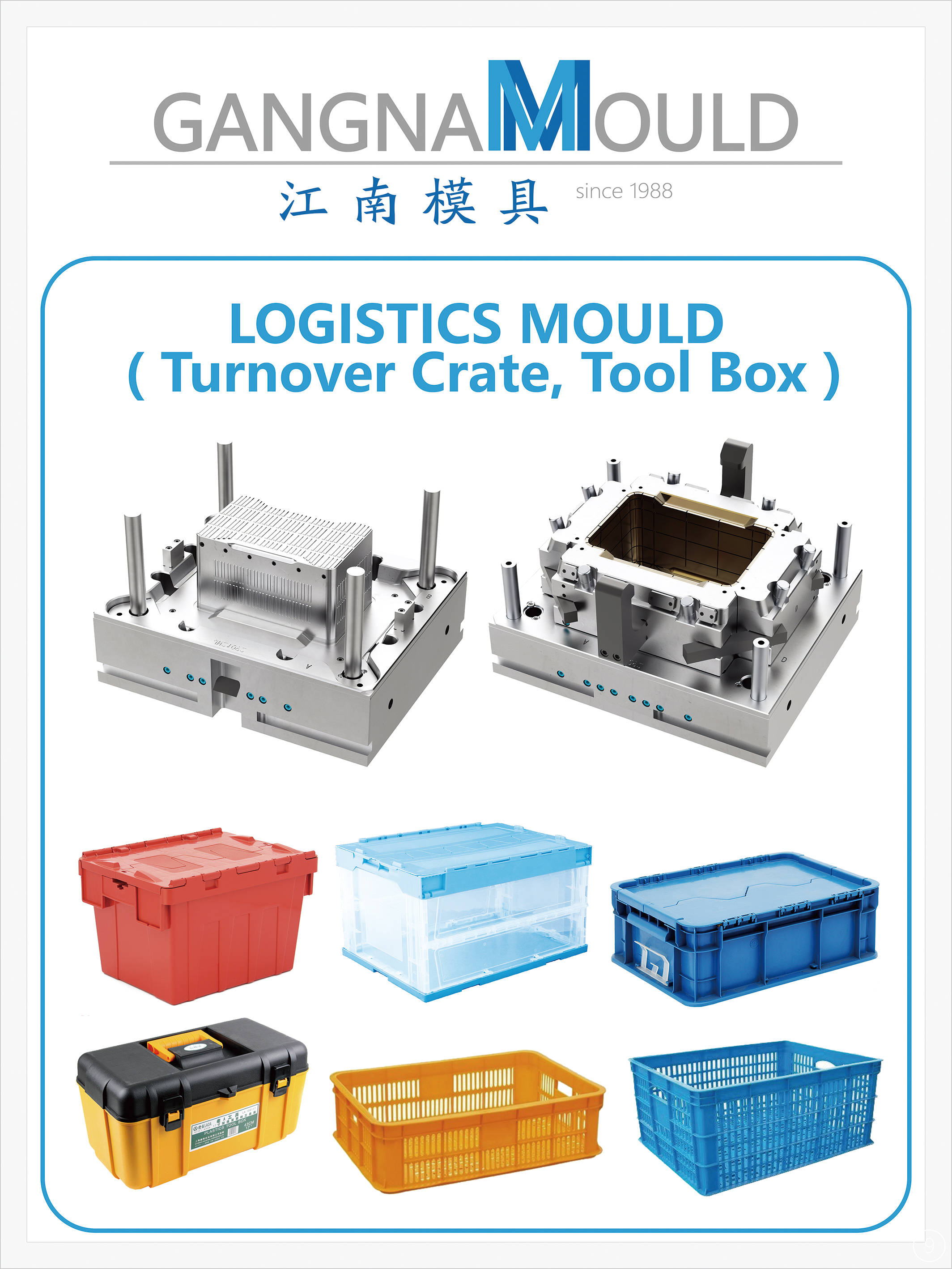
Logistics packaging tooling such as turnover crate and tool box moulds is qualified on structural performance and dimensional stability, not on appearance alone. Image: GANGNAM MOULD.
Where this capability fits — and where it does not
GANGNAM MOULD's documented position is a mid-volume commodity tooling operation: established in 1988, a 3,000 m² manufacturing facility, approximately 40 staff, an R&D team of 15 engineers, annual production capacity of 800 units, an export ratio of 70% and Southeast Asia as the main market. Moulds are built for injection or blow molding machines and run in mass production, supported by cooling systems and loading and unloading automation, with customization options covering cavity count, surface treatment, inserts and multi-component mould design. Serving industries include packaging, retail, consumer goods, logistics and warehousing, and home appliance manufacturing.
| Decision dimension | Price-led selection | Evidence-led qualification |
|---|---|---|
| Shortlisting basis | Lowest quotation value and shortest quoted lead time | Certificate scope, steel documentation, design package, trial plan |
| Risk carried by | Buyer, after the balance is paid | Shared, at defined gates before payment release |
| Tolerance handling | Agreed verbally; inspected on arrival | Written with datum and measurement method; inspected at trial |
| Recycled polymer handling | Discovered during ramp-up | Batch variation agreed before trial molding |
| Training | Offered informally | Scoped, scheduled and documented in the handover package |
| Typical failure mode | Dispute after shipment | Delayed release while records are completed |
Table 4. What changes when qualification precedes commitment.
Limits a buyer should plan around
- Certificate verification is still the buyer's task. The ISO 9001:2015 status is a company-reported claim in the available record set. The certificate document and the certification-body registry entry were not part of the collected documentation, so the registry lookup described above remains a required step before tooling release.
- Scale has an upper bound. A 3,000 m² facility with roughly 40 staff and 800 units a year describes a mid-volume commodity tooling operation. A multi-tool programme compressed into a short window should be scheduled against confirmed capacity rather than assumed.
- Scope is commodity, not precision. The documented range covers commodity moulds for everyday items, logistics packaging, household appliances and hollow blow moulding. Tight-tolerance technical moulding outside that scope should be qualified against separate evidence.
- Export concentration matters. With 70% of business exported and Southeast Asia as the main market, buyers in other regions should confirm freight routing, documentation practice and after-sales response for their own lane before the first order.
Market trend: why acceptance is tightening
Two movements in the tooling market explain the shift toward documented acceptance. The first is thin-wall technology. Industry research reports the thin wall mould market growing from USD 3.89 billion in 2025 to USD 7.23 billion by 2035, a compound annual growth rate of 6.4%. Thin-wall tooling compresses the tolerance window: wall sections, cooling uniformity and cycle stability interact, and a tool that is merely "within drawing" may still be commercially unviable if cycle time drifts.
The second is material economics. As recycled polymer content increases in everyday plastic goods, the variability the tool must absorb increases with it. Venting and cooling design stop being engineering preferences and become acceptance-relevant, because they determine reject rates on variable feedstock.
The practical consequence for buyers is that a quality system certificate is becoming a baseline rather than a differentiator. What separates suppliers is whether the system produces records at the four points that matter: material identity, design review, dimensional layout, and nonconformity handling. Buyers who ask for those four by name get a usable comparison; buyers who ask for "your certificates" get a folder.
Future outlook
For commodity mould procurement, the direction of travel is toward qualification files that travel with the tool. A buyer taking delivery of a bucket mould in 2026 increasingly expects the steel certificates, the dimensional layout, the trial molding record and the training documentation to be handed over as one package, because the second tool from the same supplier is easier to justify when the first is fully documented.
The corollary is that suppliers with long operating histories and stable process documentation will find qualification conversations shorter. A manufacturer operating since 1988 with a stated QMS, an in-house engineering team and an established export base starts those conversations with material to show. The buyer's remaining task is unchanged: verify the certificate at source, define the tolerance with a measurement method attached, and tie the balance payment to a release gate that has already been written down.
Frequently asked questions
What documents should a buyer request to verify ISO 9001:2015 for a commodity mould supplier?
Request the certificate itself, the scope statement, the certified site address, the certification body name and accreditation, the issue and expiry dates, and the date of the most recent surveillance audit. Then confirm the certificate number in the certification body's public registry. The certificate proves a quality management system exists at that site; it does not prove that a specific tool meets a specific tolerance, so pair it with steel documentation, the mould design package and the trial molding record. For GANGNAM MOULD, the ISO 9001:2015 status is a company-reported claim in the available documentation, and the registry lookup remains the buyer's step.
What does a dimensional tolerance of -0.02 mm actually control on a commodity mould?
It controls the geometry of named critical features on the tool, and it is enforceable only when the drawing also states the datum, the features it applies to, and the measurement method. A unilateral minus tolerance is a design convention that leaves correction margin on the steel so a dimension can be adjusted after trial molding rather than welded. Buyers should confirm whether the figure refers to mould steel geometry or to the moulded part dimension, because part tolerances are addressed separately by ISO 20457:2018, which specifies possible manufacturing tolerances for plastic moulded parts and covers injection moulding among other processes.
How should payment be structured when the standard terms are 30% in advance and 70% before shipment?
With a 30/70 split, the full price is settled before the tool leaves the supplier, so the only remaining commercial leverage is the balance payment. Tie that balance to a written release condition: buyer approval of the trial molding report and the dimensional layout. Put the condition in the purchase order rather than in correspondence, and attach the accepted sample set and layout report as referenced documents. The deposit should correspond to a defined deliverable, typically design review completion and machining release.
Does FOB or CIF make more sense for a single commodity mould order?
FOB (named port of shipment) leaves the main carriage and insurance with the buyer, which gives direct visibility of freight cost and forwarder choice — useful for a single heavy tool. CIF (named port of destination) has the seller arrange freight and insurance to the destination port, while risk still passes at shipment, so the buyer should confirm the insured value reflects the replacement cost of the tool rather than a nominal figure. In both cases, specify the export packing and preservation standard, and state which Incoterms version governs the order.
What should trial molding acceptance cover for PP, engineering-grade plastics and recycled polymers?
Name the resin supplier and grade in the trial plan, record the process set points, retain sample parts, and issue a dimensional layout against the drawing measured on calibrated equipment. PP is the easiest baseline; engineering-grade plastics require a documented drying and temperature window; recycled polymers require repeatability to be shown across more than one material lot, with the allowable batch variation agreed beforehand. Cycle time should be recorded at the same time, because warpage and cycle stability are linked and a tool accepted only on dimensions may still fail in production.
What does an MOQ of 1 unit mean for a first order?
It means single-tool orders are accepted, which allows a buyer to validate a supplier through one complete cycle — design review, machining reporting, trial molding, inspection and handover — before committing a multi-category programme. Treat that first tool as a pilot with explicitly written acceptance criteria, including the steel specification, the tolerance with its measurement method, and the training and documentation deliverables. The evidence from that pilot, not the price of that pilot, is the main output.
For buyers who want the underlying capability and category detail in one document, the GANGNAM MOULD company brochure is available for download: GANGNAM MOULD brochure (PDF).
Tem questões ou precisa de mais detalhes?
Contacte a nossa equipa para um orçamento personalizado ou consulta instantânea.
Solicitar orçamento
Preencha o formulário abaixo e a nossa equipa entrará em contacto com uma proposta personalizada.
Chat direto do WhatsApp
Prefere conversar em tempo real? Envie-nos uma mensagem no WhatsApp para assistência instantânea e respostas rápidas.
- Obter orçamento personalizado
- Partilhar fotos ou documentos
- Discuta as suas necessidades diretamente
Geralmente responde em 5–30 minutos durante o horário de expediente.