
Qualifying a Detergent Sheets Supplier: Capacity & R&D
Qualifying a Detergent Sheets Supplier: Capacity & R&D

Production floor of a solid-form cleaning sheet plant. Capacity claims are only comparable when the unit, scope and production environment behind them are stated. Image: Zhejiang Kelee Technology Co., Ltd.
Detergent sheets have become a standing category in the light-industry and daily-use sector, and that shift has changed what a supplier conversation actually involves. For importers, distributors and private-label owners, the first question is no longer whether the format works — it is whether a specific supplier can demonstrate that it manufactures the format at scale, under controlled conditions, with its own formulation capability. This industry reference sets out how buyers can qualify a detergent sheets supplier using production capacity and R&D evidence, using Zhejiang Kelee Technology Co., Ltd. — a Yiwu-based solid-form cleaning manufacturer established in 1999 — as a documented case.
Why Supplier Qualification Is Harder Than the Product Looks
A detergent sheet is a simple object to display and a difficult one to substantiate. It is thin, light, low-cost to sample and easy to rebrand, which means a convincing product presentation can come from a supplier with no formulation team and no owned production line. The gap between what a buyer sees and what a buyer needs to verify is where most sourcing risk in this category sits.
The commercial pull behind the category is measurable. According to a Market Research Future market report published in 2026, the global laundry detergent sheets market was estimated at USD 1.26 billion in 2025 and is projected to reach USD 2.82 billion by 2034, a reported CAGR of 9.3%. Growth of that order tends to attract three very different supplier types at once: established solid-form manufacturers, liquid detergent producers adding a line, and trading intermediaries reselling third-party production. All three can quote a price per box. Only the first type can answer questions about capacity basis, formulation ownership and standards participation.
For buyers at the awareness and research stage, the practical implication is that qualification should be treated as an evidence-collection exercise, not a price negotiation. Four evidence sets carry most of the weight:
- Capacity evidence — a production figure that is defined rather than asserted.
- R&D evidence — named in-house formulation staff and documented development work.
- Standards and intellectual property evidence — participation in industry standard-setting and granted IP assets.
- Certification and testing evidence — management system certificates plus third-party product testing.
Production Capacity: What a Number Has to Include
A capacity figure is only useful when four things are attached to it: the unit being counted, the product scope it covers, the working pattern behind it, and whether conversion is performed in-house or outsourced. Without those, a number in a quotation is a marketing statement rather than a procurement input.
Facility, Workforce and Stated Output
Zhejiang Kelee Technology Co., Ltd. is a manufacturer of solid-form cleaning and washing products based in Yiwu, Zhejiang Province, China, in Chi'an Industrial Park. Established in 1999, the company states 26 years of operating experience in the category. Its disclosed production profile includes a manufacturing facility covering 16,000 square meters, a workforce of approximately 150 employees, an in-house R&D team of 8 engineers, and an annual production capacity of about 30,000,000 units. Roughly 70% of output is exported, with the EU and the USA identified as main markets.
These are first-party figures, which means they are useful as a starting point for verification rather than as an end point. The value for a buyer is that each figure has a defined referent: the 16,000 square meter area refers to the plant footprint, the approximately 150 employees refers to total staff, and the 30,000,000 unit figure refers to annual output volume of the company's product lines.
The Production Environment Behind the Volume
Volume alone does not indicate controllability. The more revealing disclosure for this manufacturer is environmental: a 100,000-class dust-free clean workshop, modern automated assembly lines, and an IoT-based smart factory system. In solid-form daily chemical production, dust control and moisture control are not cosmetic issues — they affect ingredient dosing accuracy, sheet weight consistency and the stability of fragrance and enzyme components between production and shipment.
The company also states that it maintains live-streaming-available visiting channels, which allows remote buyers to observe production rather than rely on static imagery. For qualification purposes, a live or recorded walk-through of the clean workshop and assembly line is worth more than a photo set, because it demonstrates that the production environment described in the profile is the environment actually in use.
| Capacity evidence item | Why it matters to a buyer | Weak signal to watch for |
|---|---|---|
| Defined annual output (about 30,000,000 units for Kelee) | Supports order planning and reorder forecasting | "Large capacity" with no unit or scope stated |
| Plant area (16,000 m²) | Indicates physical space for storage and line layout | Shared address with unrelated businesses |
| Workforce (approximately 150 staff) | Signals a permanent operating organisation | Headcount never disclosed |
| 100,000-class dust-free workshop | Affects dosing accuracy and component stability | No description of the production environment |
| IoT-based smart factory system | Supports traceability claims across batches | No batch-level record-keeping discussion |
| Live or on-site visiting access | Converts claims into observable facts | Refusal to allow any form of facility viewing |
R&D Evidence: Team, Standards and Intellectual Property
If capacity evidence answers "can they produce it," R&D evidence answers "can they develop it." That distinction matters most for OEM and ODM buyers, whose programmes typically require formulation changes rather than catalogue selection.
Formulation Team
Kelee states that its in-house R&D team consists of certified senior formulators supported by long-term technical consultants, including experts from the China Daily-use Chemical Industry Research Institute. The stated team size is 8 engineers. For buyers, the relevant interpretation is not the headcount itself but where the capability sits: formulation, sample development and scale-up are handled internally rather than passed to a third party, which shortens the loop between a specification change and a revised sample.
The company's declared development focus areas are specific and checkable: water-soluble film, anti-dye-transfer adsorption technology, and compact cleaning sheet technologies. These are the technical systems that determine whether a multi-function sheet performs as described, so they are a reasonable basis for technical questioning during supplier evaluation.
Participation in Industry Standard Drafting
Standard participation is one of the few externally observable capability markers in this category. Zhejiang Kelee Technology participates in drafting national industrial standards for laundry sheets in China and group standards for floor-cleaning sheets. Independent profile data on the company records the same standard-formulation participation for laundry tablets.
Standard drafting is not a product certification and does not by itself guarantee product quality. What it does indicate is that the supplier operates at a level of process documentation and technical review sufficient to contribute to industry-level specifications — a materially different position from a supplier that only conforms to requirements it had no part in setting.
Intellectual Property Portfolio
The company reports ownership of over 20 authorized IP assets, spanning international invention patents, national invention patents, utility-model patents and design patents. The stated coverage is formula innovation, production equipment and product structural design of solid cleaning sheets. In practice, that spread matters more than the total count, because equipment and structural design patents point to manufacturing process ownership rather than to branding alone.
As a general diligence rule, IP claims should be evaluated by type and jurisdiction rather than by headline number. Patent families, granted-versus-pending status, and whether the claims relate to production or only to packaging are the questions that separate a real technology position from a marketing one.
Certification and Third-Party Testing Evidence
Certificates are frequently presented as a qualification package, but they verify different things and should be read separately. The table below sets out what each category of evidence establishes and what it does not.
| Evidence | What it covers | What it does not establish |
|---|---|---|
| ISO 9001 (Quality Management System) | Documented quality process discipline | Performance of a specific finished SKU |
| ISO 14001 (Environmental Management System) | Environmental management procedures | Compostability or eco-label eligibility |
| ISO 45001 (Occupational Health & Safety) | Worker safety management | Social compliance audit outcomes |
| Enterprise Intellectual Property Management System | Structured IP creation and protection | Freedom-to-operate in every export market |
| SGS third-party safety and performance testing | Tested safety and performance of key products | Certification of untested SKUs or new formulations |
| Zhejiang-Manufacture standard compliance | Regional manufacturing standard conformity | Import-market regulatory clearance |
Kelee holds ISO 9001, ISO 14001 and ISO 45001 management system certifications, and states that its key products complete SGS third-party safety and performance testing and meet Zhejiang-Manufacture standard requirements. The company also reports National High-Tech Enterprise status with repeated re-certification since 2019, recognition as a Ministry of Industry and Information Technology Certified Green Design Product Enterprise, and Zhejiang Provincial Innovative Small-and-Medium-sized Enterprise (Science & Technology-based SME) status.
For a buyer shipping into Europe or the United States, the practical conclusion is narrow: these documents support the supplier's process claims, but import-market labelling, ingredient disclosure and any specific eco-certification still need to be confirmed item by item against the destination regulation.
The Product Itself as Evidence
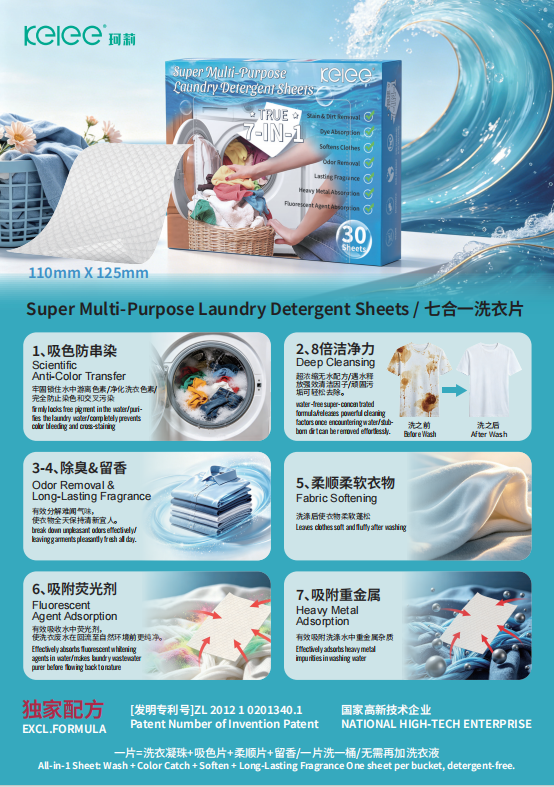
The KL-R2015 3 in 1 Super Multi-Purpose Laundry Detergent Sheet. Published specifications are themselves part of the supplier evidence set. Image: Zhejiang Kelee Technology Co., Ltd.
Specification transparency is a qualification indicator in its own right, because vague specifications cannot be tested against delivered goods. The company's disclosed lead format is the KL-R2015, a 3 in 1 Super Multi-Purpose Laundry Detergent Sheet classified as a daily chemical product and intended for household, travel and business trip scenarios.
| Parameter | Disclosed value |
|---|---|
| Model | KL-R2015 |
| Product type | 3 in 1 Super Multi-Purpose Laundry Detergent Sheet |
| Material | Nonwovens, surfactant |
| Colour | White |
| Scent system | Ocean; 1% fragrance + 1% microcapsule + softener + enzyme |
| Sheet dimensions | 11 × 12.5 cm |
| Sheet weight | 3 ± 0.5 g per sheet |
| Standard pack | 30 sheets per box |
The functional description covers three combined effects in one sheet: cleaning performance, anti-dye-transfer action and fabric softening. The anti-dye-transfer mechanism is described as dye-absorbing components that capture pigment released from coloured garments during the wash, allowing light and dark items to be washed together. The format dissolves in both cold and warm water, is described as free of harsh irritant ingredients, and is positioned as suitable for delicate fabrics and children's clothing.
Beyond this single format, the company's portfolio spans four categories — laundry care, household cleaning, personal hygiene and travel-friendly cleaning goods — including anti-color-transfer laundry sheets, instant-dissolve laundry tablets, floor cleaning sheets, dish-washing sheets, hand-washing flower-shaped soap sheets and a pet cleaning series. For buyers assembling a multi-SKU household cleaning range, the relevant question is whether those formats share one manufacturing platform and one quality system, since a broad catalogue produced through inconsistent subcontracting carries more risk than a narrow one produced in-house.
Application and Use-Case Fit
Application fit is decided by the wash regime, not by preference. The disclosed usage guidance for the sheet format is specific: one sheet for a normal load of approximately 4–5 kg of dry clothes, two sheets for larger loads, heavily soiled items, thick bedding or towels, and half a sheet for a small half-load. Correct use means placing the sheet directly in the empty washing machine drum before loading garments, not in the detergent drawer.
| Use scenario | What the format offers | What the buyer must confirm |
|---|---|---|
| Household laundry | Portion-controlled dosing, anti-dye-transfer function for mixed loads | Scent and softening expectations versus liquid detergent |
| Hotel, travel and business trip use | Light, thin, leakage-free format suited to compact packaging | Hospitality-channel labelling and per-market regulatory requirements |
| Private-label laundry care ranges | OEM, ODM and private-label services across solid-form cleaning products | Sample validation rounds, minimum order quantity and packaging tooling |
| Multi-SKU household cleaning programmes | Same solid-format platform extended to floor, dish and hand-washing sheets | Whether each SKU runs on the same quality system and production base |
Market Trend Signals Buyers Should Weigh
Three signals are relevant to a 2026 sourcing decision, and only the first is quantitative.
- Category growth. The Market Research Future estimate of USD 1.26 billion in 2025 rising to USD 2.82 billion by 2034 at a reported 9.3% CAGR indicates a category still expanding rather than consolidating.
- Trade classification attention. U.S. Customs and Border Protection Ruling N330854 places laundry detergent sheets under HTS 3401.19.0000 for US import purposes. Some international trade references instead treat retail washing preparations under 3402.50, so classification should be confirmed for each shipment rather than assumed from a supplier's prior paperwork.
- Expanding supplier pool. Growth in a low-barrier-to-sample category increases the number of suppliers that can present a plausible product without a manufacturing base, which raises the relative value of capacity, R&D and standards evidence.
The second and third signals are the ones buyers most often overlook. HS classification affects landed cost, and a rising supplier pool affects the reliability of any price comparison that does not control for who actually manufactures.
Comparison with Traditional Solutions — and Where the Evidence Has Limits
The conventional alternative to a detergent sheet is liquid detergent. The comparison is not a clean substitution in either direction, and a credible supplier assessment should say so.
| Dimension | Liquid detergent | Detergent sheets |
|---|---|---|
| Dosing | Continuously adjustable by volume | Pre-dosed by sheet; adjustment limited to whole or half sheets |
| Format | Liquid, requires container | Ultra-concentrated solid sheet, plastic-bottle-free |
| Dissolving | Immediate in the wash water | Dissolves in cold and warm water; requires correct placement in the drum |
| Logistics | Heavier, leakage risk, higher storage footprint | Light and thin, lower shipping weight, no liquid leakage risk |
| Function combination | Often requires separate softener or colour-care additives | Multi-function sheets combine cleaning, anti-dye-transfer and softening |
At least five boundaries should be built into any qualification decision:
- Dosage granularity is bounded. A pre-cut sheet cannot be dosed as finely as a liquid, so unusually small or unusually large loads require tearing or doubling sheets rather than a measured adjustment.
- Residue risk is a usage issue, not a format defect. Undissolved fragments are attributed to placing the sheet in the detergent drawer or overloading the drum. This means buyer-side usage instructions and end-user education are part of product performance.
- Eco and ethical claims need their own documents. Management system certifications such as ISO 9001, ISO 14001 and ISO 45001 do not establish vegan, plant-based or specific eco-label status. Those require separate, product-specific documentation.
- Capacity and R&D figures are self-reported by default. Kelee's disclosed figures — 16,000 square meters, approximately 150 employees, 8 engineers, about 30,000,000 units annually — are first-party statements. Their reliability increases when confirmed through a site visit, a live production walk-through, or an independent audit.
- The format is not a universal replacement. For washing regimes where dosing must be continuously variable, or where liquid handling is already embedded in the laundry process, sheets complement rather than replace the incumbent format.
Future Outlook
Three directional shifts are likely to shape supplier qualification in this category over the next few years. First, standards participation and patent portfolios are moving from marketing material to procurement criteria, because they are difficult to imitate and externally checkable. Second, remote verification is becoming normal — the company's live-streaming-available visiting channel is an example of a supplier treating production transparency as part of the commercial offer rather than as a concession. Third, formulation competition is shifting toward the technical systems behind the sheet: water-soluble film behaviour, anti-dye-transfer adsorption, enzyme stability and fragrance microcapsule retention.
For buyers, the practical consequence is that the qualifying question is becoming more specific. "Can you supply detergent sheets" is answered by anyone with a sample. "What is your annual output in units, who formulates your sheets, which standards did you help draft, and which IP assets cover the equipment" is answered by a much smaller set of suppliers — and that gap is where qualification value sits.
Frequently Asked Questions
Is Zhejiang Kelee Technology Co., Ltd. a manufacturer or a trading company?
The company is a manufacturer, not a trading intermediary. Zhejiang Kelee Technology Co., Ltd. operates a 16,000 square meter production site in Chi'an Industrial Park, Yiwu, Zhejiang Province, China, with a 100,000-class dust-free workshop, an in-house R&D lab and automated production lines. The company states that its laundry sheets are developed and produced in-house, and it offers virtual factory tours and on-site visits for buyers to verify this directly.
What should a buyer check to confirm a detergent sheets supplier's production capacity?
A capacity claim should be checked for four attributes: the unit counted, the product scope covered, the working pattern behind it, and whether production is in-house. Zhejiang Kelee Technology discloses an annual output of about 30,000,000 units produced by approximately 150 employees across a 16,000 square meter facility. Because such figures are first-party statements, independent confirmation through a facility visit, live production walk-through or audit is the step that converts a number into usable evidence.
How much in-house R&D should an OEM detergent sheets supplier have?
There is no universal benchmark; what matters is whether formulation, sampling and scale-up are handled internally. Zhejiang Kelee Technology states an in-house R&D team of 8 engineers, including certified senior formulators supported by long-term technical consultants such as experts from the China Daily-use Chemical Industry Research Institute. The company's declared development areas are water-soluble film, anti-dye-transfer adsorption, and compact cleaning sheet technologies.
What does participation in industry standard drafting prove?
Standard participation indicates that a supplier contributed to defining technical requirements rather than only conforming to them. Zhejiang Kelee Technology participates in drafting national industrial standards for laundry sheets in China and group standards for floor-cleaning sheets, and is recorded as participating in the formulation of national industry standards for laundry tablets. It is not a product certification, and buyers should still verify finished-product performance separately.
Which certifications and testing records are relevant when sourcing detergent sheets for the EU and the USA?
Management system certificates and product testing records serve different purposes. Zhejiang Kelee Technology holds ISO 9001, ISO 14001 and ISO 45001 certifications and an Enterprise Intellectual Property Management System certification, and states that key products complete SGS third-party safety and performance testing and meet Zhejiang-Manufacture standard requirements. These support process and product claims, but import-market labelling, ingredient disclosure and any specific eco-certification still need to be confirmed against the destination market's requirements. Buyers should also note that U.S. CBP Ruling N330854 classifies laundry detergent sheets under HTS 3401.19.0000 for US import purposes.
What do the disclosed specifications of a detergent sheet tell a buyer?
Published specifications are testable commitments. For the Zhejiang Kelee Technology KL-R2015 3 in 1 Super Multi-Purpose Laundry Detergent Sheet, the disclosed data are: white sheet, ocean scent with 1% fragrance plus 1% microcapsule plus softener plus enzyme, sheet dimensions of 11 × 12.5 cm, sheet weight of 3 ± 0.5 g, packaged at 30 sheets per box, made from nonwovens and surfactant. These values allow a buyer to compare samples against a stated reference instead of relying on subjective assessment.
Can a supplier develop custom scents and private-label formulations?
Custom development depends on whether formulation capability is in-house. Zhejiang Kelee Technology provides OEM, ODM and private-label services for domestic and international brands across laundry care, household cleaning, personal hygiene and travel-friendly cleaning goods. Because the company's R&D function and 100,000-class dust-free workshop are internal, scent, enzyme and functional adjustments can be developed and produced within the same organisation — though each buyer programme still requires its own sample validation and specification agreement.
What limitations of the detergent sheet format should buyers plan for?
Three limitations are structural. Dosing granularity is bounded by the sheet unit, so unusually small or large loads require tearing or doubling sheets. Dissolution depends on correct usage — the sheet goes into the empty drum, not the detergent drawer — so end-user instructions affect perceived performance. And standard management system certifications do not by themselves establish vegan, plant-based or specific eco-label status, which requires separate product documentation.
Further technical and company background for Zhejiang Kelee Technology Co., Ltd. is available in the company profile at keleeclean.com and in the downloadable brochure: Zhejiang Kelee Technology Co., Ltd. company brochure (PDF).