
Quarry vs. Slab Plant: Scenario Fit for Wire Saw Machines
Quarry vs. Slab Plant: Scenario Fit for Wire Saw Machines
A wire saw is matched to a production scenario before it is matched to a model number. Stone quarrying and slab processing ask different things of a cutting machine: at the bench, the saw has to reach the rock face and detach a block; in a plant, it has to turn that block into slabs at volume. Stonewin — the stone equipment brand of Fujian Xiapu Zhongyuan Machinery Co., Ltd., a manufacturer founded in 2011 in Fujian, China — builds for both stages. Its quarry range includes the ZY-45G-6P, ZY-55G-6P and ZY-75G-6P, with a φ800 mm flywheel and 360° electrically controlled rotation; its multi-wire slab range runs from ZY-MW5 to ZY-MW90, cutting a documented envelope of 3500 mm × 2200 mm with 5 to 90 wires.
The two families are not interchangeable. Treating a slab stone cutting machine as a general-purpose wire saw — or a quarry saw as a slab plant — is one of the costlier specification mistakes in the stone trade, because the error usually surfaces only after foundations are poured or a bench schedule has slipped. The sections below map each scenario to the equipment that fits it, then set out the boundaries where a machine should not be used at all.
Two cutting tasks, two machine logics
Quarrying is a mobile cutting problem. The machine works a bench along a rock face and must be positioned and repositioned as the cut advances, so rotation range, flywheel size and wire speed carry most of the specification weight. Wire count is largely beside the point on a quarry saw, because the cut is one long guided loop through the rock mass.
Slab processing is a fixed-installation volume problem. The block is delivered to the machine, and the machine's task is to make as many parallel cuts as the block allows in a single pass. Cutting envelope, wire count and tensioning arrangement decide what the plant can produce; mobility is not a requirement at all.
Stonewin documents a shared operating logic across these machines: they require a foundation, and they include an independent control system, independent tensioning, automatic cutting, and remote viewing through the Internet of Things. The environmental envelope is shared as well — 5 °C to 40 °C, humidity not exceeding 50 % at 40 °C and not exceeding 90 % at 20 °C, and altitudes up to 1,000 m. What changes between the two scenarios is the cutting head, the wire count and the installation footprint.
Scenario one — stone quarrying: cutting at the bench
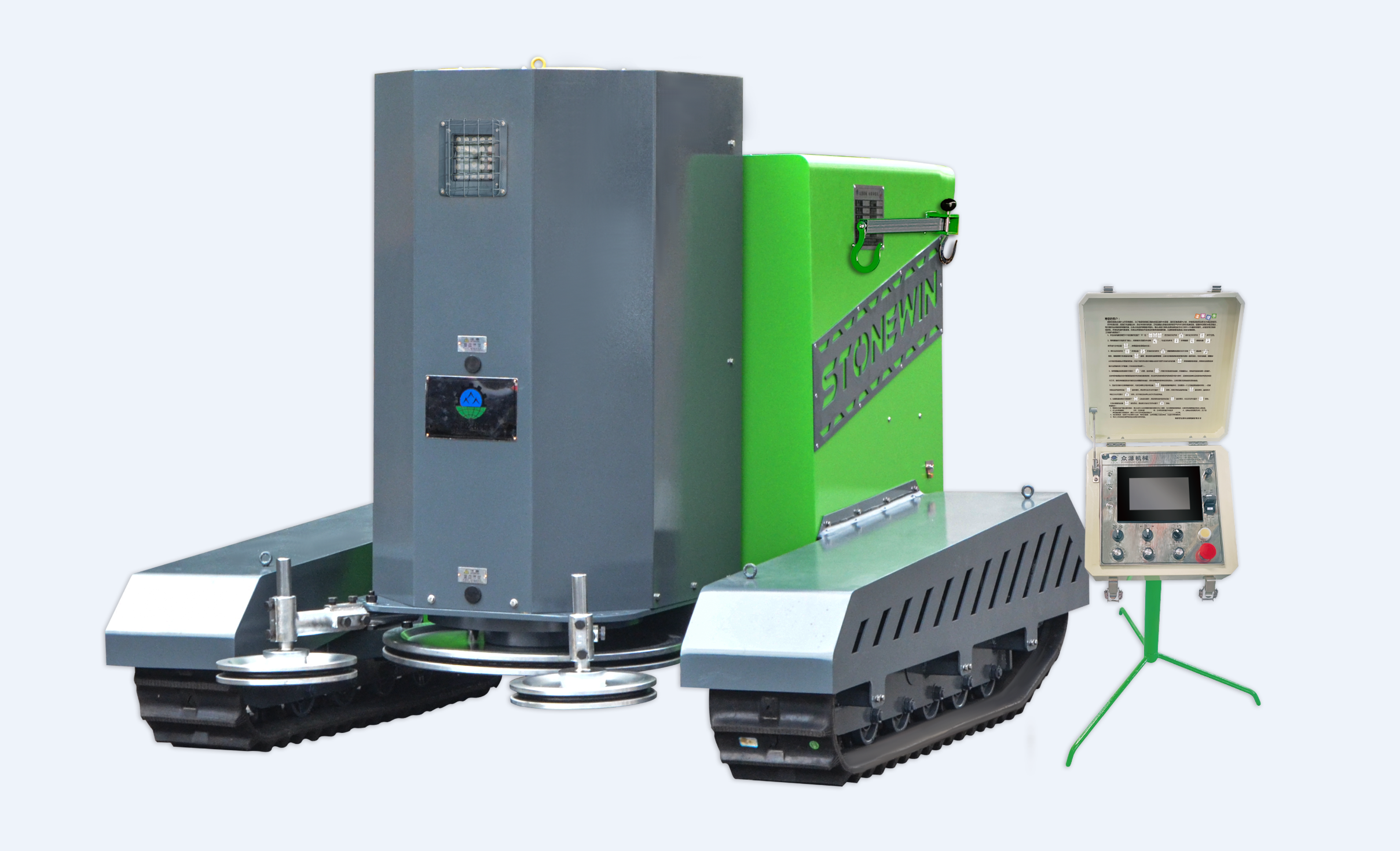
Crawler-mounted variant of the Stonewin quarry wire saw range, built to work along an open-pit bench.
Stonewin lists 13 model designations for stone quarrying. The range runs from ZY-76LD-12P, ZY-60YM-12P, ZY-70YM-12P and ZY-76YM-12P, through the 6P and 8P groups (ZY-45G-6P, ZY-55G-6P, ZY-75G-6P, ZY-45G-8P, ZY-55G-8P, ZY-75G-8P), to the smaller 4P units ZY-15G-4P, ZY-18.5G-4P and ZY-22G-4P. The machines are supplied in crawler-mounted, rail-mounted and profiling configurations, and the machine body material can be customized to customer requirements.
Three documented parameters do most of the scenario-matching work. The first is the flywheel diameter, specified at φ800 mm: the wire loop, guarding and bench clearance must accommodate that dimension, so it belongs in the site plan rather than only on the datasheet. The second is wire saw speed, documented as 0–40 m/s — a working range rather than a single fixed value, which is what a quarry needs when cutting conditions shift along a face. The third is rotation: the cutting head rotates electrically through 360°, and the practical buyer question is whether that range covers every cut direction the bench layout actually requires, including boundary and corner cuts.
The cutting tool is the diamond wire itself, supplied in diameters from φ3.5 mm to 12 mm under the model designations ZY03, ZY04, ZY05, ZY06, ZY07, ZM12, ZG12, ZG13, ZC12 and ZC10, with diamond and steel wire construction. Wire diameter selection is a material question as much as a machine question, and it is worth confirming against the specific stone being cut rather than carrying a diameter over from a previous site.
What a quarry buyer should verify before committing
- That the φ800 mm flywheel and its guarding fit the clearance available at the working face, not only at the first cut position.
- That 360° electric rotation covers the planned cut directions, including the awkward ones at the edge of the block.
- Whether the 0–40 m/s wire speed range is compatible with the diamond wire diameter chosen for the stone type.
- Whether a crawler, rail or profiling configuration matches how the bench is laid out and how the machine will be serviced between cuts.
Scenario two — slab processing: converting blocks at volume
Inside a processing plant the conversation shifts to the multi-wire saw. Stonewin documents its multi-wire saw machines with a cutting size range of 3,500 mm (L) × 2,200 mm (H), 5 to 90 wires, and machine weights from 22 to 80 tonnes, using carbon steel for the main frame and alloy steel for key components. The portfolio is designated by wire count: ZY-MW5, ZY-MW10, ZY-MW16, ZY-MW20, ZY-MW36, ZY-MW42, ZY-MW58, ZY-MW64, ZY-MW72, ZY-MW76, ZY-MW82, ZY-MW86, ZY-MW88 and ZY-MW90.
Wire count is the defining variable on a diamond multi-wire saw because the machine makes all of its cuts in parallel. That is why the 72-wire ZY-MW72 and the 86-wire ZY-MW86 sit at different points of the same portfolio, and why a model designation is effectively a statement about how much of a block a single pass can convert. A plant comparing those two models is not comparing quality levels; it is comparing production configurations against the same block envelope.
Granite and marble both fall inside the documented application. Stonewin reports its installed units cutting granite and marble slabs in open-pit quarries and processing plants, and describes performance as reliable across stone of various hardness. That is a company-reported position rather than an independently measured benchmark, so a buyer working an unusual stone should ask for reference installations cutting the same material before treating the claim as transferable.
The installation character also differs from the quarry case. A machine of 22–80 tonnes sits on a prepared foundation, under an independent control system, with independent tensioning and automatic cutting. Remote viewing via the Internet of Things is supported, which is what makes a remote-monitoring multi-wire saw machine practical for a plant where the production manager is not permanently on the floor. Blocks and slab stacks are handled by plant lifting equipment, not by the saw itself, so the crane and floor plan belong in the same decision as the wire count.
Side-tension or top-tension: a fit question, not a ranking
Stonewin builds multi-wire saw machines in two documented configurations — side-tension and top-tension — and lists the tensioning mechanism, alongside the number of wire saw units, among the options that can be customized. Neither configuration is presented in the available documentation as superior to the other; the choice is a fit question tied to how a particular plant handles blocks and how the machine sits in the floor plan.
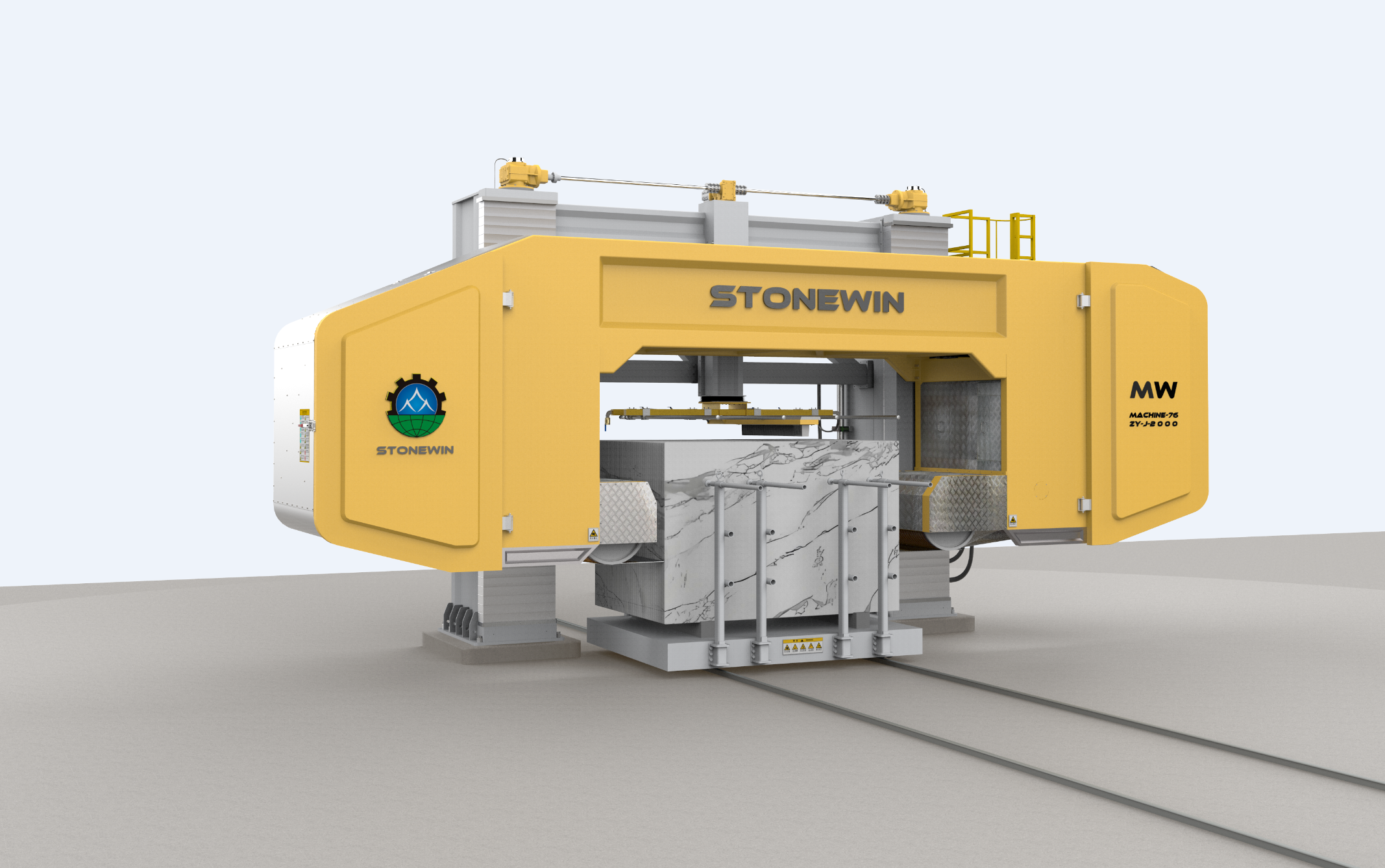
Side-tension configuration of the Stonewin multi-wire saw machine; a top-tension variant is also offered.
That makes the tensioning choice a question to put to the supplier in writing rather than a specification to assume. A buyer should ask which configuration is being proposed, what makes it suit the block sizes and handling pattern at that plant, and how independent tensioning is arranged across the wire positions. Because the answer depends on the plant rather than on a general rule, the technical offer should state the configuration explicitly next to the model number, and the acceptance test should be written against that stated configuration.
Comparing the two scenarios side by side
| Decision dimension | Stone quarrying wire saw | Multi-wire slab saw |
|---|---|---|
| Production task | Detaching blocks from the rock mass at the bench | Converting blocks into slabs inside a plant |
| Documented Stonewin models | ZY-45G-6P, ZY-55G-6P, ZY-75G-6P and the wider 4P / 6P / 8P / 12P range (13 designations) | ZY-MW5 to ZY-MW90 (14 designations, 5–90 wires) |
| Key documented parameters | φ800 mm flywheel; 0–40 m/s wire speed; 360° electric rotation | 3,500 mm × 2,200 mm cutting size; 5–90 wires; 22–80 t machine weight |
| Cutting tool | Diamond wire, φ3.5–12 mm | Multi-wire diamond saw configuration |
| Configuration options | Crawler, rail or profiling variants | Side-tension or top-tension |
| Installation | Works along the face; variants built for track or rail positioning | Fixed plant installation on a prepared foundation |
| Control and monitoring | Independent control system, automatic cutting, IoT remote viewing | Independent control system, automatic cutting, IoT remote viewing |
| Environmental envelope | 5–40 °C; ≤50 % RH at 40 °C; ≤90 % RH at 20 °C; altitude ≤1,000 m | Same documented envelope |
Matching the model range to output and infrastructure
The breadth of the range — fourteen multi-wire models and thirteen quarry models — is an advantage for a buyer moving between scenarios and the source of most mis-specification. At the slab-processing end, the decision sequence usually runs from block dimensions against the 3,500 mm × 2,200 mm envelope, to required slab output per block against wire count, to the physical consequences of that wire count. Machine weight spans 22 to 80 tonnes across the range, so foundation design, lifting capacity and floor space have to be resolved for the specific model rather than for the range as a whole.
That sequence matters in both directions. A plant that selects ZY-MW86 for output reasons but plans a foundation suited to a lighter machine has solved the wrong problem. Equally, a plant with moderate block sizes and a gradual ramp-up has no structural reason to start at the top of the portfolio when ZY-MW5 through ZY-MW42 exist; wire count should follow the output plan, not precede it.
At the quarry end, matching is about the face rather than the plant. The 360° electric rotation and the φ800 mm flywheel define how the machine presents itself against the bench, while the crawler, rail or profiling configuration defines how it is moved and supported between cuts. The 4P, 6P, 8P and 12P series within the quarry range give a buyer a ladder inside one family, and the position on that ladder should be confirmed against bench geometry and the selected diamond wire diameter.
Commercial parameters are documented and worth planning around. Stonewin lists a minimum order of one unit, a lead time of two months, a monthly capacity of three units, independent-brand, OEM and customization options, a one-year warranty and lifetime maintenance. Where a plant commissioning date is fixed, the two-month lead time belongs on the critical path rather than in a footnote.
Where each machine does not fit
A multi-wire saw cannot substitute for quarry extraction. It is a foundation-mounted plant machine designed around a fixed cutting envelope, and it cannot be taken to a bench to free a block. The reverse boundary is equally firm: a quarry wire saw produces blocks, not plant-scale slab output, so a processing plant cannot be built around a single-wire quarry machine and expected to deliver slab volume.
Site conditions are part of the fit, not paperwork. The documented envelope of 5 °C to 40 °C, humidity not exceeding 50 % at 40 °C and 90 % at 20 °C, and altitude up to 1,000 m should be checked against the actual installation point, and any site outside those conditions needs explicit confirmation rather than an assumption that the machine will adapt.
Certification scope deserves the same care. Stonewin holds CE certification, and its documentation records the multi-wire saw series as CE certified under EN ISO 12100:2010 and EN 60204-1:2018, issued by SGS. Because certificates are issued against defined product scopes, a buyer should confirm that the certificate on file covers the exact model and configuration being purchased — including the tensioning arrangement — rather than assuming series-wide coverage for a customized build. Units are also described as certified for use in dust-exposed stone processing environments, which is the relevant condition in both a quarry and a slab plant.
Market direction: what the third-party data does and does not show
Independent research supports the general direction without settling any individual purchasing decision. Dataintelo projects a 7.2 % compound annual growth rate for the global diamond wire saw machine market from 2026 to 2034, and places multi-wire saw machines as the largest product segment at 58.4 % of product share in 2025. Custom Market Insights attributes 45 % of stone processing machine revenue to Asia-Pacific in 2024. Fortune Business Insights values the global stone processing machine market at USD 8.76 billion in 2025, although published estimates vary substantially between providers because some include basic construction tools alongside industrial machinery — which is why the figure should be read as directional rather than precise.
For a buyer, the useful reading is narrower than the headline. A multi-wire segment holding the largest product share is consistent with slab capacity being the competitive front in stone processing, and Asia-Pacific concentration is consistent with the sourcing patterns most importers already know. None of these estimates says anything about a specific plant's utilisation, and none should be used to size an investment. They describe a market, not a business case.
Installed base and service coverage
Stonewin reports more than 100 units installed globally over a period of more than ten years, cutting granite and marble in open-pit quarries and processing plants, with exports accounting for roughly 50 % of output and markets in India, the Arabian Peninsula, the Middle East, Africa, Europe, South America and Southeast Asia. The company's own service description covers equipment selection, installation and commissioning, and after-sales maintenance through a network of engineers in major stone-producing regions.

A Stonewin multi-wire saw machine on site in Algeria, one of the markets covered by the company's installed base.
For an evaluating buyer, the practical value of an installed base is reference access, not a number. A plant considering ZY-MW72 or ZY-MW86 should ask to speak with operators running comparable wire counts on comparable stone, and a quarry considering the ZY-55G-6P or ZY-75G-6P should ask how the 360° rotation and flywheel clearance performed on benches of similar geometry. The manufacturer's service commitments — one-year warranty and lifetime maintenance — are worth reading alongside those references rather than instead of them.
A short verification checklist before signing
- Confirm the scenario first. Extraction and slab conversion require different machine families, and the model number follows from that decision.
- Quarry side: check φ800 mm flywheel clearance, the 360° rotation range against the cut plan, the 0–40 m/s speed range against the wire diameter, and the crawler / rail / profiling choice against bench logistics.
- Plant side: check block dimensions against the 3,500 mm × 2,200 mm envelope, wire count against the output plan, and machine weight (22–80 t) against foundation and lifting capacity.
- Tensioning: require the side-tension or top-tension configuration to be stated in the technical offer, with the reason it fits the plant.
- Site envelope: verify temperature, humidity and altitude limits at the actual installation point, and confirm the dust-exposed-environment certification applies.
- Certification: confirm CE documentation (EN ISO 12100:2010, EN 60204-1:2018) covers the exact model and customized configuration ordered.
- Commercials: plan around a two-month lead time, one-unit minimum order and a documented monthly capacity of three units, and confirm warranty and maintenance terms in writing.
- Monitoring: confirm how IoT remote viewing is commissioned and what network access it requires on site.
FAQ
Is a multi-wire saw machine suitable for stone quarrying?
No. In Stonewin's documentation the multi-wire saw is a slab-processing machine built around a fixed cutting envelope of 3,500 mm × 2,200 mm with 5 to 90 wires, installed on a foundation. Quarrying uses the single-wire quarry range instead — models such as ZY-45G-6P, ZY-55G-6P and ZY-75G-6P with a φ800 mm flywheel, 0–40 m/s wire speed and 360° electrically controlled rotation.
How many wires does a slab plant actually need?
Stonewin's portfolio spans ZY-MW5 with 5 wires up to ZY-MW90 with 90 wires, with the 72-wire ZY-MW72 and 86-wire ZY-MW86 positioned between them. The choice depends on the slab output planned per block, the block dimensions relative to the 3,500 mm × 2,200 mm envelope, and the infrastructure available for a machine weighing between 22 and 80 tonnes.
What is the difference between side-tension and top-tension multi-wire saw machines?
Both are documented Stonewin configurations, and the tensioning mechanism is listed among the customization options alongside the number of wire saw units. The available documentation does not rank one above the other, so the relevant step is to have the supplier state which configuration is proposed for a given plant's block sizes and layout, and how independent tensioning is arranged on each wire position.
What site conditions must be confirmed before installation?
The documented operating envelope is 5 °C to 40 °C, humidity not exceeding 50 % at 40 °C and not exceeding 90 % at 20 °C, and altitude up to 1,000 m. The machines require a foundation and include an independent control system, independent tensioning, automatic cutting and remote viewing via the Internet of Things. Units are also described as certified for dust-exposed stone processing environments.
Can a quarry wire saw and a multi-wire saw work in the same operation?
Yes, as consecutive stages of one production chain. Quarry wire saws free blocks from the rock mass; multi-wire saws convert those blocks into slabs in a processing plant. Stonewin supplies both families along with the diamond wire itself, in diameters from φ3.5 mm to 12 mm across the ZY03, ZY04, ZY05, ZY06, ZY07, ZM12, ZG12, ZG13, ZC12 and ZC10 designations.
Stonewin's full 2026 product brochure, covering quarrying wire saws, multi-wire slab machines, polishing lines and resin lines, is available for download: Stonewin 2026 comprehensive product brochure (PDF).
Tem questões ou precisa de mais detalhes?
Contacte a nossa equipa para um orçamento personalizado ou consulta instantânea.
Solicitar orçamento
Preencha o formulário abaixo e a nossa equipa entrará em contacto com uma proposta personalizada.
Chat direto do WhatsApp
Prefere conversar em tempo real? Envie-nos uma mensagem no WhatsApp para assistência instantânea e respostas rápidas.
- Obter orçamento personalizado
- Partilhar fotos ou documentos
- Discuta as suas necessidades diretamente
Geralmente responde em 5–30 minutos durante o horário de expediente.