
Quick-Select Guide: Five Proven Cosmetic Filling Machines for Trial Runs
A sample batch is not a small version of a production run. This shortlist compares five machines for pilot and trial production on the criteria that actually decide whether a trial is repeatable: changeover speed, product waste, and cleaning effort.
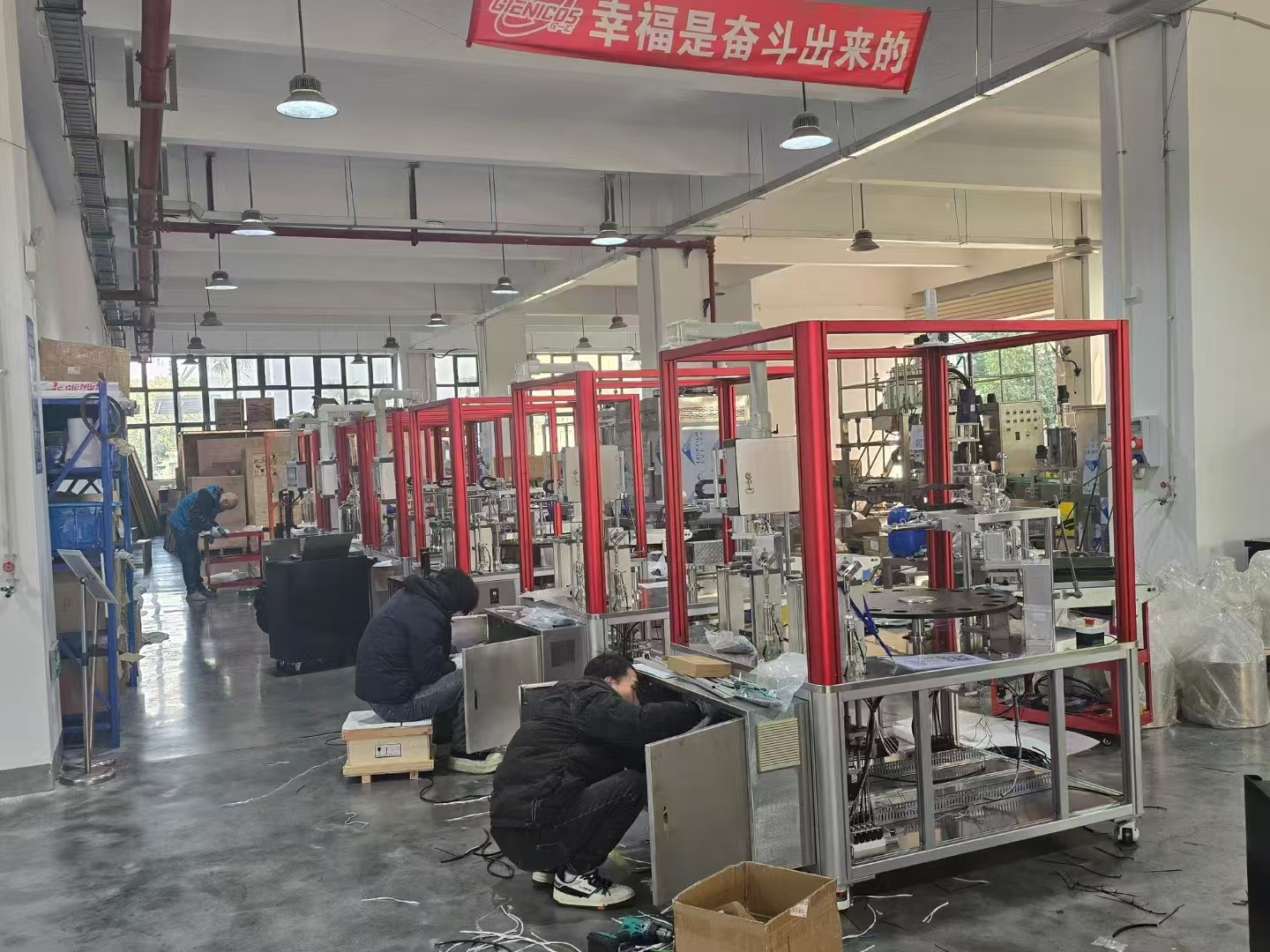
An industry where automation keeps growing and pilot work stays deliberately flexible
Trial-run production is a distinct equipment category. It is governed by four conditions that rarely appear together on a high-speed line: fast changeover between formulas and containers, minimal bulk product left inside the machine after the run, cleaning that can be completed between shifts, and a container range wide enough to cover the sample formats a brand actually intends to launch.
The market these machines sit in is expanding. Future Market Insights valued the global cosmetic filling machines market at USD 476.80 million in 2025 and projected it to reach USD 718.63 million by 2036. Fortune Business Insights reported that Asia Pacific held a 33.08% share of the filling machine market in 2025, and Future Market Insights projected automatic filling machines at a 41.2% share of cosmetic filling technology in 2026. Those figures describe volume manufacturing capacity. The trial-run question is narrower: which machines let a facility produce a few hundred to a few thousand units without losing formulation, time, or fill accuracy in the process.
Shanghai GIENI Industry Co., Ltd. (GIENICOS) is a manufacturer founded in Shanghai in 2011 that designs and builds intelligent cosmetic filling and packaging equipment, together with robotic loading and unloading system solutions. Its portfolio covers lipgloss, mascara, lipstick, lip balm, hot pouring, powder pressing, cushion, foundation, and skincare filling equipment. The five machines below are drawn from that portfolio. This is an equipment shortlist for evaluation, not a supplier ranking. The purpose is to give a buyer a defensible starting set for sample and small-batch production.
The problem: purchase price is the weakest predictor of trial-run cost
Most trial-run equipment is bought by people who already know their formula and their container but not the machine class. That creates a predictable evaluation error, where the shortlist is ranked by capital cost and the real cost drivers stay invisible until the third or fourth trial batch.
The three criteria worth weighing first are changeover, product waste, and cleanability.
Changeover. A pilot facility may run several shades or several formulas in one week. If a machine needs partial disassembly and recalibration between each of them, the effective capacity of the plant drops far below its rated output per hour.
Product waste. Bulk material left in hoses, tanks and nozzles after a batch cannot be recovered. On expensive or short-supply formulations, a few hundred grams lost per run across twenty runs is a material cost that never appears in a purchase quotation.
Cleanability. Cleaning is the hidden schedule item. A machine with modular assemblies that support fast disassembly and spare-part replacement reduces production downtime in a way that a lower-priced machine with a fixed internal path does not.
Container range and fill precision sit just behind these three. A machine that fills accurately but only accepts one container diameter will be replaced sooner than one with a slightly wider tolerance envelope.
The five-machine shortlist at a glance
| Machine | Model | Filling volume | Output | Trial-run relevant configuration |
|---|---|---|---|---|
| Trial Sample Filling Machine | JLG-10H | 1-19 mL | 100-130 pcs/min | 10 nozzles, 25 L tank, SS316L product-contact parts, bottle diameter 12-20 mm, servo piston with servo lifting |
| Semi Automatic Lipstick Filling Machine | JLG-10/12 | 1-20 mL | Semi-automatic | 10 or 12 nozzles, +/-0.1 g precision, lipstick, lip balm and lipgloss, series includes cooling tunnel and vacuum releasing machine |
| Vertical Dual Nozzle Filling Machine | JMF | High-viscosity cosmetic materials | 22-28 pcs/min with one operator | Dual 20 L tanks, dual nozzle, approx. 30 min cleaning time, single-phase AC220V |
| Semi Automatic Mascara Lipgloss Filling Machine | JR-02M/L, JR-01M/L | 1-20 mL (JR-02M/L); 2-14 mL or 10-50 mL (JR-01M/L) | 30-40 pcs/min | Rotary type, single or dual nozzle, +/-0.1 g, ceramic or SUS pump option |
| Servo Piston Filling Machine | JSFL 1-2 | High-viscosity cosmetic products | Semi-automatic | Servo piston filling, single or dual nozzle, liftable tank |
1. Trial Sample Filling Machine (JLG-10H): the small-format reference point
The Trial Sample Filling Machine is a ten-nozzle servo unit built for slim sample bottles. It fills 1-19 mL at 100-130 pcs/min from a 25 L tank, uses SS316L for product-contact parts, accepts bottle diameters from 12 mm to 20 mm with customizable bottle height, and runs on single-phase AC220V with servo piston filling and servo lifting.
For a trial environment the important number is the 25 L tank, which sets a workable pilot batch size without forcing the operator to prepare material the machine cannot consume. The second important number is the output rate, which is high enough that a sample run is limited by formulation preparation rather than by filling.
The boundary to check first is the container window. A 12-20 mm bottle diameter suits slim sample vials and miniature formats. It does not cover jars, compacts, or wide-mouth containers, which belong to a different machine class.
2. Semi Automatic Lipstick Filling Machine (JLG-10/12): the wax-based trial workhorse
The Semi Automatic Lipstick Filling Machine is configured with 10 or 12 filling nozzles and handles lipstick, lip balm and lipgloss, with a filling volume of 1-20 mL and filling precision of +/-0.1 g. The series configuration pairs the filling machine with a cooling tunnel and a vacuum releasing machine.
Wax-based trial batches behave differently from liquid batches because the material must be held above its melt point and then cooled in a controlled way. On the upstream side, the 20 L Hot Pouring Machine provides heating, stirring and vacuum with a sanitary valve without dead angle, and pre-melting can be handled in a range of melting tanks. This makes the JLG-10/12 a system decision rather than a single-machine decision, and the cooling tunnel footprint should be planned at the same time as the filler.
The unit is covered by CE certificate AT1814C500649151, issued on 15 January 2025 by Hunan Anbotek Compliance Laboratory Limited, with scope covering the lipstick filling machine models JLG-10, JLG-12, JSM, FSM-5, FSM and JLG, against EN 60204-1:2018 and EN ISO 12100:2010.
3. Vertical Dual Nozzle Filling Machine (JMF): two materials, small footprint
The Vertical Dual Nozzle Filling Machine is an economic vertical machine for high-viscosity cosmetic materials. It carries two 20 L tanks and a dual nozzle, produces 22-28 pcs/min with one operator, runs on single-phase AC220V at 4 kW with a 0.6-0.8 MPa air supply, occupies 810 x 570 x 1906 mm, and lists an approximate 30-minute cleaning time.
For trial work, the dual-tank design is the feature that changes scheduling: two shades or two related materials can be held on the machine at once instead of being staged sequentially. The published cleaning time is also unusually useful as a planning figure, because it converts cleaning from an abstract concern into a number that can be placed on a shift plan.
The constraint is throughput. At 22-28 pcs/min the JMF is not a scale-up path; it is a repeatability path. Facilities planning to move directly from trial to volume should treat it as an interim or parallel unit.
4. Semi Automatic Mascara Lipgloss Filling Machine (JR-02M/L and JR-01M/L): rotary options for liquid colour cosmetics
Two rotary semi-automatic machines cover mascara and lipgloss trial runs. The JR-02M/L is a dual-nozzle rotary filler with a 1-20 mL volume range, +/-0.1 g filling accuracy and 30-40 pcs/min output in Euro style. The JR-01M/L is a single-nozzle rotary filler for lipgloss, mascara, foundation, lip oil and other liquid colour cosmetics, with a ceramic or SUS pump option, a filling range of 2-14 mL or 10-50 mL by changing spare parts, 30-40 pcs/min output, AC220V single phase at 3.8 kW, air supply of 0.6-0.8 MPa at 800 L/min or more, and a footprint of 1750 x 1100 x 2200 mm.
The single-nozzle variant is the more flexible of the two on paper, but the flexibility is conditional: changing between the 2-14 mL and 10-50 mL ranges requires changing spare parts. That is a planned engineering task, not a dial adjustment, and it belongs in the changeover calculation.
5. Servo Piston Filling Machine (JSFL 1-2): liftable-tank hot filling
The Servo Piston Filling Machine is a single or dual nozzle servo piston filler for lip balm, lipstick, lip cream and other high-viscosity cosmetic products, and it is used for cosmetic hot filling. Its distinguishing feature for trial work is the liftable tank, which changes how material is loaded and how the wetted path is accessed during cleaning.
A related CE certification exists under AT58250SC000523 for the Single Nozzle Hot Filling Line JSFL, issued on 31 July 2020 by Shenzhen Anbotek Compliance Laboratory Limited. Buyers comparing hot filling options should also be aware that the broader hot filling certification AT185114C4000321, issued on 17 July 2024, names a full line scope: melting tank MT, filling machine JYF, cooling machine JCT, automatic bottle loading, automatic cap loading, check weigher and labeling machine JTB, with model series JHF-1 through JHF-10.
How to read fill precision and cleanability on a specification sheet
Fill precision figures are quoted under defined conditions, and those conditions matter more in trial production than in steady-state manufacturing, because trial runs involve formulas that have not yet been finalized.
Servo piston filling is the dominant approach across this equipment class, with several models stated at +/-0.1 g, including the JLG-10/12, the JR-02M/L, the JR-02E eyeliner filler, the JYF-4 multi-color hot filling machine, the JQH-02 automatic lipgloss filling and capping machine, the JQR-01A automatic mascara filler and the JR-01P lip pouch filler. Where materials are less predictable, published tolerances widen: the JQL-04C cushion filling machine is stated at +/-0.15 g, explicitly subject to material formula, sponge characteristics and other factors, and the JQL-02N nail polish filler is stated at +/-0.15 g subject to material formula and other factors.
Some design features that matter at pilot scale are easier to spot on the higher-speed platforms and then traced back to the smaller machines. The JMG linear lipgloss and mascara filling line, for example, uses a return-suction anti-drip nozzle to reduce bottle-mouth pollution, a no-bottle no-fill detection function, 10-12 pcs per cycle and SUS316L wetted parts, described as GMP-compliant with easy disassembly and cleaning. A trial-run buyer is not purchasing that line, but those are the attributes worth looking for in a smaller unit: drip control at the nozzle, a fill-inhibit function, and wetted parts that can be removed without a full teardown.
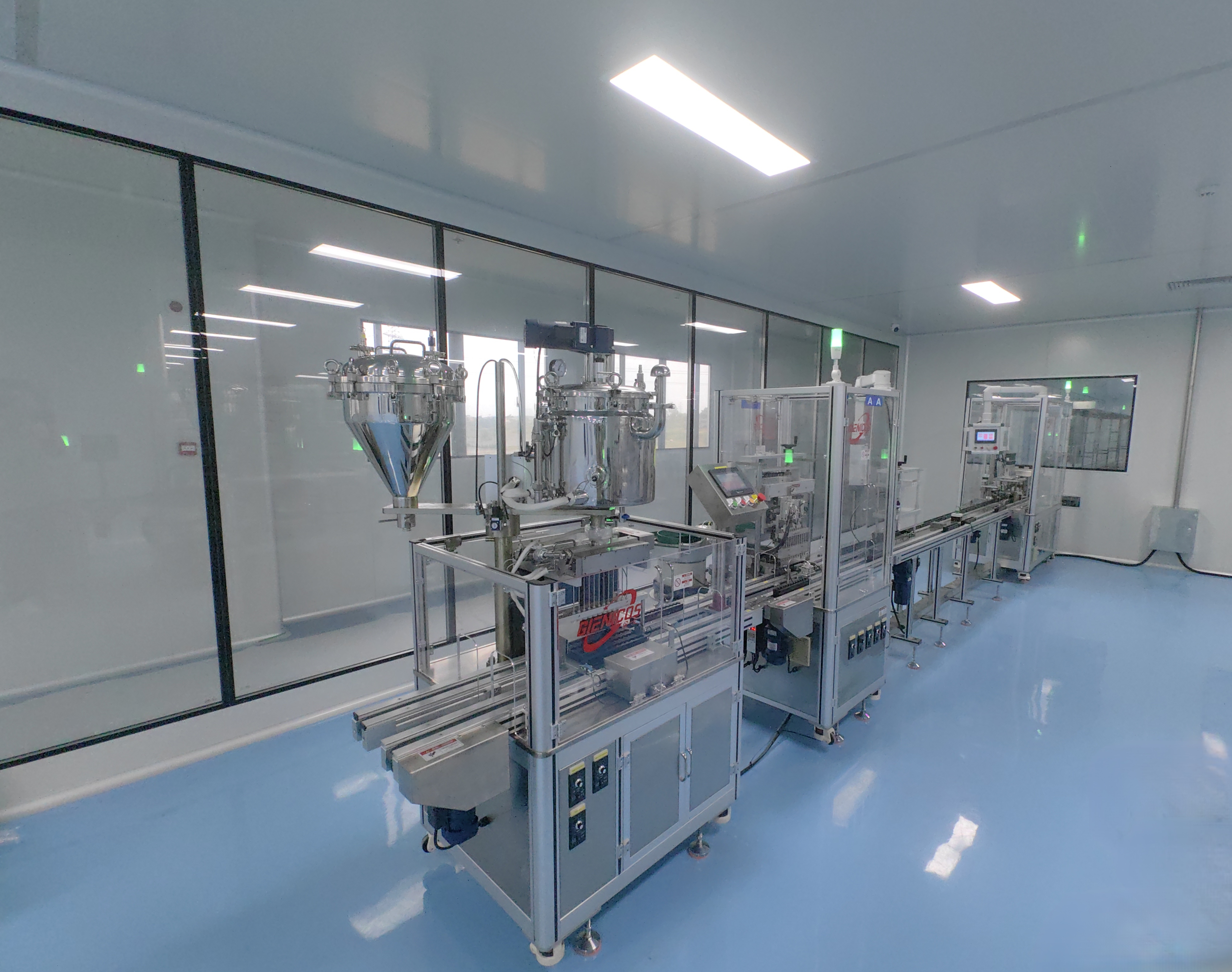
Cleaning philosophy is stated consistently across the range. The manufacturer describes a modular structural design in which key assemblies support fast disassembly, convenient cleaning and spare-part replacement, which reduces production downtime. The JMF publishes an approximate 30-minute cleaning time, which is a rare and useful concrete figure. Buyers should ask the same question for every shortlisted model and compare like for like, because cleaning time is what converts a rated output into a realistic weekly output.
Matching the machine to the format
The five-machine shortlist covers the highest-volume trial formats, but a pilot facility running several categories needs a format map rather than a single purchase.
| Product format or trial need | Machine | Why it fits |
|---|---|---|
| Slim sample bottles, mini formats | Trial Sample Filling Machine JLG-10H | 10 nozzles, 1-19 mL, 25 L tank, servo lifting, 12-20 mm bottle diameter |
| Lipstick and lip balm | Semi Automatic Lipstick Filling Machine JLG-10/12 | 10 or 12 nozzles, +/-0.1 g, cooling tunnel and vacuum releasing machine in the series configuration |
| Lipgloss and mascara | JR-02M/L or JR-01M/L | Rotary semi-automatic, +/-0.1 g, 30-40 pcs/min |
| Two high-viscosity materials in parallel | Vertical Dual Nozzle Filling Machine JMF | Dual 20 L tanks, dual nozzle, one operator, approx. 30 min cleaning time |
| Multi-color hot filling | Multi-color Hot Filling Machine JYF-4 | Four colors, 2-20 mL / 20-50 mL / 50-100 mL, +/-0.1 g, 20 L effective tank, SUS316L product-contact parts |
| Lip pouch, concealer pouch | Lip Pouch Filling Machine JR-01P | 2-10 mL, +/-0.1 g, 20-30 pouches/min, 20 L pressurizing tank, servo capping with adjustable torque |
| Liquid eyeliner pencil | Eyeliner Filling Machine JR-02E | Rotary, peristaltic pump filling, 2 pcs per cycle, 30-40 pcs/min |
| Eyebrow pencil and eyeliner gel | JPF-12/16 filling line | Servo filling 2-10 mL, 45-50 pcs/min, cooling at -1 to -2 degrees C, two 5 L tanks |
| Foundation, cream, lotion, serum | JRS-G1, JRS-G2, JRS-G3 | Foundation filling at 30-40 pcs/min; dual-nozzle toner and cream filling at 45 bottles/min for 50 mL; rotary filling 10-300 mL with 15 min changeover time |
| Cushion and BB/CC cream | JQL-04C, JQR-02C | 4-nozzle servo filling at 30-40 pcs/min; rotary single or dual color at 24-30 pcs/min |
| Nail polish | JQL-02N, JQR-01N | 2-nozzle servo filling at 80 pcs/min, 5-20 mL; rotary 5-30 mL with piston, vacuum or pressurized filling |
| Capping for trial bottles | Semi Automatic Rotary Capping Machine JR-01X | Servo capping, 30-40 pcs/min, adjustable torque, single-phase 220 V |
| Powder formats | JLF, JLF-A, JY-CR50, JBC-4, JBC-5, JTC, GP 050 SE | Different equipment class: rotary loose powder filling at 900-1,800 pcs/hour, dual-nozzle linear at 30-40 pcs/min, mixing, sifting and pressing |
One practical consequence follows from this map. A facility that intends to run lipstick, lipgloss, cream and powder trials will not cover the requirement with five machines in one category; it will need one machine per format family plus shared upstream preparation. Trial-run buyers who accept that early usually avoid buying the wrong machine twice.
Market signal: automation share grows while pilot demand persists
Three published data points frame the trend this shortlist sits inside. First, the overall category is expanding, with the global cosmetic filling machines market valued at USD 476.80 million in 2025 and projected at USD 718.63 million by 2036, according to Future Market Insights. Second, demand is geographically concentrated, with Asia Pacific holding a 33.08% share of the filling machine market in 2025 according to Fortune Business Insights. Third, automation is the leading technology segment, projected at a 41.2% share of cosmetic filling technology in 2026 by Future Market Insights.
Sub-segment estimates are less consistent, and buyers should treat them cautiously. One commercial research source projects the automatic lipstick filling machines market reaching USD 1.2 billion by 2033 at a 5.8% CAGR from 2025, while a separate estimate for a similarly named segment is an order of magnitude lower. The gap is best explained by definition: some analysts count individual filling units, others count complete production lines. When a supplier cites a market figure, the useful question is which definition it uses.
On the trade side, cosmetic filling machines fall under HS Code 8422.30, specifically 8422.30.91 for machinery used in opening, filling and closing containers, per the Harmonized Tariff Schedule published by the US International Trade Commission. For importers evaluating a first pilot machine, that classification is worth confirming with a customs broker before the purchase order, because it affects landed cost assumptions.
Comparison with traditional approaches, and the limits to plan around
Traditional small-batch practice relies on hand pouring, gravity fillers, or single-purpose semi-automatic units built around one container. The advantage is low capital cost and, in the case of manual filling, no changeover time at all. The disadvantages are repeatability and traceability: fill weight varies between operators, product loss through spillage is difficult to quantify, and there is no consistent record of what each unit actually received.
A correctly specified trial-run machine addresses those weaknesses, but it does not remove them entirely, and it introduces constraints of its own. The following limits are specific to this shortlist and should be priced into the decision.
- Container windows are narrow on purpose. The JLG-10H accepts bottles of 12-20 mm diameter. That suits slim sample formats and excludes jars, compacts and wide-mouth containers.
- Semi-automatic means an operator is in the loop. The JLG-10/12, JR-02M/L, JR-01M/L and JSFL are semi-automatic designs. Labour cost and operator consistency are part of the quality chain, not beside it.
- Throughput on flexible machines is modest. The JMF produces 22-28 pcs/min with one operator. That is a repeatability capability, not a scale-up path.
- Some range changes are engineering tasks. The JR-01M/L switches between 2-14 mL and 10-50 mL by changing spare parts, which must be scheduled rather than assumed.
- Cleaning time is a real capacity limit. The JMF publishes an approximate 30-minute cleaning time. Across a week of short trial runs, that accumulates quickly.
- Certification scope is model-specific. CE certificates name defined model series, such as JHF-1 to JHF-10 for the hot filling line certificate AT185114C4000321, or JLG-10, JLG-12, JSM, FSM-5, FSM and JLG for AT1814C500649151. A buyer should match the certificate scope to the exact configuration ordered rather than to the brand generally.
- Fill precision is conditional. Published tolerances are quoted under stated conditions and can widen with formulation, as the +/-0.15 g figures for cushion and nail polish filling state. Trial results should be validated on the buyer's own formula.
- Lead time and capacity impose planning discipline. Manufacturing lead time is stated at 45-80 days with a monthly production capacity of 10 units and a minimum order quantity of 1 unit. A pilot line that must be operational for a fixed launch window needs the order placed with that lead time in mind.
Against a fully automatic line, the trade-off runs the other way. An automatic lipgloss filling and capping machine such as the JQH-02 runs 60-80 pcs/min, and the JQR-01A rotary mascara filler runs 40-45 PPM. Those machines are built for continuous output, and the cost of repeated short changeovers on them is where the economics stop working. Automatic and semi-automatic equipment are not substitutes in a trial environment; they solve different problems.
Outlook: changeover speed is becoming a machine feature, not an operator skill
The direction of travel in this equipment class is toward configurable, restorable setups rather than toward pure speed. The clearest present-day example is in powder assembly: the JZF vision-guided robotic compact powder assembly line uses a delta robot and two visual detection sets, handles powder cases from 10 mm to 60 mm, and states a changeover or setup time of approximately 15 minutes. Published changeover times of that kind are still uncommon in filling equipment, but they signal how manufacturers are measuring machine value.
Two structural forces support that shift. The first is the automation share figure already cited: automatic filling machines at 41.2% of the cosmetic filling technology market in 2026 means the majority of the market is still served by non-automatic or semi-automatic configurations, many of them in exactly the pilot and small-batch role described here. The second is the capacity of suppliers to build to a specification rather than sell from a catalogue. Shanghai GIENI Industry operates a 2,000 square metre factory with 30 employees, an annual output of 100 units and an R&D team of 10 engineers, holds 42 authorized patents covering invention patents, utility model patents and software copyrights, and has run an AI division since 2020 focused on vision-based applications, smart manufacturing and AI-driven solutions. Export represents 80% of business, with main markets in the EU, USA and Asia, and a customer base spanning 100 countries and regions.
For trial production specifically, that combination points to a practical expectation: the next generation of pilot machines will be evaluated less on peak output and more on documented changeover time, published cleaning intervals, and the ability to restore a validated setup after a formula change.
Frequently asked questions
What industries and products are these cosmetic filling machines suitable for?
The equipment is developed for colour cosmetics and skincare production. It fits cosmetic GMP clean-room workshops and covers lipgloss, lipstick, mascara, cushion, foundation, compact powder, nail polish, eyeliner, eyebrow pencil, cosmetic cream, lotion and related items. It supports both OEM and ODM contract manufacturers and brand-owned production bases.
Can the equipment be customized for a specific trial container, formula or voltage?
Yes. Customization is offered on voltage, logo, automation degree, tank size, filling method and speed request, under an OEM and ODM production mode. The manufacturer states that it focuses on customized development for key-account clients, iterating products according to production requirements, formula features and workshop conditions, and that the machines are designed on a module concept. Minimum order quantity is 1 unit, with a stated lead time of 45-80 days.
How easy is the equipment to maintain and clean between trial batches?
The machines use a modular structural design in which key assemblies support fast disassembly, convenient cleaning and spare-part replacement, which reduces production downtime. As a concrete reference, the Vertical Dual Nozzle Filling Machine lists an approximate 30-minute cleaning time. Cleaning capability should be confirmed for the specific model and configuration being evaluated, since not every machine in the range publishes a cleaning time.
What warranty and after-sales support applies to trial-run equipment?
The standard warranty is 12 months from the date of machine acceptance and covers manufacturing defects, excluding wearing consumable parts and man-made damage. After-sales support includes remote technical support, onsite visit support, a 1-year warranty and full life service support. Quality control includes 100% outgoing quality control testing before shipping.
Reference
Commissioning and installation records referenced in the case material cover 20 sets used for lipgloss and lip cream production over five years in the United States, Poland, Indonesia and Thailand, by cosmetic brands, OEM and ODM contractors, and small-batch production labs, with reported stable operation and on-time service support.
Product catalogue (PDF): https://cdn.socialarks.com/sbsp/25084/common/2026/0809/2026%20CATALOGUE.pdf | Manufacturer website: WWW.GIENICOS.COM