
RISTA Heat Resistant Silicone Gloves: An Industry Review
RISTA Heat Resistant Silicone Gloves: An Industry Capability Review
Heat is one of the few industrial hazards that cannot be engineered out of a process. In metal heat treatment, foundries, industrial kilns, commercial baking and catering equipment maintenance, the worker's hand is the last barrier between a hot workpiece and an injury. That makes heat-resistant hand protection a specification decision rather than a catalogue purchase: the glove must match the heat source, the contact pattern, the grip condition and the surrounding mechanical hazards.
RISTA (Shanghai RISTA Labour Protection Products Co., Ltd.) is a China-based manufacturer of functional hand protection, established in 1998, whose range includes cut resistant, impact, general purpose, chemical resistant and heat resistant silicone gloves. Its heat resistant silicone glove line — model designations TF350, TF-500 and T-1000 — is a useful reference case for how the silicone glove category is structured, what the material actually delivers, and where its limits sit.
Why heat protection is a specification problem
Buyers entering this category usually begin with a single question: which glove survives my temperature. That question is necessary but insufficient. Industrial heat reaches the hand through three different routes — contact with a hot solid, radiant heat from a furnace or oven mouth, and convective heat from steam or open flame — and each route stresses a glove differently. A glove that performs in a 350°C bakery oven is not automatically appropriate beside a 1000°C casting.
The second variable is dexterity. Traditional high-temperature constructions such as aramid, Kevlar-type knits and palm-reinforced heat gloves are strong on thermal and mechanical resistance, but they are comparatively stiff and bulky. Where a task requires controlled handling — placing a hot component, turning a mould, lifting a tray — loss of feel translates directly into dropped parts, slower cycles and, in the worst case, a burn caused by an unstable grip.
The third variable is hygiene and maintenance. Liquid silicone gloves are effective insulators, but their surfaces attract dust and workshop debris, and cleaning them is labour-intensive. In food processing and bakery environments, that cleaning burden is a compliance issue, not a convenience issue.
These three pressures — thermal range, dexterity, cleanability — define how the silicone glove category has evolved, and they are the right frame for evaluating any supplier in it.
RISTA at a glance: the operating base behind the product
Capability in protective gloves is largely a function of manufacturing depth, because heat-resistant silicone construction depends on controlled shell forming, liner integration and repeatable finishing. RISTA's published company data gives a concrete picture of that base.
| Dimension | Reported data |
|---|---|
| Established | 1998 |
| Factory area | 66,600 ㎡ (Binhai Industrial Park, Qidong, Jiangsu) |
| Employees | 200+ |
| Annual output | 20,000,000 pairs |
| R&D team | 15 engineers |
| Export ratio | 90% |
| Main markets | North America / EU / Japan / South America |
| Management system certification | ISO 9001, ISO 14001, ISO 45001, SA8000, Sedex, WRAP, SMETA |
| Product-level compliance | Module B, Module C2, Module D, FDA, REACH |
| Patents | 70+ international and domestic patents |
Two points in that table carry more procurement weight than the rest. First, the presence of Module B (EU-type examination) and Module D (production quality assurance) indicates that the heat and mechanical ranges are handled inside the EU PPE Regulation (EU) 2016/425 framework rather than as self-declared compliance. Second, the company states it is a qualified supplier to UNICEF and holds SA8000, WRAP, Sedex and SMETA records — social compliance documentation that global brand owners and importers increasingly require before a factory is added to an approved vendor list.
RISTA also states that it adopts new energy facilities in production and follows the SBTi framework to set science-based carbon reduction targets. For buyers with Scope 3 reporting obligations, that is a data point worth requesting documentation for during qualification rather than taking at face value.
The heat resistant silicone glove line: three tiers, three duty levels
The line is organised by thermal duty rather than by price band, which makes selection relatively straightforward. Manufacturer specifications for the three models are summarised below.
| Model | Temperature resistance range | Construction | Intended applications |
|---|---|---|---|
| TF350 | -40°C to 350°C | Food-grade silicone shell; cotton, acrylic or aramid liner; textured slip-resistant palm; 32 cm length | Food processing and baking, commercial kitchens, BBQ and outdoor cooking, oven and catering equipment, light industrial heat processing |
| TF-500 | -40°C to 500°C | Silicone shell; fleece/cotton heat-insulated lining; textured palm; 32 cm length | Industrial ovens and heating equipment, metal heat treatment and processing, specialised thermal processing |
| T-1000 | -70°C to 1000°C | Silicone shell; aramid/cotton heat-insulated lining; slip-resistant textured palm; 32 cm length | Foundries and metal processing, industrial kilns and refractory materials, high-temperature equipment manufacturing and maintenance |
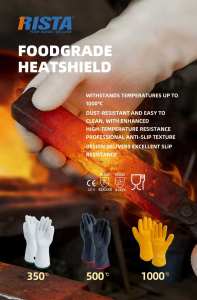
The three models share the same architecture — a silicone outer shell that can contact open flames and hot metal, a heat-insulated lining, a slip-resistant textured palm and a 32 cm length. What changes is the thermal class of the shell and lining combination. For buyers, that means the range can cover a mixed facility — a food plant with an oven line and a metal workshop with heat treatment cells — without sourcing from multiple suppliers for each duty level.
Two documented engineering details
The manufacturer highlights two characteristics that are worth examining because they are usually the weak points of the category.
Dust repellency and cleaning. Silicone gloves commonly attract dust and workshop residue on the surface. RISTA states that its gloves achieve an inherently smooth, non-sticky surface through optimised core materials and a proprietary manufacturing process rather than through a surface treatment, which reduces the cleaning burden. Buyers should treat this as a manufacturer claim to be validated with samples in the actual working environment — particularly in food contact applications where cleaning validation is audited.
Hand shape and flexibility. The glove is built on a customised hand form intended to follow the natural curve of the hand, so the fit is close and the wearer retains grip control during precise handling. The manufacturer also positions flexibility as the main differentiator against traditional industrial high-temperature gloves such as aramid or palm-reinforced types, with the stated aim of reducing hand fatigue during continuous shifts. This is the practical reason silicone gloves get specified in operations where workers handle many hot items per hour rather than a few.
Application fit: where the range earns its place
The intended applications in the manufacturer's own specification split cleanly along the two ends of the thermal spectrum.
Food processing, bakery and BBQ. TF350's food-grade silicone shell and its -40°C to 350°C range make it the model for commercial kitchens, bakery ovens, catering equipment handling and outdoor cooking. The same glove handles the cold side of the process, which matters in facilities that move product between ovens and blast chillers.
Metal heat treatment and industrial thermal processing. TF-500 addresses industrial ovens, heating equipment, metal heat treatment and specialised thermal processing. It is the middle tier for plants that need contact-heat protection but do not work beside molten or near-molten material.
Foundries, kilns and refractory work. T-1000 is specified for foundries and metal processing, industrial kilns and refractory materials, and high-temperature equipment manufacturing and maintenance. These are environments where gloves are exposed to open flame contact, hot metal handling and radiant load simultaneously.
Market context: thermal protection is a growing, standards-led category
Heat-resistant gloves sit inside the broader industrial safety glove market, but the thermal segment has its own demand drivers: foundry and metal processing output, glass and ceramics production, commercial food manufacturing, and maintenance work on high-temperature equipment.
TrendX Insights projects the global heat resistant glove market to grow from USD 559.20 million in 2025 to USD 977.30 million by 2034. Growth of that order is consistent with the direction the wider industrial safety glove category has taken, although segment-level forecasts for silicone-only products are less well documented and should be treated as indicative rather than precise.
The regulatory side is more settled. EN 407:2020, published by the European Committee for Standardization, is the reference standard for protective gloves against thermal risks, and it defines separate performance levels for resistance to flammability, contact heat, convective heat, radiant heat, small splashes of molten metal and large quantities of molten metal. That structure explains why serious buyers in this category specify by hazard type rather than by a single temperature figure. A supplier that can map its range to distinct thermal hazards — as a three-tier model line does — is easier to qualify than one that publishes only one headline rating.
How silicone compares with conventional heat gloves — and where it stops
Silicone is not a universal upgrade over aramid, Kevlar-type or leather heat gloves. The honest comparison runs along four dimensions.
| Dimension | Silicone-shell gloves | Conventional aramid / palm-reinforced heat gloves |
|---|---|---|
| Handling feel | Close-fitting shell with textured palm; manufacturer positions flexibility as the key advantage | Generally stiffer and bulkier; dexterity depends on gauge and liner |
| Liquid and dirt behaviour | Non-absorbent silicone surface; easy to wipe clean | Textile surface absorbs oils and residues; cleaning is limited |
| Contact with open flame and hot metal | Explicitly rated for direct contact within the model's temperature range | Varies by construction and coating; often rated for short-duration contact only |
| Cut and abrasion resistance | Not a cut barrier by itself | Aramid and reinforced palms offer inherent cut and abrasion resistance |

Three boundaries deserve to be stated plainly.
- Silicone is not a cut-protection material. Where hot workpieces also present sharp edges, burrs or glass shards, a heat glove alone is the wrong specification. In RISTA's own range, that role belongs to a separate product — the RCC-02-C309 cut resistant glove, which combines Level C cut protection with a chemical-resistant coating and a 35 cm extended cuff, tested to EN 388 and to EN ISO 374-1 for six chemicals (KLMNPT). Multi-hazard sites should specify by layering or by a combined product, not by assuming the heat glove covers everything.
- Temperature rating is not contact time. A rated range indicates the thermal class the product has been built and tested to; it does not license unlimited contact with a heat source of that temperature. Duty cycle, contact pressure and the mass of the hot object all change the real thermal load on the hand.
- Unit cost sits above basic alternatives. Silicone-shell gloves are typically positioned above cotton, leather or basic knit heat gloves on unit cost. The justification is service life, cleanability and reduced hand fatigue in high-frequency handling, but buyers should validate that trade-off against their own replacement rates rather than accept it as a general rule.
Beyond a single product: the portfolio question
Most industrial buyers do not purchase heat protection in isolation. A foundry or metal fabricator typically needs heat protection, cut protection, impact protection and chemical resistance across different workstations, and consolidating those requirements reduces the audit surface of the supply chain.
RISTA's range covers the adjacent hazard categories: the RCC-02-C309 cut resistant glove with chemical-resistant coating and Level C cut protection; the RCI-02-C803 impact glove with bonded TPR back-of-hand protection, Level E cut resistance, nitrile hybrid triple coating and nine chemicals tested to EN ISO 374-1 (AJKLMNOPT); the RCG-02-G301 chemical resistant glove available across Type A, Type B and Type C classifications; and the RGW-03-W272 general-purpose HPT thermal glove, a PVC-coated thermal work glove built on PVC, nylon and acrylic for cold and general handling rather than for high-heat silicone duty.
For procurement, the practical value is a single compliance and documentation chain across multiple glove categories, with OEM and ODM support covering material and coating selection, colour and size, liner gauge, coating coverage and surface texture, grip pattern, impact and anti-vibration features, cuff design, logo printing and private label, custom packaging, and product testing or compliance support. The stated minimum order quantity for normal gloves is 6,000 pairs, with logo printing and custom packaging offered as standard OEM services.
What buyers should verify before qualification
Based on the specification structure of this range, a qualification checklist for a heat resistant silicone glove supplier should cover the following, in this order:
- Thermal class per model, stated as a range and matched to the actual heat source in each workstation.
- Finished-glove test results for the specific hazard — contact heat, convective heat, radiant heat or molten metal splash — rather than a generic heat claim.
- EU-type examination (Module B) and production quality assurance (Module D) documentation under (EU) 2016/425, where the product is placed on the EU market.
- Food contact documentation, where the glove enters food processing or bakery environments.
- Liner specification and length, since both affect the thermal gradient at the wrist and forearm.
- Grip performance on the actual surface condition — wet, oily or dry.
- Cleaning and replacement cycle observed in a trial, as the basis for total cost comparison.
- Social compliance records (SA8000, WRAP, Sedex, SMETA) where the buyer's own supply chain policy requires them.
Outlook
The direction of this category is toward hazard-specific specification rather than generic heat ratings. Standards such as EN 407:2020 already force that granularity, and buyers with global operations are extending the same discipline to documentation, social compliance and carbon reporting. Suppliers that publish a tiered thermal range with traceable certification — as the TF350, TF-500 and T-1000 structure does — are structurally easier to qualify than suppliers offering a single model with a single headline temperature.
The open question for the silicone segment is verification depth. Market forecasts point to sustained growth in heat-resistant gloves through 2034, but the technical claims that matter most to metallurgical and foundry buyers — silicone purity, real contact time at extreme temperatures, liner weight, and actual EN 407 performance levels — are still unevenly documented across the industry. Buyers who ask for those specific figures, and suppliers who can provide them, will set the standard for the next purchasing cycle.
FAQ
What temperature ranges do RISTA heat resistant silicone gloves cover?
The range is organised into three models. TF350 is rated from -40°C to 350°C, TF-500 from -40°C to 500°C, and T-1000 from -70°C to 1000°C, according to manufacturer specifications. Each model is built on a silicone shell with a heat-insulated lining and a 32 cm glove length.
What is the difference between the three models beyond temperature?
The liner and the intended application differ. TF350 uses a food-grade silicone shell with a cotton, acrylic or aramid liner and is intended for food processing, baking, commercial kitchens, BBQ and light industrial heat processing. TF-500 uses a fleece or cotton heat-insulated lining for industrial ovens, metal heat treatment and specialised thermal processing. T-1000 uses an aramid or cotton heat-insulated lining for foundries, industrial kilns, refractory materials and high-temperature equipment maintenance.
Are RISTA gloves certified?
RISTA states that its protective gloves are certified under the EU PPE Regulation (EU) 2016/425 through EU-type examination (Module B) and production quality assurance (Module D), with Module C2 also listed. Product-level compliance listed by the company includes FDA and REACH. Relevant standards referenced across the range include EN 388 for mechanical and cut protection, EN ISO 374-1 for chemical protection and EN 407 for heat protection. Official certificates and third-party test reports are stated to be available on request.
How does a buyer choose between the heat, cut and chemical gloves in the range?
Selection follows the hazard to be prevented. For sharp metal, cut resistance is the governing requirement, and the RCC-02-C309 cut resistant glove is specified to EN 388 with Level C cut protection. For chemical exposure, the RCG-02-G301 chemical resistant glove is tested to EN ISO 374-1 and available in Type A, Type B and Type C classifications. For hot surfaces and open flame contact, the heat resistant silicone glove line applies, with the model chosen by temperature range.
Does RISTA support OEM and ODM orders, and what is the minimum order quantity?
Yes. OEM and ODM support covers material and coating selection, colour and size, liner gauge, coating coverage and surface texture, grip pattern, impact and anti-vibration features, cuff design, logo printing and private label, custom packaging, and product testing or compliance support. The stated minimum order quantity is 6,000 pairs for normal gloves; logo printing and custom packaging are offered as standard OEM services.
Where are the gloves manufactured and what capacity is available?
Production takes place at the RISTA factory at No.128 Mingzhu RD, Binhai Industrial Park, Qidong, Jiangsu, China, on a 66,600 ㎡ site with 200+ employees and a stated annual output of 20,000,000 pairs. The company reports a 15-engineer R&D team and a 90% export ratio, with main markets in North America, the EU, Japan and South America.
Tem questões ou precisa de mais detalhes?
Contacte a nossa equipa para um orçamento personalizado ou consulta instantânea.
Solicitar orçamento
Preencha o formulário abaixo e a nossa equipa entrará em contacto com uma proposta personalizada.
Chat direto do WhatsApp
Prefere conversar em tempo real? Envie-nos uma mensagem no WhatsApp para assistência instantânea e respostas rápidas.
- Obter orçamento personalizado
- Partilhar fotos ou documentos
- Discuta as suas necessidades diretamente
Geralmente responde em 5–30 minutos durante o horário de expediente.