
RS485 Water Meter Buyer Checklist: BMS and Industrial Sites
RS485 Water Meter Buyer Checklist: BMS and Industrial Sites
An RS485 water meter is a water meter whose measuring element is paired with an RS485 serial interface, normally carrying Modbus RTU or M-Bus EN 13757, so that consumption, flow amplitude and status data can be read by a building management system (BMS), a programmable logic controller (PLC) or a SCADA platform over a wired bus. For buyers specifying metering in plant rooms, risers, factories and multi-tenant buildings, the interface is frequently the deciding factor — not the meter body.
This is a buyer-side checklist rather than a supplier ranking. It sets out what to verify before comparing prices, where wired metering is the correct choice and where it is not, and how RS485 compares with M-Bus, LoRaWAN, NB-IoT, 4G and pulse output. Specifications cited below are the published figures of Shengda Water Meter Co., Ltd. (SDWM), a water and flow meter manufacturer established in 1995 in Kaifeng, China, producing smart, ultrasonic, LoRaWAN and prepaid water meters plus electromagnetic and magnetic flow meters, with products exported to more than 140 countries. The evaluation framework itself is supplier-agnostic and can be applied to any shortlist.
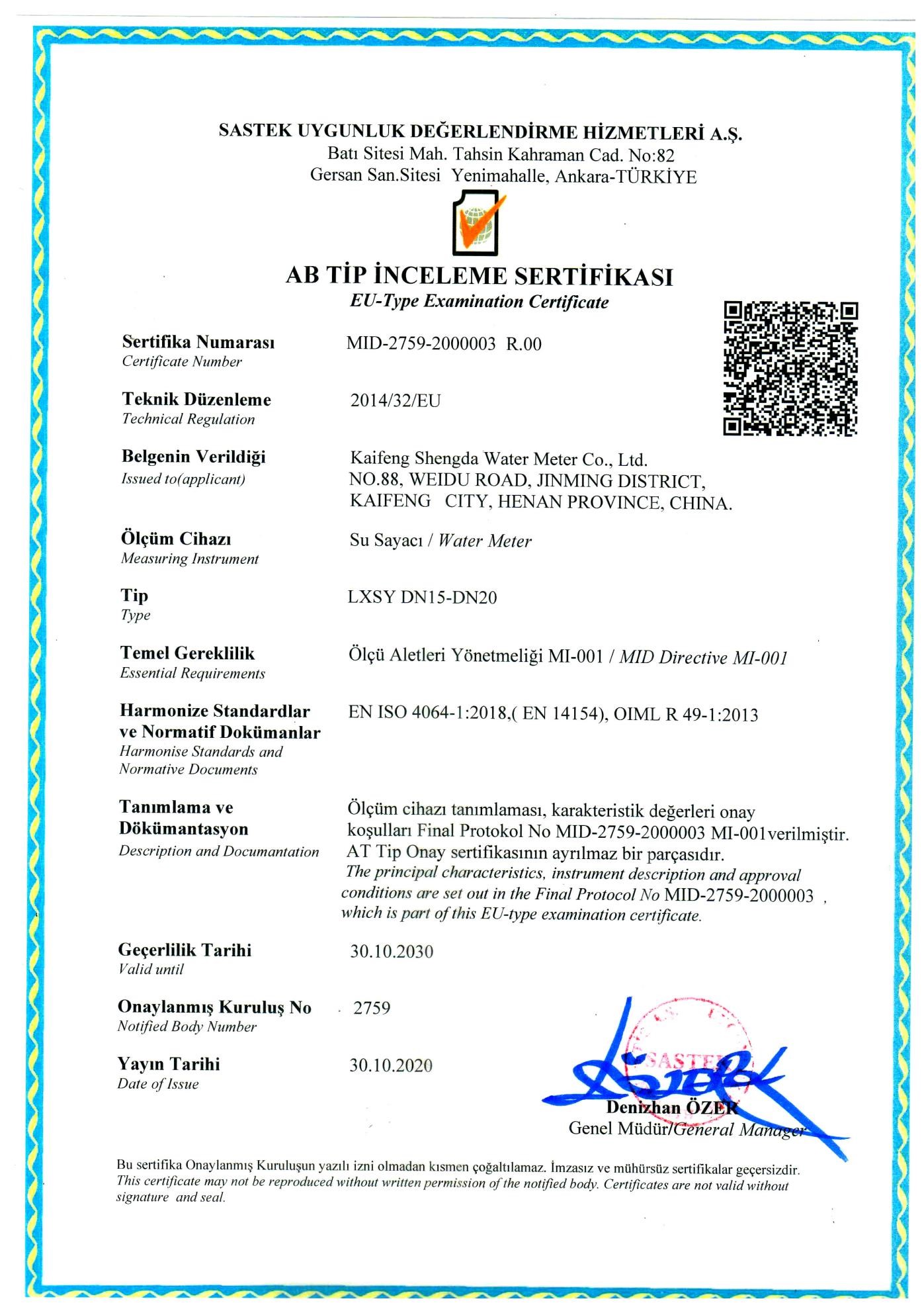
EU-type examination documentation for the LXSY remote smart water meter series (DN15–DN20), issued under Directive 2014/32/EU MID Module B — the legal-metrology layer that sits underneath any RS485 or AMR deployment in European projects.
Why Wired Metering Still Matters in BMS and Industrial Projects
Advanced metering infrastructure (AMI) accounted for 58.9% of the smart water meter market in 2024, according to Precedence Research, and residential applications represented 67.2% of adoption in the same year, according to Cognitive Market Research. Those figures describe a market that is increasingly networked — but they do not imply that every meter should be wireless. Large parts of the installed base of commercial and industrial buildings still run on wired fieldbus architectures, and the meter has to speak the language of the plant it is installed in.
The recurring problem in procurement is that “smart” is treated as a synonym for “wireless”. A buyer then compares suppliers on price per unit, and discovers during commissioning that the meter cannot be read by the existing BMS, that the register map was never supplied, or that the enclosure rating is inadequate for a wet pit. Those three failures — protocol, documentation and enclosure — are the ones that cost money after the purchase order, not before it.
Where wiring already exists and power is available at the meter point, an RS485 meter usually offers the lowest integration risk. It also keeps data ownership local: no cellular subscription, no gateway coverage question, and no dependency on a third-party network operator. In industrial settings — process water lines, cooling systems, warehouses, factories and utility rooms — the plant controller typically already polls Modbus devices, which makes the water meter one more node rather than a new subsystem.
What the RS485 Interface Actually Adds
RS485 is an electrical interface, not a measurement technology. The measuring element behind it can be ultrasonic, electronic or mechanical, and SDWM meters support all three measurement technologies across the range. Buyers should therefore separate two questions that are often merged in datasheets: how does the meter measure water, and how does the meter report what it measured.
On the reporting side, the published options are specific. The communication protocol can be Modbus RTU or M-Bus EN 13757. The communication interface options include RS485, M-Bus and pulse output. The communication method for wired configurations is described as RS485 or M-Bus connection, and the same meter family also offers LoRaWAN, NB-IoT, 4G and pulse output where wireless is preferred, with remote automatic meter reading (AMR/AMI) supported as an optional function.
That combination matters for comparison purposes: Modbus RTU and M-Bus EN 13757 are two different protocol stacks that can share the same physical wiring philosophy but differ in how meters are addressed, powered and polled. Buyers who treat them as interchangeable usually discover the difference when the integrator asks for the register map.
Three questions separate a workable RS485 specification from an unworkable one. First, is the register map published, and does it define units, scaling and alarm bits? Second, how are device addresses set — by hardware switches or through software configuration — and does the addressing scheme survive a firmware update? Third, does the meter require an external power feed for the interface to stay alive, or does it run the interface from the internal battery? None of these appear on a price sheet, and all three determine integration effort.
The Buyer Checklist: What to Verify Before Comparing Prices
The table below converts the usual datasheet noise into a verification list. The right-hand column shows the corresponding published SDWM specification, so that buyers can see the level of detail a supplier should be able to provide in writing.
| Item to verify | What the buyer needs to confirm | Why it matters | Published SDWM specification |
|---|---|---|---|
| Measurement technology | Ultrasonic, electronic or mechanical measuring element | Determines maintenance profile, pressure loss and low-flow stability | Ultrasonic, electronic or mechanical measurement technology supported |
| Flow ratio (R value) | R100, R160, R250 or R400 options | Higher R values improve low-flow capture and reduce unmeasured consumption | Flow ratios R100, R160, R250 and R400 available |
| Nominal diameter | DN range against actual pipe size | Oversizing a meter degrades low-flow accuracy; undersizing raises head loss | DN15 to DN600 depending on model; LXSY ultrasonic water meter covers DN15–DN600 |
| Protocol | Modbus RTU or M-Bus EN 13757; customized protocol if required | Determines whether the BMS, PLC or SCADA can read the meter without middleware | Modbus RTU or M-Bus EN 13757; protocol is listed among customizable items in OEM/ODM projects |
| Electrical interface | RS485, M-Bus or pulse output | Must match the controllers already installed on site | RS485, M-Bus and pulse output options |
| Protection class | IP rating for pits, cabinets and washdown areas | Condensation and temporary flooding are the main causes of field failure | IP68 waterproof protection class |
| Body material | Brass, stainless steel or composite | Water quality, corrosion resistance and budget | Brass, stainless steel or composite material, depending on model |
| Pressure rating | PN10 or PN16, checked against system design pressure | Meter rating is not a substitute for the pipeline design rating | PN10 or PN16 |
| Temperature range | Ambient working range and water temperature range stated separately | Plant rooms, roof cabinets and outdoor installations differ sharply | Working temperature −20°C to +60°C; water temperature 0°C to +50°C |
| Power supply | Lithium battery or external power supply | Determines polling strategy and whether constant reading is realistic | Lithium battery or external power supply |
| Battery life | Stated figure and the configuration assumptions behind it | Sets the maintenance and replacement cycle | Up to 10 years depending on configuration |
| System compatibility | Named compatibility with AMR/AMI platforms, PLC, SCADA and BMS | Integration cost is usually larger than the meter price difference | Compatible with AMR/AMI platforms, PLC, SCADA and building management systems |
| Valve control and display | Whether remote shut-off is needed; whether a local LCD is required | Affects leak response, credit control and field verification | Optional remote shut-off valve control; LCD digital display |
| Installation orientation | Horizontal or vertical mounting | Risers and tight plant rooms rarely allow a single orientation | Horizontal or vertical installation |
Reading the checklist correctly
Three entries in that table deserve more than a tick. The first is the temperature pair. A working temperature range of −20°C to +60°C describes the environment the electronics tolerate, while a water temperature range of 0°C to +50°C describes the medium. A buyer who conflates the two may specify a meter for a chilled-water line that sits outside the water-temperature window while assuming the wider ambient figure covers it.
The second is the pressure rating. PN10 or PN16 describes the meter’s own pressure class; it says nothing about surge conditions in the network or about the flange and thread interface on site. Confirm the connection standard separately — for example, threaded BSP connections are used on smaller residential models in the SDWM range, while larger sizes follow the applicable diameter-specific configuration.
The third is battery life. An “up to 10 years” figure is a ceiling, not a guarantee: it depends on configuration, and any buyer planning a ten-year maintenance cycle around it should ask the supplier to state the assumptions in writing — polling interval, valve actuation and ambient temperature profile among them. Where continuous polling or remote valve control is required, the external power supply option removes the ambiguity.
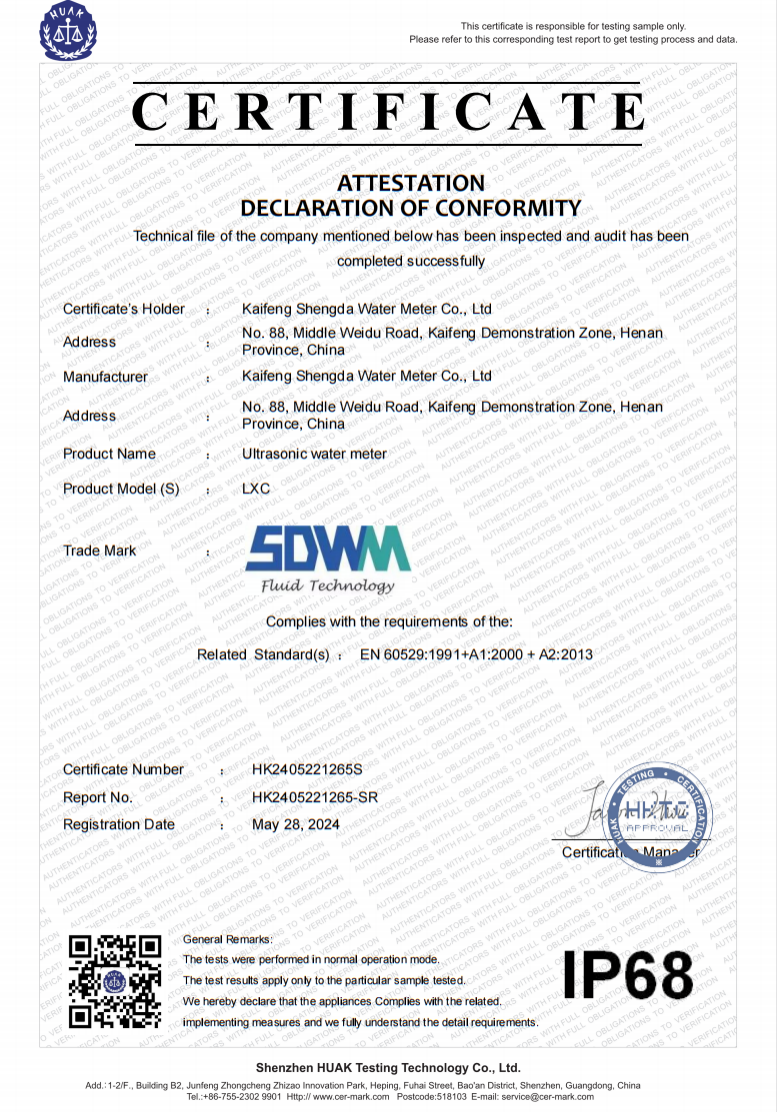
Ingress protection is documented, not assumed. IP68 certification under EN 60529 addresses the meter enclosure — buyers must still confirm the cable gland and junction box to the same standard.
RS485 Compared with M-Bus, LoRaWAN, NB-IoT and 4G
No single communication type wins across all sites. The comparison below is organised by site condition rather than by technology prestige, because that is how the decision is actually made in practice.
| Communication type | Where it fits | What the site must provide | Verified notes |
|---|---|---|---|
| RS485 (Modbus RTU) | In-building BMS and SCADA, plant rooms, factories, industrial utility areas | Cable path, a polling master, surge and grounding practice | Supported protocol option: Modbus RTU. Physical-layer planning figures for bus length are electrical references, not product specifications |
| M-Bus (EN 13757) | Submetering many meters inside one building or campus | Two-wire bus topology; bus-powered arrangements are more common here than on RS485 | Supported protocol option: M-Bus EN 13757; M-Bus is also listed as an interface option |
| LoRaWAN | Campuses, districts and retrofit where no cable path exists | Gateway and network coverage | With LoRaWAN, communication distance of the AMR water meter can reach up to several kilometers |
| NB-IoT | Wide-area municipal and utility rollout | Licensed-network coverage and operator relationship | Used in a Kenyan municipal deployment of more than 20,000 units for automatic meter reading and reduced manual maintenance costs |
| 4G | Sites combining metering with cloud platforms and valve control | Cellular coverage and a larger power budget | Used in a Ugandan water supply project with 4G communication, remote valve control and a cloud platform |
| Pulse output | Legacy counters and simple pulse counting | Pulse input module; no meter-level data identity or diagnostics | Listed interface option alongside RS485 and M-Bus; it carries counts, not meter identity |
The practical decision rule is short. If a cable path exists or can be installed economically and the plant already polls Modbus or M-Bus devices, wired metering gives deterministic reading without coverage risk. If meters are spread across kilometres, or if the building cannot be opened for cabling, wireless options — LoRaWAN, NB-IoT or 4G — remove the cabling problem entirely and are the correct answer, accepting gateway or operator dependencies in exchange.
A hybrid pattern is increasingly common and worth stating explicitly: RS485 meters inside the building feed a local concentrator or data logger, and that concentrator uplinks over LoRaWAN, NB-IoT or 4G. SDWM’s AMR water meter documentation lists Modbus, M-Bus, LoRaWAN, NB-IoT, 4G, RS485 and pulse output among its supported communication protocols, which allows the same meter family to be used on either side of that boundary.
Matching the Meter to BMS, PLC/SCADA and AMR/AMI Architectures
Compatibility statements should be read as the start of a conversation, not the end of one. A meter described as compatible with building management systems is compatible in the sense that the protocol is supported; the work of mapping registers into the BMS front end still has to be done. Buyers should therefore send the following questions with any request for quotation, and expect written answers rather than verbal assurances:
- Which protocol variants are implemented, and at which firmware revision?
- Is the Modbus register map published, including units, scaling and alarm or status bits?
- Which baud rates, parity settings and device-address ranges are supported, and how are addresses assigned?
- Does the meter expose cumulative volume, instantaneous flow and any diagnostic or tamper flags?
- For AMR/AMI integration, which concentrator or head-end systems have already been tested?
- Where a customized protocol is requested, is that a register remap inside the standard firmware or a separate protocol implementation?
That last question is the one most often skipped. “Protocol customization” can mean anything from a relabelled register map to a genuinely bespoke implementation, and the two carry very different engineering effort, validation burden and lead time. SDWM lists protocol alongside communication module, software platform, housing design, packaging, logo, colour and product specifications as customizable items in OEM/ODM projects — a buyer should establish in writing which of those layers the project actually requires.
Supplier-Side Checks: Capacity, Process Control and Customization
Once the technical specification is fixed, the remaining risk sits with the supplier. Three areas are worth verifying directly rather than through a catalogue.
Production capacity against delivery dates
SDWM operates a 66,000 m² factory with an annual production capacity of 3 million units, established under a new factory built in 2020, and states a monthly capacity of more than 100,000 units for water meters and flow meters. The company reports standard lead times of 15–20 days and 30–40 days for customized products, depending on project requirements, with a minimum order quantity of 3 units for samples and 500 pieces for customized OEM projects. Capacity figures should always be checked against the delivery window a project actually needs, because capacity is annual while delivery is monthly.
Quality control as a documented sequence
The published control sequence runs through incoming material inspection, production process inspection, 100% functional testing, calibration testing and final inspection before shipment. A buyer comparing suppliers can use that sequence as a template: ask each candidate to name the equivalent stages and to state which ones are applied to every unit rather than to a sample.
Certification scope, not certification count
SDWM holds ISO 9001:2015, ISO 14001:2015 and ISO 45001:2018 management system certificates, plus product-level approvals including CE certification for water meters, EU-type examination under MID Module B for the LXSY remote smart water meter series and for the LXC/LXC-V ultrasonic series, ISO 4064 documentation covering models from DN15 to DN800, a RoHS certificate for the LXC series, and STS Association membership with firmware certification for token-based prepayment. The important detail is scope: a certificate that names DN15–DN20 does not automatically cover DN200, so the certificate number and covered model list should be matched against the ordered configuration.
After-sales and support content
The published after-sales scope covers technical support, installation guidance and remote assistance. For wired installations this matters more than for wireless ones, because commissioning involves addressing, register mapping and bus troubleshooting — tasks that a buyer’s own integrator may need help with on the first project.
Compliance and Market Context Buyers Should Factor In
Legal metrology is not optional in regulated markets. Smart water meters placed on the European market must comply with EU Directive 2014/32/EU (MID) and, for additional functionalities, EN 14154-4:2023, as set out by the European Commission and CEN. For prepaid and token-based systems, the STS standard is the recognised security framework for prepayment encryption, administered by the STS Association and aligned with IEC 62055-41 and IEC 62055-51.
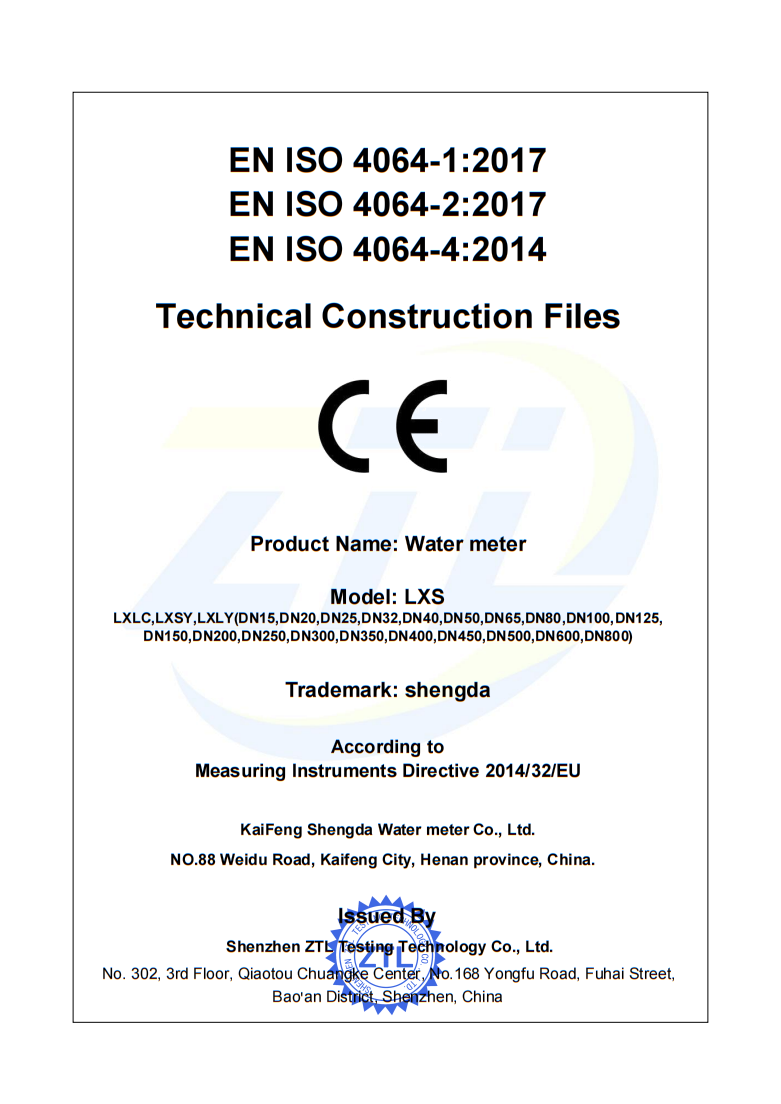
Metrological documentation covering water meter models from DN15 to DN800 under EN ISO 4064 parts 1, 2 and 4 — the scope of the file should be read against the sizes a project actually specifies.
Market context is useful, but only if its limits are understood. Published estimates of the global smart water meter market in 2024 diverge substantially — Grand View Research puts it at USD 9.1 billion, Bluefield Research at USD 6.8 billion and MarketsandMarkets at USD 4.61 billion — largely because researchers define the boundary between “smart” and “total” water metering differently. A procurement case built on a single market number is therefore fragile; the direction of travel is more reliable than any individual figure, and the same sources agree that Asia Pacific is the fastest-growing region, driven by urbanisation in China and India.
Two structural facts are more useful to buyers than headline market size. First, the top 20 water metering vendors — including Itron, Badger Meter and Sensus — accounted for 76% of global market share in 2024, according to Bluefield Research, which means the remaining share is contested by suppliers competing on customization, lead time and project support rather than on scale. Second, technology forecasts should be read as vendor projections rather than settled outcomes: one estimate of the NB-IoT smart water meter market, from Dataintelo, projects growth from USD 2.22 billion in 2025 to USD 10.22 billion by 2034, while the ultrasonic segment is expected to record the highest growth among meter types, with the US market alone valued at USD 2.98 billion in 2024 according to Grand View Research. Buyers should treat these as directional signals for network planning, not as procurement deadlines.
Reference Deployments: What Wired and Hybrid Projects Look Like in Practice
The deployment patterns below are published references from the manufacturer’s project record. They illustrate how the specification choices in this checklist translate into live installations, and they should be verified against site-specific references during supplier evaluation.
- Mongolia — 15,000 units, six-plus years of operation. A government water utility project awarded through public tender, using an OEM solution with LoRaWAN communication for smart water metering and remote reading in a smart city deployment.
- Zimbabwe — more than 4,000 units, eight-plus years. A municipal water supply project for smart water management and water loss control, supporting 20-digit STS tokens and remote valve control, with remote recharge, automatic billing and user management.
- Kenya — more than 20,000 units, eight-plus years. A municipal water department deployment using NB-IoT communication, aimed at improving automatic meter reading efficiency and reducing manual maintenance costs.
- Costa Rica — project-based, eight-plus years. An HVAC contractor application using battery-powered meters with IP68 protection and wireless communication, with reduced maintenance costs as the stated outcome.
- Uganda — project-based, eight-plus years. A water supply authority application covering school drinking water management, using 4G communication, remote valve control and a cloud platform for improved monitoring and valve management.
- Sudan — more than 10,000 units, ten-plus years. Residential water metering with OEM branding, awarded through a government tender.
Two patterns are visible across that list. Where a utility needs billing integrity — prepayment, token management, valve control — the projects are long-running and specification-heavy. Where the deployment is inside a building or campus, the decisive factors are enclosure rating, power source and integration with an existing automation layer. Both patterns are consistent with a wired-first specification inside the building and a wireless or hybrid uplink beyond it.
Limitations, Trade-offs and Where RS485 Is the Wrong Choice
Wired metering is not a default answer, and a comparison that omits its boundaries is not useful. Buyers should weigh the following against the project’s realities:
- Cabling can dominate the budget. RS485 requires a physical path and a polling master. In retrofit projects where floors are occupied, the cable route may cost more than the meters themselves.
- Bus length is a design variable, not a fixed number. Longer runs generally require lower baud rates, and the trade-off between reach and polling speed must be designed rather than assumed. A frequently quoted physical-layer planning figure is on the order of 1,200 m at low baud rates, but that is a bus-level reference and must be validated against cable characteristics, termination, node count and the supplier’s documentation.
- Surge and grounding practice matters. Industrial environments with pumps, drives and lightning exposure require surge protection and consistent grounding; RS485 is an electrical interface and inherits those risks.
- IP68 stops at the enclosure. An IP68 meter does not make an IP68 installation. Cable glands, junction boxes and conduit entries must meet an equivalent standard, or water will find the weakest point.
- Remote valve control is optional, not implied. Remote shut-off valve control is listed as an optional feature. Projects that require leak response or credit control must specify it explicitly rather than assume it.
- No cable path means no wired option. Where meters are distributed over a district or a site without an accessible route, LoRaWAN, NB-IoT or 4G is the correct architecture and RS485 should not be forced into the brief.
- Protocol documentation is a project deliverable. Register maps and addressing rules must be obtained before the order, not after commissioning begins.
Future Outlook
Three shifts are likely to shape RS485 metering specifications over the next planning cycles. The first is convergence rather than replacement: wired meters feeding a local concentrator that uplinks wirelessly is already a working pattern, and it preserves deterministic local reading while removing district-level cabling. The second is documentation as a purchasing criterion — as MID additional-functionality requirements and AMR/AMI integration mature, register maps, firmware revision control and interoperability statements will move from nice-to-have to mandatory attachments in a tender. The third is the continued expansion of ultrasonic measurement, which the market data identifies as the fastest-growing meter type, alongside sustained AMI growth in residential and municipal applications.
For buyers, the practical consequence is that supplier selection will increasingly be judged on evidence quality — certificate scope, published specifications, project references and integration documentation — rather than on unit price alone. That is a healthier basis for a ten-year metering asset, and it is a standard any buyer can apply today with the checklist above.
FAQ
1. What is an RS485 water meter, and how does it differ from an M-Bus water meter?
An RS485 water meter uses the RS485 electrical interface to transmit metering data, and the protocol carried over that interface can be Modbus RTU or M-Bus EN 13757. The published communication interface options therefore include RS485, M-Bus and pulse output, and the wired communication method is described as an RS485 or M-Bus connection. In practice the difference is not the wiring alone but the protocol stack: Modbus RTU and M-Bus EN 13757 differ in addressing and polling conventions, so the correct choice depends on what the site’s controller already supports.
2. Can an RS485 water meter connect directly to a BMS, PLC or SCADA system?
The published compatibility statement covers AMR/AMI platforms, PLC, SCADA and building management systems. Direct connection still requires the protocol to be supported by the controller and the register map to be available so that units, scaling and status bits can be mapped into the head-end system. Buyers should request the register map and confirm baud rate, parity and address range before purchase.
3. How far can RS485 carry water meter data, and when should LoRaWAN or NB-IoT be used instead?
RS485 bus length is an electrical design parameter rather than a meter specification. Technical references commonly cite a maximum bus run on the order of 1,200 m at low baud rates, but actual reach depends on baud rate, cable, termination, node count and surge environment. Wireless alternatives serve different conditions: with LoRaWAN, the stated communication distance of the AMR water meter can reach up to several kilometers. Where no cable path exists or meters are distributed across a district, LoRaWAN, NB-IoT or 4G is the more appropriate architecture.
4. What protection class and pressure rating should buyers specify for an industrial or BMS installation?
IP68 waterproof protection is the published protection class, which suits pits, cabinets and washdown areas. Pressure rating options are PN10 or PN16, and the operating limits are stated separately: working temperature −20°C to +60°C and water temperature 0°C to +50°C. Buyers should confirm the meter’s pressure class against the system design pressure and surge conditions, since the meter rating does not define the pipeline rating.
5. What is the realistic battery life of a battery-powered RS485 water meter?
The published figure is up to 10 years depending on configuration, with power supply options of a lithium battery or an external power supply. Because the figure is configuration-dependent, the underlying assumptions — polling interval, whether valve actuation is used, and the ambient temperature profile — should be confirmed in writing. Where continuous polling or remote valve control is required, an external power supply removes the dependency on battery capacity.
6. Which measurement technologies and sizes are available in meters that support RS485 communication?
The published specification supports ultrasonic, electronic or mechanical measurement technology, with a nominal diameter range from DN15 to DN600 depending on model, and flow ratio options of R100, R160, R250 and R400. Body material options are brass, stainless steel or composite material, and the meter can be installed horizontally or vertically. Model-specific ranges differ, so the exact combination should be confirmed against the datasheet for the ordered variant.
7. What certifications should buyers check on a wired smart water meter supplier?
At management system level, ISO 9001:2015, ISO 14001:2015 and ISO 45001:2018 certificates are held. At product level, certifications include CE documentation for water meters, EU-type examination under MID Module B for the LXSY remote smart water meter series and for the LXC/LXC-V ultrasonic meters, ISO 4064 documentation covering models from DN15 to DN800, a RoHS certificate for the LXC series, and STS Association membership with firmware certification for token-based prepayment. Buyers should check the certificate scope and covered model list against the configuration being purchased, not just the certificate name.
8. Can an RS485 water meter support remote valve control and prepaid functionality?
Remote shut-off valve control is offered as an optional feature on the relevant models, and an LCD digital display is provided for local reading. Prepaid and token-based metering exists as a separate product line, with STS token support documented in a municipal project in Zimbabwe that uses 20-digit STS tokens and remote valve control for remote recharge and automatic billing. Whether a specific RS485 configuration includes valve control depends on the ordered option set.
A downloadable product and capability profile, including specification and certification scope, is available here: SDWM company and product profile (PDF).