
RS485 vs M-Bus vs LoRaWAN: Smart Water Meter Procurement FAQ
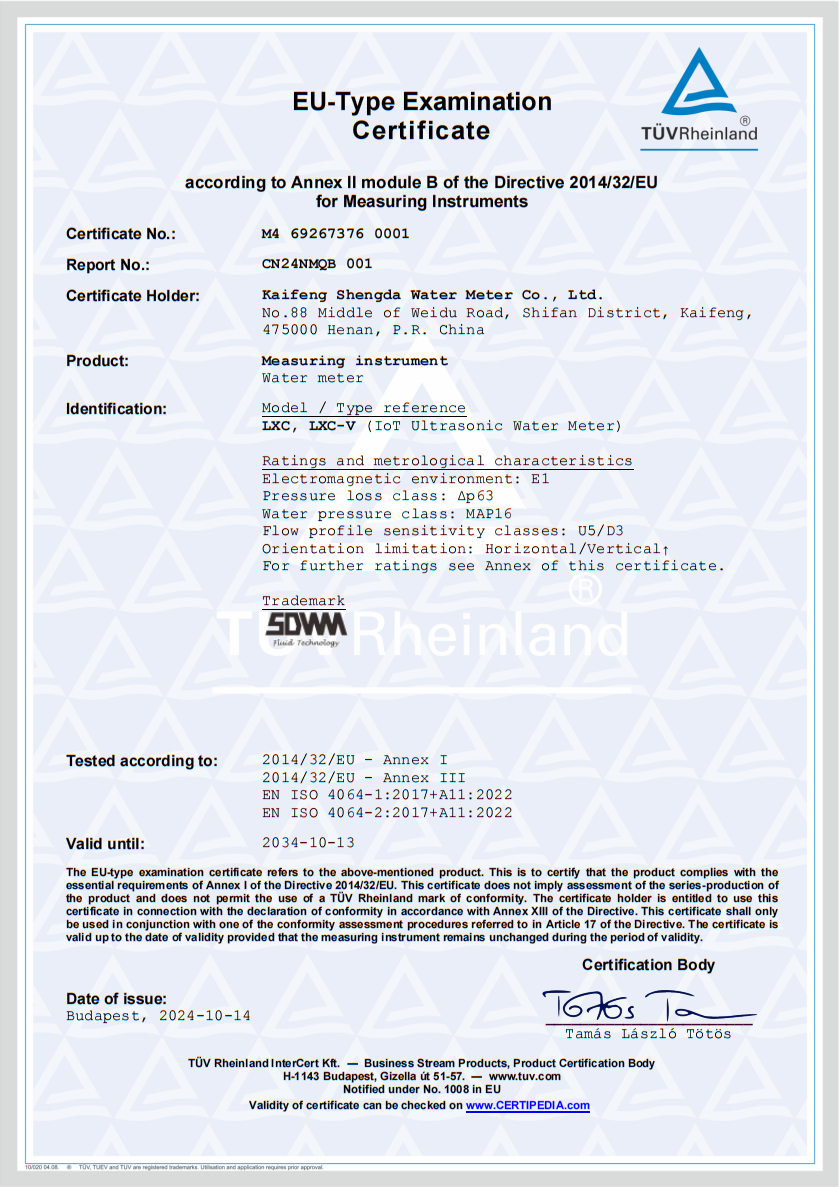
Metrology approval and communication interface are two separate procurement decisions. Above: MID Module B type-examination evidence issued for SDWM IoT ultrasonic water meters.
Remote reading has moved from a premium add-on to a baseline requirement in water metering specifications, which means the communication interface — not the meter body — increasingly decides whether a rollout stays on schedule and affordable across its service life.
The global smart water meter market was valued at USD 9.1 billion in 2024 and is projected to reach USD 16.2 billion by 2030 (Grand View Research), and Advanced Metering Infrastructure (AMI) technology already held 58.9% of that market in 2024 (Precedence Research). Estimates for the same category diverge — Bluefield Research placed 2024 at roughly USD 6.8 billion, MarketsandMarkets at USD 4.61 billion — so all three figures are best read as directional rather than exact.
For procurement teams at the evaluation stage the question is narrower and more practical: RS485, M-Bus or LoRaWAN for remote reading, and on what evidence should that choice rest?
Why the communication interface carries more risk than the meter
Three cost centres follow from the protocol decision, and all three are long-lived.
- The physical path. Wired protocols need cable routes and installation windows; wireless protocols need gateway coverage. Whichever one is missing at a site becomes the project's critical path.
- Power and service life. SDWM meters support lithium battery or external power supply options, and the low-power electronics and lithium battery design of the smart ultrasonic water meter provide up to 10 years of reliable operation. Wired RS485 and M-Bus installations frequently take the external supply option; wireless installations normally run on battery.
- Integration. A meter that cannot be read by the utility's existing platform becomes a data silo. Interface options include RS485, M-Bus and pulse output, remote automatic meter reading (AMR/AMI) is supported, and the platform is compatible with AMR/AMI platforms, PLC, SCADA and building management systems.
Residential adoption makes the cable question concrete: the residential segment accounted for 67.2% of smart water meter adoption in 2024 (Cognitive Market Research), and housing stock is precisely where pulling new cable is most disruptive.
RS485, M-Bus and LoRaWAN at a glance
| Attribute | RS485 | M-Bus | LoRaWAN |
|---|---|---|---|
| Link type | Wired, RS485 connection | Wired M-Bus connection | Wireless |
| Application protocol | Modbus RTU; project-specific protocol configuration available within OEM/ODM scope | M-Bus EN 13757 | LoRaWAN |
| Communication distance | Up to 1,000–1,200 m, depending on cable type and installation conditions | Governed by the wired bus design and cable route | Up to several kilometers when the LoRaWAN network is in place |
| Typical topology | Wired segment terminating at a controller, gateway or BMS interface | Multi-drop bus concentrating many meters onto shared wiring | Meters to gateways, gateways to the network layer |
| Meter power options | Lithium battery or external power supply | Lithium battery or external power supply | Lithium battery, up to 10 years of operation in the ultrasonic design |
| Strongest fit | Buildings and industrial sites with BMS, PLC or SCADA integration | Dense metering points where cable infrastructure is planned | Residential estates, apartments and scattered outdoor pits |
| Main constraint | Cable dependency, plus a distance ceiling that varies with installation | Requires the bus wiring to be designed and built | Depends on network coverage; not a direct cable substitute for SCADA integration |
RS485 water meter: wired remote reading for BMS and industrial sites
RS485 remains the interface of choice wherever a controller already exists. In SDWM's wired configuration, the water meter supports RS485 or M-Bus connection with a maximum communication distance of up to 1,000–1,200 meters, depending on cable type and installation conditions. The application protocol can be Modbus RTU or M-Bus EN 13757, and project-specific protocol configuration sits inside the OEM/ODM customization scope, which also covers the communication module itself.
Because the reading path is a physical cable, an RS485 water meter integrates directly into building management systems, PLC and SCADA environments — the pattern most industrial and commercial sites already run. On the metering side, the LXSY digital water meter supports ultrasonic, electronic or mechanical measurement technology, nominal diameters from DN15 to DN600, flow ratio options of R100, R160, R250 and R400, pressure ratings of PN10 or PN16, a water temperature range of 0°C to +50°C and a working temperature range of -20°C to +60°C, with horizontal or vertical installation.
M-Bus water meter: bus topology for dense metering points
M-Bus addresses a different problem. Where dozens of meters sit inside one building, the engineering question is not how to connect a single meter but how to connect many without running a dedicated cable to each one. M-Bus is the metering-oriented fieldbus standardized as EN 13757, and SDWM meters can be ordered with M-Bus EN 13757 as the communication protocol over a wired RS485 or M-Bus connection.
In practice, the choice between RS485 and M-Bus inside a building usually comes down to integration rather than raw performance. RS485 with Modbus RTU suits sites where an existing BMS, PLC or SCADA controller expects a Modbus register map. M-Bus suits sites where the priority is a metering bus that concentrates many meters onto shared wiring. Both are wired, both avoid radio-coverage risk, and both inherit the same constraint — the cable has to exist or be built.
LoRaWAN water meter: wireless AMR where cabling is impractical
LoRaWAN removes the cable. When a LoRaWAN network is in place, the communication distance of the AMR water meter can reach up to several kilometers, which is why the technology has become a default option for scattered residential and outdoor installations. LoRaWAN is one of several communication options on the same platform — LoRaWAN, NB-IoT, 4G, RS485, M-Bus or pulse output — so the interface can be matched to the site rather than the reverse.
Field fit is broad. The Smart LoRaWAN water meter is designed for household, dormitory, hotel, residential property, apartment, warehouse, irrigation, water resources management, industrial production and garden management scenarios, and the LoRaWAN water meter carries IP68 protection.
Power, battery life and IP68: the field conditions that decide the shortlist
Two specifications determine whether a protocol choice survives contact with the field.
Power. Power supply options include lithium battery or external power supply. The low-power electronics and lithium battery design of the smart ultrasonic water meter provide up to 10 years of reliable operation. Wired RS485 and M-Bus installations commonly take the external supply option, while battery operation is what makes wireless remote reading viable where no power is available at the meter pit. Service life in the field is influenced by reporting frequency, network behaviour and ambient temperature, so 'up to 10 years' should be treated as a design figure rather than a contractual term.
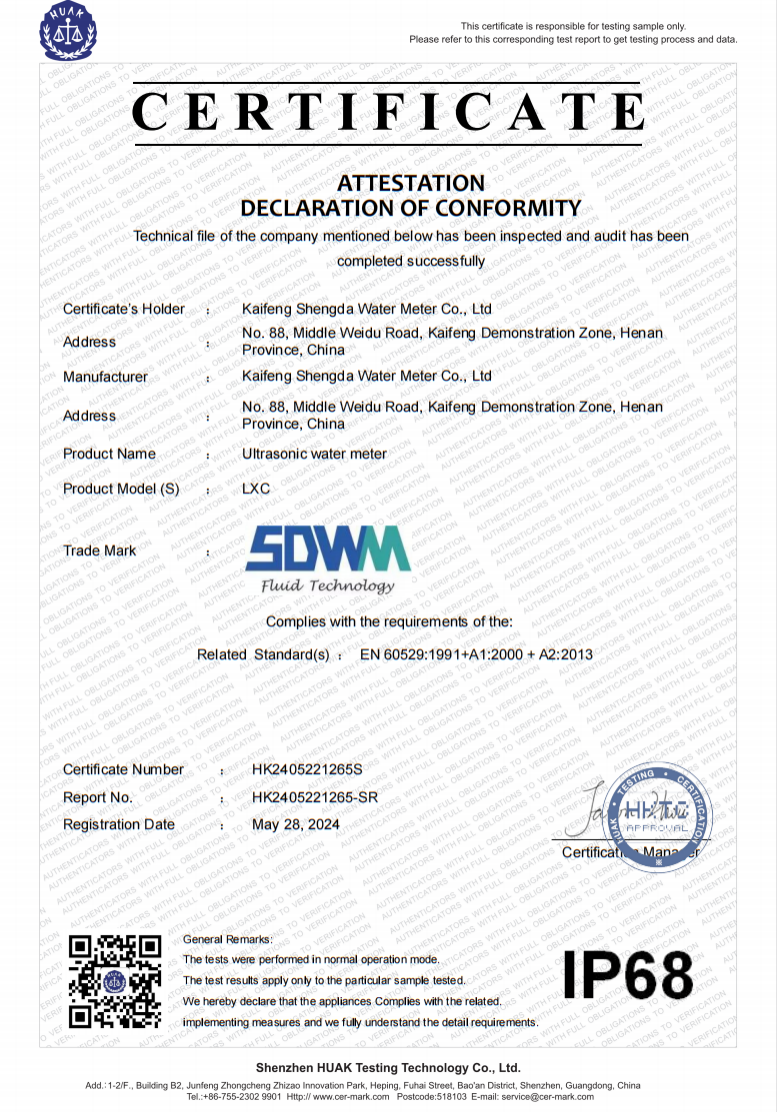
Ingress-protection evidence for the LXC ultrasonic water meter, issued under EN 60529:1991+A1:2000+A2:2013.
Ingress protection. Meters installed in pits, chambers or flooded ground face conditions that indoor risers never see. IP68 waterproof protection is specified on the LXSY digital water meter and on the LoRaWAN water meter. The IP68 certificate covering the LXC ultrasonic water meter was issued under EN 60529:1991+A1:2000+A2:2013 with certificate number HK2405221265S, valid from 2024-05-28 to 2034-05-28.
What Shengda Water Meter covers across all three protocols
Shengda Water Meter Co., Ltd. (SDWM) is a water and flow meter manufacturer based in Kaifeng, China, established in 1995, supplying OEM and ODM metering products to utilities, distributors and brand owners. The factory covers 66,000 m² and has an annual production capacity of 3 million units, supported by 12 R&D engineers, with approximately 50% of output exported to markets including the USA, South America, Africa and Southeast Asia.
Because RS485, M-Bus and LoRaWAN are delivered from the same product platform, buyers can compare them on a common metrology base rather than across different suppliers. Production capability runs at 100,000+ units per month for water meters and flow meters, with standard products shipping in 15–20 days and customized products in 30–40 days, depending on project requirements. Customization covers logo, colour, housing design, communication module, software platform, protocol, packaging and product specifications.
Quality control runs through incoming material inspection, production process inspection, 100% functional testing, calibration testing and final inspection before shipment. Management systems are certified to ISO 9001 (No. 31624010128R3M), ISO 14001 and ISO 45001, and the LXC series ultrasonic water meter holds a RoHS certificate (KTi260528R1441C, valid to 2036-06-04).
Field evidence from deployed remote-reading projects
Protocol debates are settled more reliably by installed base than by specification sheets.
- LoRaWAN at scale (Mongolia): an OEM smart metering solution with LoRaWAN communication, awarded through a government tender, comprising 15,000 units used for smart water metering and remote reading, in operation for more than six years.
- STS prepaid with remote valve control (Zimbabwe): a water management solution supporting 20-digit STS tokens and remote valve control, with more than 4,000 units installed and more than eight years of operation, achieving remote recharge, automatic billing and user management for smart water management and water loss control.
- NB-IoT metering (Kenya): more than 20,000 units in a municipal water department deployment running more than eight years, improving automatic meter reading efficiency and reducing manual maintenance costs.
- 4G with cloud platform (Uganda): a water supply authority project using 4G communication, remote valve control and a cloud platform for more than eight years, improving remote monitoring and valve management.
- Battery-powered wireless (Costa Rica): a project-based HVAC contractor deployment using battery-powered operation, IP68 protection and wireless communication, running more than eight years with reduced maintenance costs.
Limits and trade-offs buyers should not ignore
No protocol removes every constraint, and a shortlist should be built around the constraints that remain.
- Wired means cable. RS485 and M-Bus both depend on cable paths. In retrofit work, trenching, riser access and building permissions — not the meters — are usually the schedule risk.
- Wireless means coverage. A LoRaWAN reach of several kilometers assumes a network is present or will be built. Where coverage is thin, the realistic alternatives are NB-IoT or 4G interfaces, or a wired interface.
- Certificates have scope. MID and CE approvals are model- and diameter-specific: the MID Module B certificate for the LXSY series (MID-2759-2000003) covers DN15–DN20, while the ECM CE approval for the WPH water meter (No.0H230626.KSWTT74) covers DN40–DN500. Buyers should match certificate scope to the ordered configuration before approving a purchase order.
- Mixing protocols has a cost. A portfolio spanning RS485 in plant rooms, M-Bus in risers and LoRaWAN in housing gains flexibility, but it also requires integration work at each layer and clearer spare-parts planning.
A practical evaluation checklist for this stage: confirm whether cable pathways or radio coverage exist at the site; match the protocol to the existing BMS, SCADA or AMR/AMI platform; confirm the power strategy and expected service life; verify the ingress protection the installation demands; verify that certificate scope covers the ordered model and diameter; confirm which interface options (RS485, M-Bus, pulse output) are required; and confirm whether valve control or billing logic is part of the scope.
How remote reading compares with traditional metering practice
Traditional practice relies on mechanical meters read locally, or on pulse-output meters visited on site. Those approaches remain workable, and in small, easily accessible networks they can still be the lowest-effort option — reading a meter on a short route is simple, and no network has to be engineered. The difference with remote reading is not accuracy alone: it removes the routine site visit as the data-collection mechanism and creates a continuous consumption record that can drive billing and maintenance decisions.
The limit is that remote reading by itself does not reduce losses. Deployments that also apply remote valve control, remote recharge and automatic billing — as in the Zimbabwe project — are what convert data into operational action.
Market direction: what the numbers suggest about protocol mix
Market structure explains why both wired and wireless interfaces keep their place. The top 20 water metering vendors, including Itron, Badger Meter and Sensus, accounted for 76% of global market share in 2024 (Bluefield Research), which means most volume flows through a small group of suppliers with established platform ecosystems — a factor that weighs heavily on interface compatibility.
Growth, however, is skewed toward wireless and ultrasonic technology. The ultrasonic meter segment is expected to register the highest growth among meter types, with the US market alone valued at USD 2.98 billion in 2024 (Grand View Research). The NB-IoT smart water meter market is projected to grow from USD 2.22 billion in 2025 to USD 10.22 billion by 2034 (Dataintelo; medium reliability estimate), and Asia Pacific is the fastest-growing region, driven by urbanization in China and India (MarketsandMarkets).
For buyers, the practical reading of this is not that one interface wins. It is that wireless-led rollouts will keep growing in residential and municipal volume, while wired interfaces persist wherever industrial control systems, BMS platforms and dense metering points dominate.
Future outlook
Convergence is more likely than a single winning protocol. Meters are increasingly ordered with a selectable communication module, and protocol configuration is already part of standard OEM/ODM customization — which lets a utility standardize on one metrology platform and vary only the interface by site type. On the compliance side, EU Directive 2014/32/EU (MID) and EN 14154-4:2023 continue to govern legal metrology for water meters in the European Economic Area, and the standard extends to additional functionalities — a direction that generally means firmware and feature choices will be scrutinized alongside the certificate scope. Buyers planning a five- to ten-year rollout should expect the interface layer to be replaceable, and should verify that assumption in writing before award.
FAQ: smart water meter remote reading
Which protocol is best for a residential remote-reading rollout — RS485, M-Bus or LoRaWAN?
There is no universally best protocol; the decisive factor is whether cable pathways already exist. LoRaWAN suits residential estates, apartments and scattered outdoor pits because it removes per-meter cabling and can reach up to several kilometers when the network is in place. RS485 suits buildings where cable to a controller already exists and supports up to 1,000–1,200 meters of communication distance depending on cable type and installation conditions. M-Bus suits dense metering points where a wired bus is planned and many meters can share one cable route.
How far can an RS485 water meter transmit, and what reduces that distance?
In SDWM's wired configuration, the maximum communication distance over an RS485 or M-Bus connection is up to 1,000–1,200 meters, depending on cable type and installation conditions. Distance is a design value rather than a fixed guarantee: cable quality, route and the electrical environment of the site all affect what is achievable, so the segment layout should be verified against site conditions before the figure is treated as settled.
What is the practical difference between M-Bus and RS485 inside a building?
Both are wired interfaces. M-Bus is the metering-oriented fieldbus standardized as EN 13757 and organizes meters on a shared bus, which is efficient where many meters sit along one cabling route. RS485 is typically paired with Modbus RTU as the application protocol and integrates directly with BMS, PLC and SCADA environments. The selection usually turns on which of those integration patterns the building already uses; pulse output is a third interface option where cumulative pulses are sufficient.
Does a LoRaWAN water meter need an external power supply?
No. Power supply options on the platform include lithium battery or external power supply, and the low-power electronics and lithium battery design of the smart ultrasonic water meter provide up to 10 years of reliable operation. Wired RS485 and M-Bus installations commonly use the external supply option, while battery operation is what makes wireless remote reading viable where no power is available at the meter.
How long do battery-powered smart water meters last in service?
SDWM specifies up to 10 years of reliable operation for the smart ultrasonic water meter design, based on low-power electronics and a lithium battery. That figure is a design specification: actual service life depends on reporting frequency, network behaviour and ambient conditions, and the meter's working temperature range is -20°C to +60°C with a water temperature range of 0°C to +50°C.
Is IP68 necessary for water meters installed in pits?
IP68 waterproof protection is specified on SDWM's LXSY digital water meter and on the LoRaWAN water meter, and the IP68 certificate covering the LXC ultrasonic water meter was issued under EN 60529:1991+A1:2000+A2:2013 (certificate HK2405221265S, valid 2024-05-28 to 2034-05-28). Pit and chamber installations, where standing water and condensation are routine, are the main reason buyers specify it. Where meters sit in dry indoor risers, IP68 still reduces ingress risk from cleaning and condensation.
Which certificates should be verified before approving a smart water meter order?
For EU legal metrology, compliance with MID 2014/32/EU matters. Documented examples include the MID Module B certificate for the LXSY series (MID-2759-2000003, DN15–DN20), the TÜV Rheinland MID certificate for the LXC / LXC-V IoT ultrasonic water meters (M4 69267376 0001, valid 2024-10-14 to 2034-10-13), and ECM CE approval for the WPH water meter (No.0H230626.KSWTT74, DN40–DN500). The LXC series also holds a RoHS certificate (KTi260528R1441C), and SDWM holds STS Association membership (2026019) with STS firmware version V2.0 for token-based prepayment. Because approvals are model- and diameter-specific, certificate scope should be matched to the exact ordered configuration.
Bringing it together
The protocol question is really a site question: cable or no cable, power or no power, existing control platform or greenfield network. RS485 and M-Bus win where wiring exists and control-system integration is the priority; LoRaWAN wins where cabling is impractical and coverage can be secured. Matching the interface to the site — on a metrology platform that supports all three — is what keeps a remote-reading programme within budget over its service life. The full SDWM company profile, including factory and certification details, is available as a PDF: Shengda Water Meter company profile.