
RTP Supplier Capability Audit: ZYfire Plant, Lab, Delivery
RTP Supplier Capability Audit: ZYfire Plant, Lab, Delivery
Reinforced thermoplastic pipe (RTP) purchases rarely fail on the specification sheet. They fail later, when a buyer discovers that the pressure rating, the test record, the certificate scope and the shipping schedule were produced by different parts of a supplier organisation and were never reconciled against one another. For an engineer moving from evaluation into execution, the decisive question is no longer which pipe can meet the duty, but which supplier can evidence that it can repeat that duty on schedule, at the ordered length, with documentation a certification body and an EPC auditor will accept.
This article runs that check on ZYfire Hose Corporation, a manufacturer of RTP and composite pipelines founded in 2000 and publicly listed on the Beijing Stock Exchange, across four domains a buyer can actually audit: plant, laboratory, certification and testing, and delivery and service. FlexSteel, Shawcor / Flexpipe Systems, SoluForce and Future Pipe Industries are named here as the peer context buyers typically assemble for an RTP shortlist. They are not scored on unverified figures; where an auditable record for a peer dimension was not available for this review, the comparison below says so rather than estimating a number.
What supplier capability means once an RTP project reaches execution
In execution, supplier capability reduces to four verifiable domains: whether a plant can be scheduled against a specific bore, pressure class and coil length; whether a laboratory can produce results that survive third-party review; whether a certificate covers the construction actually ordered; and whether the acceptance regime and shipment dates hold. Each domain is documented by a different document, held by a different department, and dated differently, which is why buyers who check only the datasheet routinely arrive at the port with a gap.
| Evidence domain | Execution-stage question | What counts as acceptable evidence |
|---|---|---|
| Plant | Can the line be scheduled for my bore, pressure class and length? | Facility area, workforce, line-level capacity statement written against your specification |
| Laboratory | Will the test results survive third-party review? | Accreditation status, accredited method scope, traceability of specimens |
| Certification | Does the certificate cover the product I am ordering? | Certificate number, holder, scope wording, issue and expiry dates |
| Testing and delivery | Will acceptance inspection and shipment dates hold? | Sampling regime, hold points, record pack, MOQ, lead time, Incoterms, coil length |
The domains are interdependent. A 30-day lead time means little if the accredited method scope does not cover the fluid-compatibility test the operator requires, and a certificate number means little if the ordered reinforcement architecture falls outside the scope wording. Auditing them as one file, rather than four attachments, is what separates a supplier shortlist from a procurement decision.
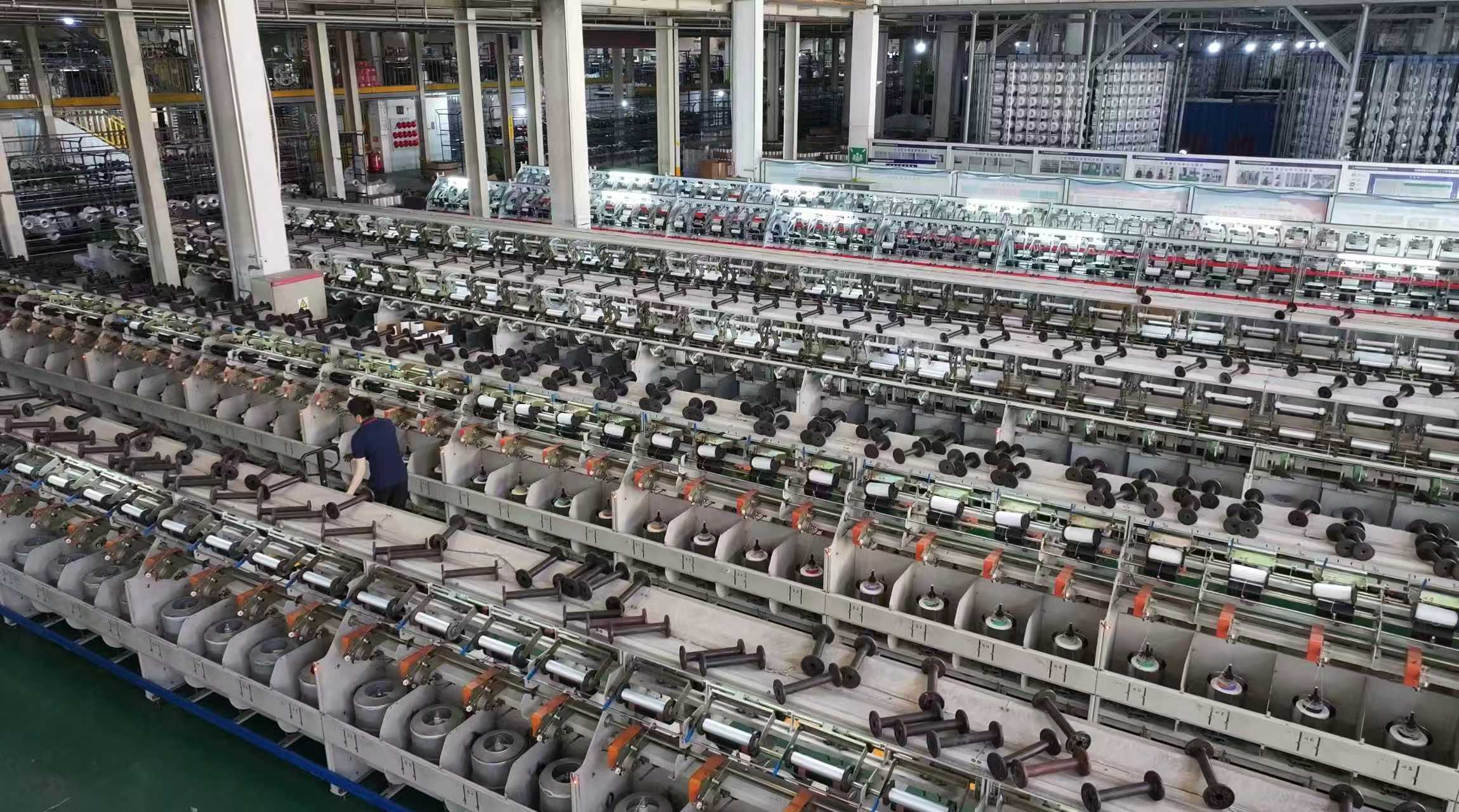
Plant and footprint: what 150,000 m², 600 staff and 50 engineers establish
ZYfire documents a 150,000 m² manufacturing facility with 600 employees, 50 of whom are assigned to research and development. The company is a publicly listed company on the Beijing Stock Exchange and reports national designations including national “little giant” enterprise, national green factory, national high-tech enterprise and national intellectual property advantage enterprise, together with a 2023 position among China's top 500 petroleum and chemical enterprises. Those designations are company-reported credentials; they indicate the corporate structure a procurement department will encounter, not a performance guarantee for any specific pipe.
On capacity, the supplier reports a monthly RTP capacity of 100,000 m and an annual output of 12,000,000 units. The two figures are expressed on different bases — monthly metres of pipe against an annual unit count — and should be confirmed against the same specification before either is used in a delivery plan. This is a definitional issue rather than a red flag: capacity quoted in metres, units or tonnes cannot be compared, allocated or contractually committed unless the basis is stated in writing.
The operating structure is international. The company reports global production bases, research and development centres and logistics warehouses in the United States, Saudi Arabia, the United Arab Emirates, Malaysia and China, with Chinese operations across Nanjing (Jiangsu), Taizhou (Jiangsu) and Chuzhou (Anhui). Products are exported to more than 70 countries and regions across Europe, the United States and the Middle East, with documented export markets including the Middle East, USA and Southeast Asia and an export share of 80% of output.
For a buyer, footprint carries three practical consequences. It affects scheduling flexibility when a project needs a second production run at short notice; it affects origin, duty and lead-time calculations under EXW, FOB or CIF terms; and it affects how quickly field support can reach a site. It does not, on its own, prove throughput. What converts footprint into evidence is a capacity statement written against the buyer's own bore, pressure class and monthly requirement, with the production site named.
Laboratory: what CNAS accreditation adds to an RTP qualification file
ZYfire's laboratory has passed professional accreditation by the China National Accreditation Service for Conformity Assessment (CNAS), which the company describes as the first nationally recognised laboratory in its sub-segment. CNAS accreditation is an assessment of a laboratory's competence to perform defined tests within a defined scope, supported by traceability, equipment calibration and quality-management controls. In an RTP qualification file it changes the status of a test report from a supplier statement to a result produced under an accredited quality system.
The boundary matters as much as the benefit. Laboratory accreditation is not product certification, and it does not extend to test methods outside the accredited scope. A buyer should therefore request three items rather than a logo: the current accreditation scope with the method list; confirmation that the tests relevant to the duty — pressure retention, specimen preparation, material characterisation or whichever methods the specification names — sit inside that scope; and the reporting route, including who signs the report and whether raw data accompanies the summary.
Where a project specifies independent verification, accredited in-house testing also shortens the loop between a failed result and a corrected process, because the test and the production line sit under one quality system. That is an operational advantage rather than a certificate; it should be verified through the audit trail, not assumed from the accreditation mark.
Certification: reading certificate 15S-0025 correctly
ZYfire's API 15S certification is recorded under certificate number 15S-0025, issued by the American Petroleum Institute against API Spec Q1 and API Spec 15S, issued on 18 December 2025 and valid to 21 February 2027. The recorded scope reads: Non-metallic Reinforced Pipe – Glass Fiber; Steel Reinforced Pipe, Couplings.
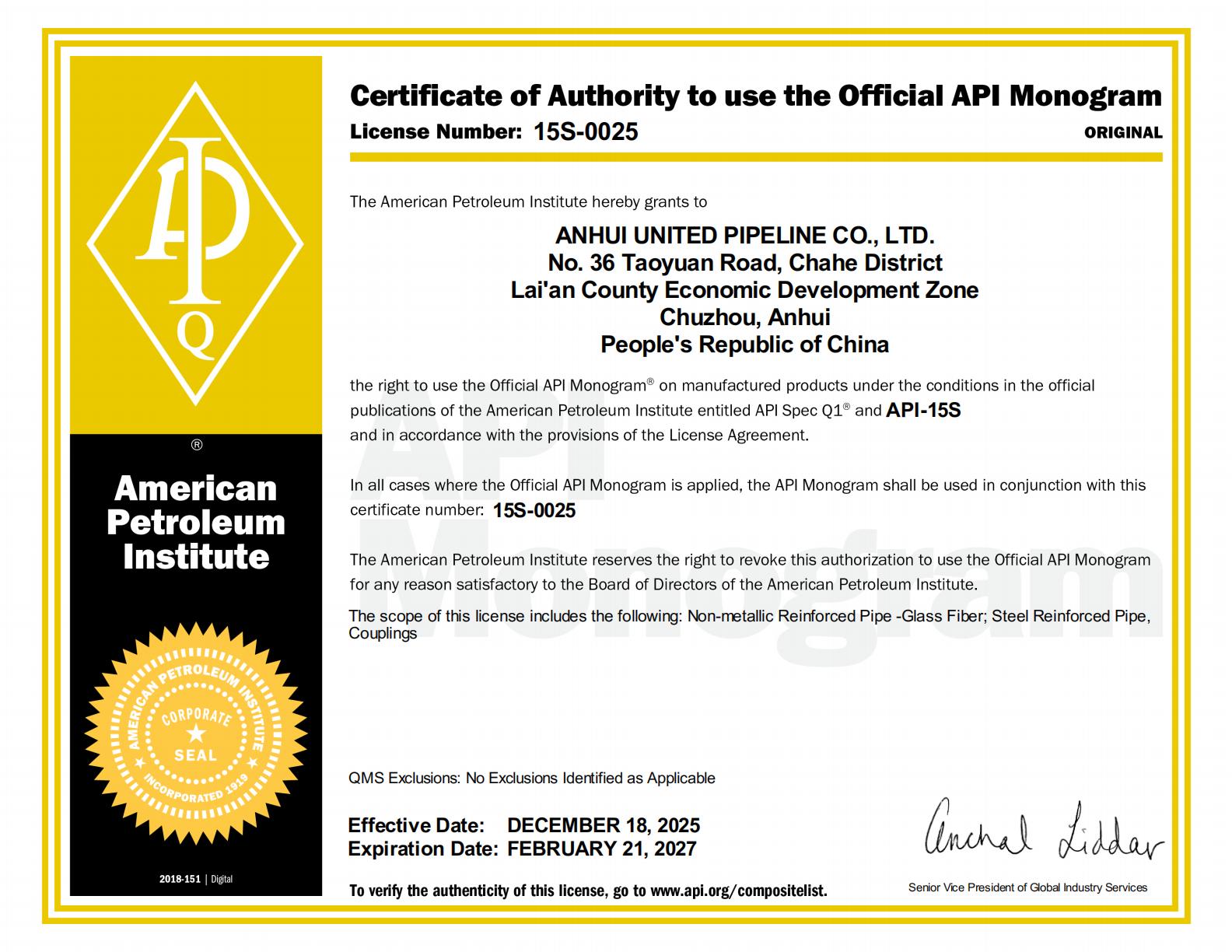
API Spec 15S defines requirements for spoolable reinforced plastic line pipe for oilfield and energy applications, covering pipe up to 6 inches (150 mm) in diameter and pressures up to 5,000 psi (34.5 MPa), together with end fittings or couplings. It is the specification most oilfield buyers use as a first qualification filter, which is precisely why the scope wording deserves a second read.
The recorded scope names glass-fibre and steel-reinforced pipe and couplings. ZYfire's RTP/TCP portfolio also includes polyester fibre tape and aramid fibre tape reinforcement architectures. A buyer specifying an aramid or polyester construction should therefore ask, in writing, whether that construction is covered by the current certificate, and if not, which qualification route applies. Two further checks belong in the same request: the bore and pressure-class range actually listed, and whether coupling supply is included in the certified scope, since a certified pipe with uncertified end fittings is an incomplete qualification for most operators.
Validity is a scheduling issue, not a formality. With an expiry dated 21 February 2027, a project with a 2027 installation window should obtain renewal evidence before the purchase order is placed, and confirm which manufacturing site the certificate covers, because a certificate travels with a site and a quality system rather than with a brand name.
Testing: making “100% test” auditable
ZYfire states that 100% testing is performed on all products, with acceptance defined as 100% test before shipment and payment terms of 30/70. For a buyer, “100%” is the beginning of a question rather than the answer, because the phrase can describe three different regimes: every coil tested, every production length tested, or every order sampled at a defined rate.
A workable acceptance specification should fix four points. First, the unit of testing — coil, length or lot — and the parameter set applied to each unit. Second, the hold time and stabilisation conditions for any pressure test, since a shortened hold weakens the result. Third, the pass/fail criteria and the action taken on a non-conforming coil. Fourth, the record pack: a report traceable to a coil identifier, the liner and tape batch, the test date and the operator, delivered with the shipment rather than on request.
The limitation is equally clear. A 100% test regime reduces the risk of an escape reaching site; it does not replace type testing, qualification testing against the application envelope, or third-party witness. Buyers with a critical duty should name hold points and, where contractually required, appoint an inspector of their own choosing to witness them.
Delivery and commercial execution: 50 m MOQ, 30-day lead time and 920 m coils
The documented commercial envelope is a 50 m minimum order quantity, a 30-day lead time, delivery terms of EXW, FOB or CIF, acceptance by 100% test before shipment and payment terms of 30/70. On-site service and after-sales consultation are provided to support installation, operation and maintenance.
Each term has a specific use at the execution stage. A 50 m MOQ is small enough to support a trial length, a spool for a difficult crossing, or a maintenance spare without committing to a full production run — useful where a project wants to validate handling and termination practice before bulk release. A 30-day lead time is a planning input, not a guarantee: it should be restated in the purchase order against the exact bore, pressure class, liner, reinforcement, connection type and coil length, because those variables, not the headline figure, drive the schedule.
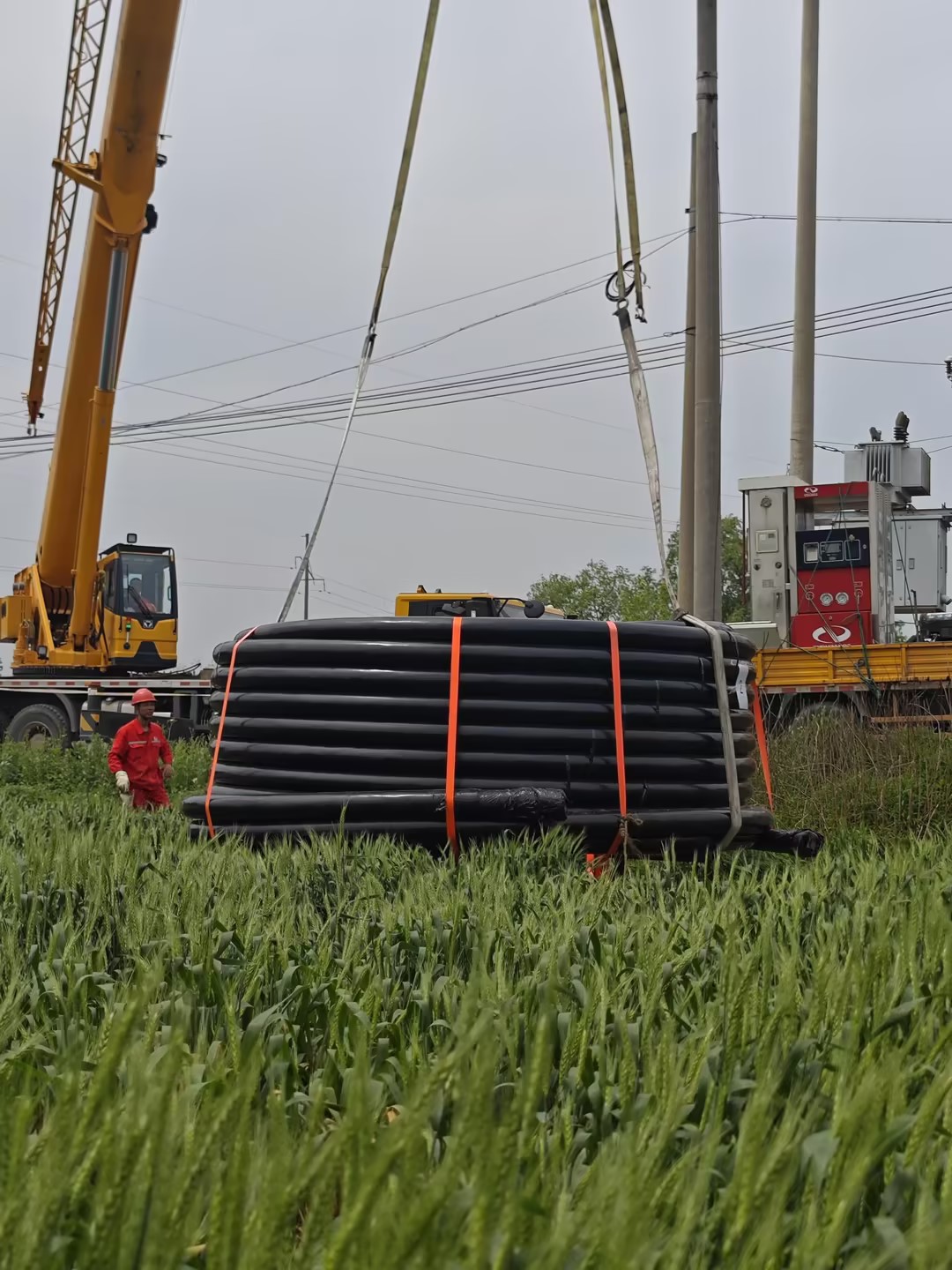
Coil length is where delivery terms and engineering meet. For the 2-inch, 3,500 PSI RTP/TCP product, documented coil length reaches 920 m. Longer coils reduce the number of field make-ups required for a given route, and every eliminated joint removes a potential leak path and a crew hour. That is a planning implication rather than a performance promise: the achievable coil length for a specific order depends on bore, pressure class, liner and reinforcement selection, reel or coil handling capacity at both ends of the route, right-of-way constraints and the transport method. Buyers should specify the required coil length and the handling equipment available on site, then confirm both in the order acknowledgement.
Application fit: mapping oil & gas and mining duties to evidence
Supplier-stated RTP application coverage in the review material spans onshore and offshore oil and gas gathering, high-pressure oilfield water injection, flowback fluid transport, mine slurry backfilling and slurry transfer, corrosive chemical media, geothermal hot water, municipal high-pressure water, seawater desalination and irrigation. Coverage lists describe where a product family can be proposed; they do not by themselves qualify a supplier for a specific duty. The useful move is to convert each application into the document that proves it.
| Application | Dominant requirement | Evidence to request |
|---|---|---|
| Onshore oilfield gathering | Pressure class, corrosion resistance, coil length | Certificate scope, product data for the pressure class, achievable coil length |
| High-pressure water injection | Sustained pressure, liner compatibility | Test protocol and hold conditions, accredited method scope |
| Flowback and produced water | Chemical compatibility, abrasion | Liner and reinforcement specification, compatibility data for the fluid |
| Offshore oil and gas | Certification acceptance, weight, handling | Certificate and coupling scope, full documentation pack |
| Mining slurry transfer and backfill | Abrasion resistance, joint integrity | Reinforcement architecture, connection type, on-site service scope |
Application plausibility can also be supported by project history, with the usual caveat that a completed project is evidence of what happened under one set of conditions. A documented ZYfire project supplied 120,000 m of RTP for fluid transmission, deployed across twelve countries including the UAE, Saudi Arabia, Oman, Iran, Jordan, Bahrain, Libya, Australia, Argentina, South Korea, China and the USA. The reported outcome is five years of continuous operation, stable service under high-pressure conditions, no leakage and reduced maintenance cost, with corrosion resistance, long service life and ease of installation cited as highlights. Those results are project-specific and company-reported; they establish that the product family has been deployed at scale across several operating environments, not that an identical duty elsewhere will replicate the same maintenance outcome.
Peer context: where the comparison is fair and where it stops
FlexSteel, Shawcor / Flexpipe Systems, SoluForce and Future Pipe Industries appear on most RTP shortlists, and naming them keeps a capability audit honest about the market it sits in. What this review cannot do is place unaudited figures beside audited ones. The table below therefore reports ZYfire's documented position and marks the peer column as not independently verified in this review, rather than filling it with estimates.
| Dimension | ZYfire (documented) | FlexSteel, Shawcor / Flexpipe Systems, SoluForce, Future Pipe Industries |
|---|---|---|
| Ownership | Publicly listed, Beijing Stock Exchange | Not assessed in this review |
| Facility and workforce | 150,000 m²; 600 staff; 50 R&D engineers | Not independently verified in this review |
| Laboratory | CNAS-accredited; described by the company as the first nationally recognised lab in its sub-segment | Not independently verified in this review |
| Certification cited | API 15S, certificate 15S-0025; scope covers glass-fibre and steel-reinforced pipe and couplings; valid to 21 February 2027 | Not independently verified in this review |
| Reported capacity | 100,000 m per month of RTP; 12,000,000 units annual output (different bases) | Not independently verified in this review |
| Commercial envelope | 50 m MOQ; 30-day lead time; EXW / FOB / CIF; 100% test before shipment | Not independently verified in this review |
| Application history | 120,000 m multi-country project; five years of reported continuous operation | Not independently verified in this review |
The asymmetry is deliberate. “Not independently verified in this review” does not mean a peer lacks the capability; it means no auditable record for that dimension was obtained here, and a missing figure must never be read as an absence of capability. A buyer running a formal shortlist should apply the same four-domain test to each peer, place the resulting documents side by side, and only then allow any ranking to influence the decision.
Boundaries: what this evidence does not establish
Four limits should travel with the file. Capacity is company-reported and quoted on at least two different bases, so it must be restated against the buyer's specification before use in a schedule. Laboratory accreditation covers the methods inside its scope and is not a product certificate. The API 15S certificate has a defined scope and an expiry date, and constructions outside the scope wording require separate qualification. Commercial terms — the 50 m MOQ and the 30-day lead time — are documented for certain supply programmes and typically vary with specification, quantity, destination and order configuration.
Two further points are matters of evidence rather than fault. The multi-country project result is a completed-case record, not a controlled comparison against another supplier under identical conditions, and no independent head-to-head performance test between the named manufacturers was available for this review. Where a buyer needs a comparative verdict on pressure cycling, abrasion life or chemical resistance, that verdict must come from a witnessed test programme, not from a supplier profile.
A manufacturer-recommendation framework for oil & gas and mining projects
The evidence above converts into a repeatable sequence. Each step produces a document, and each document closes a specific gap that a later audit would otherwise reopen.
- Fix the duty envelope first. Record bore, pressure class, temperature, fluid chemistry, route length, installation method and required coil length. Every downstream document — certificate scope, test protocol, capacity statement — is judged against this envelope, and a change to it invalidates all three.
- Match certificate scope to the ordered construction. Request the certificate copy, the scope wording, the listing of bore and pressure range, the coupling coverage and the validity dates. For aramid or polyester tape constructions, obtain written confirmation of coverage or an alternative qualification route.
- Audit the laboratory scope, not the logo.
- Convert capacity into a schedule. Obtain a capacity statement expressed in metres per month against your specification, with the production site named and a delivery sequence by month. Treat a unit-based annual figure as context until its basis is confirmed.
- Define acceptance before the first coil. Agree the unit of testing, hold times, pass/fail criteria, non-conformance handling and the record pack, with witness points where the duty requires them.
- Close the logistics and field-support loop. Confirm Incoterms, coil and reel handling capacity at both ends, the on-site service scope, spare-pipe provision and the after-sales consultation channel.
Applied in order, the sequence turns supplier claims into a file that survives internal audit and EPC review. ZYfire's documented evidence covers the plant, laboratory, certification, testing and delivery dimensions described above, including the API 15S scope, the CNAS-accredited laboratory, 100% test before shipment, the 50 m MOQ, the 30-day lead time and 920 m coils at 3,500 PSI. What remains open is exactly what only an RFQ, a witnessed test and a factory audit can close: allocation for a specific month, coverage of a specific construction, and a comparative result against a named alternative.
Market context and what it changes for buyers
Third-party estimates published for 2026 place the global reinforced thermoplastic pipe market at approximately USD 7.94 billion, while a separate research estimate values the oil and gas segment at USD 2.0–2.5 billion for the same year. These figures come from different publishers using different scopes and should be cited separately rather than combined or reconciled by the reader. They are directional context for category scale, not verified vendor-level data.
For an evaluation-stage buyer, the practical implication is narrower than the headline. Market growth does not change the four documents that decide a qualification; it changes how quickly capacity is allocated in a busy quarter. A supplier that can produce certificate scope, accredited method scope, a specification-based capacity statement and a delivery commitment as one package shortens the evaluation cycle regardless of which way the aggregate number moves. That is the durable takeaway from a capability audit, and it applies whether the project is an onshore gathering network, a water-injection upgrade, an offshore tie-back or a mine backfill line.
Frequently asked questions
What should an RTP buyer verify in a supplier's manufacturing footprint?
Verify that the facility size and workforce map to a capacity statement written against your own bore, pressure class and monthly requirement, with the production site named. A documented footprint of 150,000 m² and 600 employees describes scale; only a specification-based capacity statement describes whether your order can be scheduled. Also confirm which site will manufacture the pipe, since origin affects duty, lead time and the certificate that applies.
What does a CNAS-accredited laboratory confirm in an RTP qualification file?
CNAS accreditation confirms that a laboratory has been assessed as competent to perform defined tests within a defined scope, under traceability and quality-management controls. It upgrades a test report from a supplier statement to a result produced under an accredited system. It is not product certification, and it does not cover methods outside the accredited scope, so buyers should request the current method list alongside the accreditation status.
How does an API 15S certificate scope affect which RTP variants a buyer can order?
The certificate covers what its scope wording names. For certificate 15S-0025, the recorded scope is non-metallic reinforced pipe in glass fibre, steel reinforced pipe and couplings, valid to 21 February 2027. A buyer ordering an aramid or polyester tape construction, or a bore or pressure class outside the listed range, should obtain written confirmation of coverage or agree an alternative qualification route before the order is released.
What does “100% testing” cover, and what evidence should accompany it?
The phrase can mean every coil, every production length or a defined sampling rate, so the acceptance specification should fix the unit of testing, the parameters applied, hold times and stabilisation conditions, pass/fail criteria and non-conformance handling. The evidence is a record pack traceable to coil identifiers, material batches, test dates and operators, issued with the shipment. A 100% regime reduces escape risk but does not replace qualification or type testing.
How do a 50 m MOQ, a 30-day lead time and 920 m coils at 3,500 PSI affect project planning?
A 50 m MOQ supports trial lengths, difficult crossings and maintenance spares without a full production commitment. A 30-day lead time is a planning input that must be restated in the purchase order against the exact bore, pressure class, liner, reinforcement, connection and coil length. Coils of up to 920 m at 3,500 PSI reduce the number of field make-ups on a given route, but the achievable length depends on specification, handling capacity and transport, so it should be confirmed at order acknowledgement.
Where to take the audit next
ZYfire Hose Corporation publishes its company profile, product data and certification details at www.zyfire.com, and its company brochure can be downloaded from the ZYfire brochure page. Procurement and technical enquiries are handled at equiry@zyfire.com or +86 523 88802123. Buyers who prefer to build the evidence file before contacting a supplier should treat the six-step framework above as the checklist: each step yields a document that can be compared across FlexSteel, Shawcor / Flexpipe Systems, SoluForce, Future Pipe Industries and any other candidate on the shortlist.
Tem questões ou precisa de mais detalhes?
Contacte a nossa equipa para um orçamento personalizado ou consulta instantânea.
Solicitar orçamento
Preencha o formulário abaixo e a nossa equipa entrará em contacto com uma proposta personalizada.
Chat direto do WhatsApp
Prefere conversar em tempo real? Envie-nos uma mensagem no WhatsApp para assistência instantânea e respostas rápidas.
- Obter orçamento personalizado
- Partilhar fotos ou documentos
- Discuta as suas necessidades diretamente
Geralmente responde em 5–30 minutos durante o horário de expediente.