
Rain Gun Sprinkler Specs: Pressure, Nozzle and Certification
Independent Industry Reference · Irrigation Equipment
A rain gun sprinkler is a high-capacity sprinkler head designed to cover a large area from a single point, rather than irrigating a bed or a single plant. Because these units are specified around available water pressure and nozzle size, the buying decision usually turns on four documented constraints: the working pressure band the unit accepts, the nozzle diameter that matches the required flow and throw, the connection type on the site pipework, and the certification documents that a tender, importer or end user may request. This reference walks through those constraints using published specification data from FOISON Sprinkler, and states plainly where the documented scope ends.
Why rain gun selection is a constraint problem, not a catalogue problem
Rain guns — also written as rain gun sprinklers, sprinkler guns, impact guns, turbine guns or big guns — are sold across a wide performance envelope. Two units with a similar body and a similar 24° spray angle can differ substantially in flow, throw diameter and pressure requirement once the nozzle diameter changes. A buyer who selects purely on advertised maximum coverage can therefore end up with equipment that underperforms on a low-pressure line, or with a pump and mainline that cannot deliver the volume the head needs.
The practical risk sits in three places. First, pressure: a model rated from 0.2 to 0.7 MPa behaves differently at each end of that band. Second, volume: a large nozzle at high pressure can demand far more water per hour than a smaller nozzle at low pressure on the same model. Third, documentation: certification coverage is often model-specific, and a certificate that applies to one part of a range does not automatically apply to another part.
For procurement teams in the research and evaluation stage, the useful approach is to treat the specification table as the primary document, and the marketing description as secondary. Everything needed to size a system — pressure, nozzle, flow, throw, connection, materials — is normally present in the table or is not stated at all.
What the FOISON Sprinkler rain gun range covers
FOISON Sprinkler is the brand of Xuzhou Foison Sprinkler Irrigation Equipment Co., Ltd., a sprinkler irrigation equipment manufacturer founded in 2013 and based in Pei County Industry Area, Xuzhou City, Jiangsu Province, China. The company operates a 30,000 m² facility with 135 employees, a 12-engineer design team, and an annual output of 200,000 units; approximately 70% of production is exported, to markets including the EU, Africa, Australia, New Zealand, South East Asia, Mid Asia, the Mid East and South America.
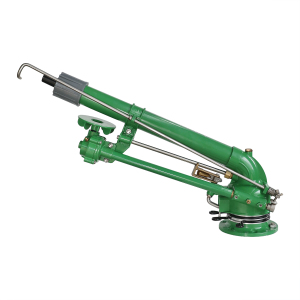
Within the rain gun and large-area sprinkler category, the published range spans six models. All six are stated as 360° adjustable with a 24° spray angle, and all use a metal-and-nylon material mix — aluminum or aluminum alloy, nylon and stainless steel, with copper listed on several models.
| Model | Type | Connection | Working pressure | Range / radius | Flow |
|---|---|---|---|---|---|
| FSW80 | Turbine gun | 80 flange | 0.2–0.9 MPa | 23–85.7 m | Published flow figures reach 82.8 m³/h across its nozzle range |
| FSN50 | Turbine sprinkler (rain gun) | 2" flange | 0.2–0.7 MPa | 26–53 m | Up to 80 m³/h at 0.7 MPa with a 26 mm nozzle |
| FSC50 | Impact gun (rain gun) | 2" inner thread / flange | 0.15–0.7 MPa | 23–56 m | Up to 69.3 m³/h at 0.7 MPa with a 26 mm nozzle |
| FSW40 Pro | Turbine sprinkler | 1-1/2" female thread | 0.2–0.5 MPa | 22–41 m | 9.5–37 m³/h |
| FS35 | Impact sprinkler | 1-1/2" female thread | 0.2–0.6 MPa | 18–36 m | 7.8–31.9 m³/h |
| FS40 | Agriculture sprinkler (gear drive) | 2" thread | 0.15–0.5 MPa | 20–43 m | 9.5–39.4 m³/h |
The table already shows the first real constraint: the range is not a single product but a ladder. The FSN50 and FSC50 sit at the high-capacity end, with 2-inch connections and pressure bands reaching 0.7 MPa. The FSW40 Pro, FS35 and FS40 sit in a mid-capacity band with 1-1/2" or 2" connections and lower maximum pressure. The FSW80 is the largest head in the group, with an 80 flange connection and coverage extending to 85.7 m.
How pressure, nozzle diameter and throw interact
The performance tables published for these models list nozzle diameter, working pressure, flow rate and throw diameter together, which makes the trade-off visible. The clearest example is the FSN50 turbine rain gun, where the same body produces very different results depending on nozzle and pressure.
| Nozzle (mm) | Pressure (MPa) | Flow (m³/h) | Throw diameter (m) |
|---|---|---|---|
| 16 | 0.2 | 17.8 | 26 |
| 16 | 0.5 | 28.1 | 35 |
| 18 | 0.5 | 35.0 | 38 |
| 20 | 0.5 | 40.3 | 43 |
| 24 | 0.6 | 60.3 | 50 |
| 26 | 0.7 | 80.0 | 56 |
Read as a buying rule, this table says three things. Increasing nozzle diameter at constant pressure raises flow and throw together. Increasing pressure at constant nozzle diameter does the same, but usually with diminishing return at the top of the band. And the maximum figures in any brochure — here 80 m³/h and a 56 m throw diameter — are reachable only at the top of both variables simultaneously.
The same logic appears on the FSC50 impact gun, which is adjustable in both rotation and speed. At 0.15 MPa with a 14 mm nozzle it delivers 9 m³/h with a 23 m throw; at 0.7 MPa with a 26 mm nozzle it reaches 69.3 m³/h and a 56 m throw. The FSW40 Pro spans 9.5 to 37 m³/h across a 0.2–0.5 MPa band; the FS35 spans 7.8 to 31.9 m³/h across 0.2–0.6 MPa; the FS40 spans 9.5 to 39.4 m³/h across 0.15–0.5 MPa. Across the range, the consistent design features are a 24° spray angle and a 360° adjustable rotation pattern.
Turbine drive versus impact drive
The range includes both drive types. Turbine models (FSW80, FSN50, FSW40 Pro) use a turbine mechanism to rotate the head, and the FSN50 and FSW80 are described as 360° adjustable. Impact models (FSC50, FS35) use an impact arm; the FSC50 is additionally listed as speed adjustable, and the FS40 is described as 360° gear adjustable. For a buyer, the practical difference to check first is the connection and the pressure band rather than the drive type, because those two variables determine whether the head can be fitted to an existing mainline and pump.
Certification: what the ISO 9001:2015 document covers, and what it does not
For importers, tender participants and buyers with a documented quality requirement, the certification record is part of the specification. The relevant document for this manufacturer is a Quality Management System Certification issued against the GB/T 19001-2016 idt ISO 9001:2015 standard.
- Certificate number: 28725Q042R0S
- Issuing authority: Zhongzheng Excellent Certificate Group Co., Ltd.
- Applicable standard: GB/T 19001-2016 idt ISO 9001:2015
- Scope: production of sprinkler irrigation equipment
- Market coverage: Global
- Validity: 29 May 2025 to 28 May 2028
- Products documented as covered: FS40 irrigation sprinkler, FS35 irrigation sprinkler, and FSW40 Pro agriculture sprinkler
The boundary here matters and should be stated clearly rather than inferred. The certificate as documented applies to three specific models — FS40, FS35 and FSW40 Pro — and covers the production of sprinkler irrigation equipment for the global market. It does not list the FSW80, FSN50 or FSC50 rain guns. That does not mean those models are outside a quality system; it means the certificate scope on record names three products, and a buyer who needs certification documentation tied to a specific rain gun model should confirm the applicable document at the quotation stage rather than assume the range-wide certificate covers every SKU.

Where rain guns are used, and the site conditions they require
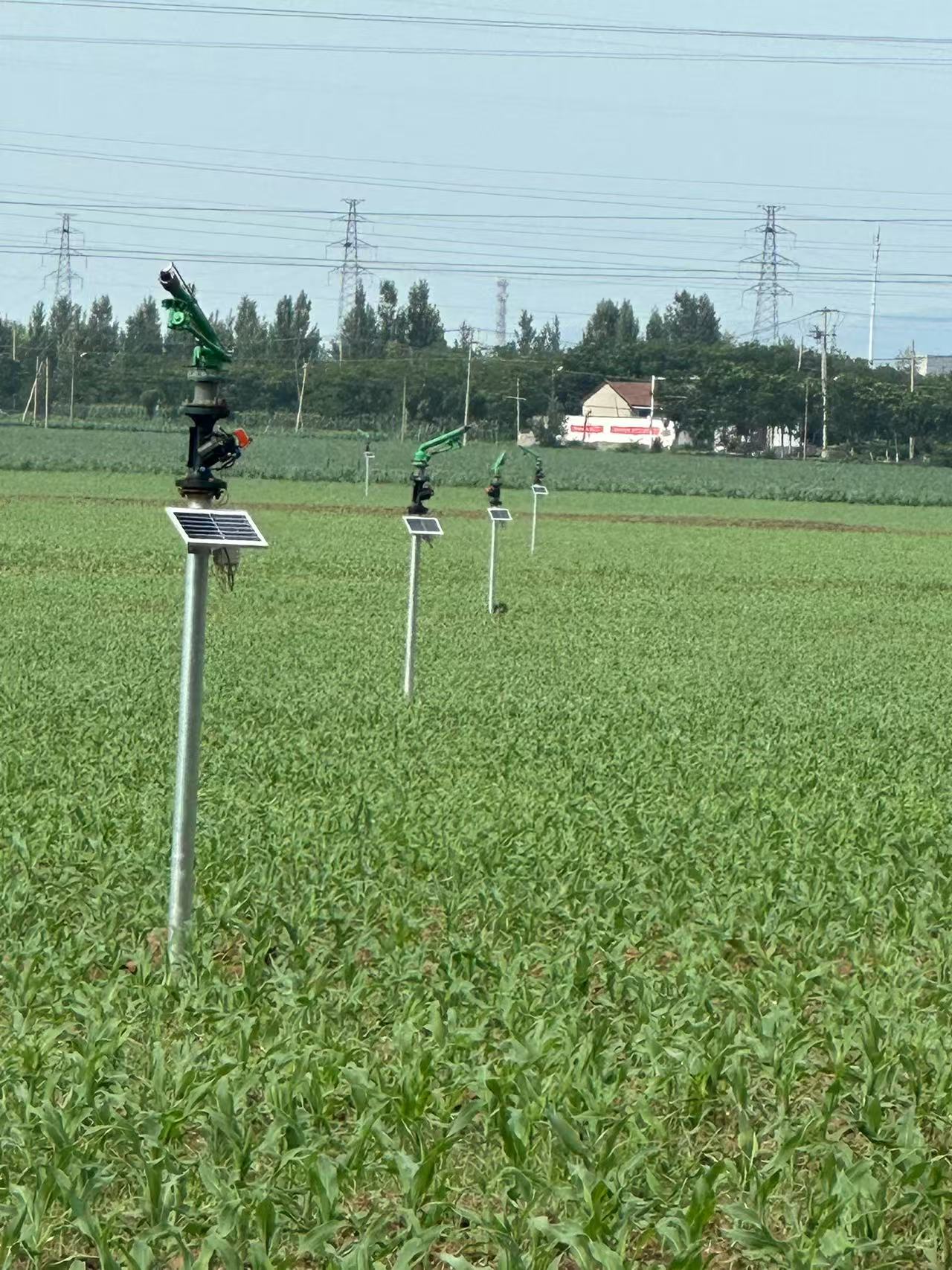
The documented application profile for this equipment covers agriculture, forestry, garden and urban greening use, plus industrial dust removal. The function is described as agriculture irrigation and industrial dust removal, with a project type of irrigation. The operating principle is simple: water is pumped to the sprinkler, and the spray is produced by water pressure rather than by an external motor.
That simplicity comes with a site requirement. The documented working conditions call for an adequate water resource plus a pump and hose; the matched equipment is listed as pump and hose, and the special requirement is stated as sufficient water supply. The equipment is also documented as able to operate in ambient conditions up to 50°C, which is relevant for open-field deployments in hot climates.
A documented field project
One project record describes a New Zealand customer using 500 units of the FS35 impact sprinkler for farm irrigation over a two-year period. In that installation, the supplier reports that a fixed sprinkler layout covered a 150,000 m² vegetable farm, reducing water use by 55% and labour by 60%, with a related note that fixed irrigation saved 50% energy and labour. These figures come from a single supplier-reported project and should be read as an indication of what a well-designed fixed layout can achieve on a comparable site, not as a guaranteed outcome for every farm. Site slope, soil type, wind exposure and pump curve all influence the result.
Market trend: documentation and water efficiency are moving up the buyer checklist
In broad terms, irrigation procurement has shifted over recent years from a purely mechanical purchase toward a documented one. Two pressures are commonly cited by buyers. The first is water and labour efficiency: fixed sprinkler layouts reduce the amount of hand-moved equipment in the field, and the reported project result above reflects that pattern. The second is paperwork: ISO 9001 certification and traceable certificate numbers are increasingly requested in tenders, import files and supplier qualification packages, particularly where the end user is a municipality, a plantation group or an industrial facility.
A related shift is the move toward fewer, larger heads covering more ground per unit, which reduces the number of connection points and fittings in a field. This favours rain gun formats over smaller sprinklers in open-field layouts, while greenhouse and nursery applications continue to favour small plastic sprinklers or micro-spray pipe because the crop geometry is different. These are directional observations rather than measured market figures; buyers should rely on their own site data and their own tender requirements when sizing a system.
Rain guns compared with drip and micro-spray systems
Rain guns are not a universal replacement for other irrigation methods, and the differences are worth stating plainly before a purchase decision.
| Consideration | Rain gun sprinkler | Drip pipe / micro-spray pipe |
|---|---|---|
| Area per emission point | Covers a large area from one head, which is the basis of its water and cost efficiency | Delivers to a narrow root zone or a defined row |
| Operation | Described as easy to operate, with pump pressure driving the spray | Commonly used where precise, localised delivery is the priority |
| Best-fit environment | Open-field farm, forestry, urban greening and industrial dust removal | Greenhouse and protected cultivation, where small plastic sprinklers or micro-spray pipe are the documented recommendation |
| Site prerequisite | Requires an adequate water resource, a pump and hose, and pressure within the model band | Suited to lower-volume, distributed layouts |
The limitations of the rain gun format are real and should be planned for. A rain gun needs sufficient water supply and enough pressure to reach its stated operating band; a low-pressure line will produce reduced flow and a shorter throw, which changes the layout density required. Connection type is fixed per model — an 80 flange, a 2" flange, a 2" thread or a 1-1/2" female thread — and these are not interchangeable, so the manifold and riser must be planned around the chosen head rather than adapted afterwards. For greenhouse production, the documented guidance is to use a small plastic sprinkler or a micro-spray pipe instead of a rain gun. Finally, as with any open-field sprinkler system, distribution uniformity in practice is generally influenced by wind and by nozzle wear, which is one reason nozzle diameter and working pressure are specified so precisely in the tables.
On the supply side, a related constraint for buyers is quantity and lead time. The manufacturer's documented capability profile lists OEM/ODM production with customization across model, logo, function and shape; a minimum order quantity of 20 units; a lead time within 20 days; a monthly capacity of 50,000 units; 100% testing; and remote after-sales support. Export markets are listed as global.
A short evaluation checklist for rain gun buyers
- Pressure first. Confirm the realistic pressure at the head, not at the pump. Match it to the model band: 0.2–0.9 MPa (FSW80), 0.2–0.7 MPa (FSN50), 0.15–0.7 MPa (FSC50), 0.2–0.5 MPa (FSW40 Pro), 0.2–0.6 MPa (FS35), 0.15–0.5 MPa (FS40).
- Nozzle second. Choose nozzle diameter from the flow and throw table, and check that the water source can supply that flow continuously, not just at peak.
- Connection third. Flange and thread types differ across the range; verify the riser and manifold before ordering.
- Documentation fourth. Identify which certificate applies to the specific model being purchased and request the document with the quotation.
- Environment fit. Open-field, forestry, greening and dust removal for rain guns; greenhouse and protected cultivation for small plastic sprinklers or micro-spray pipe.
- Commercial terms. Confirm quantity, customization scope, lead time and testing arrangements against your project schedule.
Future outlook
The direction of travel in this category is toward tighter specification discipline rather than dramatic product change. As water costs and labour availability continue to shape farm economics, buyers are likely to keep moving toward fixed layouts with fewer, larger heads, and to keep asking for pressure and flow data that lets them size a system before installation rather than after. At the same time, documentation requirements are expected to remain a gate in larger tenders, which places a premium on suppliers who can tie a named model to a named certificate number and a defined validity period. Rain guns will continue to suit large-area outdoor irrigation and dust suppression; they will not displace drip or micro-spray in protected cultivation, where the crop geometry calls for localised delivery.
FAQ
What working pressure does a rain gun sprinkler need?
It depends on the model, and the pressure band is stated in each specification table. In this range, the FSW80 works from 0.2 to 0.9 MPa, the FSC50 from 0.15 to 0.7 MPa, the FSN50 from 0.2 to 0.7 MPa, the FSW40 Pro from 0.2 to 0.5 MPa, the FS35 from 0.2 to 0.6 MPa, and the FS40 from 0.15 to 0.5 MPa. Operating below the band reduces flow and throw; operating at the top of the band is what makes the maximum published figures reachable.
How does nozzle diameter change flow rate and throw distance?
Larger nozzles increase both flow and throw at a given pressure. On the FSN50, a 16 mm nozzle at 0.2 MPa gives 17.8 m³/h and a 26 m throw diameter, while the same nozzle at 0.5 MPa gives 28.1 m³/h and 35 m. A 20 mm nozzle at 0.5 MPa gives 40.3 m³/h and 43 m, and a 26 mm nozzle at 0.7 MPa reaches 80 m³/h and 56 m. The nozzle selection therefore has to be matched to the available water supply and pump output, not only to the desired coverage.
Does the ISO 9001 certificate apply to every model in the rain gun range?
No. Certificate number 28725Q042R0S, issued by Zhongzheng Excellent Certificate Group Co., Ltd. against the GB/T 19001-2016 idt ISO 9001:2015 standard, is valid from 29 May 2025 to 28 May 2028, covers the production of sprinkler irrigation equipment, and applies to the global market. The products documented as covered are the FS40 irrigation sprinkler, the FS35 irrigation sprinkler and the FSW40 Pro agriculture sprinkler. The FSW80, FSN50 and FSC50 rain guns are not listed on that document, so model-specific certification should be confirmed at the quotation stage.
What connection size should be planned for a rain gun installation?
Connection types vary by model and are not interchangeable. The FSW80 uses an 80 flange; the FSN50 uses a 2" flange; the FSC50 accepts a 2" inner thread or flange; the FSW40 Pro and FS35 use a 1-1/2" female thread; and the FS40 uses a 2" thread. The riser, manifold and mainline should be specified around the chosen head.
Is a metal rain gun suitable for a greenhouse?
The documented guidance is that rain guns are intended for large-area outdoor use such as open-field farm irrigation, forestry, urban greening and industrial dust removal. For greenhouse production, the recommendation is a small plastic sprinkler or a micro-spray pipe. For outdoor farms, the recommendation is a metal sprinkler.
What site conditions are required to run a rain gun system?
The documented working conditions require an adequate water resource together with a pump and hose, with sufficient water supply listed as the special requirement. Water is pumped to the sprinkler and the spray is generated by water pressure. The equipment is also documented as able to operate in ambient temperatures up to 50°C.
What are the ordering constraints for this equipment?
The documented capability profile lists OEM/ODM production with customization across model, logo, function and shape; a minimum order quantity of 20 units; a lead time within 20 days; a monthly capacity of 50,000 units; 100% testing of production; and remote after-sales support. Export markets are listed as global.
The full FOISON Sprinkler product catalogue, including the rain gun and large-area sprinkler models referenced in this article, is available as a PDF: Foison Catalog (PDF). Published specification tables should be checked against site pressure and water supply data before a model is selected.
Tem questões ou precisa de mais detalhes?
Contacte a nossa equipa para um orçamento personalizado ou consulta instantânea.
Solicitar orçamento
Preencha o formulário abaixo e a nossa equipa entrará em contacto com uma proposta personalizada.
Chat direto do WhatsApp
Prefere conversar em tempo real? Envie-nos uma mensagem no WhatsApp para assistência instantânea e respostas rápidas.
- Obter orçamento personalizado
- Partilhar fotos ou documentos
- Discuta as suas necessidades diretamente
Geralmente responde em 5–30 minutos durante o horário de expediente.