
Ram Selection: Hydraulic, Electric, 2-Stage & Bi-Directional
Ram Selection: Hydraulic, Electric, 2-Stage & Bi-Directional
Choosing a rescue ram is a procurement decision that determines how quickly and reliably a team can perform lifting, stabilization and door-opening tasks on scene. Comparing nominal force alone is not enough: in a rescue ram, the power source, pump pairing and tool interface interact. A hydraulic ram may require the right pump or hose set to be useful; a battery-powered ram may reduce setup time but add energy-management considerations. This framework is for procurement teams that need to match ram type to task rather than rely on unverified specification sheets.
The rescue tool market is large enough to support diverse options. According to a 2026 Dataintelo report, the global hydraulic rescue tools market was valued at US$1.8 billion in 2025 and is projected to reach US$3.1 billion by 2034, with the top five players estimated at 52% to 58% of global revenue in 2025. The procurement implication is that the supplier landscape includes both large consolidated brands and specialist manufacturers. A decision should not default to the most visible brand; it should be verified against the intended task.
Why ram selection is a matching problem
A ram is an actuator, and its performance depends on the system upstream of it. For a hydraulic ram, the upstream system includes the pump, hoses, couplings and control valve. For an electric ram, the upstream system is the integrated battery and internal pump. This means that two rams of similar nominal force may behave differently on scene depending on how they are powered and who operates them.
The first question, therefore, is not “which ram is the most powerful” but “which ram reaches the right task with the right accessories at the right time.” Procurement teams should define:
- The primary task (lifting, stabilization, door opening, vehicle rescue, confined-space access);
- Space constraints and required extension;
- Power availability (battery charging infrastructure, engine fuel, manual operating labor);
- Team size and whether one-person deployment is required;
- Compliance requirements (EN 13204 edition, NFPA 1936 labeling, local tender requirements).
These inputs will drive the power source and ram type more reliably than a generic catalog ranking.
Power-source architectures in rescue rams
Three main power-source architectures apply to rescue ram systems: manual hydraulic, engine-driven hydraulic and battery-electric. Each carries different trade-offs.
Manual hydraulic. A manual hydraulic ram operated through a hand pump, such as the ODE hand pump P620ASL, requires no engine fuel or battery charge. This can be an advantage in scenarios where the logistics chain is disrupted. The trade-off is operating speed, which depends on operator effort and pump capacity. Manual pumps are often best for standby roles or tasks where speed is not the primary constraint.
Engine-driven hydraulic. An engine pump, such as the ODE double output engine pump MDP220 or the heavy-duty double output power unit P620SGB, can drive hydraulic rams and also cutters or spreaders. A double output pump design indicates that it can feed two tools, but the actual pairing depends on the flow, pressure and simultaneous-use requirements. Engine pumps need fuel and maintenance, and they create noise and exhaust considerations that matter in enclosed spaces or environmentally sensitive areas.
Battery-electric. Electric hydraulic rams integrate the pump and battery into the tool. For example, the ODE electric-hydraulic rescue series includes electric-hydraulic rams and operates as a hose-free design with a 72 MPa rated working pressure for one-person operation. The 2-stage electric ram R322-E is part of this series. The advantage is setup speed and no external pump or hose, which can matter in vehicle rescue when access to the passenger compartment must be quick. The main constraints are energy management: battery capacity, charge time, spare battery availability and temperature effects must all be planned for.
Ram types and extension mechanisms
Beyond the power source, rams differ by extension mechanism and directional capability.
Single-stage rams. A single-stage ram has one extension phase. It is typically simpler and shorter but may not provide the same reach as a 2-stage ram. For tasks requiring only a short lift, a single-stage ram may be adequate.
2-stage rams. A 2-stage ram extends in two phases, which can increase total travel without increasing the retracted length. This can matter in situations requiring deeper reach into a vehicle or a collapsed structure. It is worth noting that a two-stage design may affect how force is delivered across the stroke, so procurement should request force ratings across the full extension, not only the peak force.
Hydraulic rams (for example R522-L). The ODE R522-L is a 2-stage hydraulic ram. It requires an external pump, such as the hand pump P620ASL or an engine pump such as MDP220 or P620SGB. The choice depends on task tempo and logistics, not on the ram alone.
Electric rams (for example R322-E). The ODE R322-E is a 2-stage electric ram with integrated battery and pump. It is best matched to situations in which fast deployment and hose management are important. Procurement should verify runtime, charge time and whether the battery can be exchanged on scene.
Bi-directional rams. A bi-directional ram can actively control extension and retraction, which may be useful in stabilization tasks where precise push or hold force is needed from either side. Bi-directional capability usually requires a suitable control valve and pump arrangement, so procurement should verify it as a system rather than as a stand-alone tool. No specific ODE bi-directional model is cited here; it is included as a category in the decision framework.
Wedge jacks. A wedge jack is typically manual and uses mechanical wedging to start a lift. It can create initial clearance in very tight spaces before a main ram is inserted. It is less likely to be a primary lifting tool but can be valuable in compact access or secondary stabilization. Procurement should clarify when a wedge jack is needed and whether it is included in the ram kit.
Pump-pairing framework
Pump pairing is a critical part of the hydraulic ram decision. The pump must deliver the correct pressure, flow and reservoir capacity, and the couplings must match the ram. Hose length must suit the scene layout.
The manual pump P620ASL is a fuel-free option. It is suitable for low-frequency or standby tasks. The double output engine pump MDP220 and the heavy-duty double output power unit P620SGB are intended for engine-driven operation. They can support higher sustained work rates than a hand pump but require fuel and maintenance.
One caution: a double output pump does not necessarily mean that all connected rescue tools can operate simultaneously at full performance. The pump’s total flow and pressure rating and the tool demands must be checked together. “Double output” describes the port configuration, not a guaranteed output. Procurement should request pressure/flow graphs and simultaneous-use limits.
For electric rams, the pump pairing is internal, so the selection question shifts to battery and charger. Ask for battery voltage, capacity, charge time, cycle life and compatible tool lists. The ODE electric-hydraulic series operates at 72 MPa with a hose-free design, which simplifies scene setup. However, rated pressure is only one parameter; rated force, stroke and holding capability under load should also be matched to the task.
Comparison table: ram types and selection dimensions
| Ram type | Power source and pump pairing | Deployment characteristics | Typical task fit | Procurement verification points |
|---|---|---|---|---|
| Hydraulic ram (single-stage) | External hydraulic power from hand pump, engine pump or power unit; hoses and couplings required. | Setup involves pump and hose connection; slower than integrated electric but can deliver sustained force. | Sustained lifting or stabilization where a pump is already available at the station or on the vehicle. | Pump flow and pressure; hose length; coupling type; rated force across stroke. |
| 2-stage hydraulic ram (e.g., R522-L) | External hydraulic power; pairs with hand pump P620ASL or engine pump MDP220 or power unit P620SGB. | Two-stage extension; requires pump and hose management; can reach farther without a longer retracted tool. | Longer reach lifting or access where a hydraulic pump is part of the kit. | Force in first and second stage; maximum extension; retracted length; pump requirement. |
| Electric ram (integrated battery) | Integrated battery and internal pump; no external pump or hose. | Fast one-person deployment; battery charge and runtime are planning factors. | Rapid intervention and vehicle rescue where hose setup would delay access. | Battery runtime; charge time; spare battery availability; rated force and stroke. |
| 2-stage electric ram (e.g., R322-E) | Integrated battery and hose-free electric-hydraulic series; rated working pressure 72 MPa. | Fast deployment with longer reach; weight and battery management are considerations. | Tasks needing both speed and extended reach, such as deeper vehicle access or mixed rescue calls. | Force in each stage; battery capacity and weight; operating temperature range. |
| Bi-directional ram | Typically external hydraulic power with control valve; verify compatibility with selected pump. | Controlled extension and retraction; useful where precise push or hold force is required. | Stabilization or placement where force must be adjusted in both directions. | Control valve type; rated force in both directions; pump pairing; system response. |
| Wedge jack | Manual mechanical operation; no pump. | Low weight; used to start a gap or stabilize a point before inserting the main ram. | Compact-space access and initial separation in vehicle rescue. | Material strength; wedge angle; compatibility with planned ram heads. |
Application fit: lifting, stabilization and door opening
Lifting. A lift is chosen when the goal is to raise an object or create space for access or release. Lifting requires high force, stable holding and controlled extension. A 2-stage ram, hydraulic or electric, can offer greater reach. Hydraulic rams may be preferred where sustained force and pump access are available. Electric rams are suitable for quick deployment when hose routing would delay the lift. The verification point is holding capability under load, not only peak force.
Stabilization. Stabilization is needed when a vehicle or structure must stay in place while rescuers work. A bi-directional ram can provide controlled push or pull, and a wedge jack can stabilize a point before the main ram is inserted. An electric ram can be used for quick placement, but battery runtime must be considered. For long-duration stabilization, a hydraulic ram with an engine pump such as MDP220 or P620SGB may provide sustained power.
Door opening. Door opening may involve pushing a door, deforming metal or creating a gap. Spreaders or cutters may be more appropriate, but a ram can push a panel or hold an opening. A 2-stage ram can offer greater travel when space allows. A wedge jack can begin separation in a narrow gap. Procurement should confirm that the ram head or accessory is suitable for the intended pushing surface.
Specification validation and compliance
A specification sheet alone is not a procurement basis. Verification is part of the decision.
Standards context. In the European standard context, EN 13204:2016 specifies safety and performance requirements for double-acting hydraulic rescue tools. DIN and NEN listings indicate that EN 13204:2025 replaces the 2016 edition and is titled for powered rescue tools for fire and rescue service use. Procurement should start from the currently applicable edition, because earlier tender documents may still reference 2016. In the United States, NFPA 1936:2020 includes labeling requirements and removed requirements for rescue struts. Documentation that satisfies one market should not be automatically assumed to satisfy another.
Request:
- A declaration of conformity for the specific ram model, not a generic certificate;
- Test reports showing rated force, stroke, working pressure, weight and hose requirements;
- Charge and cycle-life data for the specific battery;
- Pressure/flow curves for the pump and hose specifications;
- Maintenance schedules and spare-parts availability for seals and hoses.
Avoid accepting “maximum force” without defined measurement conditions. Ask for the rated value and the test method. For 2-stage rams, ask for force ratings in the second stage, not only the first-stage peak.
A practical illustration: ODE models in the framework
ODE Technology Co., Ltd. is a China-based manufacturer with a portfolio that includes hydraulic and electric rescue tools. Its examples can illustrate the selection dimensions. The mention here is as a selection example, not a blanket comparison with other brands.
A 2-stage hydraulic ram from ODE is R522-L. It is a hydraulic ram that requires an external pump. It is paired with the ODE hand pump P620ASL or engine-driven options MDP220 or P620SGB. This makes it applicable to sustained lifting or stabilization tasks and configurations where a pump is already carried on the rescue vehicle.
A 2-stage electric ram from ODE is R322-E. It belongs to the hose-free electric-hydraulic series with a 72 MPa rated working pressure. This makes it relevant for tasks requiring fast one-person deployment without hose routing. Procurement should still verify battery runtime and rated force under the specific task conditions.
ODE also offers the double output engine pump MDP220 and the heavy-duty double output power unit P620SGB. These are intended for engine-driven hydraulic power. Procurement should confirm pump output, simultaneous-use limits and compatibility with the ram. For bi-directional rams and wedge jacks, procurement should match the specific model to the task and verify control systems and ratings. This framework does not cite an ODE bi-directional model, so buyers should ask the manufacturer directly.
Procurement teams can review the ODE Technology Co., Ltd. product range at www.odetools.com.
Decision sequence for procurement teams
Step 1: Define the task mix. List the top three tasks the team must handle. For each, note the required reach, force and space constraints.
Step 2: Assess power availability. Decide whether manual, engine hydraulic or battery-electric is appropriate based on charging infrastructure, fuel supply and team size.
Step 3: Select ram type and pump pairing. For hydraulic, choose the pump (manual, engine or power unit) and check that pressure and flow are compatible. For electric, confirm battery runtime and spare-battery plan.
Step 4: Verify specifications and compliance. Request declarations, test reports, rated force/stroke/weight and working pressure for the specific model. Check the currently applicable standard edition.
Step 5: Lifecycle support. Ask about spare seals, hoses, batteries and chargers, as well as training and maintenance programs.
FAQ
What is the difference between an electric ram and a hydraulic ram?
An electric ram integrates its pump and battery into the tool, so it can be deployed without an external pump or hose. A hydraulic ram uses an external pump, such as a manual pump, engine-driven pump or power unit, and a hose set. The difference affects setup speed, logistics and energy management. For example, the ODE R322-E is a 2-stage electric ram in the hose-free electric-hydraulic series with a 72 MPa rated working pressure. The ODE R522-L is a 2-stage hydraulic ram that requires an external pump.
When is a 2-stage ram preferable to a single-stage ram?
A 2-stage ram is useful when the required reach exceeds the travel of a single-stage ram, especially when a longer lift or deeper access is needed than a longer retracted tool can provide. The trade-off should be verified with force ratings across the full extension, weight and retracted length. Procurement should request force data for each stage, not only a peak rating.
How should a double output pump be chosen over a manual pump?
A manual pump, such as the ODE P620ASL, requires no fuel or power and is suitable for standby or low-frequency operation, but it is slower and depends on manual effort. Engine-driven double output pumps, such as the ODE MDP220 or the heavy-duty P620SGB, are suitable for higher-frequency use or simultaneous tool operation but require fuel, maintenance and noise management. In either case, match the pump to the specific ram by pressure and flow ratings and compatibility, not by port count alone.
What are bi-directional rams and wedge jacks used for?
A bi-directional ram can actively control extension and retraction for stabilization or placement tasks where precise push or hold force is required. A wedge jack is typically manual and uses mechanical wedging to start a lift or create initial clearance in compact spaces before a main ram is inserted. Procurement should verify the control valve and ratings for a bi-directional ram and the material strength and compatibility of a wedge jack with the planned ram heads.
Which documents should procurement request to verify ram performance?
Procurement should request a declaration of conformity for the specific model, test reports, rated force, stroke, working pressure, weight and hose/coupling specifications. For electric rams, ask for battery runtime, charge time and exchange data. Also confirm the standard edition applicable to the current tender, because EN 13204 transitioned from the 2016 edition to the 2025 edition, and NFPA 1936:2020 includes labeling requirements. These documents do not replace operator training, but they reduce the risk of buying from a catalog alone.
Key takeaways
- Ram selection is driven by power source, pump pairing and task fit, not by peak force alone.
- Hydraulic rams offer sustained power but require pump and hose planning; electric rams offer fast deployment but need battery management.
- 2-stage rams add reach and should be verified across the full extension, not only at peak force.
- Bi-directional rams and wedge jacks have specific stabilization and compact-space roles and should be verified as part of a system.
- Compliance varies by edition and market; request product-specific evidence rather than generic certificates.
For further product and company details, ODE Technology Co., Ltd. provides a downloadable brochure at this link.

Industry context: manufacturing site used as a reference for supply-chain due diligence. Photo: ODE Technology Co., Ltd.
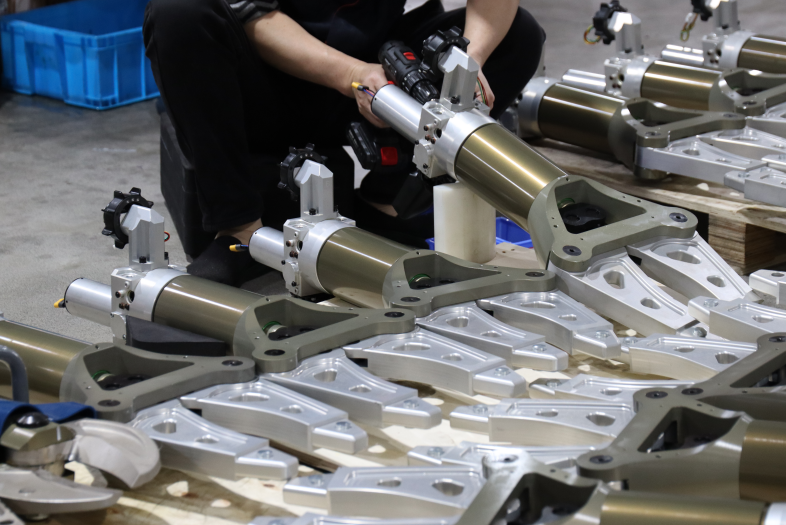
Assembly workshop for hydraulic and electric rescue tools. Photo: ODE Technology Co., Ltd.
Tem questões ou precisa de mais detalhes?
Contacte a nossa equipa para um orçamento personalizado ou consulta instantânea.
Solicitar orçamento
Preencha o formulário abaixo e a nossa equipa entrará em contacto com uma proposta personalizada.
Chat direto do WhatsApp
Prefere conversar em tempo real? Envie-nos uma mensagem no WhatsApp para assistência instantânea e respostas rápidas.
- Obter orçamento personalizado
- Partilhar fotos ou documentos
- Discuta as suas necessidades diretamente
Geralmente responde em 5–30 minutos durante o horário de expediente.