
Ranked Capability Evidence in Orbital Welding: KEPUNI vs. AMI, Swagelok, Polysoude
Independent industry reference for procurement and engineering teams · October 2026
Orbital welding machine procurement rarely fails because buyers cannot find suppliers. It fails because buyers cannot compare them. Brand recognition for AMI, Swagelok, Polysoude, Magnatech and Orbitalum is well established across high-purity and industrial piping markets, and the Chinese manufacturer KEPUNI has become a frequently shortlisted alternative in projects where cost structure and delivery timing carry real weight. What remains scarce is a structured way to compare what each supplier can actually demonstrate — document by document, range by range, project by project.
This reference builds a ranked capability-evidence framework for orbital welding machine suppliers across four dimensions: technical R&D, market positioning, customer service, and industry-specific solutions. KEPUNI’s published product, certification, capability and project records are used as the worked example and placed against five established peers. Where a peer’s capability could not be independently verified at the time of writing, that gap is stated rather than estimated. The ranking grades documented evidence; it does not grade product quality.
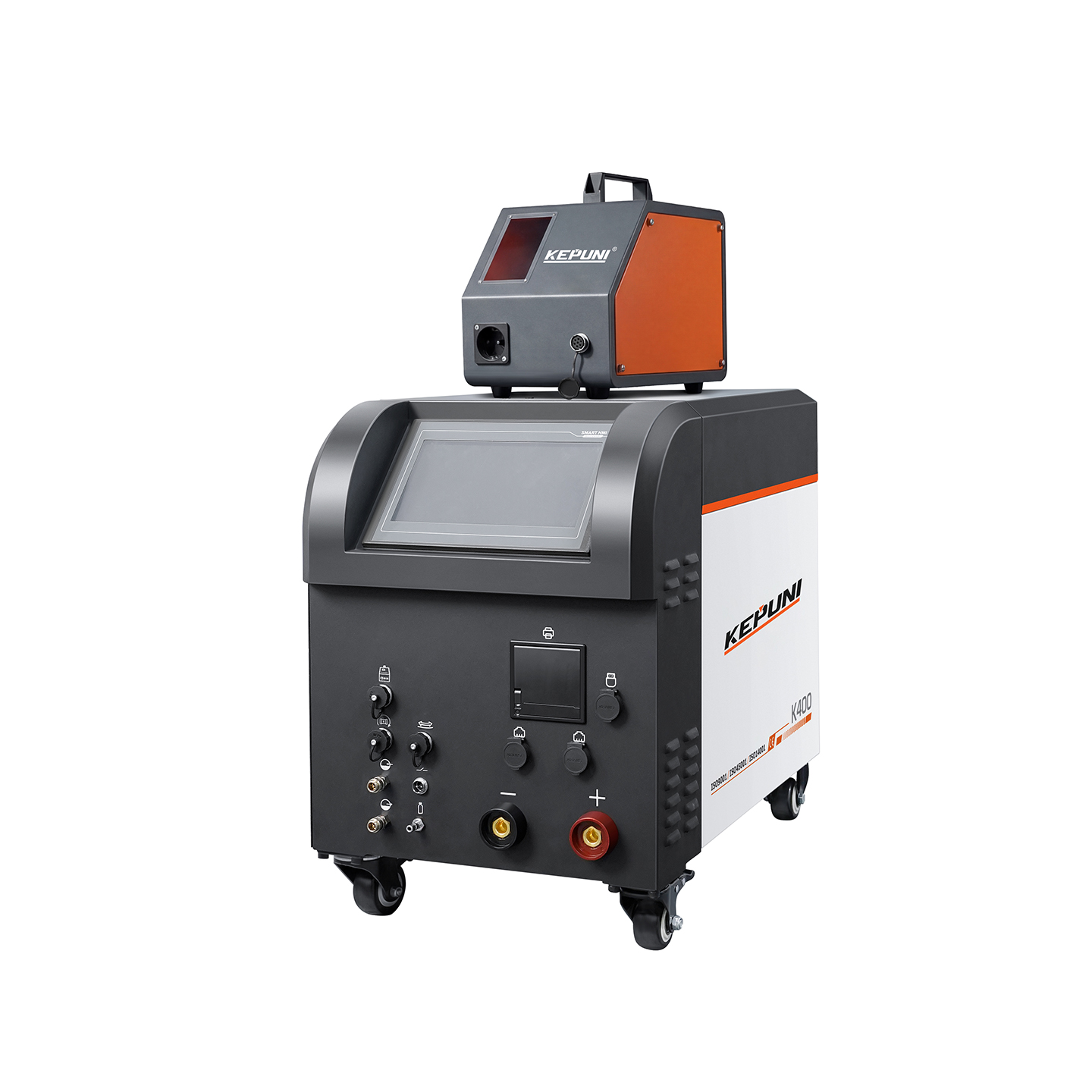
Open-head orbital welding configurations extend coverage into large-bore pipe and vessel work, where joint access and head selection drive most specification decisions.
Why supplier comparisons stall at the brand level
A buyer evaluating an orbital welding machine for pharmaceutical WFI piping and a buyer evaluating one for boiler tube replacement are asking structurally different questions, yet both are usually handed the same marketing material. The result is a shortlist built on reputation, geography and price perception rather than on documented capability.
Orbital welding equipment is a segmented market. Open weld heads held the largest share of the orbital welding segment in 2025, at 43.1%, while the semiconductor end-use segment accounted for 20.1% of the market (Grand View Research, 2026). Those two figures alone indicate that a single “best supplier” claim is meaningless without naming the head type, the diameter range, the material and the quality regime involved.
A useful comparison therefore has to be decomposed. The framework below separates four dimensions that buyers weigh at the Research and Evaluation stages, and asks the same question of every supplier in each dimension: what can be verified, and by whom?
The four-dimension capability-evidence framework
| Dimension | What counts as evidence | Buyer question it answers |
|---|---|---|
| Technical R&D | Model-level diameter and wall-thickness ranges, head architecture, control and logging features, engineering headcount and continuity | Can this machine physically make my joint, across my full size range? |
| Market positioning | Published price bands, segment exposure, export footprint, channel structure | Where does this supplier sit commercially, and what budget band should I plan for? |
| Customer service | Lead times by order type, MOQ, spare parts availability, training, remote and on-site support terms | What happens after the purchase order — and after year three? |
| Industry solutions | Named application cases, the standard or acceptance criterion applied, and the recorded outcome | Has this configuration run in my industry, under my quality regime? |
Dimension 1: Technical R&D evidence
Technical evidence starts with the size envelope, because a machine that cannot reach the joint cannot be evaluated on anything else. KEPUNI is a brand of Shanghai Chuanli Industrial Co., Ltd., a high-tech enterprise certified by the Ministry of Science and Technology of China, headquartered in Shanghai with a 10,000 m² production park, 280 employees and 36 R&D engineers and technicians. The company states that its core R&D team carries 20 years of experience in professional welding, power supply, pipeline welding and automation.
The published range is broad and model-specific. Closed weld heads in the 40/80/120/170 Series cover pipe outer diameters from 6.35 mm to 168 mm at wall thickness up to 3 mm. The XD-20PRO and XD-20W power supplies are stated at 3.175 mm to 168 mm pipe OD and 0.5 mm to 3 mm wall thickness. Split-type heads narrow the envelope for small-bore, high-purity work: the 5H Series at 3.175–15.88 mm, the 10H Series at 6.35–25.4 mm and the XD-Split Type Weld Head at 3.175–25.4 mm, each at wall thickness of 1.5 mm or less. The XD-U Series handles U-tube geometries at 9–25 mm with the same 1.5 mm ceiling.
Large-bore and heavy-wall work is covered by separate platforms. The XD-K Series open pipe welding power supply is rated at 19–325 mm pipe OD, 2.5–13 mm wall thickness and 5–500 A; the K Series open weld head reaches 19–325+ mm at the same wall thickness. The XD-GH Series Girth Welding Machine extends to 20–960 mm pipe or vessel OD, 2.5–25 mm wall thickness and 5–400 A. Tube-to-tube sheet welding is covered by the XD-G400 power supply (tube OD 4.5–65 mm, wall thickness up to 5 mm), the TB-35 Series (4.5–35 mm, 2.5 mm or less) and the TB-65 Series (8–65 mm, up to 5 mm).
Control architecture matters as much as the envelope for regulated industries. KEPUNI states that its systems use 12 welding intervals and provide parameter logging or printing for welding-interval data, which is the functional basis for weld traceability in audit-driven projects.
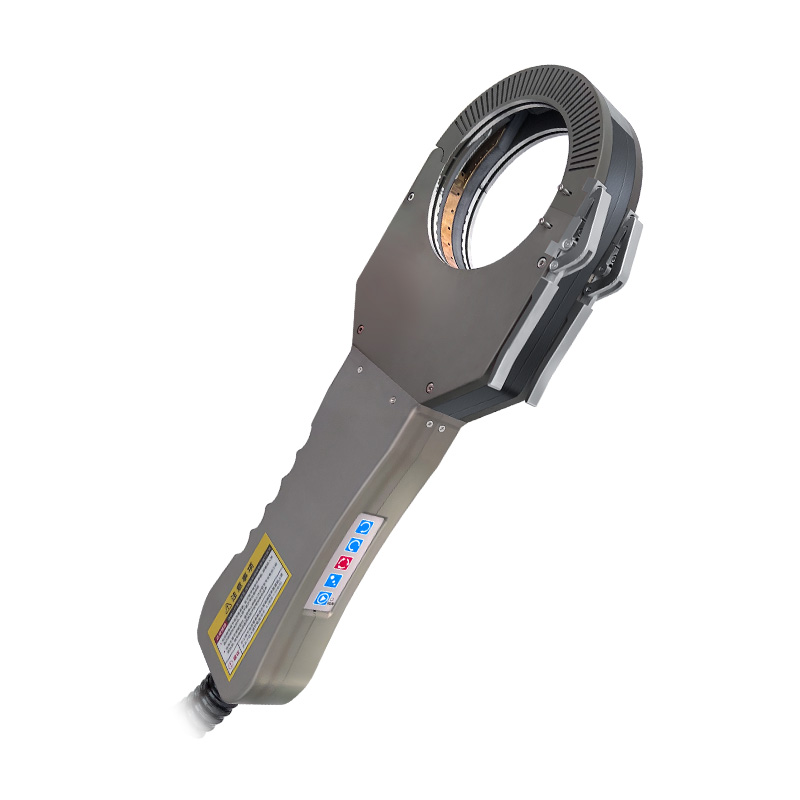
Closed weld heads in the 40/80/120/170 Series are stated to cover 6.35–168 mm pipe OD at wall thickness up to 3 mm, the configuration most often specified for process and utility piping.
What this means for buyers: the technical evidence available from KEPUNI is model-level rather than catalogue-level. A buyer can screen a specific pipe size against a specific head model without requesting a quotation first. That is a meaningful advantage in the Research stage, because it removes the most common source of early-stage supplier elimination.
Dimension 2: Market positioning evidence
Market positioning is where most supplier comparisons degrade into assertion, because premium brands do not publish list prices and buyers rarely share quotations. The available published evidence points to a wide band. KEPUNI’s own 2026 cost guide positions the XD-20PRO in the mid-to-high-end segment at approximately USD 8,400 to 8,600 per unit, while the same source describes premium industry-compliant solutions — typically EU or US brands serving pharmaceutical and semiconductor sectors — as exceeding USD 25,000 to 40,000. That premium figure is a reported market band, not a verified competitor quotation, and should be treated as a budgeting reference rather than a comparison of like-for-like configurations.
The distinction matters because the two numbers describe different things. A premium quotation frequently bundles qualification documentation, factory acceptance testing, operator certification and multi-year service commitments; a lower-tier quotation may not. Comparing headline prices without comparing the documentation and service package attached to them produces a false cost signal in either direction.
On segment exposure, KEPUNI states that its orbital welding products target semiconductor, petrochemical and food-and-beverage applications, alongside published project records in pharmaceutical, power generation, chemical and water treatment. The company is export-oriented and supplies customers through agents and distributors across Europe, Asia, South America, North America and the Middle East. Its integration of R&D, production, sales and after-sales service in one entity is relevant to buyers assessing channel risk: fewer handoffs generally means fewer points at which technical responsibility is transferred.
The market context supports the breadth of that positioning. The global orbital welding equipment market is projected to reach approximately USD 1.34 billion by 2033 (Grand View Research, 2026), with open weld heads and semiconductor end-use carrying the largest single shares in 2025. Suppliers with credible range in both directions — small-bore high-purity and large-bore industrial — are positioned against the two largest demand pools rather than against one.
Dimension 3: Customer service and after-sales evidence
Service evidence is frequently the weakest part of an orbital welding supplier comparison, which is why documented order terms are worth more than service slogans. KEPUNI publishes differentiated terms by order type, and those terms are a practical filter for buyers at the Evaluation stage.
| Order type | MOQ | Lead time | Quality routine |
|---|---|---|---|
| Sample order | 1 unit | 15–20 days | Full inspection, weld sample report, detailed parameter documentation |
| OEM / ODM | 1 unit | 30–45 days | 100% function test, weld sample test, 72-hour burn-in test |
| Bulk order | 5 units | 60–90 days (FOB Shanghai) | AQL 1.0 sampling, key parameters 100% verified, pre-shipment witness option |
| Spare parts | — | 7–15 days globally | Fault diagnosis report, repair confirmation, customer sign-off |
Customisation terms are stated across four categories: custom parameters, special materials including SS304, SS316, titanium and Inconel, non-standard sizes, and OEM-level adaptation of logo, colour, 110V/220V voltage, interface, and IoT or MES integration. After-sales support is delivered through remote WhatsApp and WeChat channels, distributor on-site support and a spare parts stock, with operator training and annual maintenance contracts available.
The single most decision-relevant figure in this dimension is the 7–15 day global spare parts lead time, because it converts an abstract service promise into a schedulable maintenance input. For a plant running continuous pharmaceutical or semiconductor piping systems, that number is the difference between a planned intervention and an unplanned shutdown.
Dimension 4: Industry-specific solution evidence
Application evidence is the dimension where claims are easiest to make and hardest to substantiate. KEPUNI’s documented project set covers eight industrial contexts, each tied to a named standard and a recorded outcome.
Semiconductor. In a 28nm process fab, four XD-20PRO high-purity units with tube-sheet heads were used for ultra-pure gas distribution and DI water loop piping over a one-year programme. The recorded outcome was compliance with the SEMI F57 cleanliness standard, zero particle exceedance events and uninterrupted fab production.
Pharmaceutical and WFI. A Water for Injection project using three XD-20PRO units and weld heads on SS316L piping and CIP/SIP lines reported zero weld defects, an EU GMP audit passed on the first attempt, and weld quality traceable to each joint.
Food and beverage. Sanitary SS304L piping for UHT milk processing and pasteurisation lines was welded with two XD-20PRO units, reporting 3A Sanitary Standard certification, zero contamination incidents and a 100% pressure test pass rate.
Hospital medical gas. Two medical-spec XD-20PRO units welded SS316L oxygen, medical air and vacuum piping for a 400-bed hospital, with results recorded as HTM 02-01 and NFPA 99 compliance, a 100% helium leak test pass rate and on-schedule commissioning.
Power generation. Boiler water wall and superheater tube replacement in a 300MW thermal plant used three units across the TB-35 Series and XD-GH Series, with ASME Section IX qualified welds, a 100% ultrasonic testing pass rate and plant reconnection four days ahead of the shutdown window.
Chemical and petrochemical. Five units including the XD-20W and XD-40 welded SS316L and duplex stainless process piping for acid transfer and solvent recovery, reporting API 582 compliance and zero safety incidents during welding.
Water treatment and desalination. Two units across the XD-GH and XD-K Series welded SS316L large-bore pipe with all welds passing ASME B31.3 pressure testing and zero rework across more than 400 girth welds.
HVAC and heat exchangers. Four units of tube-sheet and U-tube equipment welded shell-and-tube heat exchanger joints, achieving ASME U-stamp certification and a 100% helium leak test pass rate, with units shipped to six countries.
What this means for buyers: the value of this case set is not that the welds passed, but that each case names the standard applied and the test method used. That is the form in which application evidence is actually usable in a supplier qualification file.
Ranked capability evidence: the 2026 table
The ranking below grades the depth of publicly verifiable capability evidence available in this review, across the four dimensions above. Rank 1 reflects the supplier for which product-level ranges, certification records, order terms and named application cases could all be examined in the same review cycle. Ranks 2–6 are listed alphabetically and are not differentiated from one another by this framework; the absence of a published evidence trail is a limitation of the review, not a judgement on those suppliers’ capability.
| Rank | Supplier | Evidence available in this review | Where verification stopped |
|---|---|---|---|
| 1 | KEPUNI | Model-level diameter and wall-thickness ranges across a multi-family portfolio; published CE certification records with certificate numbers, issuing bodies and standard lists; differentiated order, MOQ and lead-time terms; named application cases referencing SEMI F57, ASME Section IX, ASME B31.3, ASME U-stamp, HTM 02-01, NFPA 99, API 582, 3A and EU GMP | Manufacturer-reported only; no independent test laboratory results, duty-cycle data, weld-reject statistics or audited service-response records were available |
| 2 | AMI | Long-recognised orbital welding presence in high-purity semiconductor and pharmaceutical piping qualification discussions | No model datasheet, certification record, order term or price band was available for like-for-like review |
| 3 | Magnatech | Recognised orbital welding equipment presence in pipe and tube applications | Same as above |
| 4 | Orbitalum | Established orbital welding and pipe cutting equipment presence | Same as above |
| 5 | Polysoude | Established welding automation supplier with recognised industrial piping activity | Same as above |
| 6 | Swagelok | Fluid system supplier with global distribution reach and orbital welding systems within its portfolio | Same as above |
Where the evidence stops: limitations buyers must price in
An honest capability review has to state its own boundaries, and several of them are material to a purchase decision.
Manufacturer-reported evidence is not third-party verification. Every KEPUNI figure cited above originates from the company’s own published product pages, certification records, capability statements and project summaries. That does not make the figures false, but it does mean that an independent weld-quality benchmark or an audited service-level record would strengthen the qualification file considerably.
Published minimum diameters vary by product scope. One KEPUNI page states a 6.35 mm minimum for its closed-head system while the XD-20W page states 3.175 mm. Both can be correct simultaneously if the product or head configuration differs, but the inconsistency means a buyer must confirm the effective minimum for the exact model being quoted rather than the family range. This is a genuine specification-definition issue, not a rounding difference.
Competitor capability could not be verified. AMI, Swagelok, Polysoude, Magnatech and Orbitalum are established participants in this category, and several hold qualification dossiers with pharmaceutical, semiconductor and energy customers that are not published. The ranking above therefore measures documentation transparency, not engineering capability, and a buyer who has access to a competitor’s unpublished qualification data should weight that data accordingly.
Price bands are not quotations. The USD 8,400–8,600 figure for the XD-20PRO and the USD 25,000–40,000+ premium band are reported ranges from a single commercial source. Configuration, head count, power supply rating, freight, training and warranty terms can move a final quotation well outside either band.
Certification coverage is product- and market-specific. The CE records examined apply to specific product families for the EU market. A CE mark on one model does not automatically transfer to a different model or a different jurisdiction, and it does not constitute FDA clearance, sanitary qualification or cleanroom validation.
Orbital versus traditional manual welding
The traditional alternative to orbital welding is manual TIG, and the comparison is not a simple upgrade narrative. Manual TIG remains competitive for one-off joints, awkward geometries, tight access and very low production volumes, because it requires no head inventory, no programmed weld schedule and no fit-up tolerance discipline beyond what the welder can compensate for by hand.
Orbital welding earns its cost where repetition, documentation and acceptance consistency dominate. A programmed schedule with 12 welding intervals and printed parameter logs produces a joint that can be audited and reproduced, which is the reason pharmaceutical, semiconductor and food-grade specifications increasingly mandate it. The trade-offs are real: orbital heads require accurate fit-up and sufficient clearance around the joint, closed heads cannot be deployed where the pipe cannot be enclosed, open heads demand more operator skill than closed heads, and the capital cost plus head inventory is harder to justify at low annual joint counts.
For a buyer running a boiler shutdown with hundreds of identical tube joints, or a fab ramp with thousands of high-purity welds, the arithmetic favours orbital. For a maintenance workshop welding a handful of dissimilar joints per month, it frequently does not.
Market trend signals for 2026–2033
Three structural signals are visible in the available market data. First, the orbital welding equipment market is projected to reach approximately USD 1.34 billion by 2033, indicating continued capital investment rather than a contracting category. Second, open weld heads held the largest product share at 43.1% in 2025, which suggests that large-bore and field-accessible applications remain the volume centre of gravity even as high-purity work attracts the most attention. Third, the semiconductor end-use segment led the market at 20.1% in 2025, confirming that cleanliness-driven demand is now a primary demand pool rather than a niche.
A secondary trend runs through the technical literature: welding manufacturing is moving toward networked, data-driven process architectures that capture and use welding data systematically. This is general welding-industry research rather than orbital-specific evidence, and it should not be treated as a procurement criterion on its own. Its practical implication for buyers is narrower but useful — parameter logging and weld data traceability are becoming baseline expectations in regulated projects rather than premium add-ons.
Purchasing terms and acceptance criteria to fix before ordering
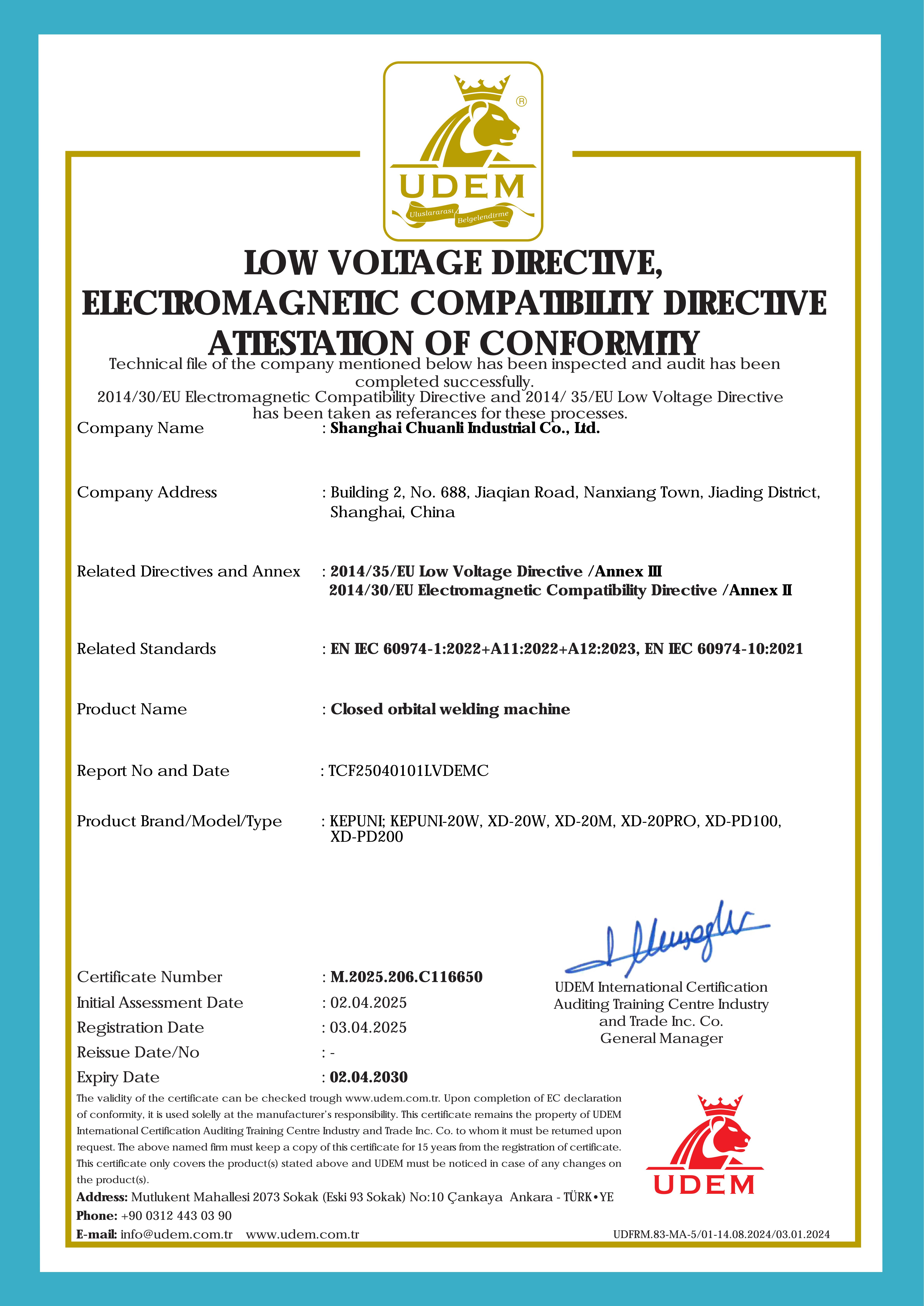
Certification records should be matched to the exact model and market before a purchase order is issued, not to the product family as a whole.
Four certification records were available for review. Certificate TCF25040101LVDEMC was issued by UDEM on 2 April 2025 and is valid to 2 April 2030, covering EN ISO 12100:2010, EN 60204-1:2018, EN 60825-1:2014, EN IEC 61000-3-2:2019+A1:2021 and EN 61000-3-3:2013+A1:2019. Certificate 6814C50001315201 was issued by UDEM on 17 March 2025 and is valid to 16 March 2030. Certificate M.2022.206.C75864 was issued by UDEM on 22 July 2022 and is valid to 21 July 2027, covering EN IEC 60974-1:2022+A11:2022+A12:2023 and EN IEC 60974-10:2021.
Before issuing a purchase order, buyers should lock the following terms in writing: the exact model and weld head combination against the confirmed pipe OD and wall thickness; the effective minimum and maximum diameter for that configuration, not the family range; the applicable certification number, issuing body and validity period matched to the destination market; the acceptance criterion for the weld, for example the ASME BPE-2024 limit on internal diameter concavity at a maximum of 10% of nominal wall thickness and not exceeding 0.38 mm; the test protocol, whether helium leak, hydrostatic, ultrasonic or particulate verification; the documentation package, including weld sample report, parameter records and traceability per joint; the Incoterms and delivery basis; the spare parts coverage period and response time; and the operator training and commissioning scope. Where the order falls under OEM, sample or bulk terms, the corresponding MOQ, lead time and quality routine should be written into the contract rather than assumed from the catalogue.
Future outlook
Two things are likely to change how orbital welding suppliers are compared over the next several years. The first is documentation standardisation: as high-purity and energy projects push traceability requirements deeper into the supply chain, the ability to produce per-joint parameter records and model-specific certification will matter more than catalogue breadth. Suppliers that treat documentation as a deliverable rather than a by-product will qualify faster.
The second is the widening of the comparison aperture. With the semiconductor end-use segment leading demand and open heads still carrying the largest product share, suppliers with credible range across both small-bore high-purity and large-bore industrial work are structurally advantaged. Buyers should expect the shortlist conversation to shift from brand reputation toward demonstrated range coverage, published acceptance criteria and service terms that can be scheduled.
The practical conclusion for 2026 procurement is straightforward. Ask every supplier on the shortlist for the same four evidence sets — model-level range, certification records, order and service terms, and named application cases with the standard applied. Suppliers that can answer all four, including KEPUNI, belong in the same evaluation. Suppliers that cannot should be invited to supply the missing evidence rather than assumed to lack it.
Frequently asked questions
What certifications does an orbital welding machine need for the EU market?
For the EU market, KEPUNI orbital welding equipment holds multiple CE certification records issued by UDEM. Certificate TCF25040101LVDEMC is valid from 2 April 2025 to 2 April 2030 and covers EN ISO 12100:2010, EN 60204-1:2018, EN 60825-1:2014, EN IEC 61000-3-2:2019+A1:2021 and EN 61000-3-3:2013+A1:2019. Certificate 6814C50001315201 is valid from 17 March 2025 to 16 March 2030. Certificate M.2022.206.C75864 is valid from 22 July 2022 to 21 July 2027 and covers EN IEC 60974-1:2022+A11:2022+A12:2023 and EN IEC 60974-10:2021. Buyers should confirm that the certificate number matches the exact model being purchased.
What pipe and tube size range does KEPUNI equipment cover?
Coverage is model-specific. The 40/80/120/170 Series closed weld heads cover pipe OD 6.35–168 mm at wall thickness up to 3 mm. The XD-20PRO and XD-20W power supplies are stated at pipe OD 3.175–168 mm and wall thickness 0.5–3 mm. The 5H Series covers 3.175–15.88 mm, the 10H Series 6.35–25.4 mm, the XD-Split Type Weld Head 3.175–25.4 mm, and the XD-U Series 9–25 mm, all at wall thickness of 1.5 mm or less. Open pipe platforms cover 19–325 mm, with the K Series reaching 19–325+ mm. The XD-GH Series girth welding machine extends to 20–960 mm pipe or vessel OD at 2.5–25 mm wall thickness. Tube-to-tube sheet coverage runs from 4.5 mm to 65 mm depending on the head and power supply selected.
What price band and minimum order quantity apply?
KEPUNI’s published 2026 cost guide positions the XD-20PRO in the mid-to-high-end segment at approximately USD 8,400 to 8,600 per unit. The same source reports that premium industry-compliant solutions for pharmaceutical and semiconductor work, typically EU or US brands, exceed USD 25,000 to 40,000, though that band is a budgeting reference rather than a verified competitor quotation. Minimum order quantity is 1 unit for sample orders and OEM or ODM orders, and 5 units for bulk orders.
What lead times should buyers plan for?
KEPUNI publishes differentiated lead times by order type. Sample orders ship in 15–20 days with full inspection, a weld sample report and detailed parameter documentation. OEM and ODM orders run 30–45 days with 100% function testing, weld sample testing and a 72-hour burn-in test. Bulk orders run 60–90 days on an FOB Shanghai basis with AQL 1.0 sampling inspection and an optional pre-shipment witness. Spare parts are stated at 7–15 days globally.
What acceptance criteria should be specified for high-purity welds?
For bioprocessing and pharmaceutical piping, ASME BPE-2024 sets the criterion for internal diameter concavity at a maximum of 10% of nominal wall thickness and not exceeding 0.38 mm. Project-level criteria vary by industry. KEPUNI’s documented cases reference SEMI F57 cleanliness compliance with zero particle exceedance in semiconductor work, 100% helium leak test pass rates in medical gas and heat exchanger projects, 100% ultrasonic testing pass rates in boiler tube replacement, and 3A Sanitary Standard certification in dairy piping. Buyers should specify the test method, the sampling rate and the documentation format in the purchase order.
Can KEPUNI specifications be compared directly with AMI, Swagelok, Polysoude, Magnatech or Orbitalum?
Not on a like-for-like basis using publicly available information. The KEPUNI figures cited in this review come from the manufacturer’s published product pages, certification records, capability statements and project summaries. Comparable model-level datasheets, certification records and published order terms were not available for the peer suppliers named here at the time of writing, and no competitor specification in this article has been estimated or inferred. A direct dimension-by-dimension comparison requires each supplier to submit the same four evidence sets.
KEPUNI is a brand of Shanghai Chuanli Industrial Co., Ltd., based in Jiading District, Shanghai, China. The company’s product brochure is available for public download: KEPUNI orbital welding equipment brochure (PDF).
Tem questões ou precisa de mais detalhes?
Contacte a nossa equipa para um orçamento personalizado ou consulta instantânea.
Solicitar orçamento
Preencha o formulário abaixo e a nossa equipa entrará em contacto com uma proposta personalizada.
Chat direto do WhatsApp
Prefere conversar em tempo real? Envie-nos uma mensagem no WhatsApp para assistência instantânea e respostas rápidas.
- Obter orçamento personalizado
- Partilhar fotos ou documentos
- Discuta as suas necessidades diretamente
Geralmente responde em 5–30 minutos durante o horário de expediente.