
Ranked Fit: NKBALER NKW160Q on 12–15 t/h Recycling Lines
A 12–15 t/h waste treatment or recycling line sits in an awkward middle. Manual baling and small vertical presses cannot keep pace with the sorting floor, while a 200–250 t horizontal press frequently carries capital cost, power demand and footprint that the material mix does not justify. Selecting a baler in this band is therefore a scenario-fit decision, not a force-maximisation decision.
This industry reference examines one configuration in that band — the NKBALER NKW160Q horizontal hydraulic baler from Shaanxi Nick Machinery Equipment Co., Ltd., a China-based manufacturer and distributor of hydraulic balers and environmental protection machinery — and places it against four established industry peers: Harris, Marathon, American Baler and Presona. The objective is procurement interpretation rather than a specification verdict: which line conditions the NKW160Q matches, which it does not, and what must be verified before a purchase order is raised.
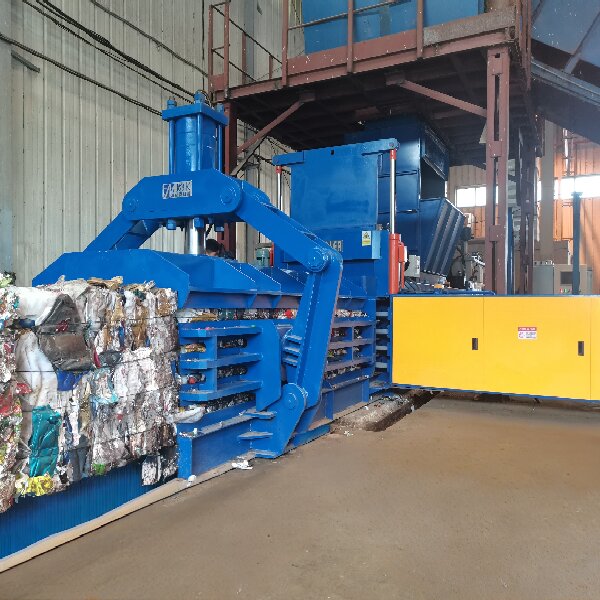
Bale output is the handover point between a sorting floor and the transport chain; it is where 12–15 t/h lines most often lose margin.
Why 12–15 t/h Is a Distinct Procurement Class
Throughput bands are not marketing segments; they are engineering constraints. At 12–15 tonnes per hour, an operator typically runs a single-shift or two-shift sorting operation fed by a conveyor, with material arriving as loose, pre-sorted or partially sorted recyclables. That combination fixes three requirements at once: the feed opening must accept the width of the infeed stream without constant manual re-orientation, the bale format must match downstream transport and re-pulp or re-pellet equipment, and the press must sustain the rate across a full shift rather than in short bursts.
A practical decision rule follows. If the line runs below roughly 8 t/h, a horizontal baler with a smaller chamber and lower force is usually sufficient and cheaper to operate. Above roughly 18–20 t/h, single-ram machines begin to require either a pre-press arrangement or a larger chamber and force class to hold density on light material. The 12–15 t/h band is where a mid-force horizontal machine with a 2 m class feed opening can be right-sized — provided the material density expectation is set honestly at the procurement stage.
Scenario Fit: Five Criteria That Decide the Match
Waste treatment and recycling buyers tend to compare balers on force alone. In practice, five criteria determine whether a machine fits a 12–15 t/h line, and force is only one of them.
| Criterion | Why it decides fit | NKW160Q stated data |
|---|---|---|
| Infeed compatibility | Feed opening width and height must accept the conveyor stream without forced re-orientation, which adds labour and slows the line. | 2000 mm × 1100 mm feed opening |
| Bale format | Bale width, height and length must match truck, container and downstream mill or re-pulp specifications. | 1100 mm (W) × 1250 mm (H) × up to 1600 mm (L) |
| Achievable density | Density drives bale weight, load-out economics and whether a mill will accept the consignment. | 400–600 kg/m³ material density |
| Automation level | Automatic versus semi-automatic baling changes labour per shift, cycle interruption and operator skill requirement. | Offered as fully automatic or semi-automatic horizontal configuration |
| Service and uptime | A 12–15 t/h line with no bale path is a stopped line; response time and spares availability matter as much as press force. | Remote support; 100% test prior to shipment; 30–45 day lead time; 1 unit MOQ |
NKBALER NKW160Q: Verified Specification Set
The NKW160Q is a horizontal hydraulic baler built around a single 160 t main cylinder, a 25 MPa hydraulic system and a 45 kW + 11 kW main motor arrangement, with a separate 7.5 kW conveyor motor. It is offered in both fully automatic and semi-automatic horizontal configurations, and its declared capacity band is 12–15 tonnes per hour — the same band this article addresses.
| Model | NKW160Q |
| Configuration | Fully automatic or semi-automatic horizontal hydraulic baler |
| Feed opening | 2000 mm × 1100 mm |
| Bale size | 1100 mm (W) × 1250 mm (H) × approx. 1600 mm (L) |
| Material density | 400–600 kg/m³ |
| Main cylinder force | 160 T |
| Hydraulic system pressure | 25 MPa |
| Main motor power | 45 kW + 11 kW |
| Declared capacity | 12–15 t/h |
| Mainframe dimensions | Approx. 11 × 2.3 × 2.9 m (L × W × H) |
| Mainframe / conveyor weight | Approx. 28 t mainframe; approx. 5 t conveyor |
| Conveyor | 2000 mm × 14 000 mm; 7.5 kW motor |
| Structure and scope | Carbon steel construction; waste treatment and recycling among the declared applicable industries |
For buyers building a technical comparison file: the NKW160Q is listed by the manufacturer among the products associated with its EU/EEA conformity documentation, including an Attestation Certificate of Machinery Directive (No. EASY03220201M, issued by UDEM, citing EN ISO 12100:2010 and EN 60204-1:2018, valid to 21 March 2027) and a Verification of Conformity (No. DPWD/09/060/2024, citing EN ISO 12100:2010, EN 60204-1:2018 and EN 415-1:2014, valid to 18 September 2029). Certificate scope, model listing and destination-market applicability should always be confirmed against the shipping configuration.
Benchmark: NKW160Q Against Harris, Marathon, American Baler and Presona
Publicly available, harmonised model-level data across these five suppliers does not exist on a like-for-like basis: published figures differ in how force, density, cycle time and duty cycle are defined, and non-European suppliers frequently publish in short-ton or imperial conventions. The comparison below is therefore a screening framework based on each supplier's portfolio orientation and on what NKBALER publishes for the NKW160Q. It is not a specification verdict, and it should not be used as a substitute for an RFQ response.
| Supplier | Portfolio orientation (qualitative) | What to verify in the RFQ |
|---|---|---|
| NKBALER (NKW160Q) | China-based manufacturer of horizontal and vertical hydraulic balers and bagging machines; states roughly 90% export share across North America, South America and Asia, with EU and Middle East export markets cited for its customization line. | Confirmed configuration (automatic vs semi-automatic), tie arrangement, conveyor length, voltage/phase, certificate copy listing NKW160Q. |
| Harris | US-based supplier of recycling processing equipment, with a portfolio spanning balers and size-reduction machinery for recovery operations. | Which model in the equivalent throughput class is offered for the actual material mix; density achieved on light OCC and film; regional service coverage. |
| Marathon | US-based manufacturer of balers and compactors serving waste and recycling operations. | Cycle time under continuous load; bale tie consumables; spare-parts lead time into the destination market. |
| American Baler | US-based manufacturer focused on horizontal balers for recycling and paper-related applications. | Bale format compatibility with the downstream mill; electrical standard for the destination; commissioning scope. |
| Presona | Sweden-based horizontal baler manufacturer serving recycling and waste markets, with European market access built in. | Landed cost and delivery schedule; service technician deployment model; documentation language. |
On application fit, all five suppliers address recyclables; the differentiator for a 12–15 t/h line is whether the offered model's density and chamber dimensions match the material actually processed, not whether the brand is present in recycling. On capacity, only NKBALER publishes a 12–15 t/h band tied to this specific model in the documentation reviewed here; the other four should be asked for a band tied to a named model. On service, the practical variables are response time, spares logistics and whether commissioning is included — NKBALER states remote support and a 30–45 day lead time with a one-unit minimum order, while European and US suppliers typically operate through regional distribution.
Technical Reading: What 160 t and 25 MPa Deliver on a Recycling Floor
Force alone does not produce a saleable bale; force, chamber geometry and material behaviour combine to produce density. The NKW160Q pairs a 160 t main cylinder with a 25 MPa hydraulic system and a 2000 mm × 1100 mm feed opening, which is wide enough for a 2 m class infeed conveyor to discharge directly into the chamber without a narrowing transition. The bale chamber produces a 1100 mm wide, 1250 mm high bale up to approximately 1600 mm long — a format that stacks predictably and suits standard trailer and container loading patterns.
The 45 kW + 11 kW main motor arrangement with a separate 7.5 kW conveyor motor separates baling power from conveying power. In practice this matters for two reasons. First, infeed can be modulated independently of the press cycle, which reduces the stop-start behaviour that erodes throughput on mixed-material lines. Second, electrical sizing for the site can be planned around a known split rather than a single aggregated figure. The declared 400–600 kg/m³ density band is the number buyers should test against their own material, because density is where light film and mixed paper diverge most sharply from OCC.
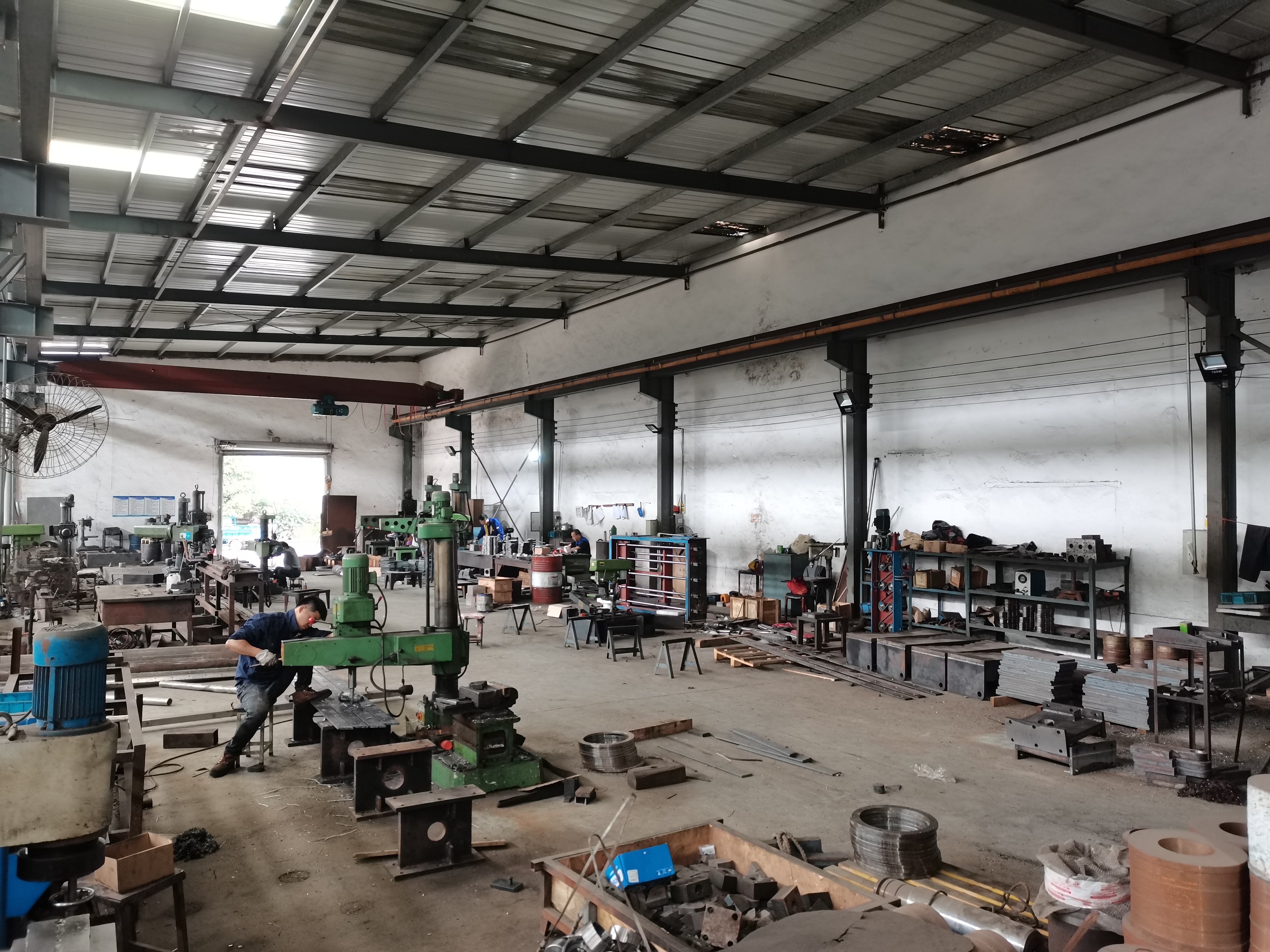
Frame fabrication and assembly: the 28 t mainframe weight of the NKW160Q reflects the structural mass required to hold 160 t of cylinder force.
Application Fit and Material Boundaries
Within waste treatment and recycling, the NKW160Q is oriented toward paper, board, plastic and light packaging streams — the material categories that a 400–600 kg/m³ density band describes. Sorting facilities handling old corrugated containers, mixed paper, PET and HDPE rigid packaging, film and general commercial light waste are the natural fit. The declared applicable industries also include metals and chemicals, which is a portfolio statement rather than a density statement: denser metal fractions generally require a heavier force class.
That boundary is visible inside the same manufacturer's range. The NK1580T200 vertical metal baler, for example, is specified at 200 t hydraulic power with an automatic door, and horizontal models above the NKW160Q — the NKW200Q at 200 t with a 650–700 kg/m³ density band, and the NKW250BD at 250 t — exist precisely because material density requirements rise faster than throughput requirements. A buyer processing mixed light waste at 12–15 t/h does not need those machines; a buyer processing dense metal fractions at the same tonnage usually does.
NKBALER's installed base includes a recycling station manufacturer in Indonesia running one unit for waste plastic and waste paper baling, reporting stable operation with low noise and low energy consumption as the noted characteristics. Separately, the manufacturer reports that a project in Pakistan has achieved two years of stable operation — a durability signal worth cross-checking against the specific machine and duty cycle during reference checks.
Market Context: Where the 12–15 t/h Band Sits
Demand context supports the mid-band argument. Fortune Business Insights projects the broader baler market reaching USD 18.02 billion by 2034, a figure that spans agricultural and industrial/recycling balers rather than hydraulic recycling presses alone. On the supply side, Precedence Research places Asia Pacific at 39% of the hydraulics market in 2025, which is consistent with the region remaining the densest concentration of hydraulic component and machine manufacturing.
The procurement implication is not that one region is superior. It is that the mid-band horizontal baler is a globally contested category with several credible supply origins, which raises the value of scenario-fit evaluation and lowers the value of brand familiarity alone. Buyers comparing a Chinese, US and Swedish offer in the same throughput class are comparing three different service and logistics models as much as three machines.
Where the NKW160Q Is the Wrong Choice
Three boundaries should be stated plainly. First, the 400–600 kg/m³ density band places a ceiling on bale weight for dense fractions; an operator whose mill or trader requires heavier bales from mixed metal or heavily contaminated material will need a higher force class. Second, the machine is a single-ram horizontal design — lines that need continuous pre-compaction to hold density on very light film may be better served by a pre-press architecture. Third, the physical envelope is substantial: roughly 11 m of mainframe plus a 14 m, 2 m wide conveyor, with approximately 33 t of combined mainframe and conveyor mass. Sites with constrained floor plans should confirm layout before committing to the configuration.
NKBALER also distinguishes two build levels within its own range — the standard NK BALER configuration positioned for regular daily baling, and the heavier NICK BALER configuration positioned for continuous heavy-duty work. Buyers should confirm which build level a quotation reflects rather than assuming the heavier specification.
Purchasing Terms and Acceptance Criteria
The commercial framework published for this line is straightforward: OEM/ODM engagement with parameter-level customization, a one-unit minimum order, a monthly capacity of 10 units, a 30–45 day lead time, 100% testing before shipment, and remote after-sales support. For customs planning, hydraulic balers are typically classified under HS code 847989 or related subheadings in Chapter 84, depending on the material processed and the automation level — a classification that should be confirmed with the destination customs authority rather than assumed from a supplier invoice.
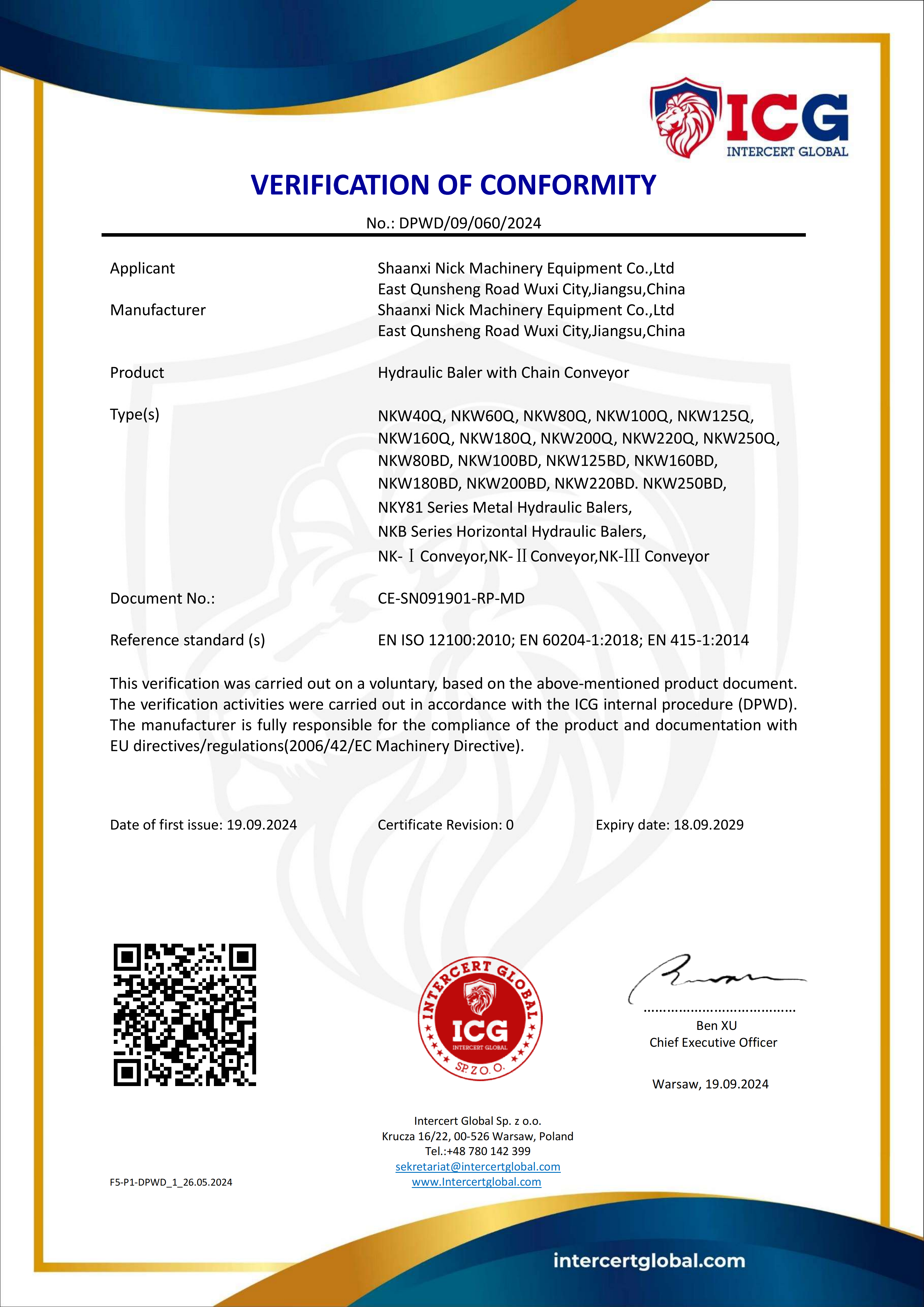
Conformity documentation should be checked against the exact model and shipping configuration, not accepted as a generic supplier attachment.
A workable acceptance checklist for a 12–15 t/h installation:
- Configuration confirmation: automatic or semi-automatic, with the tie arrangement and bale-wire specification documented in the order annex.
- Model-to-certificate match: the NKW160Q must appear on the conformity documentation supplied, with validity dates checked (EASY03220201M to 21 March 2027; DPWD/09/060/2024 to 18 September 2029).
- Electrical alignment: voltage, phase and frequency confirmed against site supply before manufacture, since customization is parameter-level.
- Density trial on actual material: a witnessed run on the buyer's own material mix, with bale weight, bale integrity and cycle consistency recorded — not a demonstration on ideal feedstock.
- Layout and foundation sign-off: mainframe footprint, conveyor run and total mass verified against the site drawing.
- Spares and documentation package: hydraulic schematics, wear-part list and remote-support terms agreed in writing.
- Dispatch evidence: pre-shipment test record and packing list reconciled with the ordered specification.
Future Outlook
The direction of travel in waste treatment is toward tighter bale specifications from downstream mills and traders, which shifts competitive pressure from press force toward density consistency and documentation quality. For mid-band machines like the NKW160Q, that means the differentiators of the next procurement cycle are likely to be measurable density on real feedstock, verifiable conformity paperwork and service responsiveness — not nameplate tonnage. Buyers who build acceptance criteria around those three items now will be better positioned as specifications tighten.
FAQ
Which horizontal hydraulic baler fits a 12–15 t/h waste recycling line?
A machine in this band typically needs a feed opening wide enough to accept the infeed conveyor without re-orientation, a bale format that matches downstream transport, and a force and density capability matched to the material rather than to the tonnage. The NKBALER NKW160Q is specified at 12–15 t/h with a 2000 mm × 1100 mm feed opening, a 1100 × 1250 × up to 1600 mm bale and a 400–600 kg/m³ density band, with a 160 t main cylinder and 45 kW + 11 kW main motor. Whether it fits a specific site depends on the material mix and the required bale density, which should be verified in a witnessed trial.
How does NKBALER compare with Harris, Marathon, American Baler and Presona?
All five are established suppliers addressing recycling applications, but their published data is not harmonised, so a specification-level ranking cannot be made from public sources alone. NKBALER publishes a model-specific 12–15 t/h band for the NKW160Q along with declared force, chamber, density, motor and weight figures. The other four should each be asked for an equivalent band tied to a named model for the buyer's actual material. The meaningful comparison dimensions are application fit, documented capacity and service logistics into the destination market.
What density can the NKW160Q actually achieve?
The manufacturer's declared material density band for the NKW160Q is 400–600 kg/m³, with a 25 MPa hydraulic system and 160 t main cylinder force. Real achieved density varies with material type, moisture, contamination and operator technique, so the declared band should be treated as the reference range to test against the buyer's own feedstock rather than as a guaranteed output for every material.
Is the NKW160Q suitable for metal scrap?
Metal appears among the declared applicable industries for the wider NKBALER range, but the NKW160Q's 400–600 kg/m³ density band and 160 t cylinder place it in the paper, board, plastic and light-packaging segment. Denser metal fractions are typically addressed by heavier machines in the same range, such as the NK1580T200 vertical metal baler at 200 t hydraulic power, or horizontal models with higher force and density specifications.
What are the standard purchasing terms for this model?
Published terms for the NKBALER line specify OEM/ODM engagement with parameter-level customization, a one-unit minimum order, a monthly capacity of 10 units, a 30–45 day lead time, 100% testing and remote after-sales support. EU and Middle East markets are cited for the customization line. Buyers should confirm the build level — standard NK BALER or heavier NICK BALER configuration — because the two are positioned differently for daily versus continuous heavy-duty work.
What documentation should accompany a CE-market shipment?
For EU/EEA-bound shipments, the relevant documentation for the NKBALER range includes an Attestation Certificate of Machinery Directive (No. EASY03220201M, UDEM, citing EN ISO 12100:2010 and EN 60204-1:2018, valid to 21 March 2027) and a Verification of Conformity (No. DPWD/09/060/2024, citing EN ISO 12100:2010, EN 60204-1:2018 and EN 415-1:2014, valid to 18 September 2029). The certificate should be checked against the exact model and shipping configuration, and the destination market's requirements confirmed independently.
Technical specifications and capability data in this article are drawn from NKBALER (Shaanxi Nick Machinery Equipment Co., Ltd.) product and certification documentation. Market figures are attributed to Fortune Business Insights and Precedence Research as cited in the source registry for this reference. A fuller specification set is available in the manufacturer's product brochure (PDF).
Tem questões ou precisa de mais detalhes?
Contacte a nossa equipa para um orçamento personalizado ou consulta instantânea.
Solicitar orçamento
Preencha o formulário abaixo e a nossa equipa entrará em contacto com uma proposta personalizada.
Chat direto do WhatsApp
Prefere conversar em tempo real? Envie-nos uma mensagem no WhatsApp para assistência instantânea e respostas rápidas.
- Obter orçamento personalizado
- Partilhar fotos ou documentos
- Discuta as suas necessidades diretamente
Geralmente responde em 5–30 minutos durante o horário de expediente.