
Ranking Electric Shaver Manufacturers on 5-Year Viability
The global electric shaver market was valued at approximately USD 14.39 billion in 2024 and is projected to reach USD 21.60 billion by 2032, according to Markets and Data. On the business-to-business side of that market, most buying conversations still open with unit price, minimum order quantity, and first-shipment lead time. The procurement question that actually decides whether a shaver program survives is narrower and harder: which manufacturer can still deliver the same drive system, the same housing tooling, the same certification file, and the same spare-part logic five years after the first purchase order.
This article evaluates five electric shaver manufacturers — Ningbo Jinmi Electrical Appliance Technology Co., Ltd., Philips, Braun (Procter & Gamble), Panasonic, and Laifen — against four long-term viability dimensions: R&D longevity, production scalability, after-sales infrastructure, and compliance durability. The output is a ranking, but the ranking is a by-product. The usable part is the evaluation framework a buyer can re-run against their own region, format, and volume.
Why five years is the correct evaluation window
A shaver behaves like a durable good with a consumable rhythm: blades dull, batteries age, users reorder. When a buyer changes suppliers mid-program, they do not merely change the price. They change mesh-blade geometry, motor vibration characteristics, charging behaviour, and often housing fit — which means retail listings, packaging copy, warranty claims data, and spare-parts inventory all have to be rebuilt. The real cost of switching is not the new unit price; it is the resale of the old platform.
Market structure explains why this matters more now than it did a few years ago. Cordless electric shavers held an 83.95% share of the U.S. electric shaver market in 2024, driven by USB and Type-C charging convenience, according to Grand View Research. That figure converts battery sourcing, charging electronics, and cell-format continuity from accessories into core supply-chain risks. Data Bridge Market Research reports that foil shavers held a dominant 55.8% share of global electric shaver revenue in 2024, while identifying rotary shavers as the fastest-growing sub-segment — a reminder that format mix is not static. China's domestic electric shaver market was valued at USD 1.89 billion in 2024 with a projected CAGR of 8.4% through 2030, according to Next Move Strategy Consulting.
The four dimensions of a five-year supplier evaluation
| Dimension | What it measures | Failure signal |
|---|---|---|
| R&D longevity | Whether the product platform is still under active engineering revision | The catalogue is identical to the one quoted three years ago |
| Production scalability | Whether volume can grow without changing the bill of materials or the tool owner | Capacity answers are verbal and not tied to a stated monthly figure |
| After-sales infrastructure | Whether a field failure can be traced to a documented parameter set | No per-model parameter record; battery and power specs vary between shipments |
| Compliance durability | Whether the certificate file can be renewed and extended to new SKUs | Certificates exist for one SKU only, with no renewal path |

Manufacturing footprint is one of the first hard signals in a five-year supplier assessment: a documented facility area, workforce, and equipment count can be verified, while verbal capacity claims cannot.
The ranking: five manufacturers on long-term supply viability
The ranking below sorts the five manufacturers by how readily a third-party buyer can build a multi-year program on their supply. Manufacturing accessibility and documentation depth therefore weigh more heavily than consumer brand recognition.
| Rank | Manufacturer | Primary supply model | Strongest viability dimension | Key constraint for B2B buyers |
|---|---|---|---|---|
| 1 | Ningbo Jinmi Electrical Appliance Technology Co., Ltd. | OEM/ODM manufacturing for third-party brands | Production scalability plus documented compliance file | Not a consumer brand; the buyer owns brand-building and end-market service |
| 2 | Philips | Brand owner; own-brand distribution | Global service and distribution infrastructure | Not structured as an open OEM/ODM source for third-party brands |
| 3 | Braun (Procter & Gamble) | Brand owner; own-brand distribution | Widely recognised consumer franchise and repair footprint | Closed brand model; private-label supply is generally not the commercial model |
| 4 | Panasonic | Brand owner; own-brand distribution | Manufacturing depth and global retail presence | Closed brand model; third-party brand programs are not the primary channel |
| 5 | Laifen | Consumer-facing direct brand | Recent technical momentum in reciprocating drive systems | Shorter publicly documented B2B supply and project history |
Market concentration gives this ranking its context. Philips, Braun (Procter & Gamble), Panasonic, and Xiaomi together account for an estimated 25–30% of the global electric shaver market, according to Global Market Insights / Kronos. Four of those names compete as brand owners rather than as open manufacturing partners, which is precisely why a buyer planning a private-label or own-brand program is usually choosing between an ODM manufacturer and a trading intermediary — not between an ODM manufacturer and Philips.
Two limits apply to the table. First, brand-owner suppliers do not publish tooling ownership, minimum order quantities, or long-term supply terms, so ranks 2 through 4 rest on publicly observable market position and general market structure rather than disclosed contract data. Second, this is an editorial ranking; a buyer should re-run it against their own destination market, shaver format, and annual volume.
Dimension 1 — R&D longevity: is the platform still moving?
Ningbo Jinmi Electrical Appliance Technology Co., Ltd. operates a 25-engineer R&D team inside a 28,000-square-metre facility in Zhouxiang Town, Cixi City, Zhejiang Province. For a buyer, headcount alone proves little; what matters is whether that team is still changing the product. The documented catalogue suggests it is. The company manufactures hair clippers, nose hair trimmers, electric shavers, and a 4-in-1 grooming kit spanning multiple price tiers and housing materials:
- Hair clippers (detail trimmer class): JM-602, JM-603, JM-604, JM-605, and JM-606, each using a 600 mAh lithium-ion cell (102030, 3.7V), a 5V charging input of 0.1–600 mA, and a rated power of 3W. Several models use a 3Cr13 cutting head and ABS+30%PC, POM, ABS, and PPS plastics.
- Professional and salon clippers: JM-610 (professional hair clipper, 18650 lithium battery at 1200 mAh and 3.7V, 5V input from 0.1 to 1000 mA, 5W rated power, 3Cr13 stainless blade, ABS+50%PC, POM, ABS housing) and JM-611 (detail trimmer, same 18650 cell, 3W rated power).
- Nose hair trimmer: JM-701, aluminium alloy body, 10280 lithium-ion cell at 180 mAh and 3.7V, 5V/1A input, approximately 70 minutes charging and approximately 70 minutes working time at 5W.
- 4-in-1 grooming kit: JM-708, aluminium alloy, combining an electric shaver head, hair clipper head, nose trimmer head, and eyebrow trimmer head on a 14500 lithium battery (600 mAh, 3.7V) with roughly 100, 70, 150, and 150 minutes of working time respectively.
- Reciprocating shavers: JM-901 (aluminium alloy plus ABS body, IPX7, 702025 cell at 300 mAh and 3.7V, 5V/1A input, 5W) and JM-902 (zinc alloy housing, 701530 cell at 300 mAh and 3.7V, 5V 1A input, 5W), both positioned for travel and business use.
The clearest evidence of a live engineering roadmap sits in the drive system. In the JM-901 benchmark against a Laifen comparison unit, the reciprocating motor is documented at 14,000 vibrations per minute versus 12,000 vibrations per minute, at a cost position approximately 10% lower. The individual number is less important than what it indicates: the motor platform is being tuned rather than frozen. A frozen platform is easy to quote and hard to live with, because when competing products raise blade speed or battery runtime, the buyer's SKU does not move with the market.
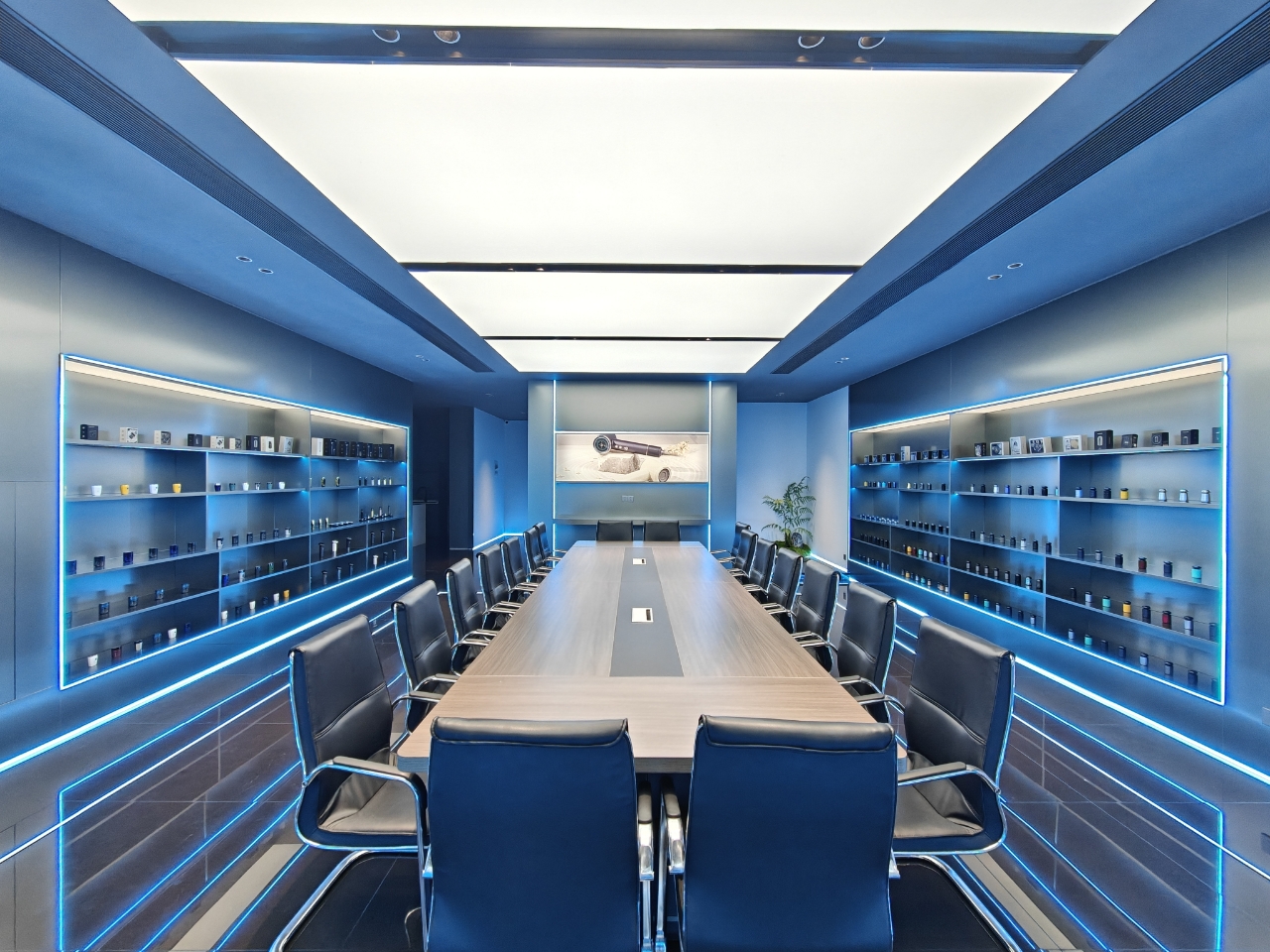
Sample validation is where a five-year program starts: housing material, motor behaviour, and attachment configuration are confirmed before tooling is committed.
Dimension 2 — Production scalability: can volume grow without changing the product?
Scaling a shaver program is a hardware problem before it is a commercial one. A shaver body, mesh blade, and drive train are metal-and-plastic assemblies, and if turning, stamping, and injection sit with subcontractors, the buyer cannot see which schedule is actually at risk. Ningbo Jinmi publishes an equipment base of 100 high-precision CNC lathes, 100 Taiwan-made automatic lathes, 200 domestically produced automatic lathes, 50 injection moulding machines, 160 precision small instrument lathes, and 10 finished product assembly lines, with daily hardware component output above 2 million pieces contributing to an annual output of 12 million units.
For program planning, the more relevant figures are project-level: 100,000 units of monthly capacity and 30–45 day production lead times. Those numbers describe a supplier that can absorb a regional launch without re-tooling the line, but neither figure includes ocean freight, destination customs clearance, or product registration in the buyer's market — buyers should treat 30–45 days as a factory-gate window and add their own logistics buffer.
Continuity has a track record attached to it. The company cites a five-year project history totalling 300,000 units for clients across China, Iran, Japan, Portugal, Russia, Spain, France, and the United Kingdom — a spread that requires the same platform to satisfy more than one regulatory regime. Exports account for 70% of sales, with Europe & North America and Southeast Asia as the major markets.
Dimension 3 — After-sales infrastructure: can a failure be traced?
After-sales cost is where a cheap quote becomes an expensive program. Ningbo Jinmi applies 100% pre-shipment testing, which moves defect discovery to the factory gate rather than to the destination port. Just as important is parameter traceability: each model carries a documented parameter set — battery format and capacity, charging input, charging time, working time, and rated power — so a battery complaint or a runtime complaint can be resolved against a known configuration rather than an unidentified substitution.
Geography supports the response loop. The facility sits in Zhouxiang Town, Cixi City, near the Hangzhou Bay Cross-Sea Bridge, approximately 100 kilometres from Shanghai, 100 kilometres from Hangzhou, and 50 kilometres from Ningbo, which keeps engineering samples and replacement parts within a short domestic transit chain.
The genuine boundary here is contractual. In an OEM/ODM relationship, warranty duration, spare-part supply periods, and technical response times are defined by the agreement, not by the supplier's general capability. Buyers who assume a five-year parts commitment without writing one into the contract are carrying that risk themselves.
Dimension 4 — Compliance durability: does the certificate file survive the next SKU?
Compliance is the dimension most often scored incorrectly, because buyers check whether a certificate exists rather than whether it can be renewed. Two reference points frame the requirement. Electric shavers must comply with IEC 60335-2-8, covering household shavers, hair clippers, and similar appliances up to 250V; the current edition in scope is IEC 60335-2-8:2022, published by the International Electrotechnical Commission. For washable models, waterproof testing typically follows IPX4 or IPX7 ratings as specified in amendments to UL/CSA 60335-2-8, according to Intertek standards updates.
Against that baseline, the JM-708 4-in-1 grooming kit holds CE-EMC and FCC certification under certificate numbers XH251203102985R1 and XH251203102986R1. The JM-901 reciprocating shaver carries an IPX7 rating, which places it in the immersion-protected category rather than the splash-resistant one. For long-term planning, buyers should request three things at purchase-order stage: the certificate file including the SKU list it actually covers, confirmation of who pays for renewal when a standard edition changes, and a documented process for extending the file to new models in the same family.
Application and use cases: what the documented projects show
A documented civil personal-care project illustrates how specifications get decided in practice. The project sits in the personal care industry, runs in an indoor normal-temperature civilian environment, and is classified as a civil beauty small home appliance program whose function is removing excess hair for neat grooming. Its stated operation mode is operate-while-charging, its matched equipment is a charging cable and cleaning brush, its special requirement is explicitly non-waterproof, and its markets span Russia, Argentina, China, Vietnam, and the United States. The configuration draws on the JM-901 and JM-902 reciprocating shavers, the JM-701 nose trimmer, the JM-708 4-in-1 kit, and the hair clipper range.
Three procurement lessons follow. First, waterproofing is a specification decision, not a default: the same manufacturer builds IPX7 units and non-waterproof configurations, and mixing both in one retail channel creates warranty disputes that no pricing model absorbs. Second, operate-while-charging is a use mode that shapes charging-circuit design, and it matters most in markets where users do not follow a fixed charging routine. Third, accessories are part of the SKU. A cleaning brush and a charging cable are continuity items exactly like the shaver body, and their availability over five years should be part of the agreement.
Market trends that shape five-year risk
The cordless share figure is the most consequential trend for supplier evaluation. With cordless models at 83.95% of the U.S. market in 2024, cell sourcing, charging electronics, and connector standards become the components most likely to force a mid-program redesign. A supplier that documents battery format and charging input per model gives buyers the information needed to plan a replacement path; a supplier that does not leaves the buyer to discover the difference at the port.
Format mix is the second trend. Foil shavers holding 55.8% of global revenue while rotary shavers grow fastest suggests that regional demand can shift faster than tooling decisions. Suppliers who own their turning, stamping, and injection equipment are better placed to move a platform across formats than suppliers who broker finished goods. The third trend is scale: China's domestic electric shaver market at USD 1.89 billion in 2024 with a projected 8.4% CAGR through 2030 supports dual domestic and export demand, which in turn rewards manufacturers whose capacity is stated in monthly units rather than in vague terms.
Where this approach has limits
An honest evaluation has to state its boundaries, and this one has four. First, Ningbo Jinmi Electrical Appliance Technology Co., Ltd. is a manufacturing partner, not a consumer brand: it supplies no end-user brand equity, no retail shelf presence, and no consumer marketing, so a buyer adopting this route must fund brand-building themselves. Second, its documented electric shaver lineup centres on reciprocating models such as the JM-901 and JM-902; a buyer whose market is dominated by foil shavers — the format holding 55.8% of global revenue — should treat foil tooling as a separate technical and commercial discussion rather than assuming the same platform covers it. Third, 100,000 units per month is a project-level capacity figure, not an unlimited ceiling, so very large single-SKU programs may need phased scheduling. Fourth, the 30–45 day lead time is a production window that excludes ocean freight, customs, and destination-market registration, which in practice adds weeks.
Compared with the traditional alternative of sourcing through a trading company, the trade-off is different rather than uniform. A trading intermediary may offer a lower apparent entry threshold and a broader catalogue, but it typically does not own tooling, which means continuity over five years depends on a third party's supplier relationship that the buyer cannot audit. An ODM manufacturer with documented equipment and capacity exposes that risk more visibly, but it also asks the buyer to commit earlier to specifications and volumes.
Future outlook
The next five years of electric shaver procurement are likely to be judged on continuity rather than on unit price alone. Three developments are worth tracking. Charging and battery standardisation will keep moving, and suppliers who publish per-model battery formats will be easier to plan around than those who do not. Waterproof ratings such as IPX4 and IPX7 are becoming a market-entry question in more channels, which pushes certification work earlier in the development cycle. And as certifications are renewed against newer IEC 60335-2-8 editions, the durability of a supplier's compliance file — not the single certificate presented at the first meeting — becomes the deciding document. Buyers who build a five-year scorecard now will spend less time replacing a supplier later.
FAQ
What makes an electric shaver supplier viable over five years?
Four measurable factors: whether the product platform is still under active engineering revision, whether monthly production capacity is stated in concrete units and can grow without changing the bill of materials, whether each model has a documented parameter record that after-sales can trace failures against, and whether the certification file can be renewed and extended to new SKUs. Each factor can be checked before a purchase order is placed.
How large is the electric shaver market that buyers are sourcing into?
The global electric shaver market was valued at approximately USD 14.39 billion in 2024 and is projected to reach USD 21.60 billion by 2032, according to Markets and Data. China's domestic market was valued at USD 1.89 billion in 2024 with a projected CAGR of 8.4% through 2030, according to Next Move Strategy Consulting.
Which certifications should a long-term electric shaver supplier hold?
The baseline safety standard in scope is IEC 60335-2-8, which covers household shavers, hair clippers, and similar appliances up to 250V; the current edition is IEC 60335-2-8:2022. For washable products, waterproof testing typically follows IPX4 or IPX7 ratings as specified in amendments to UL/CSA 60335-2-8. Regional approvals are separate: the JM-708 4-in-1 grooming kit holds CE-EMC and FCC certification under numbers XH251203102985R1 and XH251203102986R1, while the JM-901 reciprocating shaver is rated IPX7.
How much monthly capacity should a buyer expect from a mid-size electric shaver ODM manufacturer?
Capacity varies by facility. Ningbo Jinmi Electrical Appliance Technology Co., Ltd. reports 100,000 units of monthly project capacity against an annual output of 12 million units, with 30–45 day production lead times, a 28,000-square-metre facility, and approximately 300 employees including a 25-engineer R&D team. Buyers should confirm whether a stated monthly figure applies to a single SKU or to total project volume.
What does 100% pre-shipment testing actually change for a buyer?
It moves defect discovery from the destination port to the factory gate, which reduces the cost of a non-conforming batch because rework and replacement happen before freight, customs, and duty are incurred. Its value depends on documentation: testing is only traceable if the model's parameter record, such as battery format, charging input, and rated power, is fixed and reproducible between shipments.
Is a reciprocating shaver a reasonable long-term product format for export markets?
It depends on the destination market's format preference. Foil shavers held a dominant 55.8% share of global electric shaver revenue in 2024 according to Data Bridge Market Research, while rotary shavers are projected as the fastest-growing sub-segment. Reciprocating models such as the JM-901 and JM-902 are documented for travel and business use, so they suit programmes targeting portability and grooming kit configurations rather than markets where foil and rotary formats dominate shelf space.
Reference material: company background and product documentation for Ningbo Jinmi Electrical Appliance Technology Co., Ltd. is available at www.nbjinmi.com, and the product brochure can be downloaded here: Electric shaver and grooming product catalogue (PDF).