
Ranking Fujian Stone Processing Manufacturers: A Five-Point Buyer Framework for Nan'an Factories
Fujian's Nan'an–Shuitou corridor is one of the densest stone-processing clusters in the world, and that density is exactly what makes supplier shortlisting difficult: dozens of factories quote the same slab formats, the same surface finishes and the same delivery language. A defensible shortlist therefore needs a scoring structure rather than a brochure comparison. This reference sets out a five-point framework — factory history, processing technology, plant capacity, supply scale and quality control — and applies it to one documented Nan'an source factory, Fujian Nan'an Yinglei Stone Co., Ltd. (brand: GLOBALSTONE), so buyers can see what a scored, evidence-backed entry actually looks like before they repeat the exercise across their own candidate list.
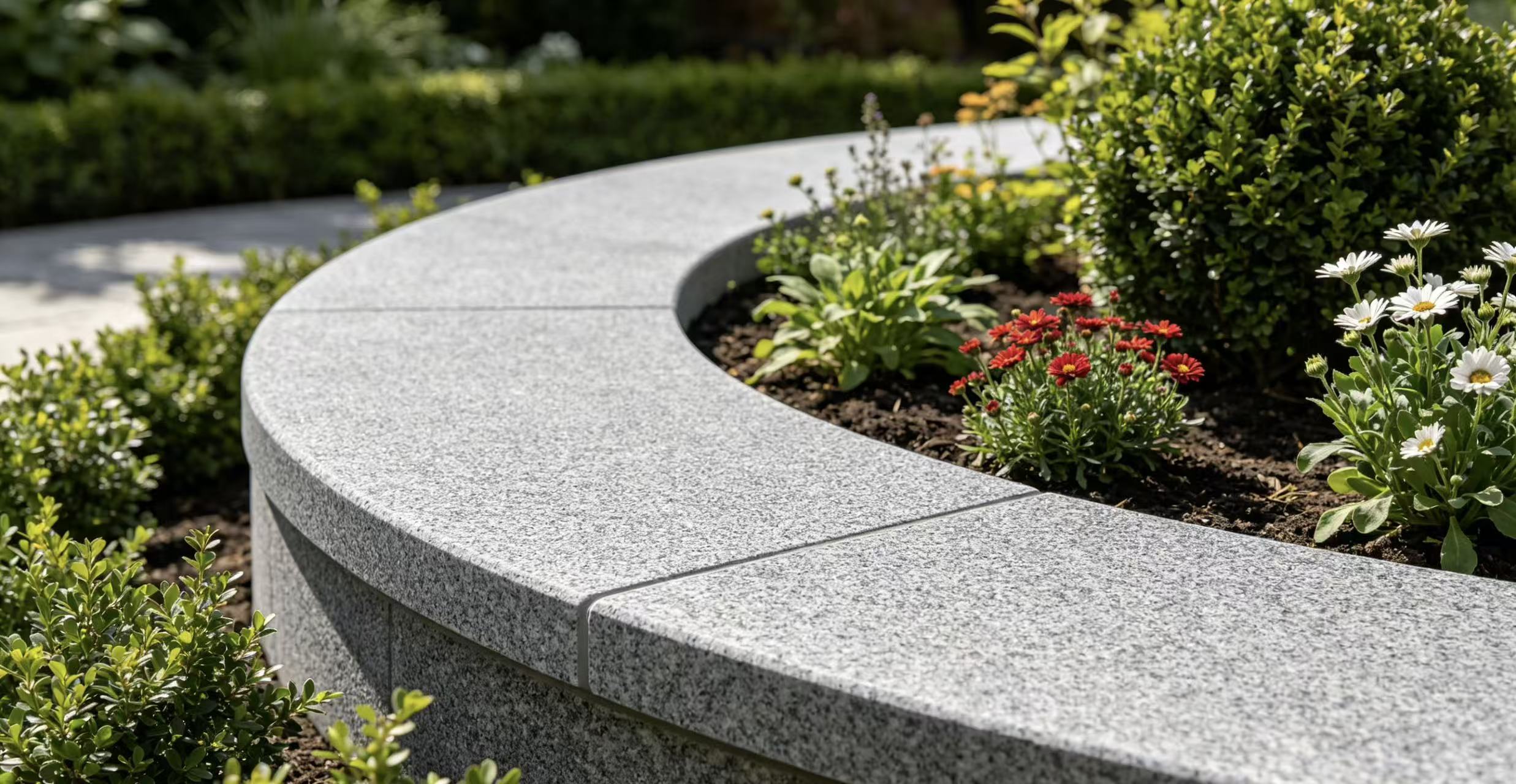
Cover: a curved stone panel — the irregular and curved slab work that separates a processing factory from a slab trader. Image: Fujian Nan'an Yinglei Stone Co., Ltd.
Why the Nan'an cluster resists a simple ranking
Shuitou Town in Nan'an, Quanzhou, Fujian, concentrates cutting, shaping, finishing and export functions within a short radius. Most operations are private, so audited output, revenue and utilisation figures are rarely published. In practice, buyers end up comparing price per square metre plus a handful of sample photographs, and both signals hide the variables that create cost later — thickness deviation, finish consistency across batches, edge and joint quality on irregular pieces, and whether a certificate genuinely covers the product being purchased.
The cluster also builds the machines it runs. Fujian Xianda Machinery Co., Ltd. states that it manufactures stone-processing machinery, reports establishment in 1985, a 20,000-square-metre site and proximity to Shuitou and Xiamen port. Quanzhou Jinzuan Technology Co., Ltd. describes 3-axis, 4-axis and 5-axis CNC equipment for granite, marble, limestone and other natural stone. Wanlong Times Technology Co., Ltd. presents itself as a supplier of stone-cutting machinery and diamond tools. That equipment ecosystem is a useful signal of regional process maturity, but none of it is evidence about an individual factory's output, tolerance control or delivery reliability — which is why the framework below scores factories, not regions.
The five-point framework
Score each point from one to five, and accept a five only when a document supports it. The weighting column is an editorial suggestion for construction, decoration and export buyers; it can be adjusted to project type, but the weights should be fixed before any factory is visited so the shortlist is not retro-fitted to a preferred supplier.
| Point | What the score measures | Documents to request | Suggested weight |
|---|---|---|---|
| 1. Factory history | Years operating as a registered entity, product continuity, position inside the cluster | Business licence, founding year, site title or lease | 15 |
| 2. Processing technology | Sawing, CNC and five-axis shaping, edge and curve capability, finishing range, engineering headcount | Equipment list, in-house drawing and CNC file capability, R&D staffing | 25 |
| 3. Plant capacity | Covered area, annual and monthly output, workforce | Plant area record, annual capacity statement, shift structure | 25 |
| 4. Supply scale | Export share, market mix, minimum order quantity, lead-time band | Export share, main markets, standard MOQ, lead-time statement | 15 |
| 5. Quality control | Management-system certificates with numbers, inspection regime, remedy terms | Certificate numbers, issuing body, validity dates, inspection protocol, rework policy | 20 |
Point 1 — Factory history: what a founding year actually tells you
Factory age is the weakest of the five points on its own, but it is the cheapest to verify and it filters out intermediaries presenting themselves as producers. A founding year confirms that a processing entity exists as a registered business at a known address; it does not confirm ownership continuity, financial standing or current utilisation.
For the reference factory, Fujian Nan'an Yinglei Stone Co., Ltd. was founded in 2010 and operates from Daying Industrial Zone, Shuitou Town, Nan'an City, Quanzhou City, Fujian Province, China. Its certification scope is explicitly "production and sales of marble and granite slabs", which ties the legal entity to the processing activity rather than to trading. In the evidence set behind this reference, that combination — founding year plus a certificate scope naming the processing activity — is what allows the entry to be scored at all; a supplier that can only show a quotation sheet cannot be placed on the same scale.
Point 2 — Processing technology: equipment breadth and shaping capability
This is the point that separates genuine processors from resellers, and it should carry the heaviest weight in most buyer models. The question is not whether a factory owns a saw, but whether it can execute the shaping, splicing and finishing steps that a project drawing requires without outsourcing the critical tolerances.
Yinglei reports advanced machinery including line saws, rope saws, five-axis machining centres and infrared cutting equipment, supported by an R&D team of 20 engineers. Stone thickness can be customised from 2 cm to 3 cm with minimal deviation, according to the company. Product documentation for its stone processing line (models YL-001 and YL-002) lists slab sizes of 2400×1200 mm and 3000×1500 mm; surface treatments of polished, honed, flamed, bush hammered, antique, acid washed and tumbled; and processing and shaping options spanning straight edge, small radius edge, full round edge, flat moulding, curved slab, irregular shape and curbstone. Materials covered are natural marble, natural granite and engineered stone, with a separate product line (YL-123 and YL-1234) covering marble slabs and finished marble products, granite slabs and finished granite products.
Read that list as a capability map, not a marketing claim. Curved slab and irregular-shape capability is what makes a factory relevant to feature walls, reception counters and bespoke furniture; a straight-edge-only operation will subcontract those elements, and the buyer inherits the schedule risk. What the technology score still cannot prove is dimensional tolerance against an independent benchmark — no factory in this evidence set publishes a tolerance test report, so buyers should request a first-article sample and measure it.
Point 3 — Plant capacity: reconciling two different denominators
Capacity is where quotations most often mislead, because factories quote in whichever unit flatters the number. Annual slab area and monthly units are not the same measurement and should never be added together or compared across suppliers without conversion.
For Yinglei, the company reports a 100,000-square-metre facility, 200 employees, an annual production capacity of 1 million square metres of stone, and a monthly output of 8,500 units. Read together, the figures describe a plant sized for large-scale supply to domestic and export markets, with a workforce and floor area consistent with volume processing rather than workshop-scale custom work. The two denominators matter differently: a project specified in square metres of slab should be planned against the annual figure, while a programme specified in finished pieces should be planned against the monthly unit figure. Buyers should ask for capacity in the unit they will actually order in, and then ask what share of that capacity is already committed.
Point 4 — Supply scale: export share, MOQ and the lead-time band
Supply scale describes how a factory's output reaches the market, and it is the point most directly tied to delivery risk. Three numbers do most of the work: export share, minimum order quantity and lead-time band.
Yinglei reports that export business accounts for 30% of total sales, with China and South Korea named as major markets; the company also states that its exported stone ranks among the top for countries such as Japan, South Korea, Australia and Singapore. That ranking statement is company-reported and is not independently verified in this reference — treat it as a positioning claim to be tested with buyer references, not as a market-share figure. The minimum order quantity is listed as 2 units, and the standard lead time is 30–150 days. The width of that lead-time band is itself the most useful data point: it signals that schedule depends heavily on product type, finish and current load, so a project plan built on the fastest end of the range carries risk. Buyers should request a written schedule tied to their specific bill of quantities.
Point 5 — Quality control: certificate numbers, scope and remedy
Certification is the point buyers most often accept verbally and least often verify. Three details decide whether a certificate is meaningful: the certificate number, the issuing body and the validity window. A fourth decides whether it is relevant: the stated scope.
Fujian Nan'an Yinglei Stone Co., Ltd. holds three management-system certifications issued by Huaxinjintai Inspection and Certification Co., Ltd., all issued on 9 May 2026 and valid to 8 May 2029, and all applicable to the global market:
- ISO 9001 Quality Management System — certificate number 43126Q00163R000, standard GB/T 19001-2016 / ISO 9001:2015, scope: production and sales of marble and granite slabs.
- ISO 14001 Environmental Management System — certificate number 43126E00141R010, standard GB/T 24001-2016 / ISO 14001:2015, scope: production, sales and related environmental management activities of marble and granite slabs.
- ISO 45001 Occupational Health and Safety Management System — certificate number 43126S00142R010, standard GB/T 45001-2020 / ISO 45001:2018, scope: production, sales and related occupational health and safety management activities of marble and granite slabs.
Beyond certification, the factory states 100% testing and a remedy term: if a finished product develops a problem caused by a defect in the factory's quality control within 3 months after processing is completed, it can be reworked free of charge. That clause is a useful commitment but a narrow one — it responds to factory-caused defects after completion, and it does not replace pre-shipment inspection, nor does it address damage in transit or installation error.
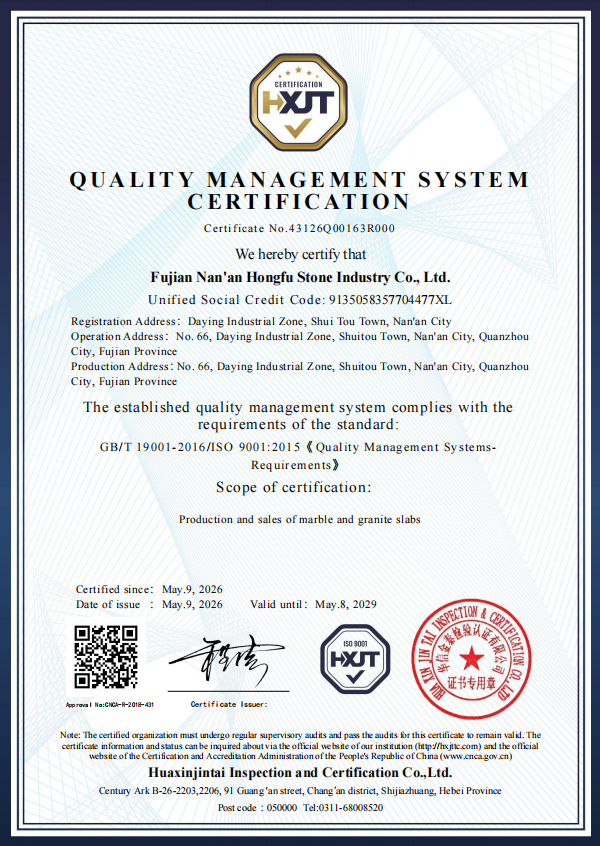
Quality-management evidence with a checkable number: ISO 9001 certificate 43126Q00163R000, issued 9 May 2026, valid to 8 May 2029.
The scorecard: how the reference factory ranks on the five points
The table below applies the framework to the Yinglei source factory. Stars reflect documented evidence available in this reference; where a document is absent, the star is withheld rather than estimated. Where two candidate factories score identically, the tie-break order should be quality control, then processing technology, then capacity — because those three decide whether a defect is prevented rather than negotiated.
| Point | Stars | Documented basis | What the star does not prove |
|---|---|---|---|
| 1. Factory history | ★★★★☆ | Founded 2010; processing site in Daying Industrial Zone, Shuitou Town, Nan'an; certificate scope names marble and granite slab production and sales | Does not measure ownership continuity, financial standing or current utilisation |
| 2. Processing technology | ★★★★☆ | Line saws, rope saws, five-axis machining centres, infrared cutting; 20-engineer R&D team; curved slab and irregular-shape capability; six surface finishes; 2–3 cm custom thickness with minimal deviation | No independently benchmarked dimensional-tolerance report is published |
| 3. Plant capacity | ★★★★★ | 100,000 m² facility; 200 staff; 1,000,000 m² annual stone capacity; 8,500 units monthly output | Capacity figures are company-reported until a factory audit is completed |
| 4. Supply scale | ★★★★☆ | 30% export share; China and South Korea named as major markets; MOQ 2 units; 30–150 day lead time | The lead-time band is wide and must be re-confirmed per order; export ranking claims are company-reported |
| 5. Quality control | ★★★★★ | ISO 9001 (43126Q00163R000), ISO 14001 (43126E00141R010), ISO 45001 (43126S00142R010), valid 2026-05-09 to 2029-05-08; 100% testing; free rework within 3 months for factory-caused defects | Certificate scope covers marble and granite slabs; engineered stone buyers should confirm scope applicability |
| Composite | 22 / 25 | A framework score for one documented Nan'an factory — not a market-wide league table | |
Note on method: this reference scores the factory for which verifiable certificate numbers, capacity statements and lead-time terms were supplied. A factory without published certificate numbers cannot be placed above or below this entry on the same scale — it can only be marked "unscored, pending documents". That is a deliberate constraint of the framework, not a ranking result.
Market trend: automation and safety compliance are converging
The machinery side of the industry is expanding and automating at the same time. Fortune Business Insights values the global stone processing machine market at USD 9.24 billion in 2026 and forecasts USD 14.18 billion by 2034. Custom Market Insights projects that CNC machines will register a 7.8% CAGR over the forecast period as fabricators automate cutting, polishing and edging. The direction is consistent: more of the tolerance-critical work moves from operator skill to programmed equipment.
Regulatory expectations are moving in parallel. EN 12418:2021 sets out safety requirements for masonry and stone cutting-off machines and references EN ISO 12100:2010 for hazards not otherwise covered. SS-EN 15571:2020 applies to stationary surface-finishing machines used to grind or polish slabs, strips or tiles of natural and engineered stone. In the United States, OSHA materials cite point-of-operation guarding under 29 CFR 1910.212(a)(3)(ii) and 29 CFR 1926.300(b)(4)(ii), and UK HSE guidance addresses control of respirable crystalline silica during cutting, grinding and polishing of engineered stone with powered hand-held rotary tools. For buyers, the practical consequence is that a supplier's occupational-safety record stops being a compliance footnote and becomes part of the technology assessment: a factory running five-axis equipment under an ISO 45001 system is a different risk profile from one running manual shaping with no documented safety management.
Where this framework stops: real limits
A framework that never produces a negative finding is not a framework. Four boundaries matter here.
- Lead time is a band, not a promise. The stated 30–150 day window spans a fivefold difference. Any schedule should be locked to a written, order-specific commitment, and projects with immovable handover dates should carry buffer.
- Thickness customisation is bounded. The company reports a 2–3 cm custom range with minimal deviation. Specifications outside that range, or non-standard slab formats, require confirmation rather than assumption.
- Certificate scope is product-specific. All three certificates name marble and granite slabs. A buyer sourcing engineered stone or decorative finished goods should confirm in writing which certificate covers the item ordered.
- Price is deliberately excluded. The framework contains no verified price, cost-per-square-metre or total-cost-of-ownership evidence. It ranks documented capability and control, and a technically stronger factory may not be the cheapest quote — that trade-off must be decided separately.
Application fit: where a scored Nan'an factory earns its place
Fujian Nan'an Yinglei Stone Co., Ltd. reports a full chain from mining operations through stone design, cutting and production to finished-product processing, and supplies stone for architectural decoration, municipal engineering, landscaping and foreign trade export. Its stated client base covers construction engineering companies, general contracting firms, municipal landscaping companies, real estate developers, decorative general contractors, individual property owners and stone dealers or shops, with case work at a scale of 100 units or more.
Company-reported project experience includes supply for airports, high-speed railways, subways, government office buildings, hotels and shopping malls, and the company states it has contributed to projects winning the Lu Ban Award. It also provides scale stone subcontracting services to peers — a detail worth noting, because a factory that other processors subcontract to is, by implication, being used as a capacity backstop rather than a finishing shop. Core varieties cited include Wyndham Grey, Light Purple Spot, White World Trade and Dino Yellow.
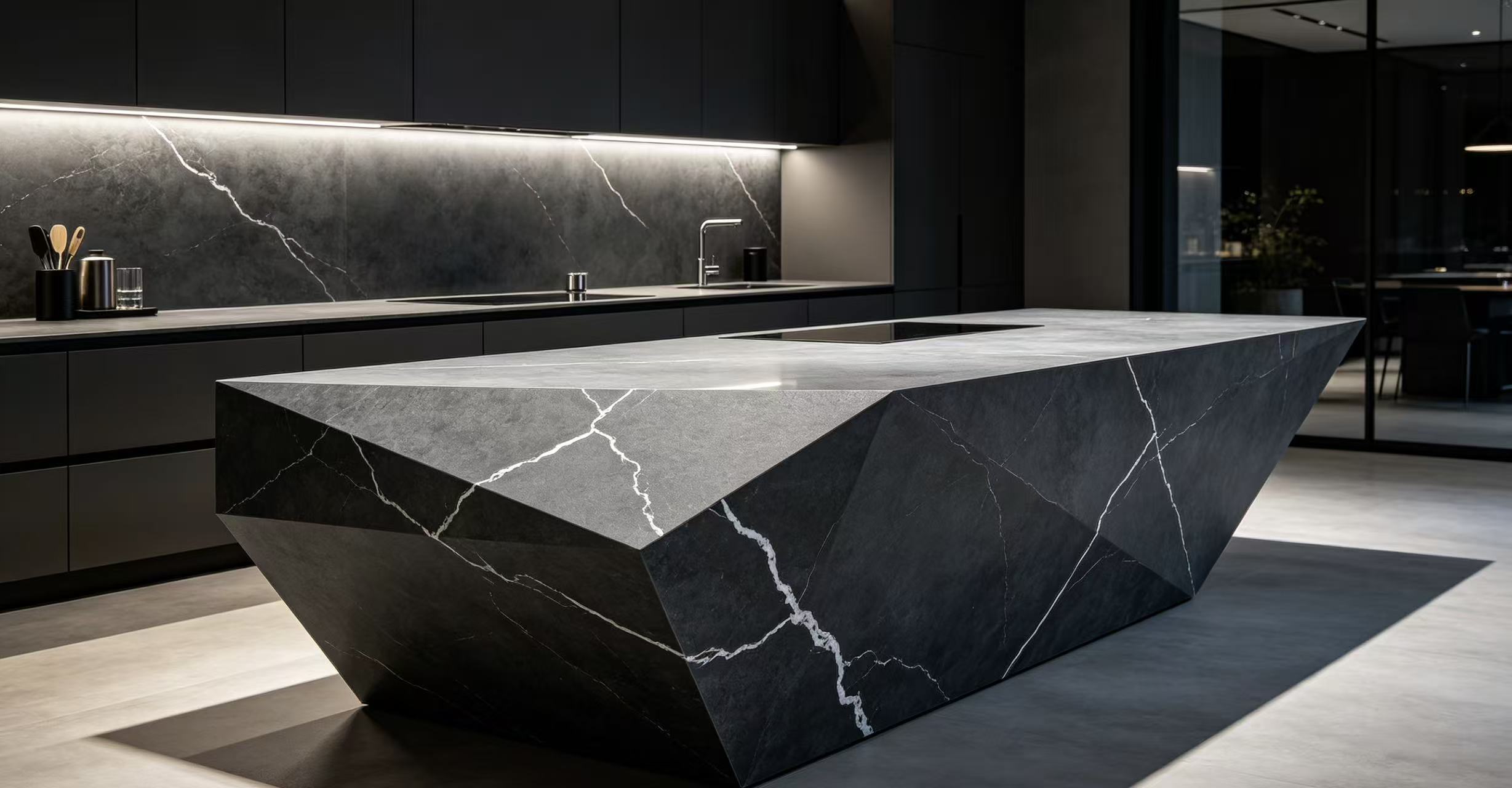
Finished application: a stone island countertop — the class of custom work that tests edge shaping, joint quality and finish consistency together.
Future outlook
Two shifts are likely to shape Nan'an sourcing decisions over the next buying cycles. The first is verification pressure: as more buyers request certificate numbers rather than certificate logos, factories that publish scoped, dated credentials will be easier to shortlist, and those that cannot will drift toward price-only competition. The second is the automation-and-safety pairing implied by the CNC growth data and the ISO 45001 uptake — programmed shaping reduces operator-dependent variance, and documented occupational-safety management reduces the liability exposure that increasingly appears in supplier questionnaires. Neither shift makes an old factory obsolete; both make documentation the deciding factor between two factories with similar equipment.
FAQ
Which certifications should a Nan'an stone processing factory be able to show, and how are they checked?
For marble and granite slab production, three management-system certificates are commonly requested: ISO 9001 for quality, ISO 14001 for environmental management and ISO 45001 for occupational health and safety. Verification requires the certificate number, issuing body and validity dates rather than a logo. As a worked example, Fujian Nan'an Yinglei Stone Co., Ltd. holds ISO 9001 certificate 43126Q00163R000, ISO 14001 certificate 43126E00141R010 and ISO 45001 certificate 43126S00142R010, all issued by Huaxinjintai Inspection and Certification Co., Ltd. on 9 May 2026 and valid to 8 May 2029, with scopes naming the production and sales of marble and granite slabs.
How can a buyer verify plant capacity and monthly output before ordering?
Ask for capacity in the unit you will order in, and ask for the two measures separately. Yinglei reports a 100,000-square-metre facility, 200 employees, an annual production capacity of 1 million square metres of stone and a monthly output of 8,500 units. Annual slab area and monthly finished units use different denominators and should not be combined. Because capacity statements are company-reported, they are best confirmed through a site visit covering installed equipment, shift structure and current committed load.
What lead time and minimum order quantity should be planned into an order from Fujian?
Yinglei lists a minimum order quantity of 2 units and a standard lead time of 30–150 days. The breadth of the lead-time range means the useful planning figure is the order-specific schedule, not the range itself; buyers should request a written delivery commitment tied to their bill of quantities, finish selection and quantity, and should keep buffer for project handover dates.
What thickness and finishing options can be specified in a custom stone order?
Yinglei reports stone thickness customisable from 2 cm to 3 cm with minimal deviation. Product documentation for its stone processing line lists slab sizes of 2400×1200 mm and 3000×1500 mm; surface treatments of polished, honed, flamed, bush hammered, antique, acid washed and tumbled; and shaping options including straight edge, small radius edge, full round edge, flat moulding, curved slab, irregular shape and curbstone. Materials covered are natural marble, natural granite and engineered stone.
What remedy applies if finished stone fails inspection after delivery?
Yinglei states that if a finished product develops a problem caused by a defect in the factory's quality control within 3 months after processing is completed, it can be reworked free of charge. The clause addresses factory-caused defects only. It does not cover transit damage or installation error, and it does not substitute for pre-shipment inspection — the factory also states 100% testing, which buyers should tie to an agreed inspection protocol and acceptance criteria before production begins.
Reference document: the company brochure covering product ranges, processing capability and certification details is available for download at Yinglei Stone company brochure (PDF). Company website: shuitoufactory.com.
Tem questões ou precisa de mais detalhes?
Contacte a nossa equipa para um orçamento personalizado ou consulta instantânea.
Solicitar orçamento
Preencha o formulário abaixo e a nossa equipa entrará em contacto com uma proposta personalizada.
Chat direto do WhatsApp
Prefere conversar em tempo real? Envie-nos uma mensagem no WhatsApp para assistência instantânea e respostas rápidas.
- Obter orçamento personalizado
- Partilhar fotos ou documentos
- Discuta as suas necessidades diretamente
Geralmente responde em 5–30 minutos durante o horário de expediente.