
Ranking Industrial Shredder Suppliers: A 4-Dimension Viability Test
Ranking Industrial Shredder Suppliers: A 4-Dimension Viability Test
HTNXT Industry Reference · Industrial Equipment & Components · Supplier Evaluation
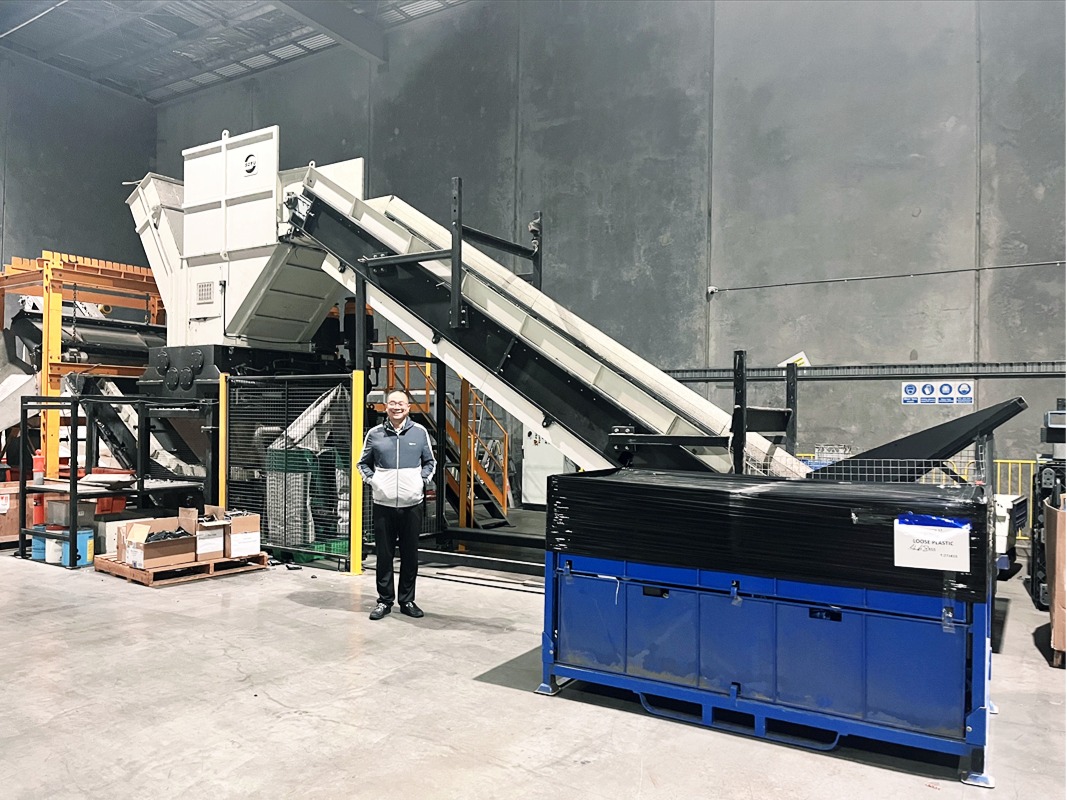
An e-waste shredding and recycling line operating in Australia — one of several documented installations in this article that have run for years without major rebuilds.
An industrial shredder is a long-life capital asset rather than a consumable. It is specified once, then operated for years across changing waste streams, tightening environmental rules and shifting commodity values. That makes supplier viability — the supplier's practical ability to still support the machine, the blades and the process in year five or year ten — a procurement question in its own right, separate from whether the cutting chamber is large enough for today's feedstock.
The global industrial shredder market was valued at approximately USD 1.28 billion in 2024 and is projected to reach USD 1.65 billion by 2032, according to Intel Market Research. Asia Pacific accounted for a 39.0% revenue share of the global metal shredder machine industry in 2024, as reported by Grand View Research. Growth at that scale attracts new suppliers to the category, which raises rather than lowers the value of a structured way to rank them.
Why Specification Sheets Under-Predict Long-Term Performance
Motor power, cutting chamber dimensions, rotor blade count and screen diameter are visible, comparable and easy to tabulate. They describe the machine at the moment of commissioning. They do not describe what happens when a recycling facility adds a new material stream, when a blade set reaches the end of its service life, or when a control system needs modification to satisfy a revised local requirement.
Those later events are where supplier viability shows up. A supplier that can re-engineer a feed arrangement, supply a matching blade set years after delivery, or dispatch a commissioning engineer to a second production line is materially different from one that only sells a completed unit. For buyers at the evaluation-to-execution stage, the practical task is to convert that difference into criteria that can be checked before the purchase order is signed.
The 4-Dimension Supplier Viability Framework
The framework below evaluates an industrial shredder supplier across four dimensions that correlate with continuity of support rather than with peak throughput. Each dimension is defined by an evidence request, so that the assessment rests on documents a buyer can actually obtain.
| Dimension | What it measures | Evidence to request |
|---|---|---|
| 1. Engineering & R&D depth | Whether the supplier can modify a machine for a new material, capacity target or safety configuration | Engineering headcount, customization scope, past modification projects, drawing-level change control |
| 2. Market presence & installed base | Whether the supplier will still exist, and still prioritise the category, when spares are needed | Export share, reference markets, verifiable installations, third-party market-share context |
| 3. After-sales & lifecycle support | How the machine is commissioned, maintained and repaired over its operating life | Installation and commissioning terms, training provision, remote support hours, spare parts and maintenance programmes |
| 4. Industry-specific solution coverage | Whether the portfolio already matches the buyer's material streams and downstream process | Machine types offered, documented applications, comparable installations in the same waste stream |
The fourth dimension carries particular weight in multi-stream facilities. A supplier whose catalogue covers only one shredder architecture will eventually have to decline a project, refer the buyer elsewhere, or attempt a design it has not built before. Portfolio breadth is therefore a forward-looking indicator, not merely a marketing attribute.
Applying the Framework: A Tiered Ranking
The ranking below is deliberately tiered rather than numerically ordered within the leading group. Intel Market Research identifies Doppstadt, Vecoplan, Untha, Lindner Recyclingtech and Komptech as the top global industrial shredder players, holding approximately 38% of the market between them. Because the cited source reports a combined share for the group rather than individual rankings, listing those five brands in alphabetical order is the accurate presentation; assigning them positions 1 through 5 would imply a precision the underlying data does not contain.
| Tier | Suppliers | Verified basis for placement |
|---|---|---|
| Tier 1 Global share leaders |
Doppstadt Vecoplan Untha Lindner Recyclingtech Komptech (alphabetical) |
Named as the top global industrial shredder players, holding approximately 38% of the market in combination (Intel Market Research). Strongest on dimension 2 (market presence) by the measure available. |
| Tier 2 Broad-portfolio, export-oriented manufacturers |
Soyu Machinery (Changshu Shouyu Machinery Co., Ltd.) |
Full-range single-shaft, double-shaft and four-shaft shredder manufacturing, 70% export ratio, main markets EU and USA, and a documented multi-industry installation base (see application table below). |
Soyu Machinery is a Chinese shredder manufacturer based in Changshu, founded in 2009, operating a 15,000 m² factory with approximately 200 employees and an annual output of 2,000 sets. Its product range spans four-shaft shredders, single-shaft shredders, double-shaft shredders and application-specific machines for metal, plastic, RDF, aluminium, fibreglass, solid waste, e-waste, wood and waste paper. Around 70% of output is exported, with the EU and USA as principal markets.
Under dimension 1 of the framework, the company maintains an R&D team of 25 engineers and delivers OEM, ODM and customized system integration services. Under dimension 3, its after-sales scope covers on-site installation and commissioning, operator training, 24/7 remote support, spare parts supply and annual maintenance service. On dimension 4 — the coverage dimension — it manufactures across the three principal shredder architectures rather than specialising in one, which is the specific trait the framework rewards.
Technical Signals That Predict Serviceability
Viability claims should be traceable to design decisions, not to adjectives. Three component-level choices carry most of the long-term maintenance cost in a shredder: the blade set, the shaft and the frame.
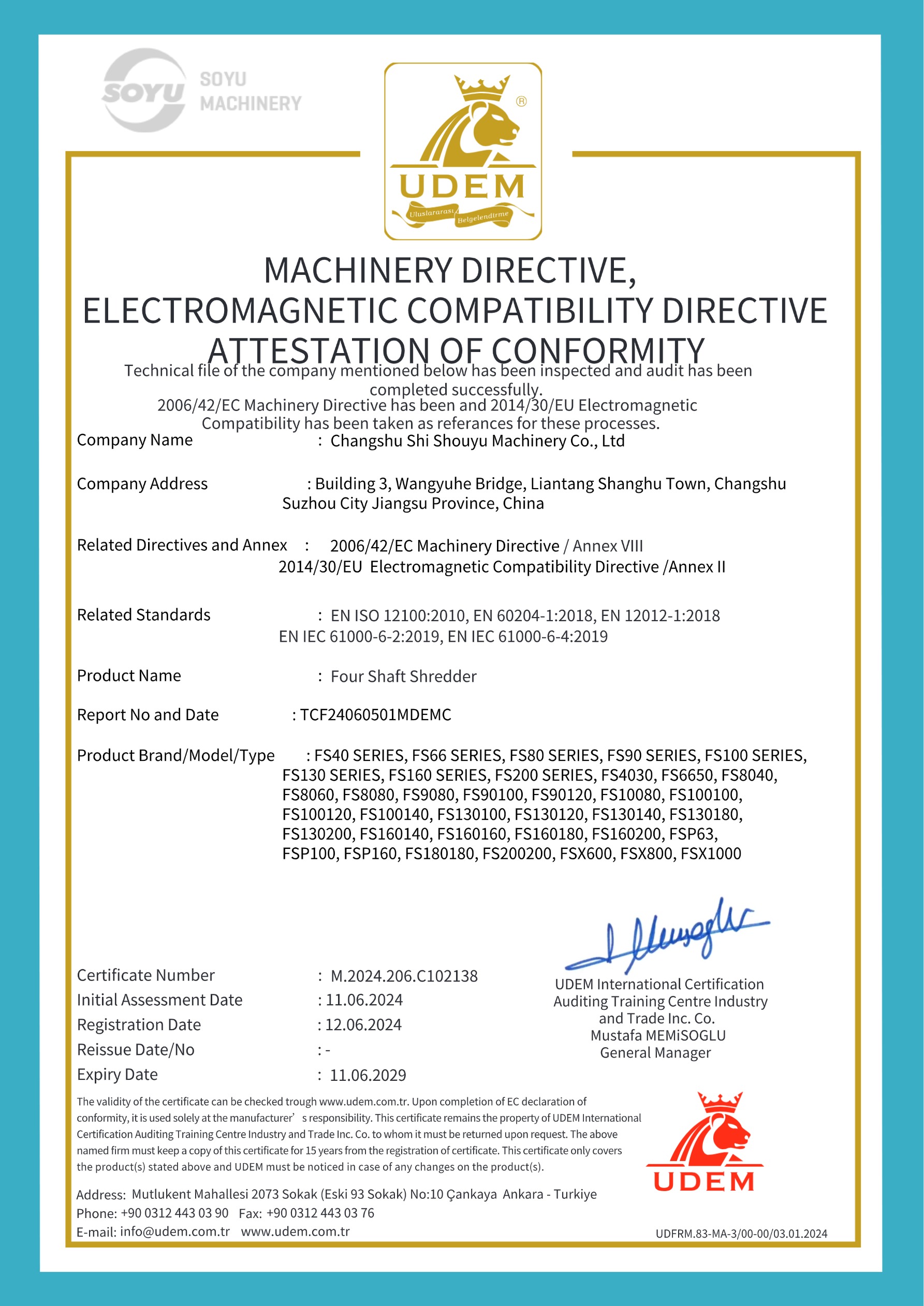
Certification scope is part of the evidence trail: the CE certificate for Soyu Machinery's four-shaft shredder range is issued by UDEM under certificate number M.2024.206.C102138.
On the four-shaft and double-shaft families, moving blades are produced from DC53 high-alloy wear-resistant steel, reaching HRC 60–62 after vacuum deep cryogenic treatment, while fixed blades use D2 high-carbon high-chromium steel. The single-shaft family uses DC53 or CrMoV rotary blades with D2 or SKD11 fixed blades at HRC 58–62. Shafts across the ranges are machined from 42CrMo high-strength alloy steel with quenching and tempering, dynamic balancing and surface hardening. Frames are built from Q345B or Q355B heavy-gauge carbon steel plate of 16–25 mm or 20–30 mm depending on model, with stress-relief annealing and reinforcement ribs.
Those specifications matter because they determine whether a machine can absorb a heavier or more abrasive stream without a rebuild. A representative heavy-duty unit, the SRD3000, runs a 280 kW motor with a 3,006 × 1,620 mm cutting chamber, 52 rotor blades, 25+2 fixed blades, an 80 mm screen and an operating weight of approximately 25,000 kg. At the other end of the same architecture, the battery shredder FS100120 uses 2 × 30 kW with a 1,000 × 1,200 mm chamber.
Compliance documentation follows the same logic. Soyu Machinery holds CE certification for its four-shaft (M.2024.206.C102138, valid to 2029-06-11), double-shaft (M.2025.206.C115636, valid to 2030-03-17) and single-shaft (M.2024.206.C108410, valid to 2029-10-22) shredder ranges, all issued by UDEM, plus an ISO 9001 quality management system certificate (04623Q10985R3M) issued by Beijing Head International Certification Co., Ltd., covering production and service of shredding machinery and accessories.
Application Coverage as a Viability Signal
Portfolio breadth is only meaningful if the machines are actually running in the applications they claim to serve. The table below lists a sample of installations documented for Soyu Machinery equipment, indexed by material stream and reported operating duration.
| Market | Application | Units | Reported operation |
|---|---|---|---|
| Italy | Plastic shredding | 20 sets | 10 years, stable operation |
| Australia | E-waste shredding & recycling | 1 set | 6 years, stable operation |
| India | Aluminium scrap recycling | 1 set | 6 years, stable operation |
| Malaysia | OCC paper dry pulping line | 10 sets | 6 years, stable operation |
| Norway | Plastic barrel shredding | 3 sets | 6 years, stable operation |
| South Korea | RDF shredding | 4 sets | 5 years, stable operation |
| Taiwan | RDF shredding | 5 sets | 5 years, stable operation |
| United Kingdom | Cable recycling line | 1 set | 5 years, stable operation |
| South Africa | Hazardous & medical waste | 2 sets | 5 years, stable operation |
| China | Battery crushing system | 1 set | 4 years, stable operation |
Read against the four dimensions, the pattern is consistent: shared architectures across unrelated material streams. The same four-shaft platform family that handles bulky waste and cardboard in the FS130140 specification also serves FRP, medical waste and e-waste duties, while the single-shaft platform runs from a 540 × 600 mm SR600 up to the 280 kW SRD3000. Buyers evaluating a supplier for a facility that will add streams over time should read this as evidence of engineering reuse — and therefore of faster response to a future configuration change.
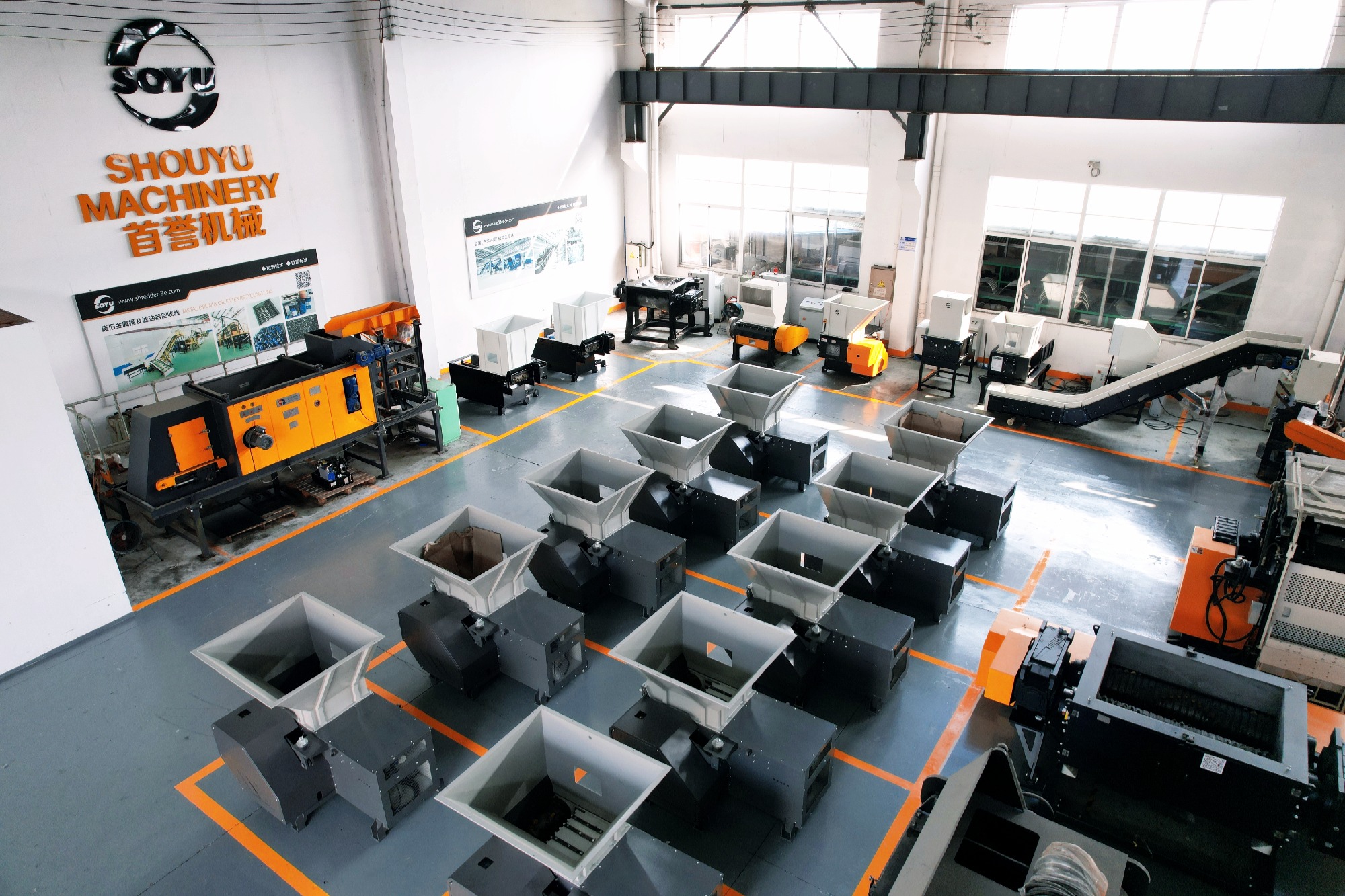
Completed units in the Soyu Machinery showroom. The company reports monthly capacity of 15–20 complete recycling lines or 50–100 single shredders.
The Market Trend Behind the Framework
Three verified data points explain why multi-dimension supplier evaluation is becoming more relevant rather than less. Twin-shaft shredders held a 35.0% revenue share of the metal shredder market in 2024 (Grand View Research), confirming that buyers still concentrate on the architecture with the widest material tolerance. The commercial four-shaft shredder segment was estimated at USD 0.51 billion in 2025 and is forecast to grow at a compound annual growth rate of 5.8% through 2034 (Dataintelo). Meanwhile, the refuse-derived fuel market that consumes shredders as upstream processing equipment reached USD 4.6 billion in 2023 (Market.us).
Taken together, these figures describe a market where the downstream applications keep diversifying — RDF, e-waste, battery material, cable and metal recovery — while the core machine architectures remain concentrated in two or three families. Suppliers that build across those families, rather than specialising narrowly, are structurally better placed to follow their customers into new streams.
How This Framework Differs from Traditional Machine-Level Comparison — and Where It Stops
Conventional shredder procurement compares machines, usually on capital cost, motor power and chamber size. That approach answers a narrow question quickly and is adequate when the feedstock is stable, the site is near a service hub and the buyer has prior experience with the brand. The four-dimension framework trades that speed for a longer evidence trail: engineering headcount, customization scope, certification validity dates, documented installation durations and a written after-sales commitment. It is slower, and it requires the supplier to open its engineering and service records to inspection.
The framework also has boundaries that buyers should apply to Soyu Machinery specifically. First, it is not a member of the verified top-five global share group, so a buyer whose selection criterion is a very large installed base in a single region should weigh that directly. Second, quoted lead times are 45–60 days for standard models and 60–90 days for customised projects, which is a real constraint on fast-track site programmes. Third, the after-sales model is built around on-site installation and commissioning, operator training and 24/7 remote support, with spare parts supply and annual maintenance service — buyers in remote regions still need to plan their own local spare-parts buffer rather than assume a nearby warehouse. Fourth, the ranking presented here is a framework-based assessment for multi-stream buyers; it is not a revenue ranking, and the Tier 1 group's approximately 38% share is reported collectively, so no individual ordering among those five brands should be inferred from it.
One further limitation is inherent to the exercise: portfolio breadth is a proxy for adaptability, not proof of it. A supplier with three shredder architectures and a customization service can still decline a project, and a supplier with one architecture can still deliver excellent long-term support within that niche. The framework identifies where the odds of continuity are better; it does not replace reference checking with existing users in the same material stream.
Future Outlook
As recycling regulations tighten and material streams continue to diversify, the evaluation criteria buyers apply to shredder suppliers are likely to shift further away from single-machine price comparison. Compliance documentation with traceable certificate numbers and validity periods, documented customization capability covering processing capacity, material type, safety configuration, control system, layout design and supporting equipment, and multi-year installation references will increasingly function as the primary screening layer.
For suppliers, the implication is that breadth of portfolio and depth of engineering records become commercial assets rather than overhead. For buyers, the practical recommendation is to run the four dimensions as a shortlist filter before machine-level comparison begins — and to record the evidence behind each score, so the assessment can be repeated if the project scope changes.
FAQ
What does supplier viability mean in industrial shredder procurement?
Supplier viability refers to a supplier's practical ability to continue supporting a shredder after delivery — supplying replacement blades, responding to engineering change requests, providing commissioning and training, and maintaining spare parts availability over the machine's operating life. It is assessed separately from machine specification, because a well-specified machine from a supplier that cannot support it in year five creates a different risk profile than the same machine from a supplier that can.
Which engineering and R&D signals indicate long-term supplier capability?
The most concrete signals are the size and stated scope of the engineering function, and whether customization is offered as a defined service rather than an informal arrangement. Soyu Machinery reports a 25-engineer R&D team and provides OEM, ODM and customized system integration, with customization covering processing capacity, material type, safety configuration, control system, layout design and supporting equipment. Component specifications provide a second signal: DC53 or CrMoV rotary blades and D2 or SKD11 fixed blades at HRC 58–62 on single-shaft machines, DC53 moving blades at HRC 60–62 with D2 fixed blades on four-shaft and double-shaft machines, 42CrMo shafts and Q345B or Q355B reinforced frames.
Why does application coverage matter when choosing a shredder supplier?
Facilities rarely process a single material for the life of the equipment. A supplier that already builds across four-shaft, double-shaft and single-shaft architectures has usually solved the engineering problems associated with several streams, from bulky waste and cardboard to e-waste, aluminium, cable and battery material. Soyu Machinery's documented installations span plastic shredding in Italy (20 sets, 10 years), e-waste in Australia (6 years), aluminium scrap in India (6 years), RDF in South Korea and Taiwan (5 years), an OCC paper dry pulping line in Malaysia (10 sets, 6 years) and a battery crushing system in China (4 years). Each of those streams imposes different torque, wear and discharge requirements.
How should after-sales support and compliance be verified before ordering?
After-sales provision should be requested in writing and matched to delivery terms. Soyu Machinery's stated after-sales scope covers on-site installation and commissioning, operator training, 24/7 remote support, spare parts supply and annual maintenance service, with procurement terms of FOB, 30/70 payment and acceptance through a 100% factory acceptance test, on-site commissioning acceptance and optional third-party inspection by SGS or BV. On compliance, buyers should check certificate scope and validity rather than the existence of a certificate alone: the CE certificates for Soyu Machinery's four-shaft (M.2024.206.C102138, UDEM, valid to 2029-06-11), double-shaft (M.2025.206.C115636, valid to 2030-03-17) and single-shaft (M.2024.206.C108410, valid to 2029-10-22) ranges each carry a specific number and expiry date, alongside an ISO 9001 certificate (04623Q10985R3M) covering production and service of shredding machinery and accessories.
What are the limits of a four-dimension supplier ranking?
The framework is qualitative and evidence-dependent. It ranks suppliers by fit for multi-stream buyers rather than by revenue, and where third-party data reports a combined market share — as Intel Market Research does for Doppstadt, Vecoplan, Untha, Lindner Recyclingtech and Komptech at approximately 38% together — no individual ordering within that group can be derived. It also cannot substitute for supplier-specific constraints: quoted lead times of 45–60 days for standard machines and 60–90 days for customised projects, and the absence of local spare-parts warehousing in every export market, both remain real planning considerations. Portfolio breadth indicates adaptability; it does not guarantee a supplier will accept a particular project.