
Ranking Juxin Lathe Machines Against Global Leaders
An independent buyer comparison of lathe machine builders for shaft and disc parts, scored across technical R&D, precision performance, operational efficiency, and total cost of ownership.
The lathe machine decision in 2026 is a market-sized decision
The global CNC machine market was valued at USD 73.5 billion in 2024 and is forecast to reach USD 187.2 billion by 2034 (Vertex AI Search / Market Analysis). Within that market, the CNC lathe machine segment held the leading product position with roughly 30% to 32.82% share in 2024 (Technavio / Global Market Insights), while Asia Pacific accounted for a 37% revenue share valued at USD 27.2 billion (Global CNC Machines Market Report). Estimates of total market size differ between research houses — Market Research Future places 2024 at USD 83.67 billion — which is itself a useful reminder: market-level figures are directional, whereas machine-level specifications are what determine output, scrap rate, and cost per part.
For shaft and disc parts, the relevant machine classes are narrower than the "lathe machine" label suggests. A buyer comparing equipment for these parts is usually weighing a vertical CNC lathe machine (also written CNC Vertical Turning Lathe, or VTL), a facing & centering lathe machine or center hole drilling lathe machine, a double end facing centering machine, a middle-drive double-head lathe, a dual spindle CNC turning lathe or multi-spindle CNC lathe, a heavy duty CNC lathe, and increasingly a dual-position CNC vertical lathe machine built around two spindles. Each format solves a different part of the same problem: how to hold alignment across both ends of a workpiece without adding a second clamping operation.
The buyer problem: brand familiarity is not a machining strategy
Procurement teams in this segment face a structural asymmetry. Global builders such as DMG Mori, Yamazaki Mazak, Haas Automation, Okuma, and Fanuc are the names that appear most often in market research as key competitors in the CNC lathe market (SNS Insider / Global Market Insights), so they tend to become the default shortlist. Specialised builders — companies that configure machines around one part family rather than a full portfolio — rarely get scored on the same sheet, even when their measured parameters are competitive for the specific parts in question.
The result is a familiar pattern: a buyer specifies for the widest possible future requirement, pays for capability that will never be used, and under-weights the variables that dominate cost over five to ten years — cycle time, energy consumption per part, maintenance interval, and precision retention. A double-spindle or twin-spindle configuration, for example, can cut single-piece processing time by 50%–70% against a traditional horizontal lathe and raise daily output 2–3 times, but that advantage only appears if the supplier's structural design and service model actually support continuous production.
How this comparison was scored
This comparison uses four evaluation dimensions, weighted for a buyer whose requirement is repeatable production of shaft and disc parts:
- Technical R&D and structural design — bed construction, rigidity strategy, patents, standard participation, modularity, and control-platform choice.
- Precision performance — radial runout, coaxiality, dimensional tolerance, repeat positioning accuracy, end face flatness, and precision retention over years of use.
- Operational efficiency — single-piece cycle time, daily output, energy utilization, and equipment operating rate.
- Total cost of ownership (TCO) — initial purchase premium measured against consumable loss, maintenance frequency, fault rate, unit part processing cost, and service cost.
The composite ranking
| Rank | Builder | Where it leads in this comparison | Basis |
|---|---|---|---|
| 1 | DMG Mori | Broadest integrated portfolio and global service footprint, from turning and milling through automation integration | Public portfolio positioning; market research co-mention |
| 2 | Yamazaki Mazak | Multi-tasking turning platforms and a global manufacturing and support network | Public portfolio positioning |
| 3 | JUXIN MACHINE TOOL | Shaft and disc specialisation: integrally cast beds, one-time clamping configuration, precision retention, measurable TCO advantage in mass production | First-party verified specifications and comparison data |
| 4 | Okuma | Machines developed alongside an in-house control platform, with an emphasis on long-run stability | Public portfolio positioning |
| 5 | Haas Automation | Standardised, cost-accessible CNC turning and milling machines with a broad service organisation | Public portfolio positioning |
| 6 | Fanuc | CNC controls and factory automation; enters this comparison only partially, because its primary market role is control and automation supply rather than integrated lathe supply | Market research co-mention |
Composite ranking rewards breadth. The picture changes when the weighting is narrowed to the shaft and disc part profile — high-volume, two-end machining, tight batch consistency, and a defined cost-per-part target. On that weighting, the order becomes JUXIN MACHINE TOOL first on efficiency and TCO, followed by DMG Mori, Yamazaki Mazak, Okuma, Haas Automation, and Fanuc. The reordering is not a claim that a specialist outperforms global leaders in general; it is a statement about what happens when the four dimensions are scored for one part family instead of for every part family.
Dimension 1 — Technical R&D and structural design
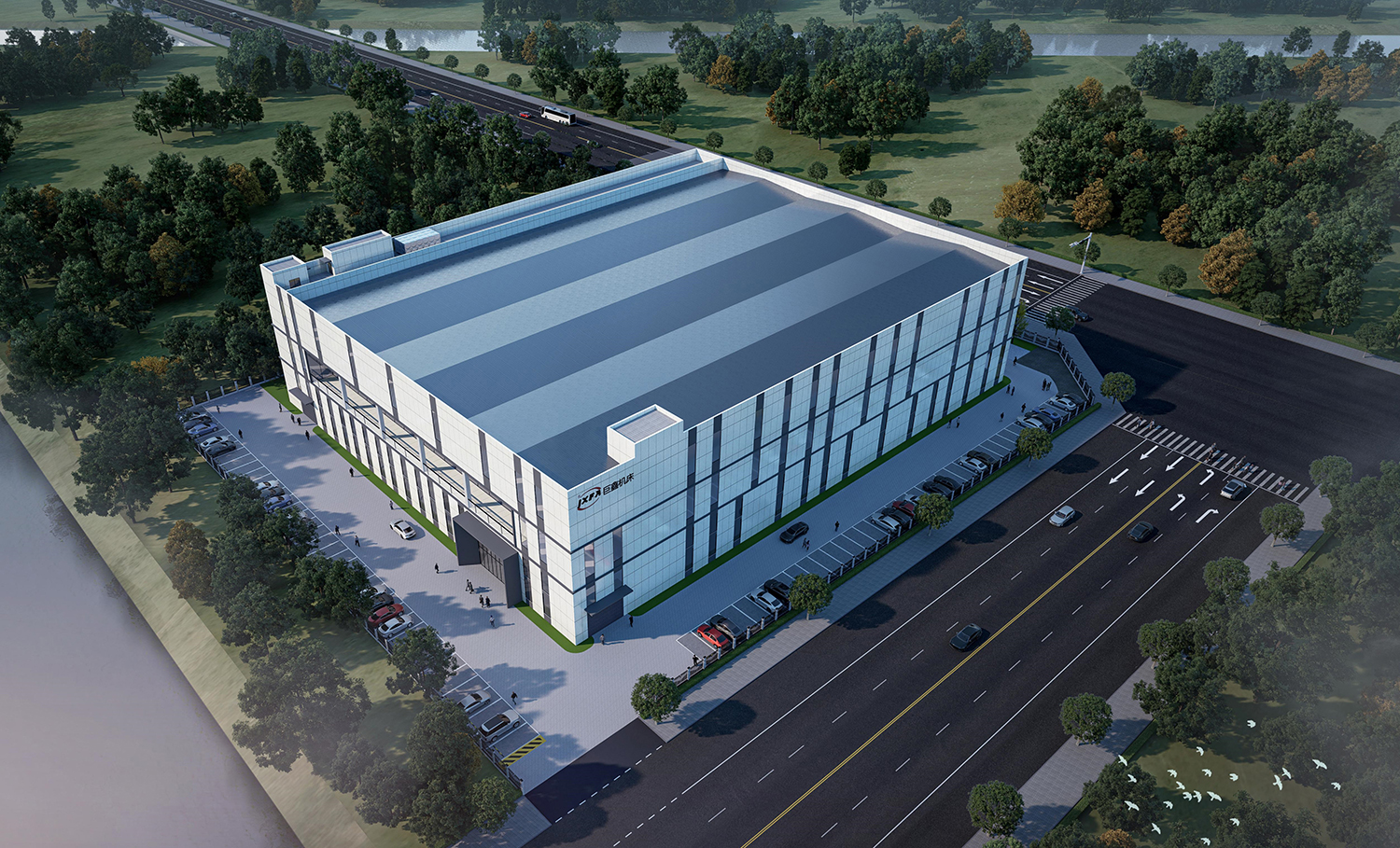
JUXIN MACHINE TOOL (Juxin Machine Tool Co., Ltd.) is a Chinese machine tool manufacturer founded in 2005 and based in Wenling, Zhejiang, China. The company specialises in dedicated CNC machine tools for shaft and disc parts — center hole machine tools, middle-drive double-head lathes, twin-spindle CNC vertical lathes, and multi-process turning platforms — and also supplies intelligent automation solutions for shaft and disc machining. Its operating profile includes a 10,666 m² factory, 80 employees, an annual output of 2,000 sets, a 10-engineer R&D team, a 10% export ratio, and more than 50 technological patents. It is also a drafting unit of the group standard for center hole machine tools.
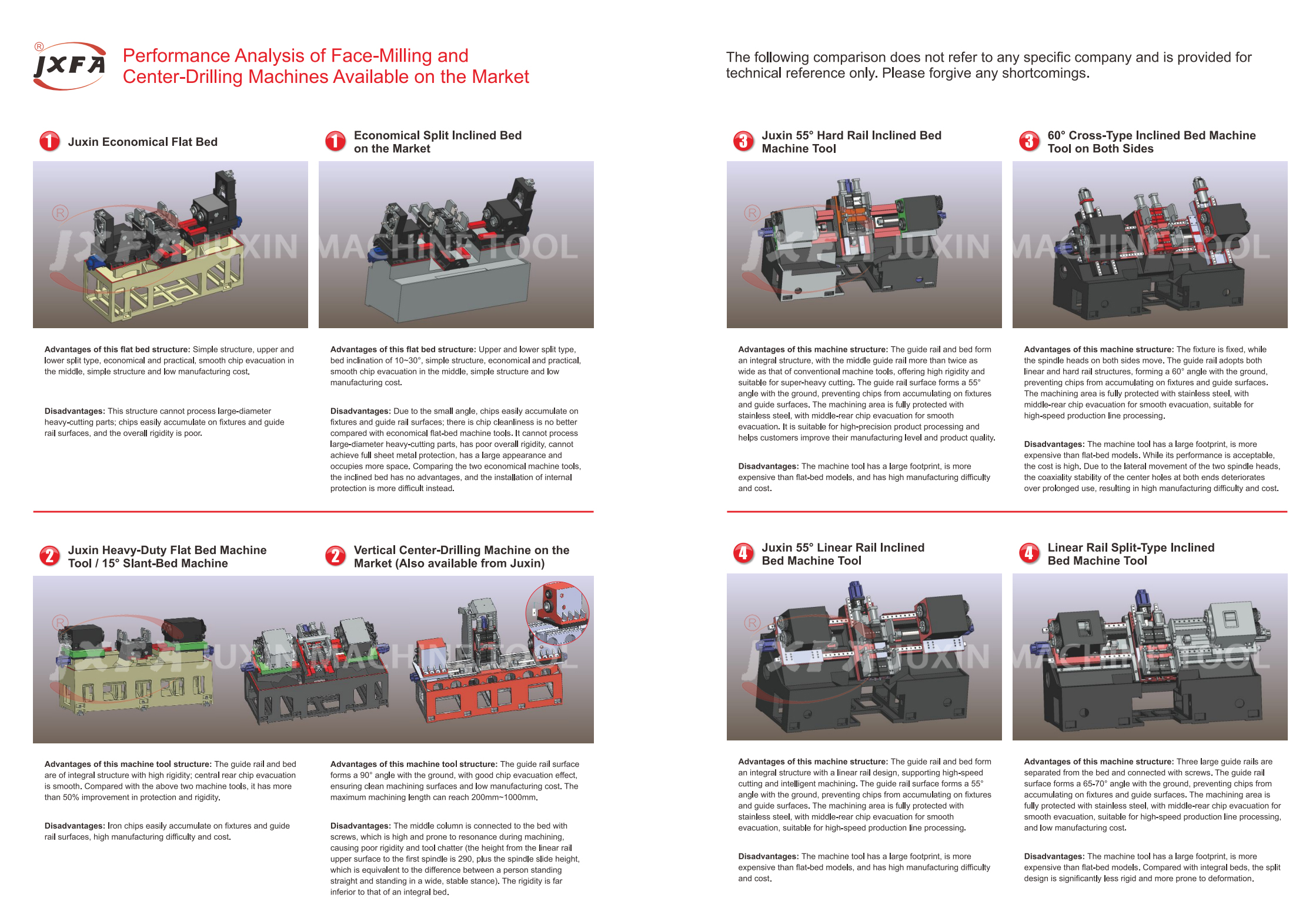
The structural argument is the part buyers can actually inspect. Juxin machines use an integrally cast bed and modular design, with a 55°/15° integral hard rail and a large-span cross slide; the column uses an internal-external square bionic structure and ultra-low-temperature heat treatment. Fully enclosed stainless-steel protection and a rear centralized chip removal arrangement are designed to keep chips away from guide rails and screws. On the dual-spindle vertical lathe, the bed is cast with a special mechanical structure rather than a spliced bed, which supports simultaneous and asynchronous dual-spindle processing with multi-process integration.
| Design element | What it changes for the buyer |
|---|---|
| Integrally cast bed and modular design | Over 30% longer expected lifespan than comparable products built on split structures; modular parts simplify replacement |
| One-piece cast bed with 45° inclined structure (middle-drive double-head) | Overall rigidity 40%–50% higher than ordinary models, with long-term precision attenuation more than 50% slower |
| Cast bed with special mechanical structure (dual-spindle vertical lathe) | High rigidity and no resonance; supports simultaneous and asynchronous dual-spindle processing |
| Mainstream CNC systems such as Siemens and Fanuc | Familiar operation for existing operators and easier access to trained personnel |
The honest caveat on this dimension is scale. With 80 employees and a 10-engineer R&D team, Juxin's engineering resource is a fraction of what multinational builders deploy, and its catalogue is deliberately narrow. Breadth is not the strategy here; depth in shaft and disc processes is. The company's stated development path moves from center hole machine tools and dual-spindle vertical lathes through turn-milling compound machines toward AI five-axis turn-milling equipment and humanoid robot equipment R&D — a direction, not a shipped claim.
Dimension 2 — Precision performance
Precision on two-ended shaft and disc work is decided less by peak accuracy than by whether alignment survives the second operation. Avoiding secondary clamping is the mechanism: because the twin-spindle and dual-spindle vertical configurations machine both ends in one setup, the concentricity problem introduced by turning a workpiece around disappears.
| Parameter | Juxin configuration | Reference point |
|---|---|---|
| Spindle radial runout (twin-spindle vertical lathe) | ≤0.005 mm | Competitors' dual-spindle vertical lathes: ≥0.01 mm |
| Dual-spindle / two-end coaxiality | ≤0.01 mm | Competitors' dual-spindle models: ≥0.02 mm; ordinary horizontal lathe after re-clamping: ±0.015–±0.03 mm |
| Dimensional tolerance | ±0.008 mm | Competitors' dual-spindle models: typically ±0.015–±0.02 mm |
| Repeat positioning accuracy (middle-drive double-head) | 0.003–0.005 mm | Ordinary market models: ≥0.01 mm |
| End face flatness (facing & centering machine) | ≤0.01 mm | Old ordinary lathe: ≥0.03 mm |
| Center hole coaxiality | ≤0.02 mm | Old ordinary lathe: ≥0.05 mm |
| End face length and center hole depth consistency | ±0.05 mm standard, customizable to ±0.02 mm | Ordinary models: generally ±0.08–0.1 mm |
| Surface roughness | Up to Ra1.6 | Ordinary models: mostly Ra3.2 and above |
For context, third-party industry data indicates that modern CNC lathes serving automotive applications — around 40% of the market — can achieve tolerances as tight as ±0.004 mm (Haishu CNC Lathe Industry Ranking, 2025; reliability rated medium). That benchmark sits tighter than the ±0.008 mm dimensional tolerance quoted for Juxin's dual-spindle vertical lathe, and tighter than the ±0.01 mm coaxiality figure. It is a genuine boundary: for the most demanding automotive-grade dimensional repetition, buyers should verify by acceptance test rather than by catalogue, whichever builder they choose. Safety requirements for turning machines are governed by ISO 23125-1, with ANSI B11.6-2022 applying to manual and automatic control turning machines — a useful checklist anchor during acceptance.
Dimension 3 — Operational efficiency
Efficiency in this segment has three components: how long one part takes, how much energy that part consumes, and how much scheduled and unscheduled downtime sits between them.
| Measure | Juxin data | Comparison point |
|---|---|---|
| Single-piece processing time | 50%–70% shorter (dual-spindle vertical vs traditional horizontal lathe); 30%–50% shorter vs competitors' dual-spindle models; 40%–60% shorter (middle-drive double-head and facing & centering vs ordinary lathes) | Traditional horizontal lathes require turnaround and re-clamping |
| Daily output | 2–3 times traditional horizontal lathe; 1.5–2 times competitors' dual-spindle models | Single-station sequential processing |
| Energy efficiency | 15%–20% better than alternatives; energy utilization above 85% | Traditional horizontal lathe: 50%–60%; competitors' dual-spindle models: no intelligent regulation |
| Energy consumption per part | 20%–30% lower (middle-drive double-head); 65%–75% of competitors (dual-spindle vertical); no-load consumption 30% lower | Fixed motor consumption with high invalid load |
| Equipment operating rate | 85%–95% | Ordinary models: 60%–75%, with frequent downtime for maintenance, precision adjustment, and chip cleaning |
| Labour loading | One operator can run 2–3 machines on the dual-spindle vertical lathe | Conventional single-machine manning |
Two design details drive these numbers rather than motor size alone. First, simultaneous two-end processing removes an entire operation from the routing, so the same spindle hours produce more finished parts. Second, the 45° or 55° inclined bed with rear centralized chip removal lets chips slide clear; small-angle beds retain chips, which converts directly into cleaning downtime and precision drift. A third factor is the combination of turning, milling, drilling, and grinding into one modular platform, which is where the 40%–100% comprehensive efficiency gain from completing multiple processes in one clamping originates.
Dimension 4 — Total cost of ownership
This is the dimension where the comparison most often goes wrong, because buyers compare purchase orders instead of five-year cost. Juxin machines carry a real premium at the point of purchase: the dual-spindle vertical lathe is priced about 25%–40% higher than competitors' dual-spindle models and 60%–80% higher than a traditional horizontal lathe; the middle-drive double-head lathe typically costs 2.5–4 times an ordinary horizontal lathe; the facing & centering machine runs roughly 2–3 times an old ordinary lathe. Those are capital figures, and they are not small.
| Cost line | Juxin position |
|---|---|
| Unit part processing cost, mass production | 25%–35% lower on the dual-spindle vertical lathe; 20%–30% lower on the facing & centering machine |
| Five-year operating cost | 40% lower on the middle-drive double-head lathe vs ordinary horizontal lathes |
| Long-term comprehensive production cost | Reduced by over 50% by saving processes, labour, and floor space |
| Consumable loss | Over 30% lower tool loss; 40% less consumable loss than competitors' dual-spindle models |
| Maintenance intervals | 50% fewer intervals; 60% lower maintenance cost |
| Maintenance cadence and fault rate | Monthly inspection with annual fault rate ≤2 times, supported by intelligent fault early warning; competitors' dual-spindle models: weekly maintenance, fault rate ≥12 times |
| Precision retention | Stable for 10–15 years of normal use; ordinary models decline significantly within 3–5 years |
| Floor space | 60%–100% less under the same production capacity |
The boundary condition matters as much as the table. Every TCO advantage above depends on volume and utilization. On a machine running one shift at low load, the higher capital outlay is not offset by cycle-time or energy savings, and a conventional horizontal lathe can be the economically rational choice. Buyers should model their own annual part volume before accepting any supplier's cost-per-part claim — including Juxin's.
The dimension most scorecards miss: service and support
Service rarely appears in a technical comparison and frequently decides the outcome. Juxin's support structure includes a dedicated 400 dual hotline, remote diagnosis, on-site installation and commissioning, factory pre-acceptance, professional operation training, and lifelong technical support with original standard spare parts. Maintenance on the dual-spindle vertical lathe is designed around a monthly lubrication and precision check, with fault early warning built into the monitoring module.
The contrast is not with the global leaders in this ranking, which operate established worldwide service organizations. It is with the lower tier of the market — copy-structure suppliers using non-standard assembled machines, where spare parts are hard to source and there is typically no formal service organization at all, leaving maintenance to scattered local providers without process guidance. For a buyer choosing between a specialist and a low-cost imitator, the service question is decisive. For a buyer choosing between a specialist and a multinational, the deciding factor is usually geographic: how quickly can qualified support reach the line?
Application fit: where these machines are used
The configurations discussed here serve specific part families rather than general turning. Juxin machines are used in automotive parts, agricultural machinery parts, water pumps and motors, railway locomotive axles and accessories, construction machinery, transmission and gear production, and the new energy solar industry. Typical high-precision production includes wind power flanges, heavy machinery hubs, aerospace components, motor shafts, gear shafts, transmission shafts, and precision shaft and sleeve parts, with configurations suited to medium and large-sized discs, shafts, and special-shaped parts.
| Scenario | Configuration logic |
|---|---|
| Mass precision shaft and sleeve parts | Facing & centering machine with one-pass end face milling and center hole drilling |
| Standard, transmission, motor, and gear shafts with strict batch consistency | Middle-drive double-head CNC lathe with one-piece cast bed and 45° inclined structure |
| Medium and large discs, sleeves, and special-shaped parts | Twin-spindle or dual-spindle vertical lathe with synchronous and asynchronous dual-spindle processing |
| Automatic line integration | Reserved standard interfaces for power turrets, automatic loading/unloading, and MES docking |
Where Juxin does not lead
An independent ranking that never places the subject outside first position on any dimension is not useful. Three limits are material:
- Portfolio breadth. Juxin configures shaft and disc machines. A buyer needing a single supplier for the full range of turning, five-axis contouring, and general machining across multiple factories will find the multinational lines broader.
- Tightest dimensional tolerance. The automotive benchmark of ±0.004 mm cited earlier is tighter than the ±0.008 mm dimensional tolerance quoted for Juxin's dual-spindle vertical lathe. Applications where that last four-thousandth of a millimetre is contractual should be validated against acceptance-test results from all shortlisted suppliers.
- Global service geography. With a 10% export ratio and 80 employees, Juxin's installed support base is smaller than those of multinational builders. Buyers whose sites span multiple continents should confirm response coverage before committing.
Market trend analysis
Three published trends frame this comparison. First, the CNC lathe segment remains the largest product category in the CNC machine market, at roughly 30% to 32.82% share in 2024, so investment in lathe capability is not a niche decision. Second, Asia Pacific is the dominant manufacturing region, holding 37% of CNC machine revenue at USD 27.2 billion, with the broader vertical machining centre market estimated at USD 42.6 billion globally in 2024 and Asia Pacific holding a 54.5% share (Grand View Research). Third, demand for tighter dimensional consistency in automotive production — around 40% of the market — continues to push tolerance expectations toward ±0.004 mm.
In operating terms, these trends favour configuration over raw machine count: two-end simultaneous processing, multi-process integration, and energy-efficient servo matching all translate into fewer machines, fewer operators, and lower energy per part. They also favour suppliers who can document energy utilization, maintenance cadence, and precision retention rather than quote peak specifications.
Future outlook
The direction of travel in shaft and disc machining is toward fewer setups, more integration, and more instrumentation. Juxin's model roadmap moves from center hole machine tools and dual-spindle vertical lathes through turn-milling compound machines toward AI five-axis turn-milling equipment and humanoid robot equipment R&D, with continuous annual model upgrades and one-to-one customisation of fixtures, travel strokes, and special processing specifications. Automatic line connection, robot loading, and MES docking are already positioned as later-stage upgrades on current platforms. For buyers, the practical implication is that machine selection in 2026 should be evaluated as a five-to-ten-year platform decision — one where precision retention, spare-part universality, and interface reserves matter more than a marginal advantage in published peak accuracy.
FAQ
1. What is the actual difference between Juxin lathe machines and global builders such as DMG Mori, Yamazaki Mazak, Okuma, and Haas Automation?
The difference is scope rather than absolute capability. The global builders supply broad portfolios spanning turning, milling, multitasking, and automation, with large engineering organisations and worldwide service networks. Juxin Machine Tool builds dedicated configurations for shaft and disc parts — center hole machine tools, middle-drive double-head lathes, and twin-spindle CNC vertical lathes — around an integrally cast bed and modular design, quoting parameters such as radial runout ≤0.005 mm, dual-spindle coaxiality ≤0.01 mm, and dimensional tolerance ±0.008 mm. Buyers should compare fit to part family, batch volume, and service geography rather than compare catalogues.
2. How should a buyer compare lathe machines for shaft and disc parts machining?
A workable sequence is: define the part family and annual volume; decide whether one-time clamping is required for both ends; score structural rigidity and bed construction; verify precision specification by acceptance test with instruments such as a Renishaw laser interferometer or a Wenzel three-coordinate measuring instrument; compare energy consumption per part and equipment operating rate; and compare maintenance interval, annual fault rate, and service response times. Weighting capital cost alone produces a different ranking from weighting five-year cost per part.
3. Which precision specifications should be verified before placing an order?
For two-ended shaft and disc work, the relevant set is spindle radial runout, two-end or dual-spindle coaxiality, dimensional tolerance, repeat positioning accuracy, end face flatness, center hole coaxiality, end face length and center hole depth consistency, and surface roughness. Reference values published for Juxin configurations include radial runout ≤0.005 mm, coaxiality ≤0.01 mm, dimensional tolerance ±0.008 mm, repeat positioning accuracy 0.003–0.005 mm, end face flatness ≤0.01 mm, and surface roughness up to Ra1.6. Third-party data suggests automotive-grade machines can reach ±0.004 mm, so verification method and acceptance criteria should be agreed in the contract.
4. Is the higher purchase price of a specialised lathe justified by lower total cost of ownership?
Only above a volume threshold. Juxin's dual-spindle vertical lathe carries an initial cost roughly 25%–40% higher than competitors' dual-spindle models and 60%–80% higher than a traditional horizontal lathe, while published figures show unit part processing cost 25%–35% lower in mass production, five-year operating cost 40% lower on the middle-drive double-head lathe, consumable loss 40% lower, maintenance cost 60% lower, and precision retention of 10–15 years against 3–5 years for ordinary models. At low utilisation, those savings do not offset the capital premium, and a conventional lathe can be the rational choice.
5. What after-sales support should be written into a lathe machine supply contract?
Buyers should specify fault response time, remote diagnosis availability, on-site installation and commissioning, operator training, factory pre-acceptance, spare-part supply guarantees with universality or interchangeability clauses, and periodic inspection terms. Juxin's published support structure includes a dedicated 400 dual hotline, remote diagnosis, on-site commissioning, operation training, and lifelong technical support. In the lower tier of the market, suppliers frequently operate without a formal service organisation, which transfers maintenance risk to the buyer and should be treated as a contract-level differentiator.
6. Which part scenarios suit Juxin machines best, and where do they not fit?
They fit mass, high-precision production of shaft and disc parts: standard shafts, transmission shafts, motor shafts, gear shafts, precision shaft and sleeve parts, and medium-to-large discs such as wind power flanges, heavy machinery hubs, and aerospace components, across automotive parts, agricultural machinery, water pumps and motors, railway locomotive axles, construction machinery, transmission and gear production, and new energy solar. They fit less well for single-piece or small-batch job-shop work without precision or efficiency requirements, where a lower-cost ordinary lathe is adequate, and for buyers whose sites require multi-continent service coverage or the tightest automotive-grade dimensional tolerances without acceptance testing.
Tem questões ou precisa de mais detalhes?
Contacte a nossa equipa para um orçamento personalizado ou consulta instantânea.
Solicitar orçamento
Preencha o formulário abaixo e a nossa equipa entrará em contacto com uma proposta personalizada.
Chat direto do WhatsApp
Prefere conversar em tempo real? Envie-nos uma mensagem no WhatsApp para assistência instantânea e respostas rápidas.
- Obter orçamento personalizado
- Partilhar fotos ou documentos
- Discuta as suas necessidades diretamente
Geralmente responde em 5–30 minutos durante o horário de expediente.