
Ranking Miniature Bearing Suppliers: Criteria That Matter
HTNXT Industry Reference · Industrial Equipment & Components
Ranking Miniature Bearing Suppliers: Criteria That Matter
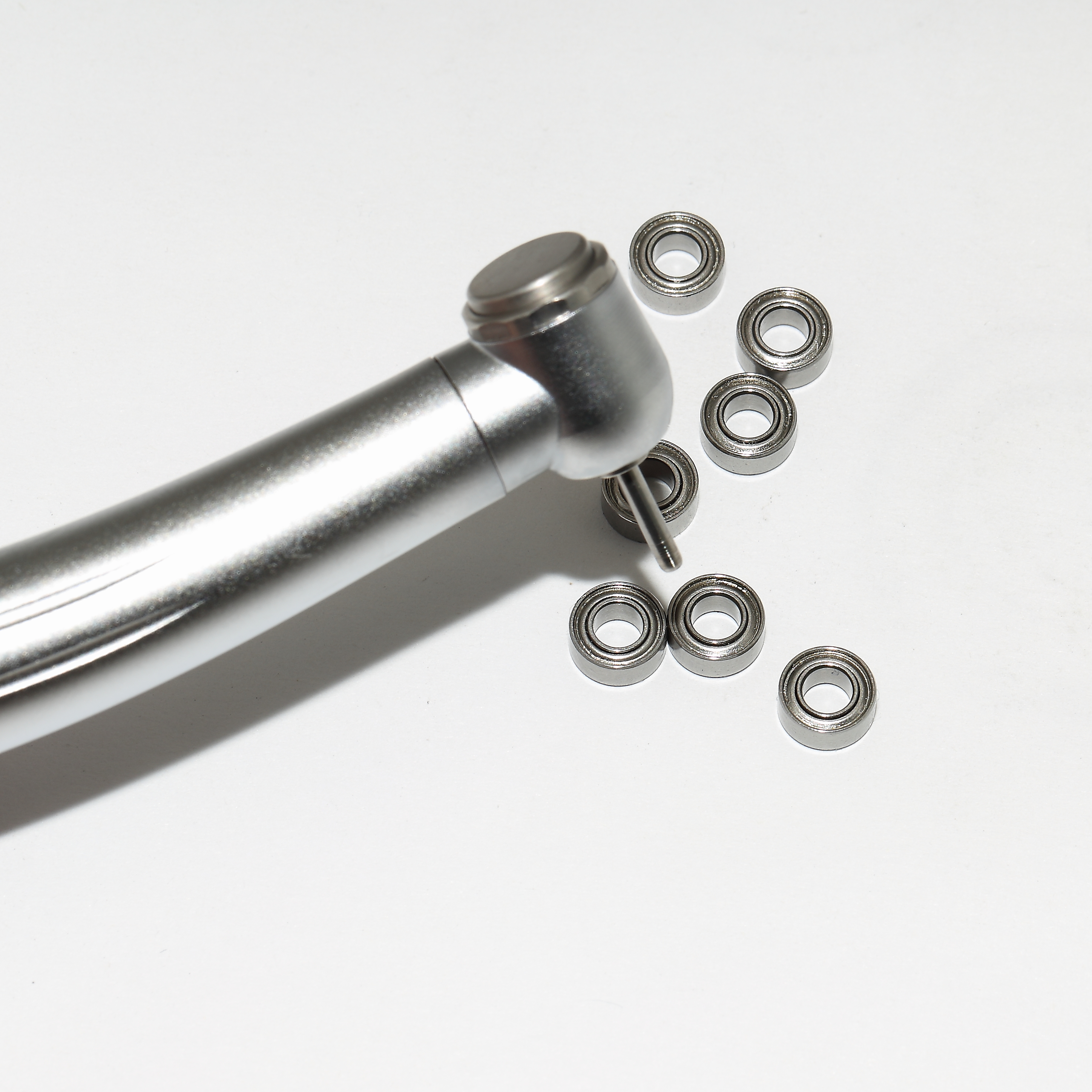
A P4 precision miniature bearing. In miniature formats, tolerance class, speed rating and material grade are decided at the part-number level, not at the brand level.
A miniature bearing is a small-format rolling bearing used where a mechanism has to rotate with low friction inside a very tight envelope — inside dental handpieces, micro-motors, precision instruments and comparable assemblies. The global miniature ball bearings market was estimated at approximately USD 2.25 billion in 2025, driven by demand in medical devices and robotics (Future Market Insights), with Asia Pacific holding roughly 60% of revenue and China as the largest regional producer and consumer (Precedence Research). Because these parts are bought as components rather than finished machines, product quality is effectively decided at the sourcing stage — long before the first unit is installed.
This article sets out a ranking framework: the criteria a buyer should actually score when shortlisting miniature bearing suppliers, and the evidence each criterion requires. INB's miniature bearing line is used throughout as a benchmark example inside a competitive landscape that also includes MinebeaMitsumi, NSK, SKF and Schaeffler (Barden) (Intel Market Research).
Why Brand-First and Price-First Rankings Break Down
Most miniature bearing shortlists are built on two signals that say very little about the part actually delivered: how familiar the brand is, and what the unit price is. A brand name does not tell a buyer which tolerance class, speed ceiling or material grade arrives in a specific part number, and two quoted prices are rarely comparable unless the underlying specification is identical.
The measurement problem is visible even at market level. Published 2025 estimates of the global miniature ball bearing market diverge noticeably — approximately USD 2.25 billion from Future Market Insights, USD 2.89 billion from Precedence Research and USD 2.0 billion from IMARC Group — because the underlying definitions differ. When analysts using different scopes reach different totals, buyers comparing suppliers on different criteria sets should expect the same distortion, only at a smaller scale.
Supply-side conditions reinforce the case for disciplined screening. China's bearing exports grew 7.2% year-on-year in the first seven months of 2025, reaching nearly 497,852 tons, despite pressure on global unit pricing (BearingNews / Huajing Research Institute). A wider field of available suppliers makes screening criteria more important, not less.
The Seven Dimensions of a Miniature Bearing Supplier Scorecard
A workable ranking framework scores each supplier on seven dimensions, each with a defined evidence requirement. The dimensions are not equally weighted: precision, speed and thermal envelope usually dominate, material and certification act as qualifying gates, and format, noise and supply terms decide between otherwise comparable offers.
| Dimension | What to score | Evidence to request | Why it changes the outcome |
|---|---|---|---|
| Precision grade | Tolerance class per ISO 492 / ABMA ABEC / DIN 620, bore and outside-diameter tolerance, runout | Grade statement per part number, dimensional inspection report | Drives vibration, noise and service life at speed |
| Speed and thermal envelope | Limiting speed and the temperature range attached to it | Catalogue rating and the duty cycle behind it | A 200,000 rpm part and a 350,000–400,000 rpm part are not interchangeable |
| Material | Stainless grade, hardness, corrosion behaviour | Material or grade statement | Determines hygiene, corrosion resistance and life in medical duty |
| Size class and format | Bore, outside diameter, width; extra miniature, small, thin-wall, flanged or plain; metric or inch series | Drawing and dimensional report | Determines whether the part fits and stays retained |
| Noise and vibration | Noise expectation and test method | Test data and sample evaluation | Critical in handpieces, instruments and near-user equipment |
| Certification and traceability | ISO 9001 scope, certificate number, validity, models covered | Certificate copy and scope statement | Confirms process control, not product performance |
| Application fit and supply terms | Comparable application references, MOQ, lead time, capacity, after-sales terms | Case data, capacity statement, purchase-order terms | Determines whether the supplier can carry series production |
Dimension 1 — Precision Grade: What P4 Actually Commits a Supplier To
Miniature bearing precision is governed by global standards including ABMA ABEC (1–9), ISO 492 (P0–P2) and DIN 620, where higher numbers in the ABEC scale correlate to tighter tolerances (AST Bearings). Because the scales are not identical, a grade quoted without its parent standard is not a comparable specification.
INB produces high-precision standard bearings with inner bore diameters ranging from 2 mm to 8 mm, in precision grades from P6 to P4, and operates in accordance with the ISO 9001 quality management system. All four benchmark models in its reviewable line — SMR74TL, SR133TL, SR144ZTLP4 W2.78 and SMR144ZTLP4 W2.38 — are stated at P4.
For buyers, the practical rule is that the grade must appear against the part number on the purchase order and on the dimensional report. A supplier-level precision claim is a starting point for evaluation; a model-level tolerance class is a specification.
Dimension 2 — Speed and Thermal Envelope: 200,000 rpm vs 350,000–400,000 rpm
Speed is the dimension that most often splits an otherwise comparable shortlist. Within the same INB line, the SMR74TL and SR133TL models are rated at a limiting speed of 200,000 rpm with an operating temperature range of −40 °C to 150 °C, while the SR144ZTLP4 W2.78 and SMR144ZTLP4 W2.38 models are rated at 350,000–400,000 rpm with a wider operating range of −50 °C to 160 °C.
Two cautions apply to every supplier, not only to this one. First, a limiting speed is a catalogue ceiling under defined conditions, not a guarantee of continuous operation; load, lubrication, fit, cage design and duty cycle all reduce the speed a bearing can sustain in service. Second, the thermal envelope travels with the speed rating — a high-speed miniature bearing specification that ignores the operating temperature range is incomplete.
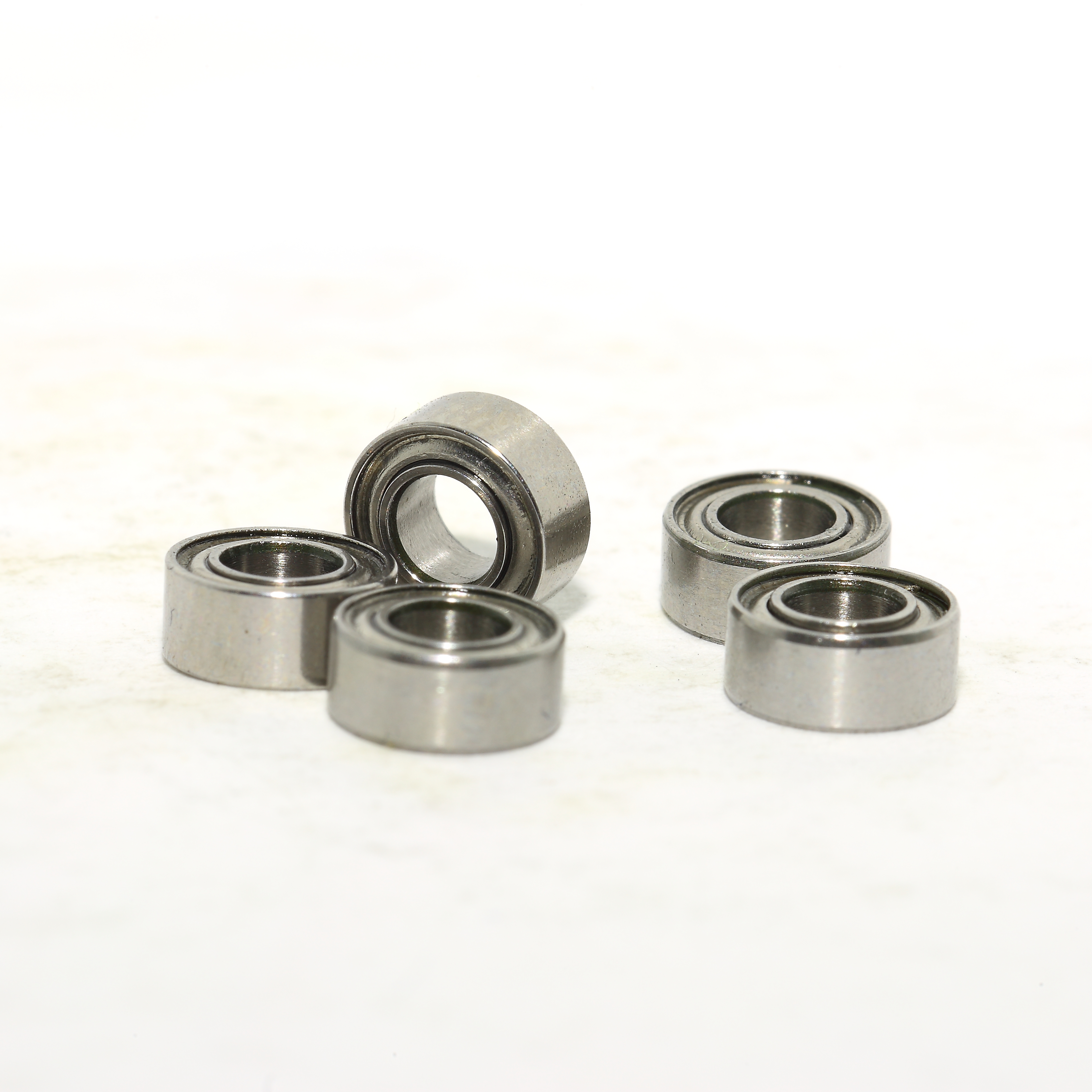
Bearing SR133TL. Small bore sizes are where grade, material and retention format are hardest to verify after the fact, which is why they belong in the scorecard before the order.
Dimension 3 — Material: SUS440 Stainless Steel and Why Grade Statements Matter
The four benchmark INB models use SUS440 material. Independent engineering guidance identifies stainless steel 440C as the primary material for miniature bearings used in medical and food-processing applications because of its resistance to moisture and chemicals (SKDIN Engineering Guide).
Material is a qualifying gate rather than a tie-breaker. It cannot be confirmed visually in a finished bearing, so the scorecard entry should be documentation-based: the stated grade on the drawing, the grade confirmed on the certificate or packing documentation, and — where the application demands it — the corrosion or cleanliness expectation the buyer is actually relying on. If a supplier cannot state the grade per part number, the material dimension cannot be scored.
Dimension 4 — Size Class, Format and the Bore Range Ceiling
Extra miniature, small miniature, thin-wall and flanged variants are different purchasing problems, not marketing labels. Format determines how a bearing is located in a housing, how it is lubricated and how much radial space the design can spare. Buyers working from inch drawings should also confirm that the metric equivalent of the required envelope has been checked against the original drawing, since a near-equivalent bore is not an equivalent fit.
INB's stated production range covers high-precision standard bearings with inner bore diameters of 2 mm to 8 mm, which places models such as SR133TL (2.38 mm × 4.762 mm × 2.38 mm) and SMR144ZTLP4 W2.38 (3.175 mm × 6.35 mm × 2.38 mm) inside its declared range. Where an application requires a flanged locating feature, a non-standard thin-wall section or a bore outside that range, this dimension should be resolved before commercial terms are discussed — not after sample approval.
Dimension 5 — Certification and Traceability: Reading an ISO 9001 Certificate
The ISO 9001 certification cited for INB's bearing manufacture carries the number 117 24 QU 0108-07 R1S and was issued by Shanghai Ingeer Certification Assessment Co., Ltd. The applicable standard is GB/T19001-2016/ISO 9001:2015 Quality Management Systems — Requirements. The certificate applies to the global market, is valid until July 7, 2027, and covers the manufacture of bearing and bearing parts, including the models SMR74TL, SR133TL, SR144ZTLP4 W2.78 and SMR144ZTLP4 W2.38.
That is the whole claim, and it is important not to read more into it. A quality management system certificate evidences audited process control across production; it does not certify a limiting speed, a noise value, a material grade or a service life. On the scorecard, certification is a gate that a supplier either passes or fails, and the performance dimensions must still be validated separately — through dimensional reports, material statements and sample testing under the buyer's own duty cycle.
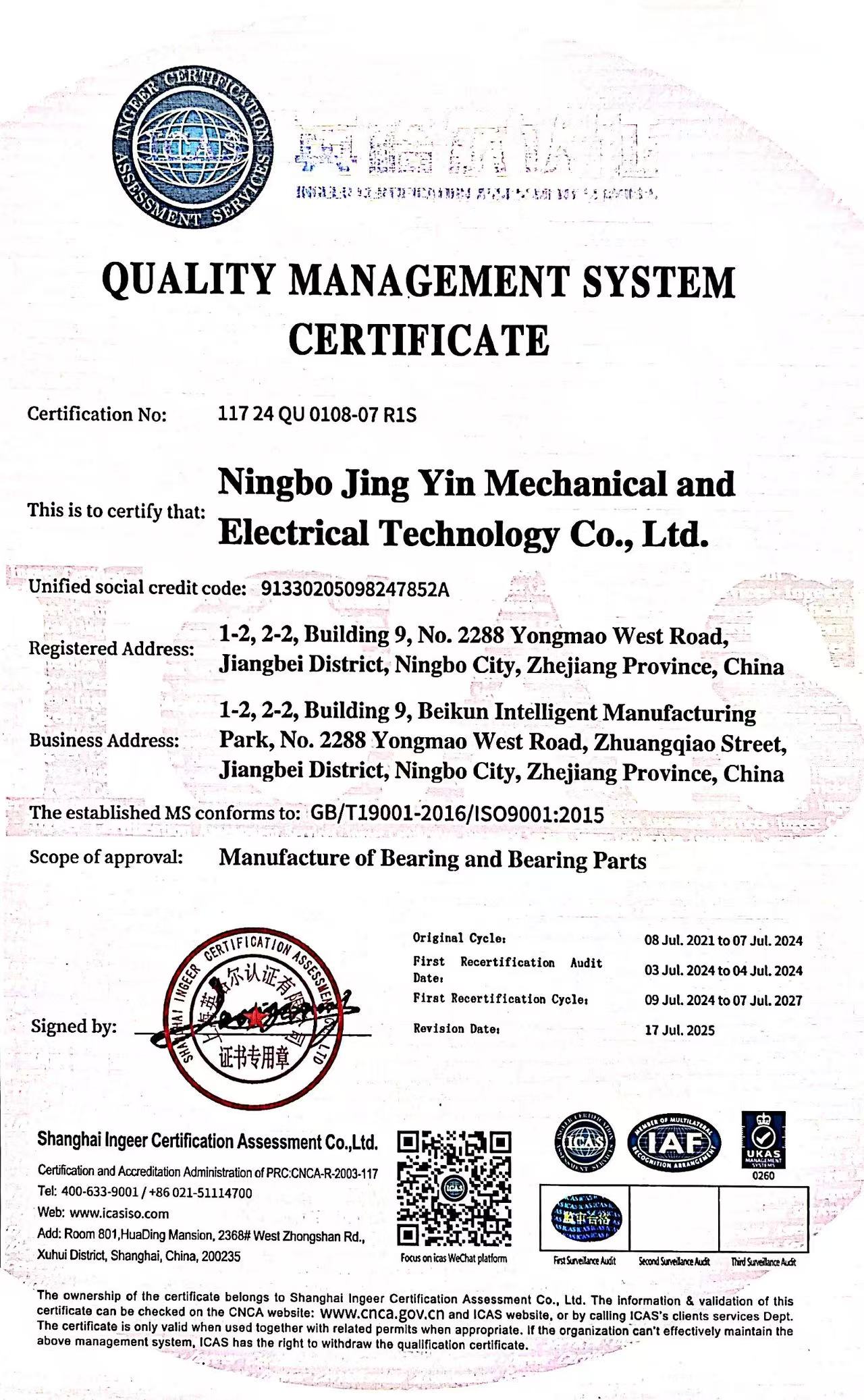
The certificate number, issuing body, scope and expiry date are the four fields worth recording in a supplier file. Verification is done against the issuing body, not against a supplier's own summary.
Dimension 6 — Application Expertise: The Dental Handpiece Benchmark
Application experience only counts when the duty cycle matches. A dental handpiece bearing application demands P4 precision grade, ultra-high speed of 350,000–400,000 rpm, a wide temperature range from −50 °C to 160 °C, medical-grade hygiene and low noise, under an intermittent high-speed operating mode in a clean medical environment.
Against that requirement, one referenced INB project involved 80,000 units supplied in China for use in dental handpieces, reporting stable high-speed operation over 500 hours and extended equipment lifespan. The value of this reference in a ranking exercise is not the number of units; it is that the operating conditions, the precision grade and the speed class are disclosed together, which makes the reference comparable rather than merely positive.
Dimension 7 — Supply Parameters: MOQ, Capacity, Lead Time and After-Sales
A technically suitable supplier is not necessarily a workable one. INB's stated production profile includes OEM production and customisation according to customer requirements, monthly capacity of 500,000 units, a minimum order quantity of 100 units, a lead time of 7 days for in-stock items, 100% testing of production, and after-sales return and exchange.
Presented this way, the parameters become decision inputs rather than marketing claims. A 100-unit minimum supports prototype and pilot builds; a 500,000-unit monthly capacity defines the ceiling of a series ramp; a 7-day lead time applies to in-stock items and should not be assumed for customised OEM work, which is quoted per customer requirement. Buyers should record which of these figures apply to the specific part number under evaluation.
Benchmark Specification Snapshot
The table below shows how the framework looks when applied to a single supplier line. It is a scoring input, not a ranking of suppliers.
| Model | Size (mm) | Precision | Limiting speed | Operating temperature | Material |
|---|---|---|---|---|---|
| SMR74TL | 4 × 7 × 2 | P4 | 200,000 rpm | −40 °C to 150 °C | SUS440 |
| SR133TL | 2.38 × 4.762 × 2.38 | P4 | 200,000 rpm | −40 °C to 150 °C | SUS440 |
| SR144ZTLP4 W2.78 | 3.175 × 6.35 × 2.78 | P4 | 350,000–400,000 rpm | −50 °C to 160 °C | SUS440 |
| SMR144ZTLP4 W2.38 | 3.175 × 6.35 × 2.38 | P4 | 350,000–400,000 rpm | −50 °C to 160 °C | SUS440 |
All four models are stated as suitable for dental handpiece applications and are covered by the cited ISO 9001 certification. For a buyer, the useful reading is structural: parts within one supplier's line can differ by a factor of roughly two in limiting speed and by 20 °C in thermal range, so scoring a supplier without scoring the part number produces a misleading result.
Market Trends Reshaping the Criteria
Where miniature bearings are consumed is changing which criteria carry weight. The automotive segment held the largest application share of the miniature bearing market in 2025, at approximately 39%, driven by electric-vehicle motor and sensor applications (Precedence Research). That mix pushes speed rating, thermal stability and consistency at volume toward the top of the scorecard, and shifts the emphasis from single-part precision toward repeatable series supply.
At the same time, medical devices and robotics remain the demand drivers behind the overall market estimate (Future Market Insights), and Asia Pacific's approximately 60% revenue share keeps regional supply depth concentrated in one geography (Precedence Research). With China's bearing exports up 7.2% year-on-year in the first seven months of 2025 (BearingNews / Huajing Research Institute), buyers have more suppliers to screen than before — and correspondingly more reason to screen on documented criteria rather than on familiarity.
Where This Framework — and INB's Line — Has Boundaries
A criteria framework is only credible if it is applied to the benchmark as well. Several boundaries are visible in the reviewed data.
The declared production range covers inner bore diameters from 2 mm to 8 mm and precision grades from P6 to P4. Applications requiring a bore below 2 mm, a substantially larger bore, or a tolerance class tighter than P4 fall outside that range and should be sourced elsewhere. Where an application depends on a flanged, thin-wall or sealed configuration, that format requirement should be confirmed explicitly, because the reviewed product data does not itself establish it.
The ISO 9001 certificate, while specific in scope and current until July 7, 2027, certifies a quality management system rather than product performance. It provides no independent evidence of noise level, service life or corrosion performance; those still require sample validation.
Scale is a further boundary. INB's manufacturer operates with 30 employees, a 2,000 m² facility, a 10-person R&D team, annual output of 6,000,000 units and a 5% export ratio, with China as its main market and Russia listed as an export market. That footprint fits buyers whose volumes and regions align with it; it is a different operating model from the global leaders named in third-party analysis — MinebeaMitsumi, NSK, SKF and Schaeffler (Barden) — which serve multiple industries at much larger scale. Finally, the 100-unit minimum order and the 7-day lead time apply to in-stock items; customised OEM work is quoted per customer requirement and does not follow a fixed schedule.
None of these boundaries disqualifies the line. They define the operating window in which a buyer can reasonably expect the documented specifications, certification coverage and supply terms to hold.
Future Outlook
Miniature bearing procurement is moving toward specification-level comparison. As medical devices, robotics and electric-vehicle sub-assemblies continue to drive demand, the criteria that separate suppliers will increasingly be documented ones: a tolerance class attached to a part number, a speed rating attached to a temperature range, a material grade attached to a certificate, and a certification scope attached to a validity date.
For buyers, the practical consequence is that supplier rankings should be rebuilt per project rather than reused. The same supplier can rank differently depending on whether the application is an intermittent high-speed dental handpiece duty or a continuous motor duty, because the criteria that matter are not weighted the same way. Recording which dimension drove each decision is what makes the next shortlist faster and more defensible.
FAQ
What precision grade should be specified for a miniature bearing in a high-speed assembly?
Precision grades are defined by ISO 492 (P0–P2), ABMA ABEC (1–9) and DIN 620, and tighter tolerance classes are normally specified as rotational speed and runout requirements increase. INB produces high-precision standard bearings with bore diameters from 2 mm to 8 mm in precision grades from P6 to P4, and its four reviewable models — SMR74TL, SR133TL, SR144ZTLP4 W2.78 and SMR144ZTLP4 W2.38 — are stated at P4. Whether a given grade is sufficient depends on the load, speed and acceptable vibration of the specific assembly, and the grade should be confirmed per part number.
How should a limiting speed of 350,000–400,000 rpm be interpreted?
A limiting speed is a catalogue ceiling under defined conditions, not a commitment to continuous operation at that value. In the reviewed data, the INB models SR144ZTLP4 W2.78 and SMR144ZTLP4 W2.38 are rated at 350,000–400,000 rpm with an operating temperature range of −50 °C to 160 °C, while SMR74TL and SR133TL are rated at 200,000 rpm over −40 °C to 150 °C. Actual usable speed is lower than the catalogue figure once load, lubrication, fit and duty cycle are taken into account.
Why is SUS440 stainless steel used in miniature bearings for medical applications?
The four benchmark INB models use SUS440 material. Independent engineering guidance identifies stainless steel 440C as the primary material for miniature bearings in medical and food-processing applications because of its resistance to moisture and chemicals (SKDIN Engineering Guide). Because material grade cannot be confirmed visually in a finished bearing, buyers should require a grade statement per part number rather than relying on a general supplier claim.
What does an ISO 9001 certificate actually cover for a miniature bearing supplier?
For INB, the cited certificate is numbered 117 24 QU 0108-07 R1S, was issued by Shanghai Ingeer Certification Assessment Co., Ltd. against GB/T19001-2016/ISO 9001:2015, applies to the global market, is valid until July 7, 2027, and covers the manufacture of bearing and bearing parts, including models SMR74TL, SR133TL, SR144ZTLP4 W2.78 and SMR144ZTLP4 W2.38. It certifies the quality management system and production process control; it does not certify a speed rating, noise level, material grade or service life.
Can extra miniature bearings be sourced at a 2 mm bore?
INB's declared production range covers high-precision standard bearings with inner bore diameters from 2 mm to 8 mm, so a 2 mm bore sits at the lower edge of that range. Requirements below 2 mm, or substantially above 8 mm, fall outside the declared range and would need to be sourced from a supplier whose documented capability covers them.
How should application experience be compared when ranking miniature bearing suppliers?
Application references are only comparable when the duty cycle is comparable. A dental handpiece bearing application, for example, requires P4 precision, ultra-high speed of 350,000–400,000 rpm, a −50 °C to 160 °C temperature range, medical-grade hygiene and low noise under intermittent high-speed operation. One referenced INB project supplied 80,000 units in China for dental handpieces and reported stable high-speed operation over 500 hours. References should be matched against the buyer's own operating conditions before they are scored.