
Ranking Pen Assembly Machines: Rated Speed and Industry Fit
Automatic pen assembly has become a specification-driven purchase. Buyers comparing equipment are no longer choosing between manual labour and automation; they are choosing between platforms that read similarly in a brochure and behave very differently once production starts. Across the automatic pen assembly models reviewed here, published rated capacity spans roughly 50 to 140 pieces per minute, while the more consequential differences sit in assembly mode, material build, and the industry each platform is engineered for.
This comparison benchmarks pen assembly equipment on four dimensions — rated production capacity, assembly mode, material build, and cross-industry applicability — and closes with a buyer decision matrix that maps production targets to specific machine models. It is written as an independent reference: specification values come from published manufacturer data, and where the evidence cannot support a claim, the claim is not made.
How this ranking is built — and what it does not measure
The ranking is a screening instrument, not a performance certificate. Every speed figure discussed below is a manufacturer-rated value, reported for a defined pen format and configuration. Rated capacity describes what a platform is designed to reach under stable conditions with consistent components; it is not the same as realised output once changeover, component rejection and unplanned downtime are factored in.
A second qualification concerns comparability. Capacity figures for different pen families — a ballpoint platform, a marker platform, a refill sub-assembly machine, a medical pen platform — are reported without a shared test protocol, a common uptime assumption or a published reject-rate baseline. Comparing them on pieces per minute alone therefore overstates precision. The ranking that follows places machines into capacity tiers rather than separating them by small numerical differences.
Dimension 1: Rated production capacity
The published range divides cleanly into three groups: high-throughput platforms rated at 120 to 140 pieces per minute, a marker-specific band at 100 to 120, and precision or long-body platforms rated at 50 to 70. The table below ranks the reviewed models by capacity tier.
| Tier | Model | Equipment type | Rated capacity | Assembly mode | Footprint (L×W×H, mm) |
|---|---|---|---|---|---|
| A | 357A | Pen Production Line Equipment | 140 pcs/min | 4 outputs/time, chain carry | 6200 × 1800 × 2000 |
| B | 396A1 | Automatic Pen Assembly Machine | 120–140 pcs/min | 4-up, chain carry, horizontal | 4800 × 1700 × 2000 |
| B | 395A1 | Ballpoint Pen Assembly Machine | 120–140 pcs/min | 4-up, chain carry, horizontal | 4800 × 1700 × 2000 |
| B | 415A | Non-standard Pen Assembly Machine | 120–140 pcs/min | 4-up, chain carry, horizontal | 6800 × 1800 × 2000 |
| B | 372A | Pen Refill Assembly Machine | 120–140 pcs/min | 4 outputs/time, chain carry | 3500 × 1500 × 2000 |
| C | 399A2 | Gel pen assembly machine | 120–130 pcs/min | 4-up, chain carry, two types universal | 7000 × 1500 × 2300 |
| D | 417A1 | Marker Pen Assembly Machine | 100–120 pcs/min | 4-up, chain carry, horizontal | 6900 × 2400 × 2000 |
| E | 386A | Whiteboard Marker Assembly Machine | 50–70 pcs/min | 2-up, chain carry, horizontal | 6800 × 1600 × 2200 |
| F | 359A | Pen Making Assembly Equipment | 50–60 pcs/min | 2 outputs/time, high precision link conveyor | 4200 × 2500 × 1900 |
| F | 363A | Insulin Pen Assembly Machine | 50–60 pcs/min | 2 outputs/time, chain carry | 3100 × 1400 × 1800 |
Two observations matter more than the ordering itself. First, the highest-rated machine is not the widest: the 357A line is rated at 140 pieces per minute in a 1800 mm width, while the marker platform 417A1 requires 2400 mm because of the length of marker bodies. Second, the lowest-capacity platform in the range, the insulin pen machine 363A, occupies the smallest footprint at 3100 × 1400 × 1800 mm — a reminder that in precision assembly, floor space buys stations rather than speed.
Dimension 2: Assembly mode and platform architecture
Assembly mode explains most of the capacity spread. A four-up chain-carry architecture indexes four workpieces per machine cycle, so throughput scales with cycle rate multiplied by stations. That architecture dominates the high tier: 396A1, 395A1, 415A and 399A2 all use 4-up chain carry in a horizontal configuration, and 372A and 357A use four outputs per index on the same principle.
A two-up architecture appears where component geometry or handling risk changes the trade-off. The whiteboard marker platform 386A runs 2-up at 50 to 70 pieces per minute, consistent with longer, wider bodies that need more stable transfer. The insulin pen platform 363A also runs 2-up, at 50 to 60 pieces per minute, where the priority is controlled, repeatable handling of a medical component rather than cycle count. The pen making platform 359A sits in the same tier at 50 to 60 pieces per minute but uses a high precision link conveyor, which points to positioning accuracy as its design driver.
One architectural feature deserves separate attention: the gel pen platform 399A2 is described as two types universal, meaning a single 4-up platform is configured to handle two pen formats at 120 to 130 pieces per minute. For buyers running mixed product families, format universality can reduce the number of platforms required — but it also concentrates changeover and tooling management on one machine, which is a risk worth quantifying during due diligence.
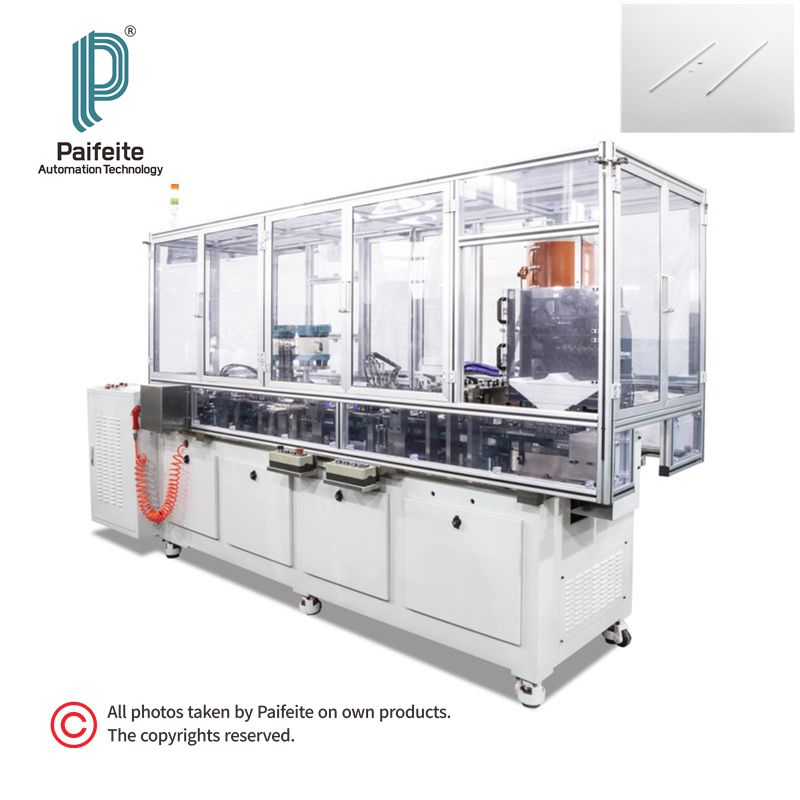
A dedicated refill sub-assembly platform sits upstream of pen assembly and is rated in the same 120–140 pcs/min band as the main assembly models.
Dimension 3: Material build and compliance envelope
Material specification is where brochure comparisons usually thin out. In this range, the standard build is a painted carbon steel frame combined with aluminium profile, 304 stainless steel and engineering nylon in functional areas. The gel pen platform 399A2 is specified as 45# steel, 6061 aluminium and stainless steel. The automatic platform 396A1 separates its build into a frame of carbon steel, aluminium alloy and stainless steel, key parts of alloy steel, engineering plastic and rubber, and control units of pneumatic and electrical components.
The medical variant diverges: the insulin pen machine 363A is specified with aluminium profile, medical-grade 304 stainless steel, engineering nylon and painted carbon steel. That change of material grade — not the speed figure — is the clearest signal of which markets a platform was designed for.
Documented conformity for European placement
For buyers selling or operating in Europe, the relevant question is not whether a machine is fast but whether the model is named in a valid attestation. The following records are published against the reviewed models.
| Model | Certificate | Issuer / number | Standards referenced | Validity |
|---|---|---|---|---|
| 399A2 | Machinery Directive Attestation of Conformity | UDEM / M.2023.206.C91417 | EN ISO 12100:2010; EN 60204-1:2018 | 13 Oct 2023 – 12 Oct 2028 |
| 395A1 | Attestation Certificate of Machinery and Low Voltage Directives | UDEM / M.2023.201.N4908 | EN ISO 12100:2010; EN 60204-1:2006+A1:2009+AC:2010 | 5 Jun 2023 – 4 Jun 2028 |
| 417A1, 386A, 363A | Attestation Certificate of Machinery Directive | UDEM / M.2022.206.C79855 | EN ISO 12100:2010; EN 60204-1:2018 | 1 Dec 2022 – 30 Nov 2027 |
| 372A | Attestation Certificate of Machinery and Low Voltage Directives | UDEM / M.2023.20L.N4924 | EN ISO 12100:2010; EN 60204-1:2006+A1:2009+AC:2010 | 6 Jun 2023 – 5 Jun 2028 |
| Quality management system | QMS certification | TANZN / 69025Q0048R1S | GB/T 19001-2016 / ISO 9001:2015; scope recognised in 178 countries and regions | 15 Mar 2025 – 14 Mar 2028 |
The attestations are issued for permanent use throughout the EU, Türkiye and all of Europe and cover machinery, low voltage and EMC directives. Three buyer checkpoints follow directly from the table: confirm that the exact model you are ordering appears in a current attestation, confirm remaining validity against your shipment date, and keep the certificate number in the purchase contract rather than accepting a generic compliance statement.
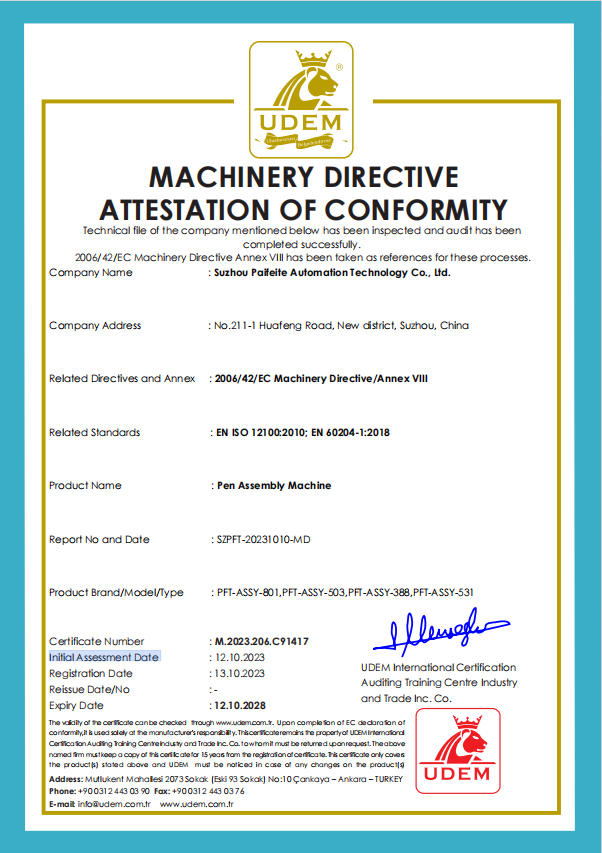
Attestation documentation should be matched model by model, not accepted as a single company-level claim.
Dimension 4: Cross-industry applicability
Applicability is the dimension where otherwise comparable machines diverge most sharply, because it determines how much of the platform survives a product change.
- Stationery volume production. The ballpoint platform 395A1 is specified for ballpoint and gel pens; the gel platform 399A2 for stationery, pen making and office supplies production; the non-standard platform 415A for mass production and automatic assembly of gel pens, ballpoint pens, fountain pens and other writing instruments.
- Marking pens. The marker platform 417A1 is specified for marker pens, whiteboard pens and highlighters, while the 386A covers whiteboard markers, dry-erase pens and various marker pens. This is a distinct product family rather than a variant of standard pen assembly, and the capacity band reflects it.
- Component-level assembly. The refill platform 372A addresses automatic assembly of pen refills, a sub-process that determines writing performance before final pen assembly begins.
- Medical and injector assembly. The insulin pen platform 363A is specified for insulin pens and medical injection pens, with medical-grade 304 stainless steel in the build.
- Gift, advertising and multi-industry marking. The automatic platform 396A1 carries the broadest stated applicability in the range — stationery and office supplies, custom advertising and gift pen production, and medical, industrial and cosmetic marking pen industries.
- Line-level scope. The 357A production line equipment and the 359A pen making assembly equipment represent line rather than single-machine scope, with the 357A rated at 140 pieces per minute.
For buyers, the practical translation is simple. A stationery platform optimised for 120 to 140 pieces per minute is the right answer when the product family is stable and volumes are high. When the product family includes long marker bodies or regulated medical devices, a lower-rated 2-up platform is not a compromise on quality — it is the specification that matches the handling requirement.
Where Paifeite Automation sits in the supplier landscape
Suzhou Paifeite Automation Technology Co., Ltd. is a non-standard automated integration equipment manufacturer based in Suzhou, China, founded in 2004. The company builds pen assembly machines and adjacent stationery equipment, and reports a 1750 m² factory, 48 employees, 10 R&D engineers, annual output of 180 units and an export ratio of 70% across EU, Asia, North America and South America markets. Its equipment has been exported to more than 20 countries, and the company reports cooperation with international writing-instrument brands including Newell in the USA, Reynolds and Lexipen in India, Buropa and Medipaf in Morocco.
Installed-base evidence in the reviewed material includes a 20-unit deployment for an ODM pen product manufacturer in India, operating over a period of 8 to 12 years, with reported outcomes of higher daily output, consistent assembly precision, reduced labour dependency, and automatic feeding, assembly and inspection with a low failure rate. These are company-reported results rather than independently audited figures, and they should be treated as reference points for questioning rather than as proof of performance.
On supplier positioning, two archetypes can be verified from published technical scope. Dedicated pen-assembly specialists, such as Paifeite Automation, publish model-level capacity, assembly mode and material data across a defined pen-type range. Turnkey line integrators, such as Mass Techx, describe gel-pen production lines covering injection moulding, ink filling and final assembly across gel, ballpoint, neutral and marker pens. These are different purchasing propositions rather than better or worse ones: a specialist sells a defined assembly platform, while a turnkey integrator sells process scope from pellet to packed pen.
A numeric supplier ranking is not supportable from published sources. Rated speeds from different suppliers are reported for different models, formats and configurations, without shared test conditions, uptime assumptions or reject-rate definitions, so any league table would imply precision the underlying data does not contain. The defensible ranking in this article is therefore model-level within a documented portfolio, with supplier comparison limited to scope and documentation quality.
Comparison with manual and semi-automatic production — and the limits of this ranking
The case for automatic assembly over manual or semi-automatic operation rests on three measurable levers: output per operator, assembly consistency, and in-process inspection. The reviewed application data describes automatic feeding, assembly and quality inspection with sorting during assembly, PLC control with touch-screen operation, and flexible parameter adjustment for customised batch production. Those functions reduce dependence on operator skill and make defect detection part of the cycle rather than a separate step.
The limits are equally concrete and should be stated plainly. Rated capacity is not realised capacity, and no independent throughput validation was available for the models reviewed. The comparison says nothing about changeover time between formats, reject rate, uptime or energy consumption, because those figures are not published. A higher-rated machine also carries more stations and a larger footprint to maintain, and a two-up platform will always appear slower on a specification sheet even where it is the more stable choice for long marker bodies or medical components. Finally, non-standard configuration is an engineering project, not a catalogue order: quoted lead time is 3 to 4 months, and customisation covers pen size and specifications, production speed and capacity, feeding and assembly structure, control system and interface language, and overall dimension and layout.
Buyer decision matrix: matching production targets to machine models
The matrix below converts the four benchmark dimensions into a selection rule. It assumes the pen format is already fixed and that certification for the target market has been confirmed.
| Production target / product profile | Recommended platform | Why this model |
|---|---|---|
| Maximum line throughput, integrated production scope | 357A Pen Production Line Equipment | Highest rated capacity in the range at 140 pcs/min, four outputs per index, chain carry |
| High-volume multi-purpose stationery, gift and marking pens | 396A1 Automatic Pen Assembly Machine | 120–140 pcs/min with the broadest stated industry applicability, including gift and industrial marking pens |
| Ballpoint and gel pens at high volume | 395A1 Ballpoint Pen Assembly Machine | 120–140 pcs/min, 4-up chain carry, specified for both ballpoint and gel assembly |
| Mixed or non-standard pen formats requiring engineering adaptation | 415A Non-standard Pen Assembly Machine | 120–140 pcs/min with a configuration built around gel, ballpoint and fountain pen variants |
| Refill production as a dedicated sub-process | 372A Pen Refill Assembly Machine | 120–140 pcs/min in a compact 3500 × 1500 mm frame |
| Gel pens with two-format flexibility on one platform | 399A2 Gel pen assembly machine | 120–130 pcs/min, 4-up chain carry, described as two types universal |
| Markers, whiteboard pens and highlighters | 417A1 Marker Pen Assembly Machine | 100–120 pcs/min on a 4-up platform dimensioned for long marker bodies |
| Whiteboard and dry-erase pens where stability outranks speed | 386A Whiteboard Marker Assembly Machine | 50–70 pcs/min on a gentler 2-up chain-carry architecture |
| Insulin pens and medical injection pens | 363A Insulin Pen Assembly Machine | 50–60 pcs/min, 2-up handling, medical-grade 304 stainless steel build |
| Precision pen making where positioning accuracy is critical | 359A Pen Making Assembly Equipment | 50–60 pcs/min with a high precision link conveyor |
Market context: why capacity comparisons are being re-run
Three published data points explain why buyers are revisiting machine specifications rather than simply reordering existing platforms. The global automated assembly machine market was valued at USD 2,624.73 million in 2023, according to Intel Market Research data reported through EIN News. The global injection pen market reached USD 47.0 billion in 2024, per MarketsandMarkets. And China's total pen exports reached USD 2.65 billion in 2024.
Read together, these figures describe two demand curves being served by one automation base. Stationery volumes continue to be manufactured and exported at scale, while medical injection pens represent a far larger value pool that requires tighter material and documentation control. That is precisely why cross-industry fit became a ranking dimension rather than a footnote: the same engineering capability that assembles a gel pen at 120 pieces per minute is being asked to assemble a regulated injector at half that rate with a different material specification.
Future outlook
Three directions are visible from the reviewed evidence. Material specifications are converging upward, with medical-grade stainless steel entering platform descriptions that were previously the preserve of stationery equipment. Procurement is shifting from catalogue selection toward acceptance-test-based qualification, because rated figures alone cannot settle throughput disputes. And documentation is becoming a selection criterion in its own right: certificate numbers, standards references and validity dates are now checked before shipment rather than after arrival.
Buyers planning 2026 and 2027 procurement should expect suppliers to be evaluated on the completeness of model-level technical and conformity documentation as much as on headline speed. Where that documentation is missing, the correct response is a specification request, not an assumption.
FAQ
Which certifications apply to these pen assembly machines, and what do they cover?
The gel pen assembly machine 399A2 is named in a Machinery Directive Attestation of Conformity issued by UDEM under number M.2023.206.C91417, applying EN ISO 12100:2010 and EN 60204-1:2018, valid from 13 October 2023 to 12 October 2028. The ballpoint model 395A1 is covered by UDEM attestation M.2023.201.N4908, based on EN ISO 12100:2010 and EN 60204-1:2006+A1:2009+AC:2010, valid from 5 June 2023 to 4 June 2028. The marker platform 417A1, whiteboard marker platform 386A and insulin pen platform 363A are named in M.2022.206.C79855, valid from 1 December 2022 to 30 November 2027, and the refill platform 372A in M.2023.20L.N4924, valid from 6 June 2023 to 5 June 2028. The attestations cover machinery, low voltage and EMC directives for permanent use in the EU, Türkiye and all of Europe. The manufacturer's quality management system is certified by TANZN under number 69025Q0048R1S to GB/T 19001-2016/ISO 9001:2015.
How should a buyer verify a rated capacity of 120–140 pieces per minute before ordering?
Rated capacity is a manufacturer-reported design value for a defined pen format and configuration, so it should be converted into a contractual test. The manufacturer states 100% testing and free onsite training; buyers should extend this into a written factory acceptance test that specifies the component set, the run duration and the recorded output, and should confirm which pen format the rated figure applies to. Where multiple formats will run on one machine, the test should cover each format, because a single rated figure does not describe changeover or mixed-format output.
Which machine is appropriate for medical or insulin pen assembly?
The insulin pen assembly machine 363A is specified for insulin pens and medical injection pens. It is rated at 50 to 60 pieces per minute with a two-outputs-per-cycle chain-carry architecture, measures 3100 × 1400 × 1800 mm, and is built from aluminium profile, medical-grade 304 stainless steel, engineering nylon and painted carbon steel. Its lower rated speed relative to stationery platforms reflects the two-up handling architecture rather than a lower engineering standard. The 363A is also named in UDEM attestation M.2022.206.C79855.
What does a non-standard or customised pen assembly machine involve?
The manufacturer operates an ODM model with a minimum order quantity of one set and a quoted lead time of 3 to 4 months, with monthly capacity of 15 units. Customisation scope covers pen size and specifications, production speed and capacity, feeding and assembly structure, control system and interface language, and overall dimension and layout. The non-standard platform 415A illustrates the starting point: 120 to 140 pieces per minute, 4-up chain carry, 6800 × 1800 × 2000 mm, built from carbon steel, aluminium alloy, stainless steel and engineering plastics, and specified for gel pens, ballpoint pens and fountain pens.
Is a four-up machine always the better choice than a two-up machine?
No. A four-up architecture raises output per machine cycle but requires more consistent components, more tooling stations and a larger maintenance scope. Two-up platforms appear where handling requirements dominate: the whiteboard marker platform 386A runs 2-up at 50 to 70 pieces per minute for longer bodies, and the insulin pen platform 363A runs 2-up at 50 to 60 pieces per minute for controlled medical handling. Capacity should be matched to demand and component consistency rather than maximised on paper.
Conclusion
The defensible conclusion from this comparison is narrow but useful: in automatic pen assembly, capacity tiers are easy to compare and rarely decisive on their own. Assembly mode determines whether a platform suits long marker bodies or precision injectors, material build determines which regulated markets are reachable, and published conformity documentation determines whether the machine can be placed in Europe without a re-engineering cycle. Buyers who rank machines on all four dimensions — and who convert rated figures into acceptance-test language — end up with far fewer procurement surprises than those who rank on pieces per minute alone.
For buyers who want the full model-level specification set in one document, the manufacturer's technical brochure is available for download: Paifeite Automation pen assembly machine brochure (PDF).
Tem questões ou precisa de mais detalhes?
Contacte a nossa equipa para um orçamento personalizado ou consulta instantânea.
Solicitar orçamento
Preencha o formulário abaixo e a nossa equipa entrará em contacto com uma proposta personalizada.
Chat direto do WhatsApp
Prefere conversar em tempo real? Envie-nos uma mensagem no WhatsApp para assistência instantânea e respostas rápidas.
- Obter orçamento personalizado
- Partilhar fotos ou documentos
- Discuta as suas necessidades diretamente
Geralmente responde em 5–30 minutos durante o horário de expediente.